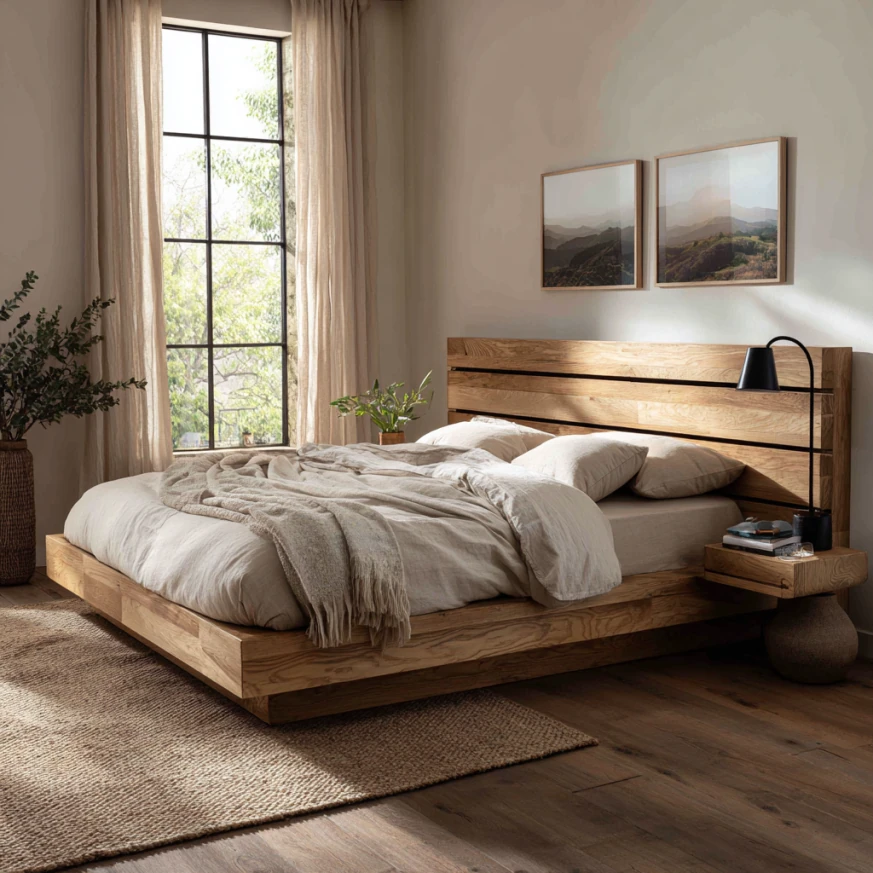

An eco friendly bed frame is one you can trace and repair: solid or reclaimed wood carrying an FSC chain-of-custody claim, recycled-content steel, or bamboo, finished with low-emission coatings and joined so parts can be replaced instead of thrown out. If you want one shortcut, look for two things on the spec sheet: solid wood (not particleboard or MDF) and a third-party emissions certification such as GREENGUARD Gold. The rest of this page is about making it fit your room, your mattress and your body weight.
What Makes an Eco Friendly Bed Frame Actually Eco Friendly
Four claims on an eco friendly bed frame listing are worth checking, and only four. The rest is marketing.
- Where the wood came from. FSC chain-of-custody certification tracks material from forest to finished shelf through an unbroken chain, and a product can only be labeled FSC-certified when every company along that chain is certified too. A brand saying “sustainably sourced” with no certificate number is telling you nothing verifiable.
- What’s inside the panels. Hardwood plywood, MDF and particleboard sold in the US must meet EPA formaldehyde emission standards under TSCA Title VI, and since March 2019 those products and finished goods containing them have had to be labeled as compliant. Compliant is the legal floor, not a green badge.
- What it off-gasses. UL’s GREENGUARD program caps total VOC emissions at 500 µg/m³; GREENGUARD Gold tightens that to 220 µg/m³ and adds health-based limits across more than 360 individual VOCs. There’s a third tier, Formaldehyde-Free, which meets Gold limits plus a very low formaldehyde emission factor.
- Whether it can be fixed. Bolt-together and joinery-based frames can be tightened, re-slatted and moved. Frames glued around cam-lock fittings in particleboard usually cannot survive two moves.
Honest caveat: none of these certifications measures carbon footprint. FSC covers forest management, GREENGUARD covers indoor air. A frame can hold both and still ship 8,000 miles. If that matters to you, buy from a maker who states where the frame was built.
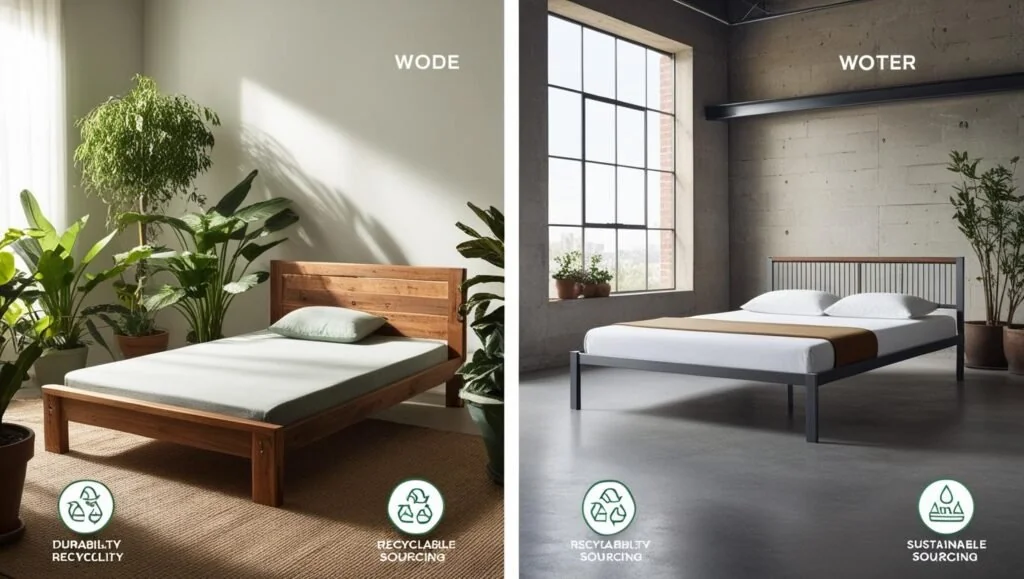
Materials Compared: Hardwood, Reclaimed, Bamboo, Recycled Steel
Every eco friendly bed frame material trades something away. Pick the compromise you can live with, not the one with the best story.
| Material | What you gain | What you give up | Noise risk | End of life | Best for |
|---|---|---|---|---|---|
| Solid hardwood (FSC oak, maple, walnut, ash) | Highest published load ratings; joints re-tighten; surface repairable | Heaviest to carry; priciest tier; needs a certificate number to mean anything | Low if joinery is tight | Repairable for decades, then compostable or resellable | Couples, heavier sleepers, anyone keeping the frame 15+ years |
| Reclaimed timber | No new tree felled; grain and nail holes you can’t fake | Supply is inconsistent, so sizes and finishes are limited; “reclaimed” is an unregulated word | Low | Already a second life; still repairable | People who want character and don’t need a matching set |
| Bamboo (laminated strand or ply) | Grass, not timber, so regrowth is fast; light to move | It’s laminated, so the adhesive matters more than the bamboo; ask for emissions data | Low to medium | Recyclable only as wood waste; glue lines complicate it | Smaller rooms, renters, light to average combined weight |
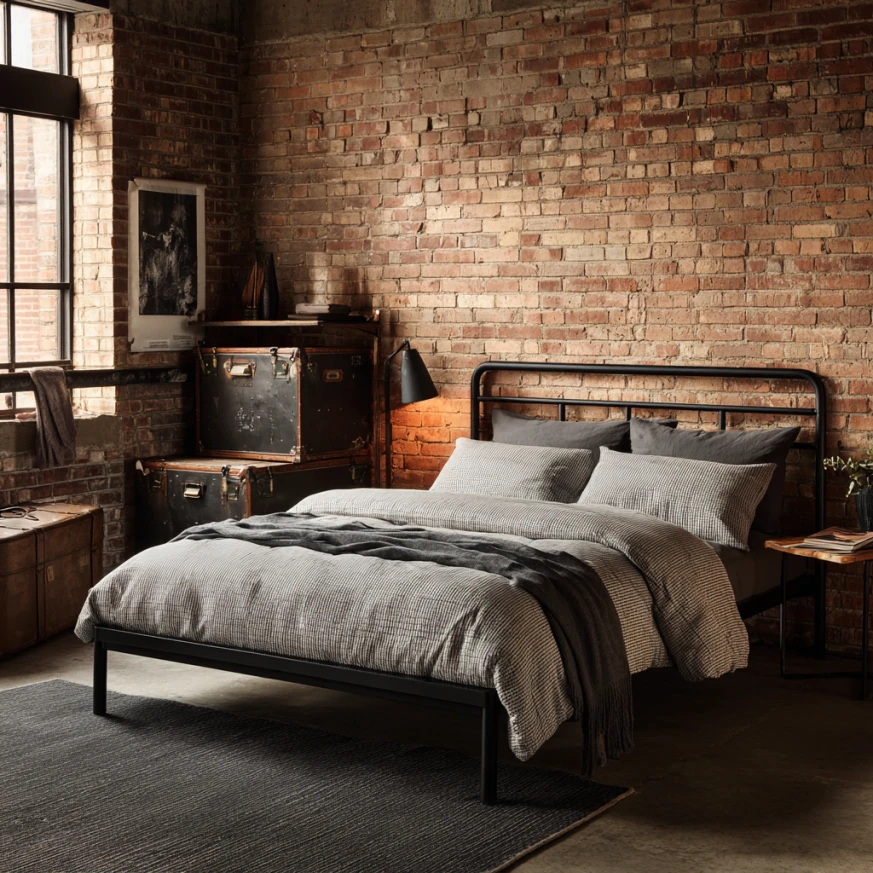
| Recycled-content steel | Steel is recycled endlessly without losing strength; slim profile saves floor space | Squeaks are the number one complaint; bolts loosen; cold, hard look | High unless bolts are washered and re-torqued | Genuinely recyclable at any scrap yard | Budget buyers, frequent movers, humid climates |
| Engineered board (MDF, particleboard) with veneer | Cheapest; uses mill residue | Sags, strips out at the fittings, rarely survives disassembly | Medium, and gets worse | Landfill in most areas | Short-term or guest-room use only |
Where the evidence is thin: lifespan. You’ll see “20 to 30 years” quoted everywhere for solid wood, and nobody has run that test. The only lifespan number anyone commits to in writing is the warranty — read it, and check whether frame, slats and hardware are covered separately. Our wood vs metal bed frame comparison goes further on finish and maintenance.
What about cardboard and other low-impact oddities?
Honeycomb cardboard frames are real, low-carbon and fine for a spare room or student let. They’re also humidity-sensitive and unforgiving if you sit on one edge. Strength numbers and catches are in our cardboard bed frame guide.
Sizes and Dimensions: Mattress, Frame and Room
An eco friendly bed frame is sold by mattress size, but the frame itself is bigger, and that difference is what wrecks a layout. Start with mattress dimensions, then find the frame’s exterior dimensions in the spec table, then check the room.
| Size | Mattress (inches) | Mattress (cm) | Room minimum | Realistically suits |
|---|---|---|---|---|
| Twin | 38 x 75 | 96.5 x 190.5 | 7 x 10 ft (2.1 x 3.0 m) | One child or a compact guest room |
| Twin XL | 38 x 80 | 96.5 x 203 | 7 x 10 ft (2.1 x 3.0 m) | Adults over 6 ft sleeping solo |
| Full | 54 x 75 | 137 x 190.5 | 9 x 10 ft (2.7 x 3.0 m) | One adult who sprawls; tight for two |
| Queen | 60 x 80 | 152.5 x 203 | 10 x 10 ft (3.0 x 3.0 m) | Most couples; the default size |
| King | 76 x 80 | 193 x 203 | 12 x 10 ft (3.7 x 3.0 m) | Couples with kids or dogs in the bed |
| California King | 72 x 84 | 183 x 213.5 | 12 x 12 ft (3.7 x 3.7 m) | Tall sleepers; narrower but 4 in longer than king |
Two things people get wrong. Twin, full and queen are all 75 to 80 in long, so going full to queen buys width, not legroom. And a California king is narrower than a king by 4 in (10 cm); it only wins on length.
Clearance and walkway numbers
- Beside the bed: allow at least 24 in (61 cm) of clear floor on each side you walk down. Thirty inches (76 cm) is where a nightstand plus a person stops feeling like a squeeze.
- At the foot: the same 24 in (61 cm) minimum if the room’s main path runs past the end of the bed.
- Against a wall: one side can go to zero for a solo sleeper, but making a bed jammed into a corner is miserable. Leave 12 in (30 cm) if you can.
- Door swing: check the arc of the bedroom and closet doors before you commit to a king.
- Under the bed: Thuma publishes 9 in (23 cm) of clearance under The Bed, which swallows flat under-bed bins but not tall tubs. If storage is the point, measure your boxes first and shop by clearance, not looks.
Will it fit through the door and up the stairs?
Flat-pack eco frames usually arrive in cartons close to the length of the longest rail, which for a queen or king means a box in the 80 in (203 cm) region. Measure three things: the narrowest doorway on the route, the diagonal of any stair turn or landing, and ceiling height above the stairs. Interior bedroom doors are commonly around 30 to 32 in (76 to 81 cm) wide, so width is rarely the problem; the half-landing turn usually is. Frames that break down into rails, slats and legs without glue are the ones that survive apartment stairwells, which is one practical reason to favor a knock-down eco friendly bed frame over a welded or glued one.
Weight Limits, Slats and Center Support
This is the number most eco friendly bed frame listings bury. Published capacity is the total load — both sleepers plus the mattress, and mattresses are not light. A king latex or hybrid can clear 100 lb (45 kg) on its own.
- Thuma’s The Bed is published at a weight capacity of 1,500 lb (about 680 kg) and up, with slats spaced just under 3 in (7.6 cm) apart.
- Avocado states its frames are built from solid North American hardwoods with traditional joinery rather than engineered wood or glued composites, and says even its lightest-duty frame supports 900 lb (about 408 kg); its low-profile City Bed Frame is listed at 1,000 lb (454 kg) and GREENGUARD Gold certified.
- Center support: at queen and larger, you want a center rail with at least one leg reaching the floor. Several mattress makers require it for the warranty to stand, and Avocado’s guidance for third-party bases is five to six legs including a center leg at queen, king and Cal king.
Slat spacing and your mattress warranty
All-foam and latex mattresses need slats no more than about 3 in (7.6 cm) apart, which matches what Thuma specifies. Wider gaps let foam bulge between the slats, which shows up as body impressions and is the classic reason a sag claim gets refused. If your frame has 5 in gaps, a sheet of bed slat conversion boards or a bunkie board fixes it for very little money and no new frame.
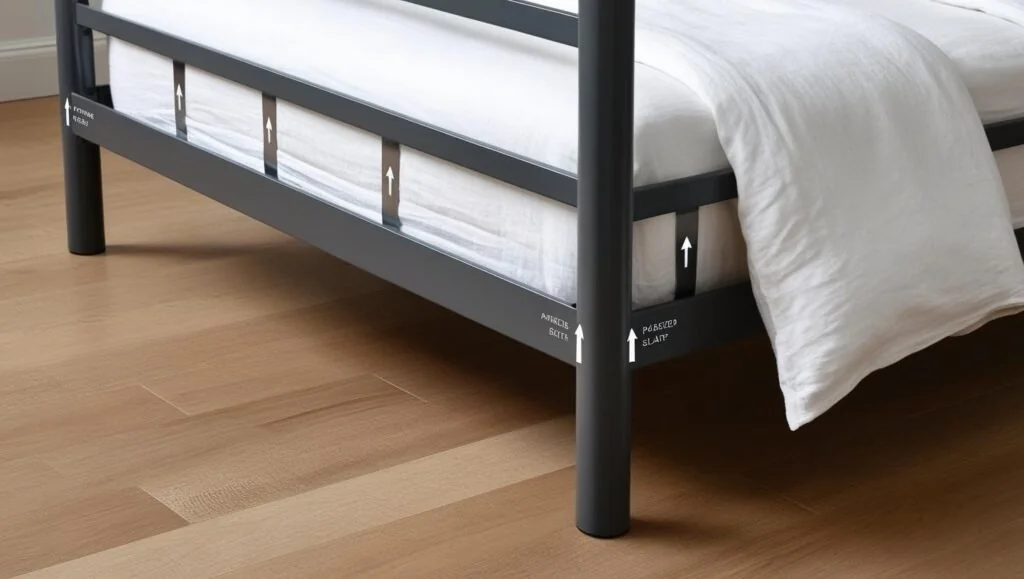
Metal frames need a warning: capacity is usually fine, noise is not. Bolted steel joints work loose as the frame flexes, and that’s where squeaks start. Our guide to stopping a metal bed frame from squeaking covers the washer-and-torque fixes before you spend anything.
Certifications Decoded (and Which Ones Are Just Noise)
FSC
Forest Stewardship Council chain-of-custody certification verifies that certified material is identified and kept separate from ineligible material all the way from the forest to the market. Ask for the certificate code. A retailer who can’t produce one is selling you a vibe. Read the standard directly at FSC’s chain of custody page.
GREENGUARD and GREENGUARD Gold
UL’s program tests finished products in chambers for chemical emissions. Standard certification allows total VOC emissions of 500 µg/m³; Gold allows 220 µg/m³ and applies health-based limits for over 360 VOCs, which is why it’s the tier aimed at nurseries, schools and healthcare settings. GREENGUARD-certified furniture also complies with the BIFMA X7.1 standard, and the criteria have underpinned the LEED credit for low-emitting furniture since 2002.
TSCA Title VI / CARB Phase 2
This is a legal requirement in the US, not a green upgrade. Since March 2019, composite wood products and finished goods containing them must be labeled TSCA Title VI compliant. Useful to check on cheap frames; meaningless as a selling point on a solid wood one. The background is on the EPA’s formaldehyde standards page.
OEKO-TEX
Relevant to upholstered headboards, webbing and any fabric on the frame. Irrelevant to bare wood or steel. Don’t let it stand in for an emissions test on the frame itself.
What’s noise
“Eco-conscious”, “green materials”, “responsibly made”, “natural finish” and leaf icons are unregulated. So is “non-toxic” — there is no test behind the phrase. Treat it as a prompt to ask which finish was used, not as an answer.
Finishes, Glues and Off-Gassing
The frame is mostly inert; the coating is what you breathe. Water-based polyurethane, hardwax oil and plant-oil blends cure with far less solvent than traditional oil-based lacquer. Even a low-VOC finish smells for a while, so unbox and air a new frame for two or three days with a window cracked before the mattress goes on, especially in a nursery.
Oiled finishes are repairable — spot-sand and re-oil a ring mark, which you can’t do with factory lacquer. And on a cushioned headboard, ask what the foam is; a certified hardwood frame with a mystery-foam headboard has moved the problem, not solved it. If you’re rebuilding the whole setup, pair the frame with one of the eco-friendly organic mattress brands rather than dropping a conventional mattress onto a certified base.
Matching Bedding, Mattress Height and Sheets
Sheets are sized to the mattress, never the frame, so a queen takes queen sheets however chunky the rails are. Two fit details matter:
- Pocket depth. Measure mattress height. Standard fitted sheets handle roughly 12 to 14 in (30 to 36 cm); deep-pocket versions reach about 18 in (46 cm). A tall hybrid plus a topper needs the deep version or the corners pop off nightly.
- Drop length. On a platform frame 9 to 13 in (23 to 33 cm) tall, an oversized duvet pools on the floor. Size the duvet to the mattress and skip the bed skirt.
If you’re buying new sheets at the same time, the fiber choice matters more for comfort than for footprint — a bamboo vs cotton comparison covers how those two behave after twenty washes.
What to Measure Before You Buy
- Room: wall-to-wall length and width, then mark the frame’s exterior footprint on the floor with painter’s tape. Live with the tape for a day.
- Walkways: confirm 24 in (61 cm) minimum on every side you use.
- Delivery route: narrowest door, stair turn diagonal, elevator depth, ceiling height over the stairs.
- Mattress: length, width and height, plus its own weight if it’s latex or a hybrid.
- Under-bed: the height of the storage bins or vacuum head you actually own.
- Headboard clearance: distance from floor to window sill, radiator or wall-mounted outlet, so a 35 in (89 cm) headboard doesn’t block them.
- Total load: both sleepers plus the mattress, compared against the published capacity.
What an Eco Friendly Bed Frame Costs
No dollar figures here: eco friendly bed frame prices move with hardwood costs and constant promo cycles, and a number I can’t verify today is worse than none. What’s stable is the ranking — certified solid-hardwood frames from small North American workshops at the top, upcycled-rubberwood and bamboo platforms in the middle, recycled steel well below both. Read what’s excluded, too. Slats, center rails and headboards are often separate line items, which is how a mid-priced frame becomes a top-tier one at checkout.
The cheapest low-impact option nobody advertises is reuse: a second-hand solid wood frame plus new hardware beats any new purchase on footprint. Check joints for movement, look for woodworm holes, budget for new bolts.
Who Each Option Suits — and Who Should Skip It
- Solid FSC or reclaimed hardwood: right if you’re staying put, sleep two and want one frame for 15 years. Wrong if you move yearly — repeated disassembly wears joinery.
- Bamboo: right for light weight and small rooms. Wrong if nobody will say what adhesive holds the laminate together.
- Recycled steel: right for tight budgets if you accept maintenance. Wrong if you or your partner wake at the slightest noise.
- Tool-free joinery: right if stairwells and future moves are in your life. Wrong if you need a non-standard size.
- Skip anything that won’t publish weight capacity, slat spacing and exterior dimensions. That silence is the review.
FAQ
Is bamboo really better than FSC hardwood?
Not automatically. Bamboo regrows in a few years versus decades for hardwood, which is a genuine advantage, but a bamboo frame is laminated strips held together with adhesive, and that adhesive is the part with an emissions profile. An FSC-certified hardwood frame with a hardwax oil finish is the safer bet on indoor air; bamboo wins on renewability and weight.
Do I need a box spring with a platform eco friendly bed frame?
No. A slatted platform with gaps of about 3 in (7.6 cm) or less is a complete support system for foam, latex and hybrid mattresses. Adding a box spring on top just raises the bed by 8 to 9 in (20 to 23 cm) and makes getting in and out awkward.
Will a new frame void my mattress warranty?
It can. Most warranties specify maximum slat spacing and require a center support with a leg to the floor at queen and larger — Avocado, for example, asks for five to six legs including a center leg on third-party bases. Photograph your assembled frame before the mattress goes on; it’s the evidence you’ll need if you ever claim.
What does GREENGUARD Gold actually test?
Chemical emissions from the finished product in a test chamber. Gold caps total VOCs at 220 µg/m³ against 500 µg/m³ for standard certification, and adds health-based limits for more than 360 individual compounds. It says nothing about forestry, labour or carbon.
How do I dispose of my old frame responsibly?
Steel goes to any scrap yard and recycles without losing strength. Solid wood can be resold, donated to a reuse charity or cut down for other projects. Particleboard and MDF are the hard case — many municipal programs won’t take them because of the resins, so check your local waste authority first.
Is “non-toxic finish” a regulated claim?
No. There is no standard behind the phrase. Ask which product was used — water-based polyurethane, hardwax oil, plant-oil blend — and whether the finished frame carries an emissions certification. A brand that can answer both questions in writing is the one to trust.
If you want the shorter shortlist version of all this, our sustainable bed frames guide covers the picks; this page is the spec sheet behind them.
Updated September 2026.