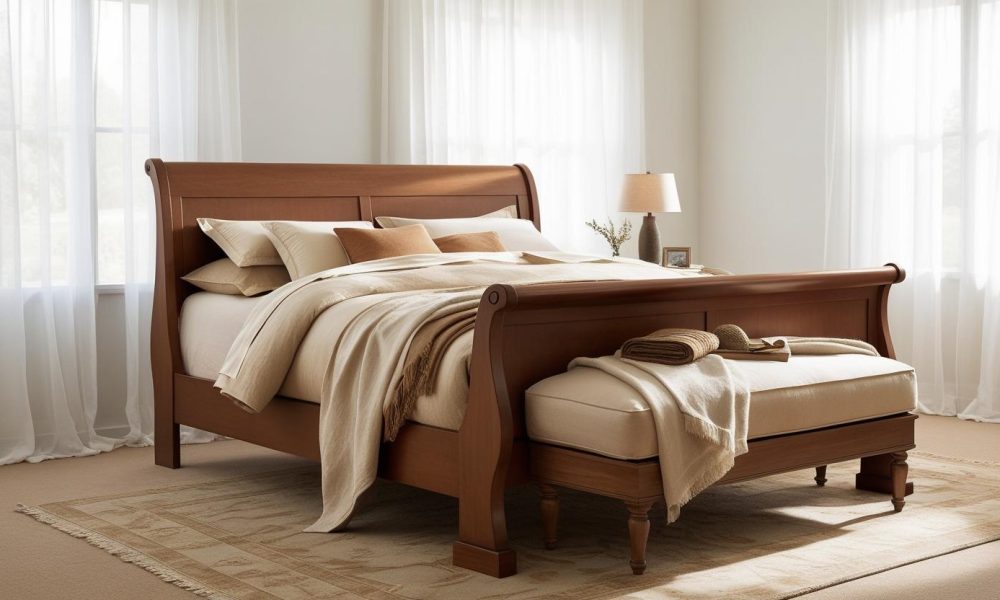
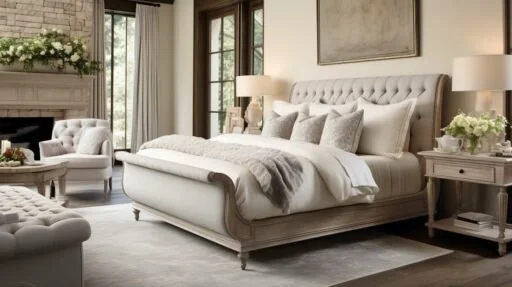
What is a sleigh bed? It’s a bed frame with a headboard and footboard that curve or scroll outward, so the profile looks a bit like an old horse-drawn sleigh. The style came out of early 1800s French and American Empire furniture, and today it shows up in solid wood, upholstered and storage-drawer versions that fit standard mattress sizes.
What makes a bed a sleigh bed
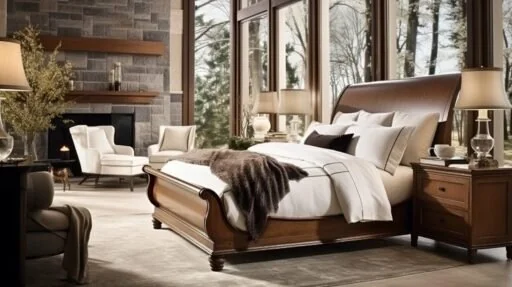
Three things, really, and they’re what separate a sleigh bed from any other wooden frame. The headboard curves back away from the mattress instead of standing straight up. The footboard mirrors it, curving out toward the room. And the side rails are usually solid panels rather than thin metal angle iron, which is why these frames feel heavy and look grounded.
Everything else varies. Some sleigh beds have a dramatic C-shaped scroll at both ends; others only hint at the curve with a gentle rake. Upholstered versions round the shape with padding and a wing-like flare instead of bent wood.
A few numbers that help you picture it:
- Headboard height: commonly 45 to 58 inches from the floor on traditional wood models.
- Footboard height: roughly 20 to 35 inches on classic designs, 14 to 22 inches on low-profile ones.
- Wall gap: because the headboard leans back, the frame usually sits 2 to 5 inches off the wall.
- Weight: a solid hardwood queen frame can easily top 100 pounds, which matters if you move often.

Sleigh bed vs. panel bed vs. platform bed
| Feature |
Sleigh bed |
Panel bed |
Platform bed |
| Headboard shape |
Curved or scrolled, leans back |
Flat, vertical |
Often low or none |
| Footboard |
Tall and curved, standard |
Usually present, flat |
Often skipped |
| Foundation needed |
Depends on model; many take slats only |
Often needs a box spring |
Built-in slat deck |
| Floor footprint |
Largest for the same mattress |
Medium |
Smallest |
Where the sleigh bed came from
The shape traces back to the Neoclassical wave that swept France after the digs at Pompeii and Herculaneum sent designers hunting through ancient Greek and Roman couch forms. Under Napoleon that taste hardened into the Empire style, full of classical scrolls and mahogany veneer. The Metropolitan Museum of Art’s overview of Empire style, 1800–1815 notes how Napoleon’s architects, Percier and Fontaine, spread that vocabulary through published pattern books.
In France the form was the lit en bateau, or boat bed: two scrolled ends of equal height, built to sit sideways against a wall in an alcove. Surviving 19th-century examples are usually figured mahogany with moulded front panels and bracket feet.
American cabinetmakers picked up the shape during the American Empire period, roughly 1810 to 1840, and that’s where the name stuck: the scrolled ends echoed the runners and dashboard of a winter sleigh. Early versions were massive, with thick veneered panels and carved paw feet. Victorian makers slimmed them down, and by the late 20th century a sleigh bed could be pine, metal or padded fabric.
If old bed forms interest you, the history of the four-poster bed covers a parallel story from a different century.
What is a sleigh bed made of today?
- Solid wood: oak, acacia, rubberwood, mahogany or cherry. Heaviest, longest-lasting, most expensive. Curves are made by steam bending or by laminating thin plies over a form.
- Veneered engineered wood: MDF or particleboard with a wood or paper-foil face. Cheaper, lighter, likelier to chip at the corners.
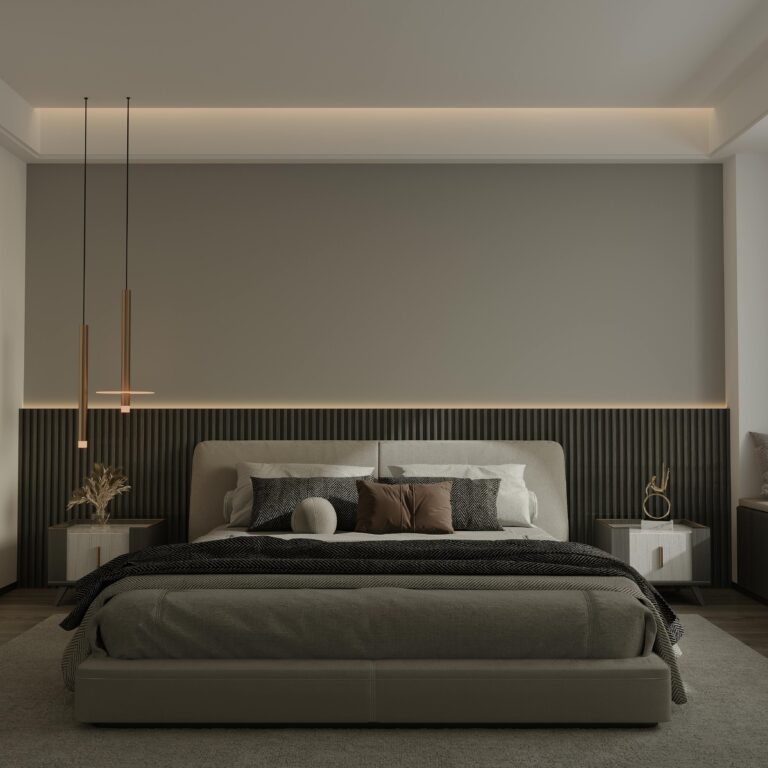
- Upholstered: velvet, linen-look polyester, faux leather or boucle over foam. Softer against your back for reading, but it collects dust and shows pet claws. Our look at the Dulane upholstered sleigh bed covers what that style is like to live with.
- Metal: curved tube frames with a scroll silhouette. Lightest and usually cheapest, though they squeak more as joints loosen.
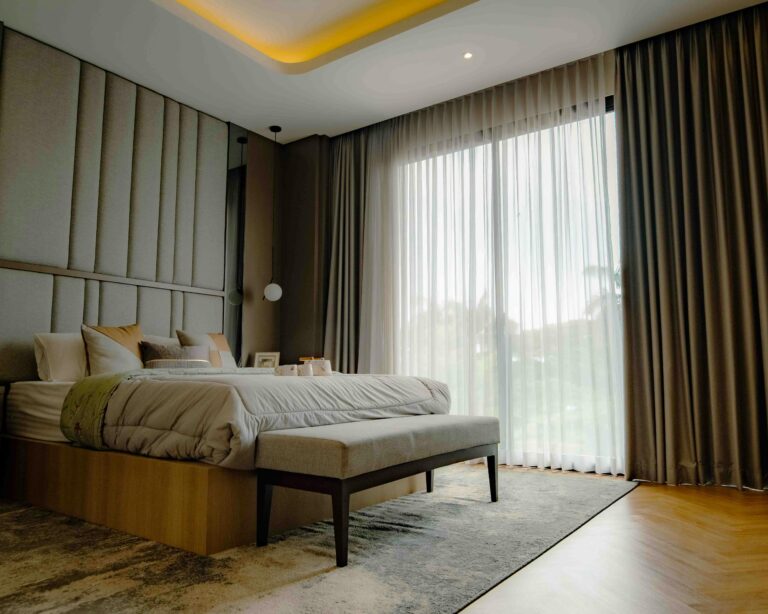
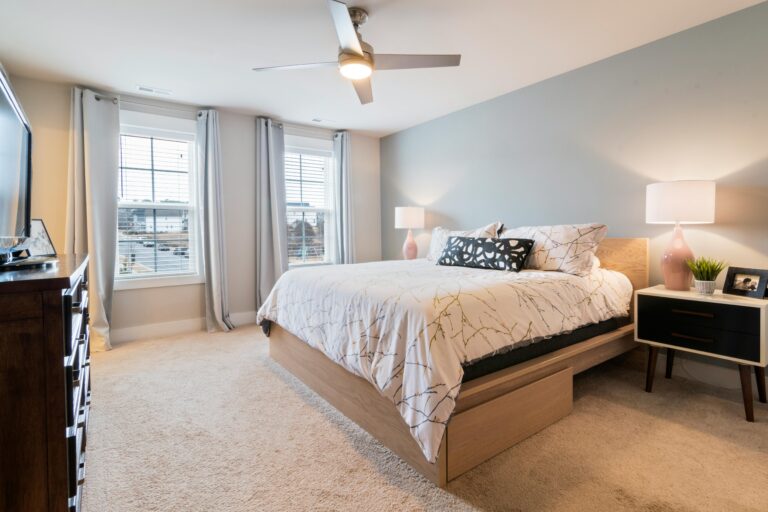
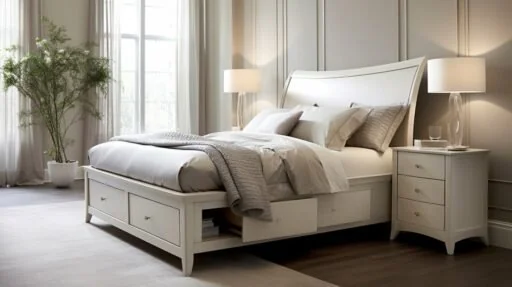
- Storage sleigh beds: two to four drawers built into the side rails or a lift-up deck underneath.
Will a sleigh bed fit your room?
So what is a sleigh bed going to cost you in floor space? More than you’d guess, and this is the part people skip and then regret. The outside footprint is bigger than the mattress inside it, because the ends flare out — so you lose floor space you didn’t budget for.
Start with mattress sizes: twin 38 x 75 inches, full 54 x 75, queen 60 x 80, king 76 x 80, California king 72 x 84. A sleigh frame typically adds 4 to 10 inches of width and 6 to 14 inches of length on top, depending on how far the scrolls project, so a queen can occupy roughly 68 x 92 inches of floor.
Then add walkways. Aim for about 30 inches of clear space on each side you use and 30 to 36 inches at the foot. Run the math before you order:
- Measure the room wall to wall, noting where doors swing or slide.
- Find the frame’s overall dimensions on the spec sheet, not the mattress size.
- Add 60 inches of width if you want to walk both sides, or 30 if one side goes against a wall.
- Add the headboard’s lean-back gap, often 2 to 5 inches.
- Tape the outline on the floor and live with it for a day.
Rooms under about 10 x 10 feet usually do better with a low-profile sleigh bed, or one with no footboard at all. Sizing a full instead? Our full size bed dimensions guide has layout diagrams, and if space is really tight, the space-saving bed frames roundup is a better starting point.
Storage drawers need pull-out room
A side drawer needs 20 to 24 inches to open, so a storage sleigh bed jammed against a narrow wall ends up with a drawer you can never fully use. Check which side the drawers sit on; many models assemble left or right.
What to check before you buy a sleigh bed
Buying a sleigh bed comes down to joinery and support. Run this checklist:
- Slat spacing. Most foam and hybrid mattress warranties want gaps of about 3 inches or less plus a center support with legs to the floor. Read the mattress warranty, not the bed listing.
- Center rail legs. Queen and larger frames should have at least two, ideally three, legs down the middle. One flimsy plastic foot is a sag waiting to happen.
- Rail-to-post hardware. Steel hook plates or bolt-and-barrel-nut joints outlast dowels and cam locks. Retighten every bolt after a month, then yearly — that’s what stops the midnight creak.
- Mattress thickness. Sleigh rails often sit 10 to 14 inches off the floor. Stack a 14-inch mattress on top and the curved footboard shrinks to a nub while your pillows slide over the headboard. Match mattress height to the rail height in the specs.
- The curve itself. Tap it. Bent solid wood or laminated ply sounds dense; a hollow molded shell sounds like a drum.
- Formaldehyde. If the frame uses MDF, plywood or particleboard, look for a TSCA Title VI or CARB Phase 2 compliance label. The EPA’s composite wood emission standards cover panels made in or imported into the US, and the label should name the panel producer and a third-party certifier number.
- Delivery. Measure stairwell turns and doorway widths — sleigh headboards are wide, rigid pieces that won’t flex around a tight landing.
Curious how the curves are actually produced in different woods? Our wooden bed design guide goes deeper on species and finishes.
Living with the footboard
The tall footboard is the whole look, and the main complaint. If you’re over about 6 feet, stretch out on the mattress before buying: a footboard that curves inward at the top crowds your feet on a 75-inch twin or full. An 80-inch queen or king usually fixes it.
Bedding behaves differently too. Duvets can’t drape over the end, so they bunch against the footboard. Either size down one step on the duvet or skip the tucked look and fold a throw across the foot. Deep-pocket fitted sheets help when the mattress sits low between high rails.
Styling a sleigh bed without making the room feel heavy
A sleigh bed already carries a lot of visual mass, so let it be the loud thing in the room.
- Keep nightstands slim and leggy so light passes under them.
- Size the rug to the footprint: an 8 x 10 under a queen leaves rug showing on three sides, so the bed doesn’t look marooned.
- Hang art higher than feels natural; the headboard eats 45-plus inches of wall.
- Pale walls balance a dark mahogany or walnut frame; with light oak or fabric, you can go darker around it.
- Limit the pillow pile to three or four. Curved headboards push pillows forward anyway.
Care and repair
Dust wood frames with a dry or barely damp cloth and skip silicone sprays, which build up on curves and go cloudy. Wipe spills off veneer fast, since water creeping into a seam lifts the edge. On upholstered frames, vacuum the crevice where the deck meets the headboard monthly and check the tag’s cleaning code before using water. Felt pads under the feet protect hardwood floors.
Squeaks almost always come from loose rail bolts or slats rubbing their ledger. Tighten the bolts first; if it keeps going, stick adhesive felt strips where the slats rest, and work through a full guide to tracking down a squeaky bed frame.
Sleigh bed FAQ
Are sleigh beds out of style?
No, but the look has shifted. Heavy high-gloss mahogany sets read dated to a lot of people now, while low-profile wood and upholstered versions fit current bedrooms fine. For the shape without the formality, pick a matte finish and a footboard under about 22 inches.
Do sleigh beds need a box spring?
Depends on the model. Many modern ones ship with a full slat deck and need nothing else. Traditional frames have rails cut for a box spring, which adds 5 to 9 inches of height. The listing should say “foundation required” or “no box spring needed.”
Can you use an adjustable base with a sleigh bed?
Sometimes. The base has to fit inside the side rails, and the headboard curve has to clear the raised head section, so frames with removable slat decks work best. Measure inside rail width and height, then check the base specs.
Do sleigh beds work in small bedrooms?
Yes, with edits. Choose a footboard-free or low-profile version, a lighter finish, and storage drawers only if you have pull-out room. Losing the tall footboard gives back a foot or more of usable floor.
Why are sleigh beds more expensive?
Curved parts cost more to make than flat ones, since steam bending or laminating over a form takes tooling and time. Solid side rails also use more material than a metal-railed panel bed, and upholstery adds foam, fabric and hand labor.
Updated September 2026.