
The quick answer to how to choose a dresser: measure the wall and the walkway in front of it first, then pick the shape that fits — tall and narrow for tight rooms, long and low for wide walls. After that, match drawer depth to what you actually own, choose a frame you can trust (solid wood or a well-built engineered panel with smooth glides), and anchor it to the wall.
Everything else — finish, hardware, whether it matches your bed — is style, and style is the easy part. Here’s the full process, in the order that saves you from returns.
How to choose a dresser: the five-minute checklist
- Measure the wall, then subtract a few inches so the piece doesn’t look wedged in.
- Leave room to open drawers — a fully extended drawer plus standing space.
- Count your stuff: bulky sweaters need deep drawers, socks and tees don’t.
- Check the build: drawer glides, joinery, a solid back panel.
- Plan for anchoring before it’s loaded with clothes.
Start with measurements, not with the photo you saved
Write down three numbers: the usable width of the wall, the depth you can give up, and the height that works with your window sills, outlets and any art above.
Most bedroom dressers land somewhere between 30 and 40 inches deep-ish in height for a wide, low “double dresser,” while tall chests of drawers climb to 45 inches or more on a footprint around 30–36 inches wide. Depth is usually 16–20 inches. Those are ranges, not rules — always check the listed dimensions rather than assuming.
Two clearances matter more than people expect. You need enough space in front for a drawer to pull out fully and for you to stand there — roughly 30 to 36 inches is a comfortable target. And if the dresser sits near a door swing or the foot of the bed, open a drawer in your head and walk the path before you buy.
In a small room, vertical wins. A tall chest stores the same volume on half the floor, which frees up the wall for a chair or a full-length mirror. If floor space is the real problem, our guide to space-saving bedroom furniture and these tricks for making a small bedroom feel bigger are worth a look before you commit to a big piece.
Match drawers to what you actually own
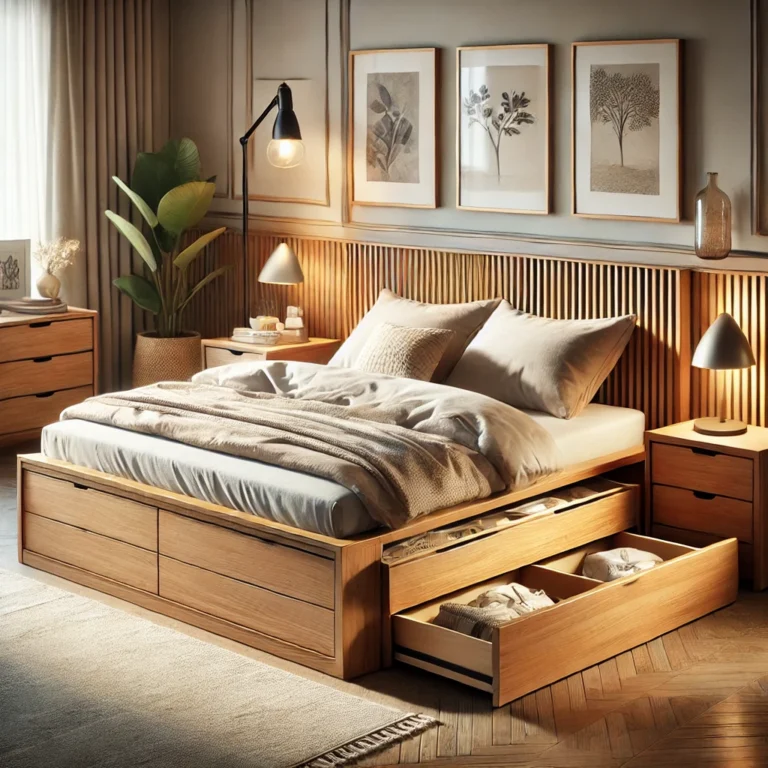
Pull open a drawer you use now and look at it honestly. Chunky knits, denim and spare bedding need deep drawers — usually the bottom two on a well-designed piece. T-shirts, underwear and socks live better in shallow top drawers where nothing gets buried.
A few common situations:
- Sharing with a partner: a wide dresser with side-by-side drawers splits cleanly, no negotiating required.
- Guest room: a slim three-drawer chest is plenty. Guests rarely unpack much.
- Kids’ rooms: shallower drawers and easy-glide hardware mean small hands can actually use it — and there’s less temptation to climb.
- No closet: you’ll want hanging space elsewhere. Our storage ideas for bedrooms with no closets cover the workarounds.
Felt-lined top drawers, removable dividers and a cutout for a charging cable are genuinely useful features. Skip anything that sounds clever but adds cost without solving a problem you have.
Materials: what lasts and what’s fine to compromise on
Solid wood is the durable choice. It can be sanded and refinished, holds screws well, and takes decades of opening and closing. Pine is soft and casual and dents easily; oak is hard-wearing with visible grain; walnut is darker, pricier and richer looking. Solid wood also moves with the seasons, so expect small gaps and slightly stickier drawers in very dry or very humid months.
Veneer over a stable core is not a downgrade by default — plenty of good furniture uses a thin real-wood face over plywood or MDF, which resists warping better than a wide solid panel. The weak point is edges and corners, where veneer chips and can’t easily be repaired.
MDF and particleboard keep prices low and make flat-pack shipping possible. They’re heavier than they look, hate standing water, and don’t love being moved repeatedly. If you’re sensitive to indoor air quality, note that composite wood products sold in the US must meet formaldehyde emission limits and be labeled as compliant under EPA’s TSCA Title VI rule — the label is on the product or packaging, so it’s worth a look.
Metal and mirrored dressers bounce light around, which helps a dim room, but mirrored fronts show every fingerprint. Rattan and cane fronts are light and breathable, though they’re harder to wipe clean.
How to spot a well-built dresser in 30 seconds
- Pull a drawer all the way out. It should glide, not wobble or drop.
- Look at the drawer box corners — dovetail or strong interlocking joints beat staples.
- Check for dust panels between drawers and a back panel that’s screwed on, not tacked.
- Press down on a corner of the top. Any rocking means a frame that won’t age well.
- Feel the hardware. Cheap pulls are easy to swap; a flimsy frame isn’t.
Anchor it — this part isn’t optional
Dressers tip. Loaded drawers pull the center of gravity forward, carpet tilts the whole unit, and a child climbing the open drawers can bring it down. CPSC staff have counted 234 deaths from clothing storage unit tip-overs between January 2000 and April 2022, 199 of them children.
The rules tightened recently. Under the STURDY Act, the CPSC adopted ASTM F2057-23 as a mandatory federal safety standard, effective September 1, 2023. It covers freestanding dressers, chests and armoires 27 inches or taller, and the tests simulate carpet tilt and loaded drawers. Newer pieces are harder to tip than older ones — but the standard doesn’t replace an anchor.
CPSC’s Anchor It! campaign is blunt about it: anchor anything with drawers, doors or shelves to the wall. Use the restraint kit that comes in the box, fix it into a stud where you can, and re-check it after you move the furniture. Keep remotes, toys and snacks off the top so nobody has a reason to climb. Free how-to guides are at anchorit.gov.
If the dresser will hold a TV, check the manufacturer’s weight rating and push the TV as far back as it will go.
Pick a style that fits the room you already have
A dresser is usually the largest flat surface in a bedroom, so its finish sets the tone. Three directions that work well:
Cottagecore
Painted or lightly distressed wood, soft colors, vintage-look pulls. It suits rooms with lace or linen curtains, florals and warm lamplight. Swapping the hardware on a plain painted chest gets you most of the way there for very little money.
Dark academia
Deep wood tones, brass or antique-finish hardware, classic proportions. Style the top with stacked books, a small lamp with a warm bulb and a framed print. It reads best in a room with layered, low lighting rather than one bright ceiling fixture — see our cozy bedroom lighting guide if the room currently has one overhead light doing all the work.
Modern minimalist
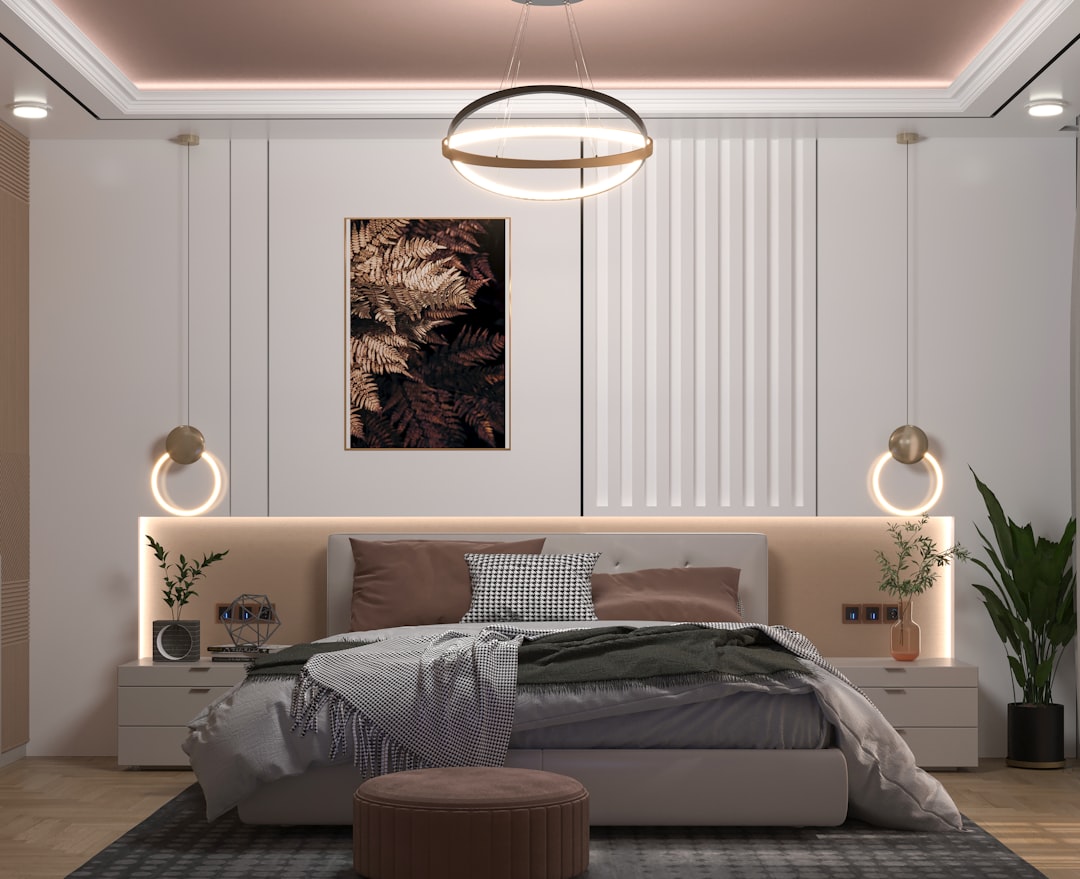
Straight lines, matte or flat finishes, push-to-open or integrated handles. Fewer visual interruptions make a small room feel calmer. The trade-off is that fingerprints and clutter show immediately.
Do dresser and bed need to match? No. A full matching set looks tidy but can feel like a showroom. Mixing works if you repeat something — a wood tone, a metal finish, a shape — somewhere else in the room. Coordinating the dresser with your bedside piece is usually enough; our nightstand guide walks through how to pair them.
Styling the top without creating clutter
Three-object rule, roughly: something tall (lamp or vase), something low and wide (tray or stack of books), something living or textured (plant, bowl, candle). A tray corrals the daily pile of keys and jewelry so the surface still reads as intentional.
A mirror above a dresser is the most useful move of all — it doubles as a dressing mirror and pushes light deeper into the room. Height and placement matter more than size; our bedroom mirror placement tips cover where to hang it.
Keeping it in good shape
Dust with a soft dry or barely damp cloth, then dry it. Skip soaking anything with water, especially on engineered panels and veneer edges. Use coasters or felt pads under lamps, candles and anything ceramic.
Keep the piece out of constant direct sunlight — UV fades finishes unevenly, and the difference shows up first under whatever’s been sitting on top. Avoid parking it right against a radiator or a vent, since repeated drying and re-humidifying is what makes solid wood panels crack and drawers stick. If drawers start to bind in a damp season, it’s usually the wood, not a defect.
Buying a dresser online
Online is fine if you’re disciplined about three things. Read the dimensions, then tape the outline on your floor. Check whether the piece arrives assembled or flat-packed, and whether delivery includes carrying it upstairs. And read the return policy before you click — returning a heavy dresser is a different experience from returning a pillow.
In reviews, ignore the photos and search the text for words like “wobble,” “glide,” “stripped,” and “missing.” That’s where real build quality shows up. If you’re piecing together a whole room, our bedroom furniture and layout guide helps you sequence purchases so nothing ends up blocking a door.
FAQ
What size dresser works best in a small bedroom?
A tall, narrow chest — roughly 30–36 inches wide — gives you the same drawer volume on a much smaller footprint. Just make sure you can still stand in front of it with a drawer fully open.
Should the dresser match the bed frame?
It doesn’t have to. Matching sets look cohesive; mixing gives a room character as long as you repeat one shared element, like a wood tone or a metal finish.
What’s the most durable dresser material?
Solid hardwood, because it can be repaired and refinished. Good veneer over plywood is a close second and resists warping well. Particleboard is the least durable, especially if you move often.
Can a dresser be used as a TV stand?
Yes, if it’s wide, low and rated for the weight. Anchor both the dresser and the TV, and push the TV back from the front edge.
Do I really need to anchor a new dresser?
If children live in or visit your home, yes — CPSC recommends anchoring all furniture with drawers, doors or shelves, even under the newer stability standard.
Does a tidy bedroom actually help you sleep?
Clutter itself hasn’t been shown to cause poor sleep, so treat “tidy room, better sleep” as a comfort argument rather than a proven one. What is well established is how much sleep to aim for: the CDC recommends 7 or more hours a night for adults. Storage that keeps the floor clear simply makes a consistent bedtime routine easier to stick to.
Updated September 2026.