

King size bed frames with storage are bed bases that turn the empty floor space under a king mattress into usable storage, either through built-in drawers or a lift-up (ottoman) platform. They suit bedrooms where closet space is tight and there is no room for another dresser, and they cost more and weigh more than a plain frame. The right choice comes down to two questions: how often you need to reach what you store, and how much clear floor space you have around the bed.
Below you will find the four main designs, how much space you actually gain, the clearance and mattress rules that catch people out, and how to decide whether one is worth it for your room.
How Much Space Do King Size Bed Frames With Storage Really Add?
A king mattress measures 76 by 80 inches (193 by 203 cm). Sleep Foundation notes that a king has a surface area of 6,080 square inches, which is more than any other standard size.
That is roughly 42 square feet of floor underneath the bed. A lift-up frame gives you most of that footprint as one open compartment, minus the depth taken by the base and frame rails.
Drawer frames give you less than the full footprint, because the drawer boxes sit inside the frame and leave gaps at the corners and along the center rail. What you get instead is easy access without moving the mattress.
The honest way to plan is to think about what the space replaces: bulky seasonal bedding, spare pillows, suitcases, and off-season clothes. Those are the items that usually eat a closet shelf or a whole storage cube unit.
The 4 Types of King Size Bed Frames With Storage

Not all storage beds work the same way, and the differences matter far more than the styling. Here are the four designs you will see most often.
1. Drawer Storage Beds
Drawer beds have two to six built-in drawers along the sides, at the footboard, or both, behaving like a low dresser hidden inside the bed frame.
They are the best choice for things you touch weekly: pajamas, t-shirts, spare bedding, towels. Nothing has to be lifted, and you can open one drawer without disturbing the bed.
Pros: instant access, no lifting, easy to organize by category.
Cons: you need clear floor space beside or in front of the bed, runners can sag if you overload them, and a rug under the bed can stop a drawer opening fully.
2. Lift-Up (Ottoman) Storage Beds
Lift-up beds use gas struts to raise the whole mattress platform, revealing one large compartment underneath. Side-lift and end-lift versions exist; end-lift is usually the one to pick if the bed sits against a wall.
This design gives the largest single storage volume of any king frame, which is why it suits apartments and small rooms. It is best for bulky, low-frequency items: suitcases, winter duvets, spare pillows, vacuum-bagged clothing.
Pros: the most capacity, no side clearance needed, and everything stays enclosed and dust-free.
Cons: higher price, you have to clear the bed before opening it, and the gas struts are a wearing part that may eventually need replacing.
3. Headboard Storage Beds
These add shelves, cubbies, or a hinged compartment to the headboard itself. Some include built-in USB or power outlets, which effectively replaces a nightstand.
The storage is shallow, so treat it as a home for books, a tablet, glasses, and chargers rather than bulk items. In a narrow room where a king already leaves little walking space, losing the nightstands can be the difference between a workable layout and a cramped one. Bear in mind that a storage headboard adds length to the bed’s footprint, so measure the frame, not just the mattress.
4. Bookcase and Platform Storage Beds
Platform storage beds combine a slatted or solid base with open shelving, cubbies, or under-bed drawers on runners. They are the most flexible of the four and often the easiest to live with if you like open display space.
Open shelving looks lighter than a solid drawer bank, but it collects dust and shows clutter, so it works best with baskets or boxes.
Drawers or Lift-Up? A Quick Comparison
| Feature | Drawer bed | Lift-up (ottoman) bed |
| Storage volume | Moderate, split into sections | Large, one open compartment |
| Access | Instant, one drawer at a time | Whole bed lifts, clear the surface first |
| Floor clearance needed | Yes, beside or in front of the bed | No side clearance needed |
| Best for | Daily clothing and linens | Suitcases and seasonal bulk |
| Moving parts | Drawer runners | Gas struts and hinges |
| Typical cost | Lower | Higher |
If your bedroom is small and the bed sits close to the walls, the lift-up design usually wins. If you want the bed to replace a dresser you use every morning, go with drawers.
How Much Clearance Do You Need Around the Bed?
This is where most disappointment with king size bed frames with storage starts. A king frame is already the biggest object in the room, and drawers need somewhere to go when they slide out.
A practical target is 18 to 24 inches of walking space on each side you use, and around 30 inches where a drawer pulls out or two people pass, according to Castlery’s storage bed clearance guide. A bed can sit tight against a wall as long as no storage opens on that side.
Before you buy, mark it out with painter’s tape:
- Mark the full frame footprint including headboard depth, not the mattress size.
- Mark a second line at the listed drawer extension depth.
- Check that doors, closet doors, and radiators still clear those lines.
- Stand in the gap left over and see whether you can bend down comfortably.
Also check how the frame gets into the room: these arrive as large, flat panels, so measure your stairwell, landing, and door openings too.
Will Your Mattress Work on a Storage Frame?
Almost all king size bed frames with storage are designed to be used without a box spring; the drawer deck or lift-up platform is the foundation. Adding a box spring on top usually makes the bed uncomfortably tall and can block the lift mechanism.
If the base uses slats, check the gaps. Puffy’s slat spacing guide explains that closely spaced slats, around two inches apart, support foam, latex, and hybrid mattresses evenly and reduce the risk of sagging. Many mattress warranties set a maximum gap, so it is worth reading yours before ordering.
Two more checks that are easy to miss:
- Center support. A king base needs a center rail with legs. Without it, the middle of the bed dips over time.
- Adjustable bases. Most lift-up and drawer frames cannot take an adjustable base, because the moving mechanism needs the space. Confirm compatibility before you buy if that matters to you.
Frame material affects how well all of this holds up under daily use. Our comparison of king-size bed frame materials: wood vs metal vs upholstered goes through the trade-offs in detail.
Airflow, Damp and What to Store Under the Bed
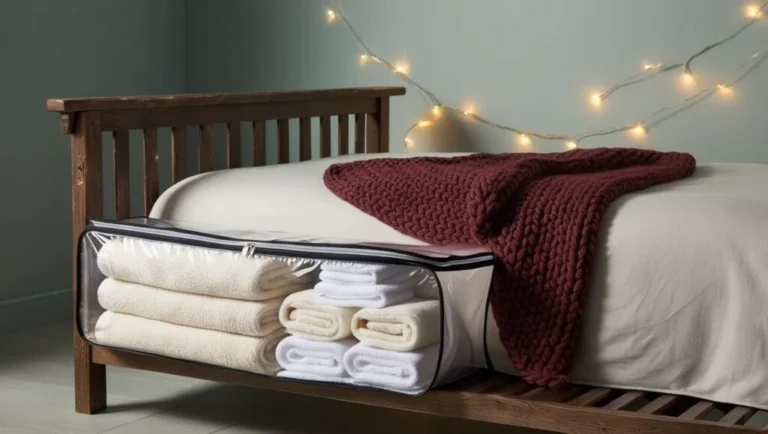
Enclosed storage restricts airflow under the mattress, and that is the downside people underestimate. Moisture from normal sleeping has to go somewhere, and a sealed base gives it fewer escape routes than an open frame. Keeping the room’s humidity in check is the main defense. The US Environmental Protection Agency advises keeping indoor humidity below 60 percent, ideally between 30 and 50 percent, to limit mold growth.
A few habits make an enclosed base easier to live with:
- Choose a base with a slatted or vented deck rather than a fully sealed board where you can.
- Pull the duvet back for a while in the morning instead of making the bed immediately.
- Air the room daily, especially in winter when condensation is worse.
- Open the compartment now and then rather than leaving it sealed for months.
- Store textiles clean and dry in breathable bags rather than sealed plastic.
Keep food and damp sports gear out of there. Suitcases, off-season clothing, spare bedding, and gift wrap are the natural fit.
Weight, Assembly and Moving
Storage frames are heavier than plain frames because of the extra panels, drawer boxes, and hardware, which is also why they feel solid and quiet under a king mattress. Assembly takes longer, and with a king it is genuinely a two-person job.
Once built, a storage bed is not something you shift to vacuum behind. If you rent and move often, weigh that against the storage you gain, and check whether the frame can be dismantled without damaging the panels.
Who Should Buy One, and Who Shouldn’t
King size bed frames with storage solve a specific problem well, but they are not the right answer for every bedroom.
A good fit if you
- Live in an apartment or older home with shallow closets.
- Have no wall left for a dresser once the king is in place.
- Need somewhere for seasonal bedding, suitcases, or kids’ overflow.
- Are downsizing and want fewer, harder-working pieces of furniture.
Think twice if you
- Move house frequently.
- Want an adjustable base now or later.
- Have a damp or poorly ventilated bedroom.
- Have less than about two feet of clear floor on the sides where drawers would open.
If the last point describes your room, cheaper alternatives can work almost as well. Rolling bins on a standard frame, or bed risers that lift an existing frame, buy you under-bed space without replacing the bed at all.
How to Choose the Right King Storage Bed
Work through these in order and the shortlist gets short quickly.
- Measure first. Room size, frame footprint, drawer extension, and the route into the bedroom.
- Decide on access. Daily items point to drawers; bulky, occasional items point to lift-up.
- Check the base. Center support, slat spacing, and whether your mattress warranty is happy with it.
- Check the hardware. Metal drawer runners and quality struts tend to outlast stapled plywood boxes.
- Match the height. Add your mattress depth to the frame height and check the total is comfortable to sit on.
- Then pick the style. Upholstered, wood, or metal, once the practical boxes are ticked.
For a full walk-through of sizing, support and construction quality, read our how to choose a king bed frame buying guide. And if you are still deciding between sizes, our king vs California king comparison explains how the four-inch difference in width and length changes what fits.
Styling a Storage Bed So It Doesn’t Look Bulky

King size bed frames with storage can dominate a small room if you let them. Light bedding and a light frame finish visually lift the bed, while dark upholstery makes it read as one heavy block.
Keep the floor around the bed clear, since the point of the storage is that nothing has to sit on display. Draw the eye upward with tall lamps, a mirror, or wall art above the headboard.
Are King Size Bed Frames With Storage Worth It?
For a bedroom where the closet is full and there is no wall left for a dresser, yes. You pay more for one piece of furniture and get back storage that would otherwise need a second piece and more floor space.
For a large bedroom with good closets, the maths is less convincing. You take on extra weight, longer assembly, and moving parts for space you may not need.
The deciding factor is usually the room, not the budget. Measure your clearances honestly, then choose between drawers and a lift-up base based on how you actually live.
FAQs About King Size Bed Frames With Storage
Do storage beds need a box spring?
No. The drawer deck or lift-up platform acts as the foundation, and adding a box spring usually makes the bed too tall and can interfere with the mechanism.
How much clearance do drawer beds need?
Enough for the drawer to come fully out plus room to stand in front of it, roughly 30 inches on the drawer side. End-lift ottoman frames avoid the problem entirely.
Are lift-up beds hard to open?
Gas struts carry most of the mattress weight, so opening one is manageable for most adults. You do need to clear loose pillows and bedding first.
Can a storage bed replace a dresser?
A drawer bed can take over much of what a dresser holds, particularly folded clothing and linens. Hanging items and anything you need at eye level still need a closet or a chest.
Will an enclosed base cause mold under the mattress?
Not on its own, but restricted airflow plus a humid room raises the risk. Keep room humidity in the range the EPA recommends, air the bed in the morning, and choose a vented or slatted deck where possible.
Do they work with memory foam mattresses?
Yes, provided the base gives even support. Check your mattress warranty for the maximum slat gap it allows, and make sure the king base has a center rail with legs.
Explore More Related Guides
- Best King Size Bed Frame: Top Picks and What to Look For
- Under Bed Storage Frames That Maximize Bedroom Space
Updated September 2026.