

Modern Velvet Upholstered Beds: The Short Answer
A modern velvet upholstered bed is a wood or metal bed frame wrapped in a short, dense pile fabric, usually polyester or a polyester blend, with a padded headboard that doubles as a backrest. Choose one for the soft texture, light-catching colour and comfort it adds to a bedroom; skip it if your room gets hours of direct sun or you want a frame you can wipe down in seconds. The two things that decide whether you love it in five years are the frame underneath (solid, kiln-dried hardwood or reinforced metal rather than thin particleboard) and the density of the velvet pile.
What Velvet Actually Is
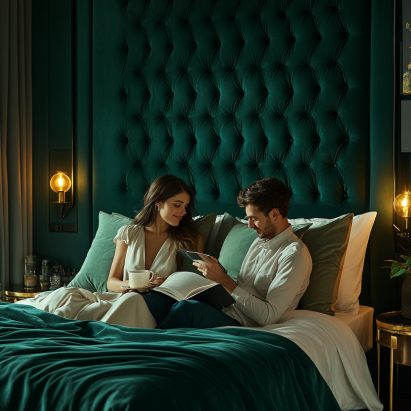
Velvet is not a fibre — it is a construction. Britannica describes velvet as a fabric with a short, dense pile made in the pile weave from silk, cotton or synthetic fibres. That pile is why velvet behaves the way it does: it catches light differently depending on the angle you view it from, so a single colour can read light in one spot and deep in another. It is also why velvet shows brush marks and finger tracks, and why the pile can flatten in high-contact areas such as the centre of a headboard.
Most bed frames sold today use polyester velvet rather than cotton or silk. Polyester pile is more abrasion-resistant, holds colour well and tolerates water-based spot cleaning better than rayon or viscose velvet, which can water-spot. If a listing says “performance velvet,” that usually refers to a polyester pile with a stain-resistant finish — a useful signal, but not a regulated term, so read the fabric content and cleaning code rather than the marketing name.
Why People Choose a Velvet Bed
- Comfort where you use it. A padded headboard is more forgiving to lean against — and to knock into — than wood or metal, which matters if you read or watch TV in bed.
- Visual warmth. Pile absorbs and reflects light unevenly, which makes a velvet headboard read as a soft focal point rather than a flat panel.
- Colour depth. Dyed pile gives richer, more saturated colour than most flat woven upholstery, which is why jewel tones look convincing in velvet and muddy in cheap flat fabric.
- Quiet frame. Upholstered side rails and slat systems tend to squeak less than bolted metal frames, though this depends far more on assembly quality than on fabric.
If you are still weighing velvet against plain upholstery, our comparison of velvet vs upholstered bed frames lays out the trade-offs side by side.
The Main Velvet Bed Styles
Platform
Low, streamlined and slat-supported, so no box spring is needed. Platform frames are the easiest velvet style to live with in a small or low-ceilinged room, and they suit minimalist and Scandinavian rooms. See our overview of platform bed benefits if you are new to the format.
Wingback
The headboard wraps forward at the sides, creating an enclosed, hotel-suite feel and useful back support for reading. Wingbacks eat visual space and often add several inches of width, so measure carefully in rooms under about 11 by 11 feet.
Tufted and channel
Button (diamond) tufting adds depth and traditional character; channel stitching runs in straight vertical or horizontal lines for a cleaner, more contemporary look. Channel designs are easier to vacuum — buttoned tufts collect dust in the dimples.
Canopy and four-poster
Upholstered posts plus velvet give the most dramatic result, best in tall rooms where the frame does not crowd the ceiling. Our guide to upholstered canopy beds covers the practical side of living with one.
Storage
Side drawers or a gas-lift base turn the bed’s footprint into usable storage — the single most useful feature in a small bedroom. Check drawer clearance against your walls and rug before buying; more options are in our roundup of storage beds.
Sleigh, curved and scalloped
Curved silhouettes soften a room and photograph well, but they are harder to push flush against a wall and often cost more because of the shaped frame underneath.

Choosing a Colour
- Emerald and forest green: works with brass, walnut and warm whites.
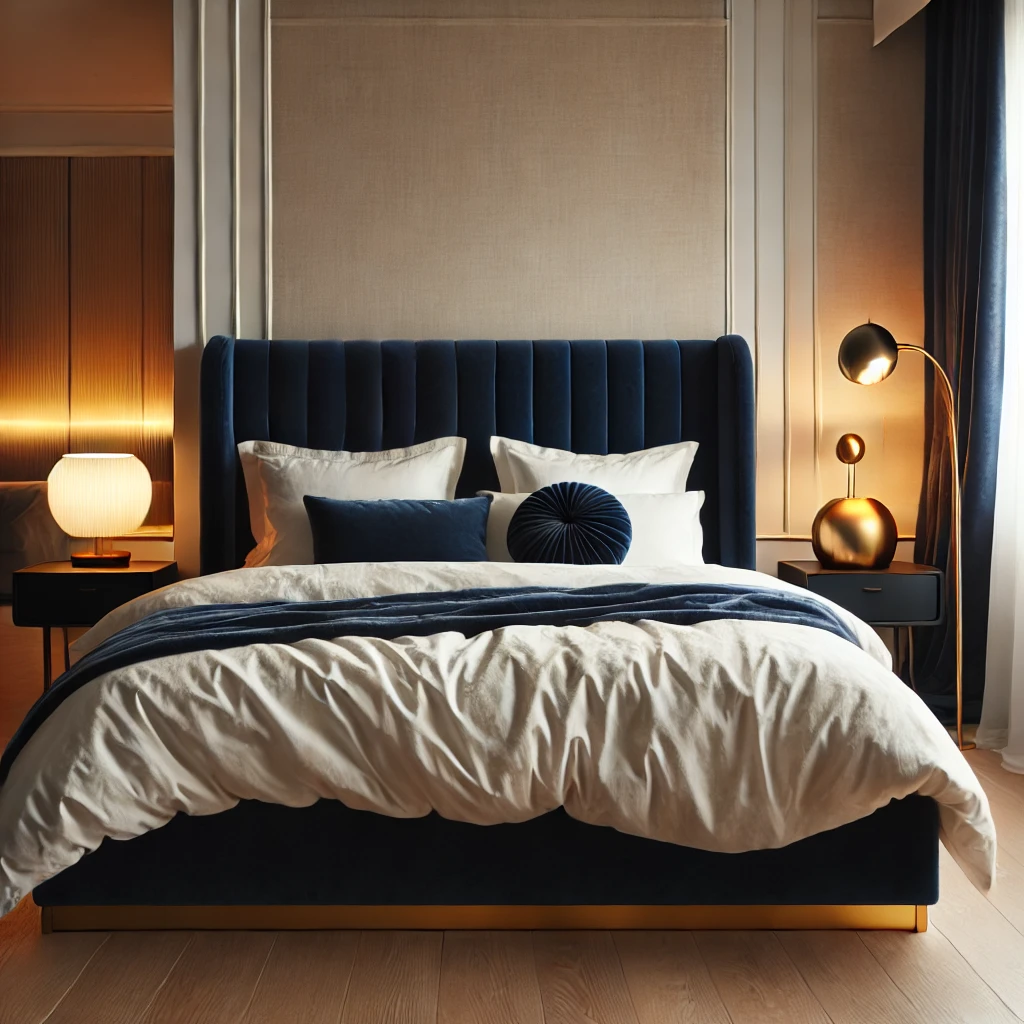
- Navy and deep blue: the most forgiving dark tone; hides marks better than black or grey.
- Charcoal and slate: a neutral with weight, easy to restyle season to season.
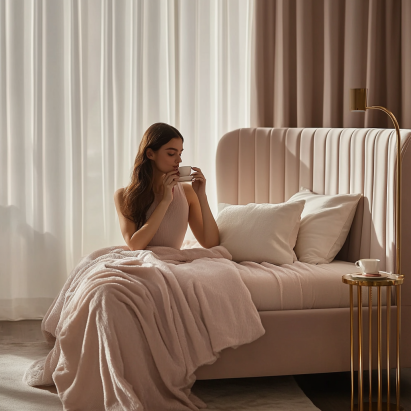
- Blush and dusty rose: soft and light-reflective, but shows pile marks most clearly.
- Cream, sand and taupe: calm and roomy-looking; hardest to keep clean with pets.
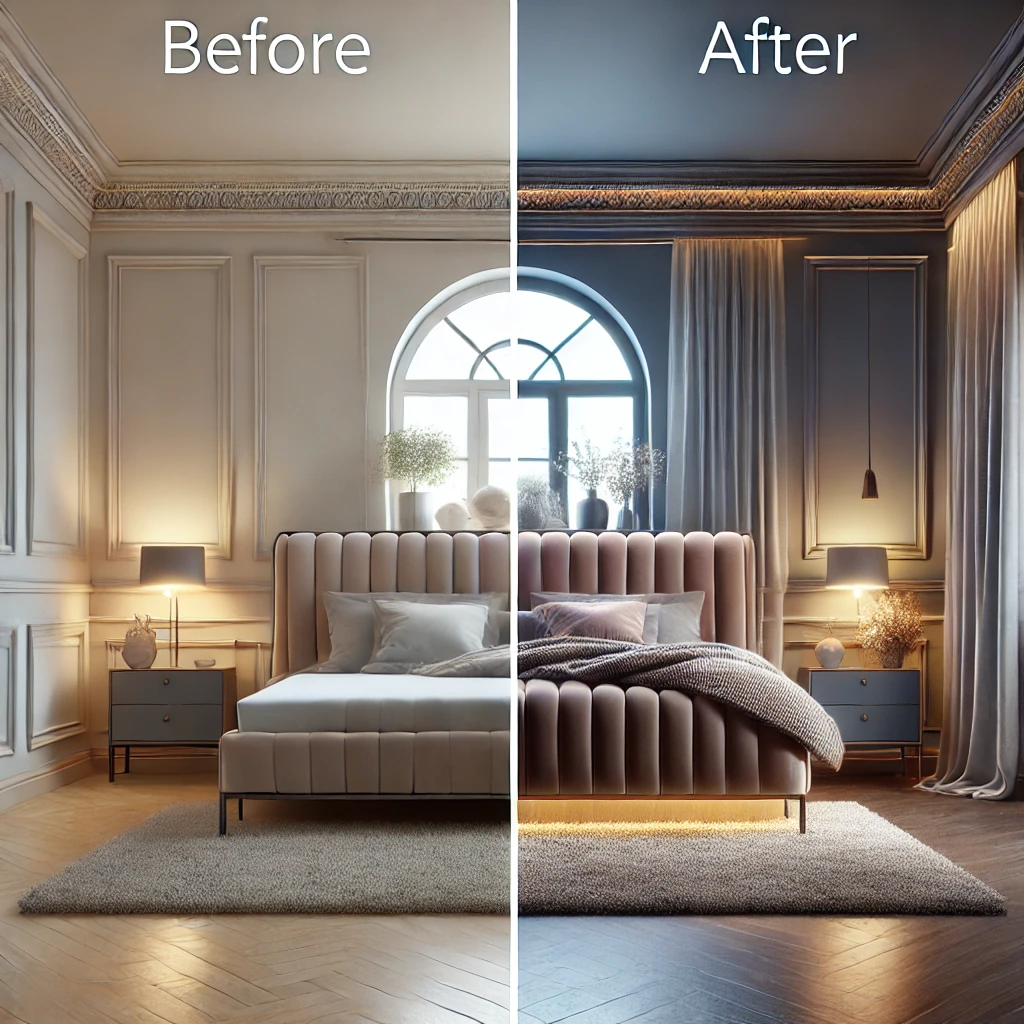
Two practical notes. First, velvet’s pile means the colour you see in a product photo may not match what you see at home under warm bulbs — order a swatch if the retailer offers one. Second, dark velvet does not automatically shrink a room; because pile reflects light unevenly, a deep colour reads as depth rather than a flat block. That is a design observation, not a measured effect.
Matching the bed to the room
- Small bedrooms: platform or storage frames, lighter tones, low headboards.
- Medium bedrooms: tufted or channel headboards in a saturated colour.
- Large bedrooms: wingback, canopy or tall-headboard designs that can hold the wall.
What to Check Before You Buy
| Feature | What to look for |
|---|---|
| Frame material | Kiln-dried hardwood or reinforced steel; treat all-particleboard construction as short-term |
| Fabric content | Stated fibre (polyester, poly blend, cotton, viscose) — not just the word “velvet” |
| Cleaning code | W or W/S means water-based cleaners are acceptable; S means solvent only; X means vacuum only |
| Stitching and seams | Straight, tight seams, reinforced corners, no loose threads or puckering around tufts |
| Support system | Closely spaced slats plus centre legs on queen and king sizes; check the mattress warranty’s slat-spacing requirement |
| Assembly and shipping | Upholstered headboards are bulky; confirm carton dimensions fit your stairwell and doorways |
| Warranty | Read what the fabric warranty excludes — pile crushing and fading are commonly excluded |
On price: velvet beds span a very wide range, and published figures move constantly with sales and sizes, so we are not going to quote tiers we cannot verify. What reliably drives cost is the frame material, the density and fibre of the pile, whether the headboard is foam-padded over a solid panel, and whether slats and centre supports are included. Compare those specs rather than the sticker. If you are torn between materials entirely, our breakdown of wood vs metal vs upholstered frames is a useful next step.
Labels and certifications worth knowing
- OEKO-TEX STANDARD 100: tests textiles for harmful substances, with stricter limits for products that sit closer to skin.
- UL GREENGUARD: certifies products for limited chemical and VOC emissions, which matters in a closed bedroom.
- FSC-certified wood: the Forest Stewardship Council certifies responsibly managed forest sources for the frame.
- Flame-retardant disclosure: in California, upholstered furniture must state whether flame-retardant chemicals were added. The U.S. Consumer Product Safety Commission notes this disclosure requirement under SB 1019, separate from the TB 117-2013 flammability standard itself.
On sustainability claims, be sceptical of vague wording. Life-cycle comparisons generally credit mechanically recycled polyester with a lower greenhouse-gas footprint than virgin polyester, but the size of that gap varies a lot between studies and system boundaries, so treat “eco velvet” as a prompt to ask what the fibre actually is.
How to Care for a Velvet Bed Frame
Velvet is not fragile, but it is fussier than flat fabric because dirt and crushing both show up in the pile. A short routine prevents almost every problem.
- Vacuum weekly with a soft upholstery attachment, working in the direction of the pile. Do the headboard dimples and the rail tops where dust settles.
- Brush the nap monthly with a soft garment or upholstery brush to lift flattened areas and even out shading.
- Blot spills immediately — press with a dry white cloth, never rub. Rubbing pushes liquid into the backing and permanently distorts the pile.
- Spot clean to the code. On W or W/S fabrics, use a barely damp cloth with a drop of mild soap, then dry the area quickly. On S-coded fabric, use an upholstery solvent only. Test any product on a hidden section first.
- Keep it out of direct sun. The Canadian Conservation Institute notes that light fades textile colours and weakens fibres, and the damage is cumulative. Sheer or light-filtering curtains are the simplest fix.
- Steam gently, from a distance. A handheld steamer held a few inches away relaxes crushed pile; do not press the plate into the fabric.
- Avoid harsh cleaners. Solvent-heavy or high-alkaline products can strip finishes and stiffen the pile.
- Call a professional for set-in stains or an all-over refresh, and tell them the cleaning code.
Pets and kids are workable with polyester velvet: fur lifts off with a rubber brush or lint roller, and a tight, dense pile sheds crumbs better than a loose one. Claws are the real risk — a loose loop or snagged pile cannot be brushed out.
Velvet Compared With Other Upholstery Fabrics
| Fabric | Feel and look | Everyday practicality |
|---|---|---|
| Velvet | Plush pile, deep colour, light-catching | Shows pile marks and dust; vacuum and blot, no rubbing |
| Linen | Casual, matte, airy | Breathable but creases and marks easily |
| Cotton weave | Soft, flat, understated | Easy to clean; colours look flatter than velvet |
| Microfibre / faux suede | Smooth, matte, budget-friendly | Very forgiving; less visual depth |
| Leather / faux leather | Sleek and firm | Wipes clean but scratches and can feel cool in winter |
Styling a Velvet Bed
- Contrast the texture. Velvet reads best next to matte surfaces — linen bedding, a wool throw, rattan or raw-wood nightstands.
- Pick one metal. Brass and warm gold flatter green, rust and blush; matte black and chrome suit charcoal and navy.
- Light it deliberately. Because pile reacts to light angle, wall sconces or a dimmable lamp either side of the headboard do more for a velvet bed than a single ceiling fixture. Our bedroom mirror and lighting ideas cover the placement basics.
- Keep the rest quiet. One statement texture per room is enough; too many shiny surfaces compete with the velvet’s sheen.
- Repeat the fabric once, lightly. A velvet cushion or bench ties the scheme together — the same logic behind pairing it with a velvet sofa elsewhere in the home.
Common mistakes
- Oversizing. A tall wingback in a small room swallows the floor plan; scale the headboard height to the ceiling.
- Buying on photos alone. Pile depth and colour rarely translate accurately on screen.
- Parking it in a sunbeam. The fastest way to end up with a two-tone headboard.
- Ignoring the cleaning code. Water on an S-coded velvet can leave permanent rings.
- Skipping the centre support. Missing centre legs on a queen or king can void a mattress warranty and sag the slats.
FAQ
Are velvet beds hard to clean?
Not difficult, but specific. Weekly vacuuming, blotting rather than rubbing spills, and following the fabric’s cleaning code handle nearly everything. Deep stains usually need a professional upholstery cleaner.
Does velvet wear out quickly?
A dense polyester pile over a solid frame holds up well to normal bedroom use. The visible signs of age are usually crushed pile at contact points and sun fading, not fabric failure.
Will a velvet bed make a small room feel smaller?
The fabric itself does not; the silhouette does. A low platform or storage frame in a light tone keeps a small room open, while a deep-buttoned wingback will dominate it.
Can velvet work in a hot climate?
Yes — you only touch the frame, not sleep on it. Pair it with breathable cotton or linen bedding and the pile has no effect on how warm you sleep.
Is velvet a bad choice with pets?
It attracts fur, which lifts off easily with a rubber brush, but claws can snag the pile. A tightly woven performance velvet is the safer option.
Do velvet beds fit all mattress sizes?
They are made in standard sizes, but always check interior rail dimensions and slat spacing against your specific mattress, especially for thick hybrid or all-foam models.
Related Reading
- Velvet vs Upholstered Bed Frames: Which One Suits Your Style?
- Exploring Bed Frame Material Types and Modern Bed Styles
- The Best Beds for Small Rooms: From Murphy to Daybeds
Updated September 2026.