How to Clean Mattress Stains: Step-by-Step Guide

Steps to clean stains out of mattress after wine spill

How to Clean Mattress Stains (Quick Answer)

To clean a mattress stain, blot up as much liquid as you can, then treat the spot with the mildest cleaner that matches the stain type — cool water and a drop of dish soap for most spills, an enzyme cleaner for anything biological, and a lightly dabbed 3% hydrogen peroxide only for stubborn discolouration. Work in thin layers instead of soaking the surface, blot rather than scrub, and then dry the mattress quickly with fans and open windows. For a full refresh, the order is always the same: strip, vacuum, spot-treat, deodorise, dry.

Below you’ll find the deep-clean routine, stain-by-stain instructions, what to do about odours and mildew, how memory foam changes the rules, and a realistic maintenance schedule.

Why Cleaning Your Mattress Is Worth the Effort

A mattress collects sweat, skin cells, body oils, dust and the occasional spill. Those deposits are also food and habitat for house dust mites, which are a common trigger for allergy and asthma symptoms. Allergy organisations recommend attacking mites in the bedroom first: the Mayo Clinic advises washing sheets, blankets and covers weekly in water of at least 130 Â°F (54.4 Â°C), and notes that items which can’t be hot-washed can be tumbled above that temperature instead. An allergy practice parameter published by the AAAAI points to the most effective combination: keeping indoor humidity roughly between 35% and 50%, washing bedding regularly, vacuuming with a high-efficiency vacuum, and encasing the mattress and pillows in allergen-impermeable covers.

Be sceptical of dramatic claims you may have read elsewhere about how many skin cells you shed or how much a clean mattress improves sleep — those numbers get repeated constantly but rarely trace back to solid measurement. The defensible case for cleaning is simpler: fewer allergens, no set-in stains, and no lingering smell.
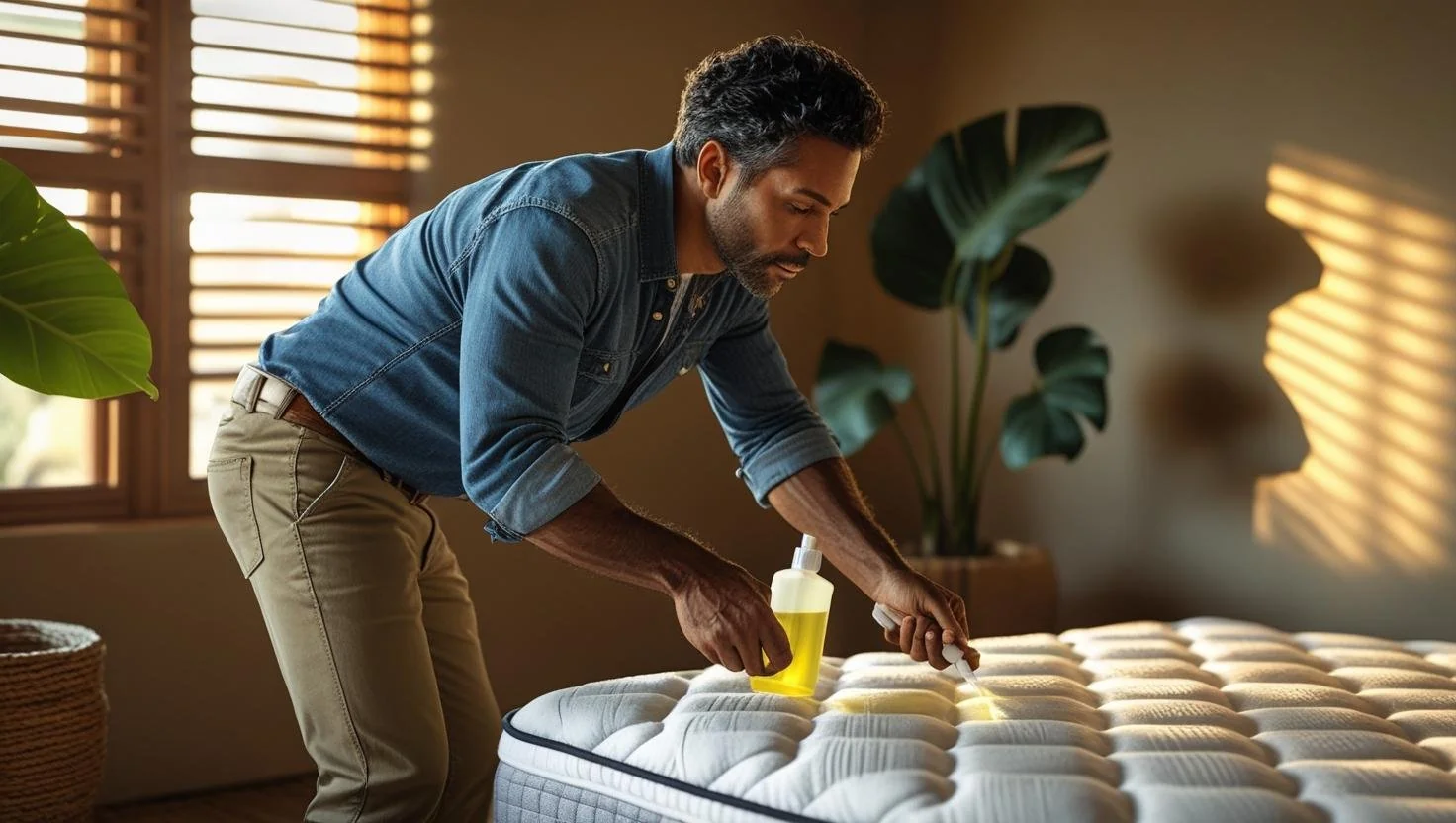
Bare mattress with marks being treated, showing why it helps to clean mattress stains promptly

What You Need

  • Vacuum with an upholstery head and a crevice tool
  • White, lint-free cloths and old towels (coloured cloths can transfer dye)
  • Two spray bottles: one for plain cool water, one for your cleaning solution
  • Unscented liquid dish soap
  • An enzyme cleaner labelled for protein or pet stains
  • 3% hydrogen peroxide and plain white vinegar
  • Baking soda
  • Gloves, plus a fan and open windows for drying

You do not need a steam cleaner, and for foam beds you’re usually better off without one — heat plus moisture is exactly what you’re trying to avoid.
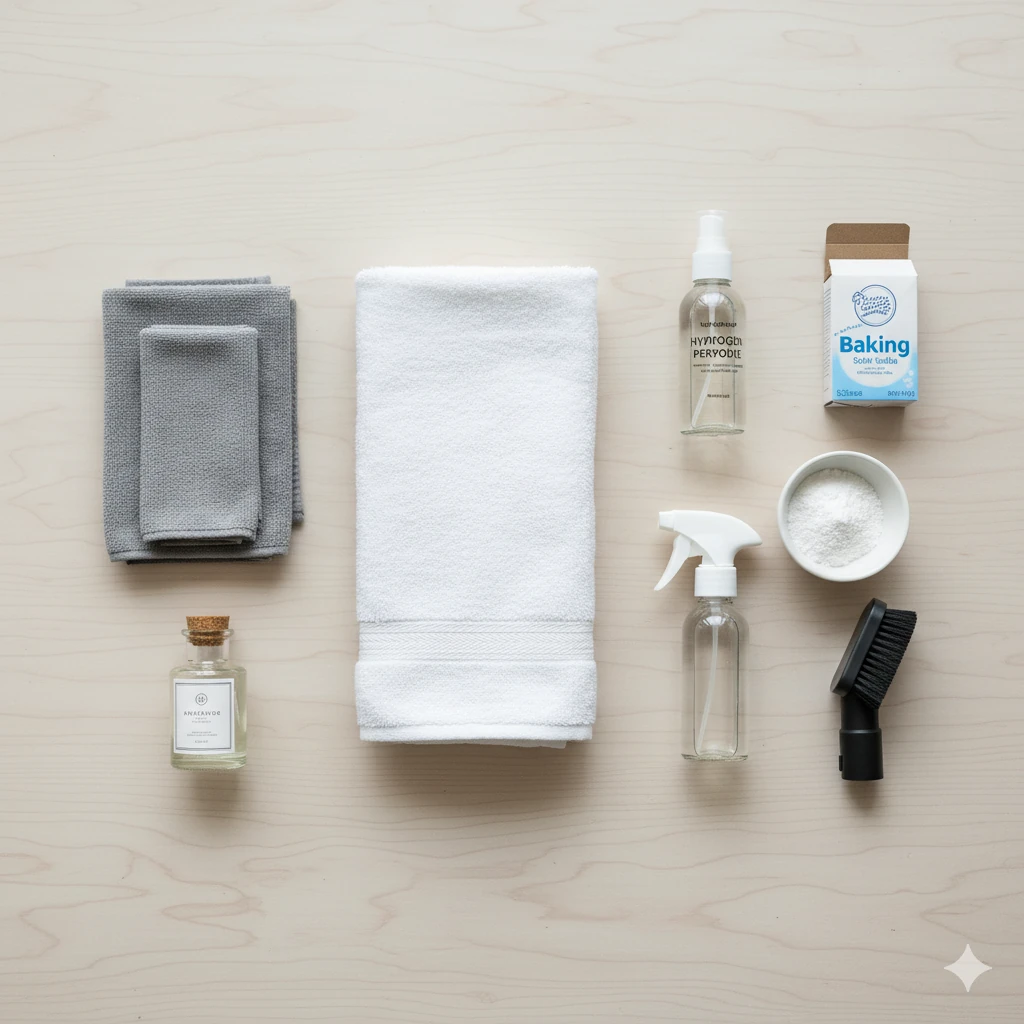
essential safe tools for how to clean a mattress without damaging foam featuring clean mattress

The Five-Step Deep Clean

1. Strip the bed and check the label

Remove everything, including the protector, and wash it on the warmest setting the care labels allow. Read the mattress law tag or care instructions first — many makers warn against saturating the cover, and some warranties exclude damage from soaking or steam.

2. Vacuum slowly

Use the upholstery head in slow, overlapping passes across the top and sides, then switch to the crevice tool for seams, piping and tufts. Go over the surface twice, once lengthways and once across. Vacuuming first matters: dust and crumbs smear into a muddy mess once they get wet.

3. Spot-treat the stains

Match the remedy to the stain (see the next section), mist lightly rather than pouring, and blot from the outside of the stain inward so you don’t spread it. Repeat in short rounds, letting the area dry between attempts, instead of drenching the spot once.

4. Deodorise

Sift a thin, even layer of baking soda over the surface and leave it for a few hours, or overnight for stronger smells, then vacuum it up with slow passes. Baking soda is cheap, gentle and genuinely absorbs moisture, though controlled evidence for how much odour it pulls out of a thick mattress is thin — treat it as a helpful finishing step, not a miracle. Keep the layer light so powder doesn’t pack into the seams, and add essential oils only to the baking soda in a bowl first, never directly to the mattress.

5. Dry it completely

This is the step people skip, and it’s the one that causes problems. The US EPA notes that when damp materials are dried within 24 to 48 hours, mould usually won’t grow. Aim a fan across the surface, open the windows, and run a dehumidifier if your room is humid. Press a dry white cloth into the treated area before you remake the bed — if it comes away damp, keep drying.

Stain-by-Stain Instructions

Stain First move Treatment
Sweat / yellowing Vacuum, then mist with cool water Cool water plus a drop of dish soap; dab 3% peroxide only if needed
Blood Cold water only — never hot Cold water and soap, then an enzyme cleaner
Urine / vomit Blot hard with towels Enzyme cleaner, then a light vinegar-water mist
Wine, coffee, tea Blot, then absorb with salt or baking soda Cool water and dish soap; diluted peroxide as a last resort
Musty / mildew smell Dry the mattress out completely Airflow, low humidity, baking soda; replace if mould is visible

Sweat and yellow discolouration

Yellowing is usually oxidised sweat and body oil, and it’s the hardest mark to remove completely because it has built up over months. Start mild: a few drops of unscented dish soap in cool water, misted on and blotted off, then blotted again with a cloth dampened in plain water. If the shadow remains, dampen a cloth with 3% hydrogen peroxide and touch it to the fabric only. Peroxide is a mild bleach and can lighten dyed covers, so patch-test somewhere hidden and expect improvement rather than perfection. If night sweats are the root cause, the fix is upstream — see our guide to the best cooling mattresses for hot sleepers.

Blood

Cold water only. Heat cooks the protein into the fibres and makes the mark permanent; K-State Research and Extension advises soaking fresh blood in cold water and specifically warns that hot water sets it, and notes that older stains often respond to an enzyme product. So: blot with a cloth dampened in cold water and a little unscented soap, changing to a clean part of the cloth each time. For dried blood, mist an enzyme cleaner on, wait the time stated on the label, then blot until nothing more transfers. Only after that should you consider a dab of diluted peroxide.

How to clean stains out of mattress from blood spills

Urine and pet accidents

Urine is a protein stain with an odour problem attached, so the sequence is blot hard, apply an enzyme cleaner made for biological stains, blot again, and dry fully before judging the result. Because dried and repeat accidents need a different approach — and memory foam needs extra care — we’ve put the full method in a dedicated guide: how to get urine out of a mattress, including foam, spring and pet accidents.

Vomit

Wear gloves, lift off the solids with a stiff card or paper towels, and dispose of them. Treat the remaining mark like urine: enzyme cleaner first, then a light mist of one part white vinegar to one part water to help with the residual smell, blotting between rounds. Finish with baking soda once the spot is dry to the touch.

Red wine, coffee and tea

These are tannin stains, and speed matters more than any product. Blot up the liquid straight away, then sprinkle salt or baking soda over the damp patch to pull out more moisture and pigment; vacuum it off once it dries. Follow with cool water and a drop of dish soap, blotting until colour stops lifting. Diluted peroxide can fade what’s left of a red wine mark, but patch-test first — on a dark or printed cover it may trade a purple stain for a pale one.

Steps to clean stains out of mattress after wine spill

Musty smells and mildew

A musty smell means moisture is still in there. Strip the bed, get air moving across both sides, bring the room’s humidity down, and give it a day or two. If you can see fuzzy or black mould growth rather than just a stain, the honest answer is that porous foam and fibre fill can’t be reliably cleaned out at home, and replacement is usually the safer call. A brand-new mattress that simply smells of chemicals is a different issue — that’s covered in our guide to reducing mattress off-gassing.

Memory Foam and Other Materials

Foam is the fussiest surface to clean because it holds water and dries slowly from the inside out. The rules that change:

  • Memory foam and latex: mist, never pour. Use the smallest amount of liquid that works, and allow a full day of airflow before remaking the bed. Skip steam cleaners — heat and moisture can affect adhesives and take a long time to leave the core.
  • Hybrids: treat the comfort layers like foam, even though there are springs underneath.
  • Innerspring: more forgiving of light misting and faster to dry, but the same blot-don’t-scrub rule applies.

If you’re weighing up materials for your next bed, our comparison of memory foam versus spring mattresses covers how each behaves day to day.

Prevention Beats Stain Removal

  • Use a waterproof, breathable protector. It’s the single change that makes every future spill a laundry problem instead of a mattress problem. For allergy households, a full zip-around encasement is the version worth buying.
  • Wash bedding weekly and hot. The Asthma and Allergy Foundation of America recommends washing bedding at 130 Â°F or above to kill dust mites.
  • Vacuum the mattress monthly and wash the protector along with your sheets.
  • Rotate every three to six months — head to foot — and flip only if your mattress is designed to be two-sided.
  • Keep humidity in check and let the bare mattress breathe for an hour on laundry day.
  • Keep food and, ideally, pets off the bed. Crumbs attract pests; dander works its way deep into the fibres.
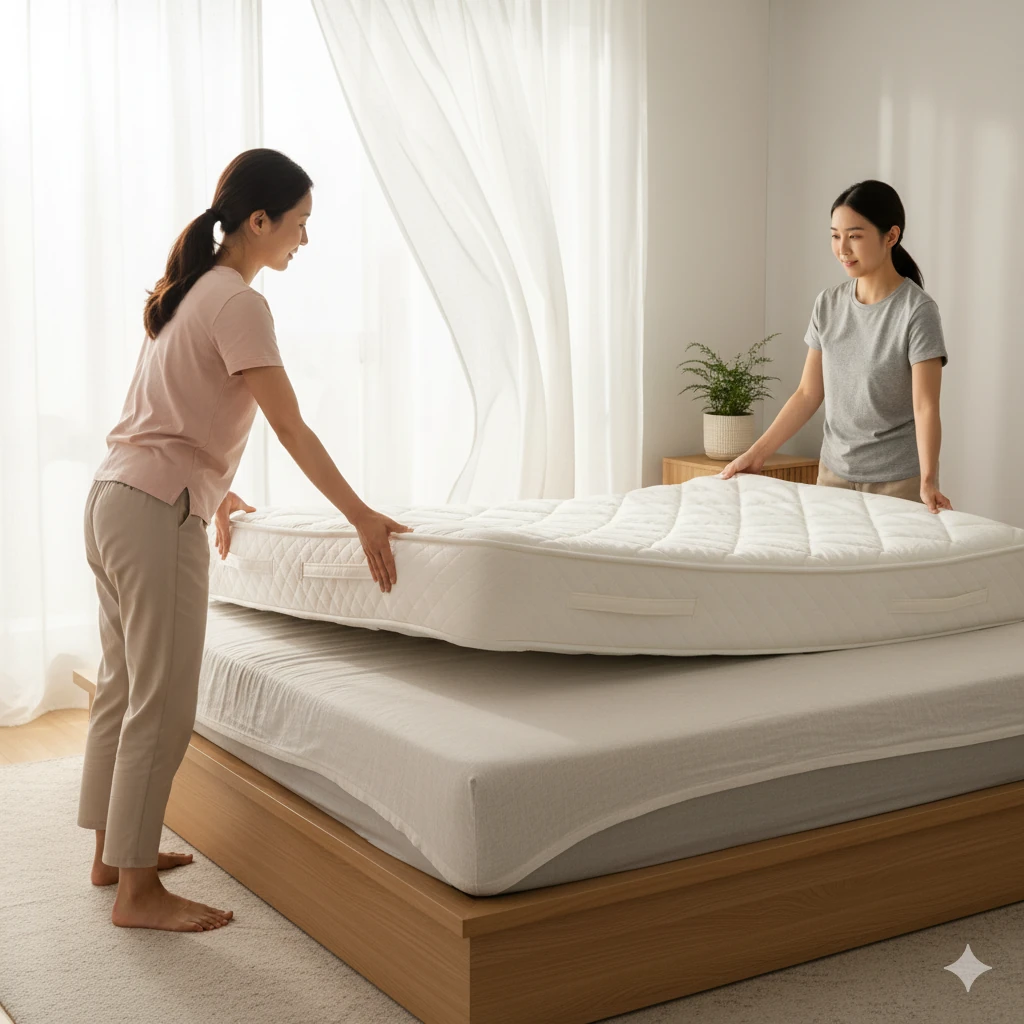

simple routines that support how to clean a mattress and keep it fresh longer - clean mattress

Routine steps to clean stains out of mattress and extend life

Safety Notes

  • Never mix cleaning products. The CDC is blunt about it: don’t mix bleach with ammonia or any other cleaner. Ventilate the room while you work.
  • Skip chlorine bleach on mattresses entirely — it damages fabric and the smell lingers.
  • Patch-test every solution in a hidden spot and wait for it to dry before treating a visible area.
  • Wear gloves for any biological mess.

When Cleaning Isn’t the Answer

Stop cleaning and start shopping if you see visible mould, if odours come back after two full treatment-and-dry cycles, or if there are deep body impressions that leave you waking up sore. The AAFA suggests replacing mattresses roughly every ten years in the context of dust mite control, though the right timing depends on the bed and the sleeper — our guide on how often you should replace a mattress walks through the signs.

FAQ

How often should I clean my mattress?

Vacuum monthly, spot-clean spills the moment they happen, and do a full strip-vacuum-deodorise-dry refresh every six months. Every three to four months is reasonable if you have pets, allergies or night sweats.

Can I use a steam cleaner on a mattress?

It isn’t recommended for foam or hybrid beds. The moisture is difficult to dry out of a thick foam core, and many manufacturers warn against it. Stick to low-moisture methods and fast drying.

Will hydrogen peroxide damage my mattress?

It can lighten dyed fabric. Use 3% only, apply it to a cloth rather than spraying the mattress, patch-test in a hidden spot, blot with clean water afterwards and dry quickly.

Is baking soda safe on memory foam?

Yes — it’s a dry powder, so it doesn’t add moisture. Use a light layer, leave it a few hours, and vacuum thoroughly so powder doesn’t collect in the seams.

Does putting a mattress in the sun disinfect it?

Sun and moving air are excellent for drying a mattress out, which is the main goal. Claims that household sunlight sterilises a mattress or kills dust mites inside it aren’t well supported, so treat sunning as a drying method rather than a disinfection one.

Can I still get a set-in stain out?

Sometimes, and rarely completely. Old protein stains often lighten after two or three enzyme treatments with full drying in between; old yellowing usually fades rather than disappears. Once a mark is clean and odour-free, a protector hides the rest.

Updated September 2026.

How to Get Urine Out of a Mattress: Foam, Spring & Pets

Clean Urine Mattress Apple Cider Vinegar

How to Get Urine Out of a Mattress (Fresh, Dried, Pet and Foam)

Short answer: Blot up as much liquid as you can without rubbing, lightly mist the spot with a 1:1 mix of white vinegar and cool water, blot again, then cover the damp area with baking soda and leave it for several hours before vacuuming or brushing it away. Finish by drying the mattress completely with airflow before you put sheets back on. For pet urine or stains that have already dried, add an enzymatic cleaner made for urine — that is the step that removes the smell rather than masking it.

Apple cider vinegar can be used in a pinch, but it is not the magic ingredient some recipes suggest. Vinegar works because of its acetic acid, and apple cider vinegar is tinted and contains sugars, so plain distilled white vinegar is the safer, cheaper choice on a light-coloured mattress cover. Everything below works the same way with either bottle — just use white vinegar if you have it.

What you need

  • Paper towels or clean white cloths (coloured cloths can transfer dye)
  • Spray bottle with 1 part white vinegar to 1 part cool water
  • Baking soda (a fresh box absorbs better than an open one from the back of the cupboard)
  • A few drops of mild dish detergent — optional, for visible yellowing
  • An enzymatic cleaner labelled for urine odour (essential for pets and old stains)
  • Vacuum with an upholstery attachment, or a stiff brush and dustpan
  • A fan and an open window or two

If you shop for a spray cleaner rather than mixing your own, the US EPA’s Safer Choice program lists products screened for safer chemical ingredients, which is a useful filter for anything you spray on a surface you sleep on.

Fresh accident: the six-step cleanup

  1. Strip the bed immediately. Sheets, protector, mattress pad, pillows if they were hit. Start a wash on the warmest cycle the care labels allow so urine does not set in the fabric.
  2. Blot, never rub. Press firmly with towels and work from the outside of the wet patch inward. Rubbing spreads the stain sideways and pushes liquid deeper into the comfort layers. Swap towels as soon as they feel damp.
  3. Mist the vinegar solution. Dampen the area, do not soak it. Excess liquid is the single biggest mistake with foam mattresses because it takes days to leave the core. Let it sit 10–15 minutes.
  4. Blot again with fresh towels. Keep pressing until very little moisture transfers.
  5. Cover with baking soda. An even layer over the still-damp spot pulls out remaining moisture and helps absorb odour. Leave it several hours, or overnight if you can sleep elsewhere.
  6. Remove the powder and dry. Vacuum slowly with the upholstery tool, then run a fan across the surface until the spot is dry to the touch and smells of nothing.

One chemistry note worth knowing: vinegar and baking soda largely cancel each other out if you mix them in a bowl first. Use them in sequence — acid first, absorbent powder second — rather than combining them into a fizzing paste.

Baking soda layered on a damp spot, a key step in how to get urine out of a mattress

Dried or set-in stains

Dried urine leaves behind salts and residues that need to be re-wetted before anything can lift them, so plan for two passes over two days.

  1. Find the full extent of the stain in good light — yellow-brown rings often reach further than they first appear, and darker centres usually mean the spot was hit more than once.
  2. Dab the area with the vinegar solution (add a drop of mild detergent if there is visible yellowing) until the residue softens.
  3. Lay a sheet of plastic wrap over the damp patch for an hour or two so it does not dry out too fast. This is the trick that makes old stains respond.
  4. Remove the wrap, blot hard, then apply an enzymatic cleaner per its label. Enzyme formulas break down the organic compounds that hold odour, which vinegar alone does not fully do.
  5. Finish with baking soda, vacuum, and dry thoroughly. Repeat the enzyme step once more if a faint smell returns as the area dries — odour reappearing on drying is the classic sign of untreated residue deeper down.

For non-urine marks such as sweat, blood or drink spills, the approach differs slightly; see our guide to cleaning stains out of a mattress.

No baking soda? No vacuum? Do this instead

Neither one is mandatory.

  • Without baking soda: use the vinegar solution followed by an enzymatic cleaner, blotting between steps, then dry hard with a fan. Enzymes are the real odour remover; baking soda is a moisture and smell absorber, not a cleaner.
  • Without a vacuum: let the baking soda dry completely, then sweep it off with a stiff brush and dustpan, or brush it toward the edge of the mattress onto a towel. Never brush damp powder — it smears and hardens.
  • Cornstarch or unscented cat litter in a breathable cloth pouch laid on the dry spot can absorb residual odour if you have no baking soda at all. Evidence here is anecdotal rather than tested, so treat it as a stopgap.

Hydrogen peroxide: useful, but with limits

For old, yellowed stains on an innerspring, hybrid or pillow-top mattress, a peroxide mix can lighten discolouration that vinegar leaves behind: 1 cup of 3% hydrogen peroxide, a few tablespoons of baking soda and one drop of dish soap. Apply lightly, let it dry, then brush or vacuum the residue away.

Three cautions. Peroxide has a mild bleaching effect, so always spot-test on a hidden area — near the bottom edge or under the handle seam — and skip it on dark or patterned covers. Avoid it on memory foam and latex, where over-wetting matters more than stain colour. And never combine cleaning chemicals in the hope of a stronger result: mixing bleach with acids like vinegar, or with ammonia-based cleaners, can release toxic gases, as the Washington State Department of Health explains. Use one product, rinse-blot, dry, then try another if needed.

Mattress type changes the method

Mattress type Best approach Avoid
Memory foam Fine mist of vinegar solution, enzyme cleaner, long drying time with a fan Soaking, peroxide, high heat, hair dryers on hot
Latex Light blotting and minimal moisture; dries slowly Saturation and prolonged direct sun, which degrades latex
Innerspring Vinegar solution, baking soda, peroxide mix on light covers after a spot test Letting liquid run down into the coil layer
Hybrid / poly foam Enzyme cleaner plus airflow that reaches the comfort layer Over-wetting the quilted top
Pillow-top Spot treat only; the extra padding holds moisture Peroxide on the quilted panel without testing

Foam holds water far longer than coils do, which is why every foam instruction above says “mist, don’t soak.” If you are weighing up a replacement and want to understand the difference in construction, our comparison of memory foam and spring mattresses covers how the layers are built.

Dog and cat accidents

Pet urine is usually more concentrated than human urine and tends to recur in the same spot, because animals are drawn back to a scent they can still detect even when you cannot. That makes enzymatic cleaners the priority rather than the backup step. Saturate the affected area per the label, cover it loosely so it does not evaporate before it finishes working, then blot and dry. Expect to repeat on a set-in spot.

Two specifics for pets: skip any cleaner containing ammonia, since urine itself smells of ammonia and can re-mark the area in your pet’s mind — guidance echoed by Humane World for Animals. And if house-soiling is new, frequent or accompanied by straining, book a vet visit; urinary tract infections, bladder stones, diabetes and kidney disease all show up this way before they show up anywhere else.

An enzymatic cleaner bottle beside towels shows how to clean urine memory foam mattress when stains are already set.

Drying: the step people rush

A mattress that feels dry on the surface can still be damp two inches down, and trapped moisture is what causes musty smells and mildew later. Give a lightly treated spot a few hours with a fan aimed across it; give a saturated spot the rest of the day and overnight. Stand the mattress on edge if you can, so air reaches both faces. Room-temperature airflow beats heat: high heat can stress foam and adhesives, and prolonged direct sunlight fades and degrades foam and latex. A short airing in indirect light is fine; leaving a foam mattress baking on a patio is not.

Mistakes to avoid

  • Rubbing instead of blotting — it drives urine deeper and widens the stain.
  • Pouring liquid on rather than misting it.
  • Using bleach, which can damage covers and foam and leaves its own harsh smell.
  • Vacuuming damp baking soda, which clogs the powder into the fabric and your filter.
  • Remaking the bed before the spot is bone dry.
  • Skipping a spot test with peroxide or an unfamiliar spray.

Preventing the next one

A waterproof mattress protector is the only prevention step that works every time. Choose one with a breathable knit or Tencel top over a thin polyurethane barrier rather than a crinkly plastic sheet, check the pocket depth against your mattress, and wash it on the schedule the label sets so the barrier survives. Keeping a spare fitted sheet and a washable pad in the room turns a 2 a.m. accident into a five-minute job.

For children, a bathroom trip at bedtime and less fluid in the last hour help, and waterproof layers take the pressure off everyone. Bedwetting is common in young children and usually resolves on its own, but the National Kidney Foundation advises talking to a doctor when it continues in older children or starts again after a dry period, since it can have a treatable medical cause. If you are buying for a child’s room, our notes on choosing a toddler mattress cover wipeable, breathable options.

When to call a pro — or replace the mattress

Consider professional upholstery cleaning if the accident was large, repeated in the same place, or is on a mattress you cannot move outdoors. Ask specifically whether they use enzyme treatments and low-moisture extraction that is safe for foam. Replacement is worth considering if odour survives several enzyme treatments and full drying, if the core feels permanently damp, or if you see mould growth — none of which home cleaning reliably fixes. Age matters too; if the bed was already sagging, see how often you should replace a mattress before spending money on cleaning.

FAQ

Does apple cider vinegar work as well as white vinegar? Chemically it acts the same way, since both rely on acetic acid. White distilled vinegar is preferred because it is colourless and contains no sugars that could leave residue.

Will vinegar alone get rid of the smell? Often on a fresh accident, yes. On dried or pet urine, no — you need an enzymatic cleaner to break down what is left behind.

How long before I can sleep on it? Until it is fully dry to the touch with no damp coolness and no smell. With a fan, a small treated spot is usually ready the same day; a soaked area may need overnight.

Can I mix vinegar and hydrogen peroxide? Don’t. Use them as separate treatments with drying in between, and never mix either with bleach or ammonia-based products.

Do essential oils help? They add scent, not cleaning power, and heavy use can irritate sensitive skin or airways. If you use them, a drop or two in the vinegar mix after the mattress is clean is plenty.

Is a UV flashlight useful for finding old spots? It can make dried urine easier to see in a dark room, which helps you treat the whole area rather than just the visible ring. It is a locating tool, not a cleaning one.

Updated September 2026.