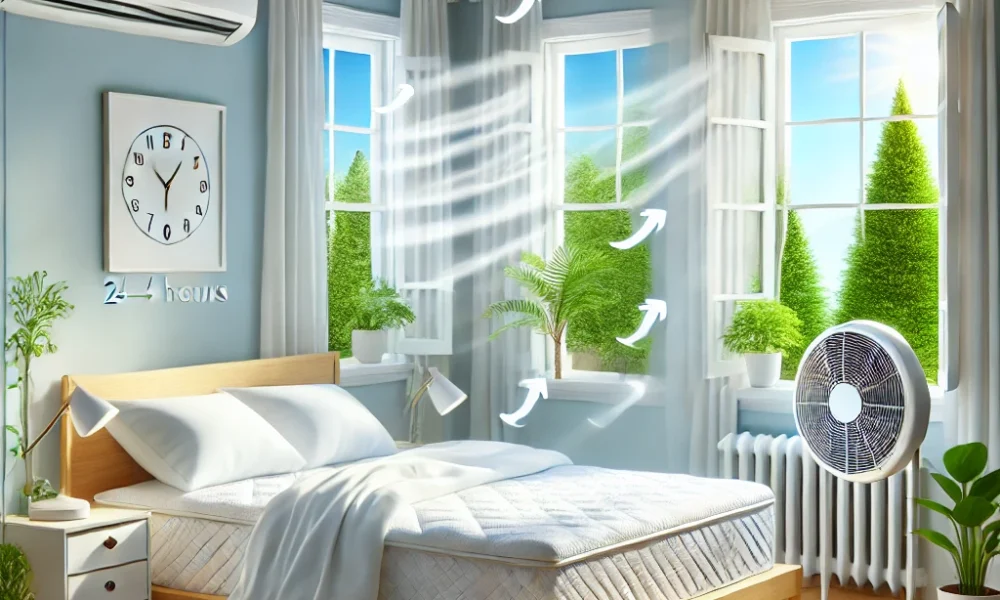
Most mattress off-gassing fades in three to seven days, and you can speed it up by unwrapping the bed in a well-ventilated room, pointing a fan across it, and leaving it bare and unslept-on for the first 24 to 48 hours. That “new mattress smell” comes from volatile organic compounds (VOCs) released by foams, glues and the plastic shipping wrap. It’s strongest with memory foam in a box and mildest with innersprings, wool and untreated cotton.
What causes mattress off-gassing
Polyurethane and memory foam are petrochemical products. Traces of leftover solvents, blowing agents and adhesives stay trapped in the foam cells, then drift out as gas once the mattress is unwrapped and expands. Compression-packing makes it worse: months of pressure inside an airtight bag means everything escapes at once when you cut the plastic.
VOCs aren’t unique to beds. Paint, new carpet, particleboard furniture and cleaning sprays all release them, which is why the EPA puts indoor VOC levels at up to ten times higher than outdoors. A new mattress just adds one more source to a room you spend eight hours a night in.

Which materials smell the most
| Material |
What the smell is like |
Typical fade time |
| Memory foam (boxed) |
Sharp, chemical, plasticky |
3–7 days, faint traces up to 2 weeks |
| Polyfoam comfort layers |
Milder chemical smell |
2–5 days |
| Synthetic (Dunlop/Talalay blend) latex |
Rubbery, slightly sweet |
2–7 days |
| Natural latex |
Vanilla-ish rubber, less harsh |
A few days, often lingers faintly |
| Innerspring with cotton or wool |
Faint, often just “packaging” |
1–2 days |
Hybrids land wherever their foam layers put them. Four inches of memory foam on top smells much like an all-foam bed; an inch of latex under a wool pad barely registers. The comfort layer matters far more than the coils underneath, and our rundown of the seven main mattress types shows what’s inside each build.
How long does mattress off-gassing last?
The strong phase is short: sharpest in the first 24 hours after unwrapping, way down by day three, close to nothing by the end of week one. A faint smell you notice only with your face against the bare foam can hang on for a month, and that’s normal.
Three things stretch it out:
- A sealed room. With no airflow the gases just sit there, and a closed bedroom can still smell strong on day five.
- Thick foam. A 12-inch all-foam bed holds more material than a 10-inch hybrid and takes longer to clear.
- Early covers. A vinyl-backed protector on day one traps the gases inside the foam.
One useful detail from research: emissions climb as a mattress warms. University of Toronto researchers testing children’s mattresses in 2025 simulated a sleeping child’s body heat and weight and saw chemical emissions rise substantially. Heat is a lever you can pull either way — warm the room to flush the smell out while the bed is empty, or keep it cool if you must sleep on it tonight.
Is mattress off-gassing dangerous?
For most healthy adults it’s an annoyance, not a hazard. Short-term VOC exposure at household levels is linked to headaches, watery eyes, throat irritation, nausea and dizziness — symptoms that fade once the source is gone or the room is aired out.
Take it more seriously if:
- Someone has asthma, chemical sensitivity or bad seasonal allergies.
- The bed is for an infant, toddler or pregnant sleeper.
- The bedroom is small, has one window or no real ventilation.
That same University of Toronto work, published in Environmental Science & Technology, matters most for kids’ beds: the team detected phthalates, organophosphate flame retardants and UV filters in new children’s mattresses and in bedroom air. Those are semi-volatile compounds. They don’t evaporate off like the new-foam smell, so airing out won’t fix them — that’s a materials and certification question.

How to clear the smell faster, step by step
1. Pick the unboxing room before the truck arrives
A garage, spare room or covered porch beats the bedroom when the weather is dry and mild. Keep the mattress off damp concrete and out of direct sun. If the bedroom is your only option, strip the bedding first so sheets and pillows don’t soak up the odor.
2. Unwrap immediately and give it room
Cut the plastic the day it arrives and pull off every scrap, inner sleeve included. Leave a foot of clearance on all sides, and stand a boxed foam mattress on its edge for the first hour so both faces breathe. No protector, no sheets yet.
3. Set up real cross-ventilation, not just an open window
One open window moves almost no air. Open a second window or the door opposite it, then put a box fan in one window facing out to pull air through. Run it four to six hours at a stretch over the first two days. If it’s raining or freezing, aim a fan at the mattress and crack a window for 15 minutes every couple of hours.
4. Warm the room while you’re not in it
VOCs come out faster in heat. If the mattress is in an empty spare room, let it get warm — 75 to 80°F — with a fan running and a window cracked, so you’re driving the release and venting it at the same time. Don’t do this in a sealed room you’ll sleep in that night.
5. Use baking soda for odor, and know its limits
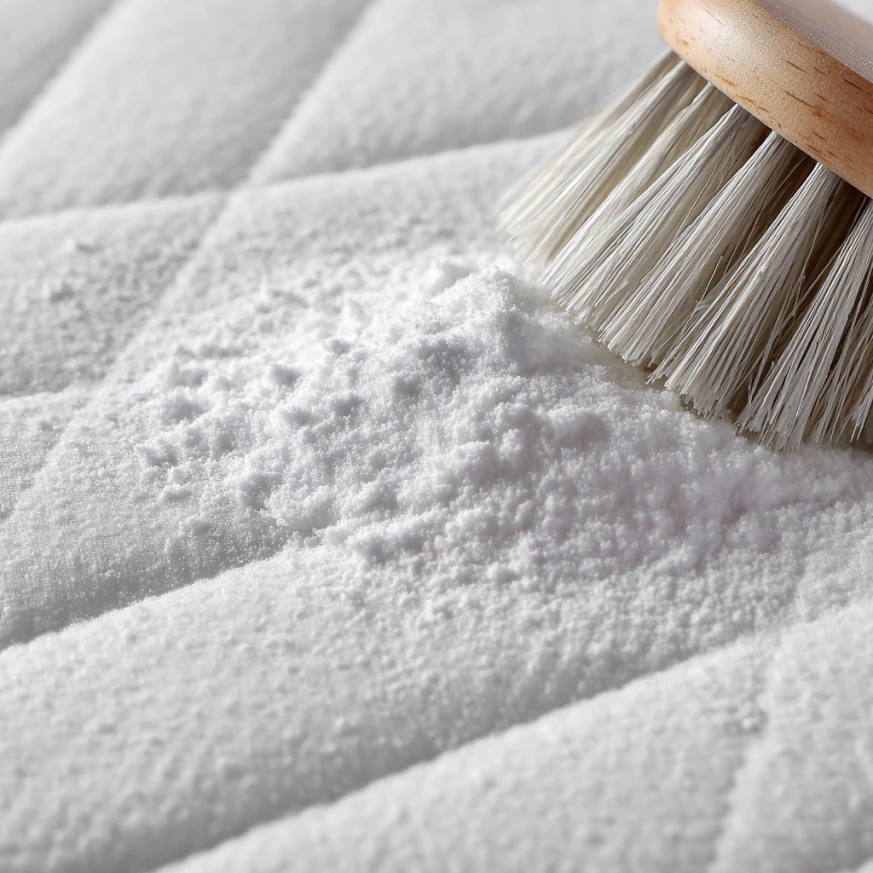
Baking soda absorbs surface odor. It won’t pull gases from the middle of a 12-inch foam core, so treat it as a finishing step, not the main fix.
- Sift a thin, even layer over the bare top surface — about a cup for a queen.
- Leave it 4 to 8 hours, longer if the room is dry.
- Vacuum it all off with an upholstery attachment, going slowly in overlapping passes.
- Repeat once if needed. Never add water, vinegar or essential oils — moisture in foam invites mildew and can void a warranty.
6. Filter the air with the right kind of filter
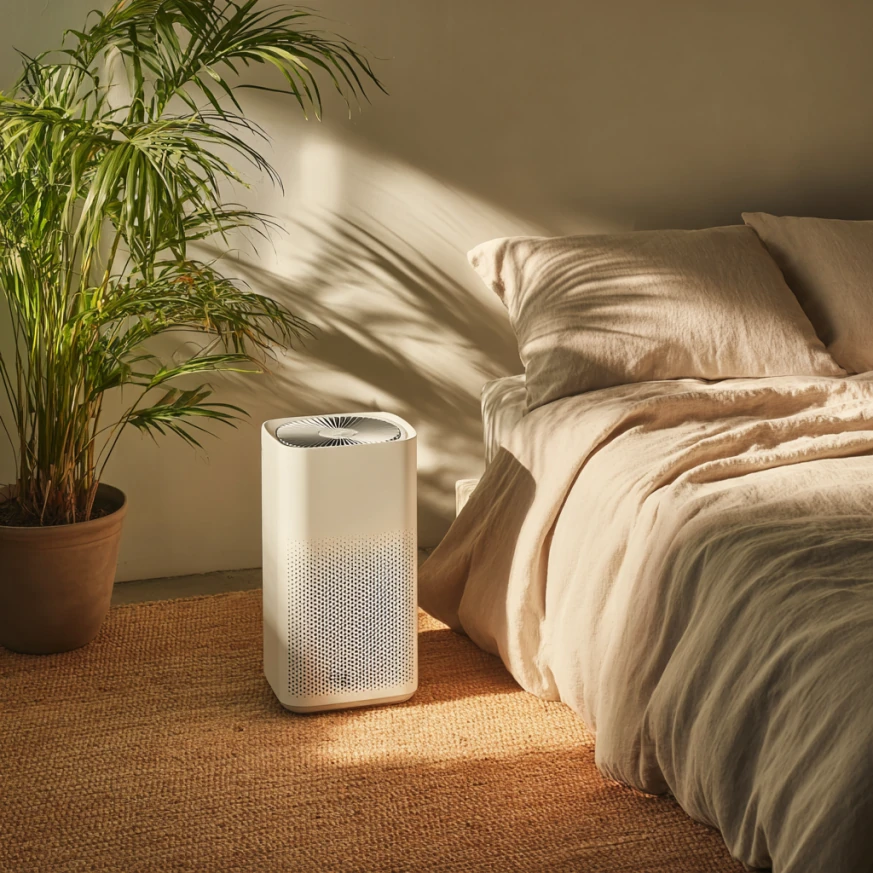
Here’s where a lot of advice goes wrong. HEPA catches particles — dust, dander, pollen. VOCs are gases and sail straight through. To capture them you need a real bed of activated carbon, not a thin carbon-dusted pre-filter. Look for a unit that lists carbon weight in pounds and covers your room size.
Houseplants don’t replace ventilation either. A 2019 Drexel University review of decades of studies found normal air exchange clears VOCs far faster than potted plants can. Keep the peace lily because you like it, not as an air-quality plan.
7. Wait to dress the bed
Sheets go on after 48 hours, once the smell is mostly gone. Only wash the mattress cover if the maker says it’s removable and washable — many aren’t. Pick a breathable cotton or Tencel protector over a vinyl one; it still handles spills without sealing the foam in plastic.
What to check before you buy a low-odor mattress
Prevention beats airing out, and certifications are the only practical way to compare — no brand will volunteer that its foam stinks.
| Certification |
What it covers |
Worth knowing |
| CertiPUR-US |
Polyurethane foam only |
Foam is chamber-tested to ISO methods after 72 hours of conditioning, must come in under 0.5 ppm total VOCs, and is screened for certain flame retardants and heavy metals. |
| UL GREENGUARD Gold |
The finished product’s emissions |
Limits more than 360 VOCs and requires compliance with California Section 01350 — the stricter tier, aimed at nurseries and schools. |
| GOTS |
Organic cotton and wool content |
A fiber and processing standard, not an emissions test. |
| GOLS |
Organic latex content |
Same idea for latex; says nothing about covers or adhesives. |
| OEKO-TEX Standard 100 |
Textiles and components |
Screens fabrics for harmful substances; check which parts are listed. |
Read the scope. “Made with CertiPUR-US certified foam” covers the foam, not the cover, adhesives or fire barrier. GREENGUARD Gold tests what the assembled mattress emits into a room.
Beyond labels, a few buying habits cut odor down:
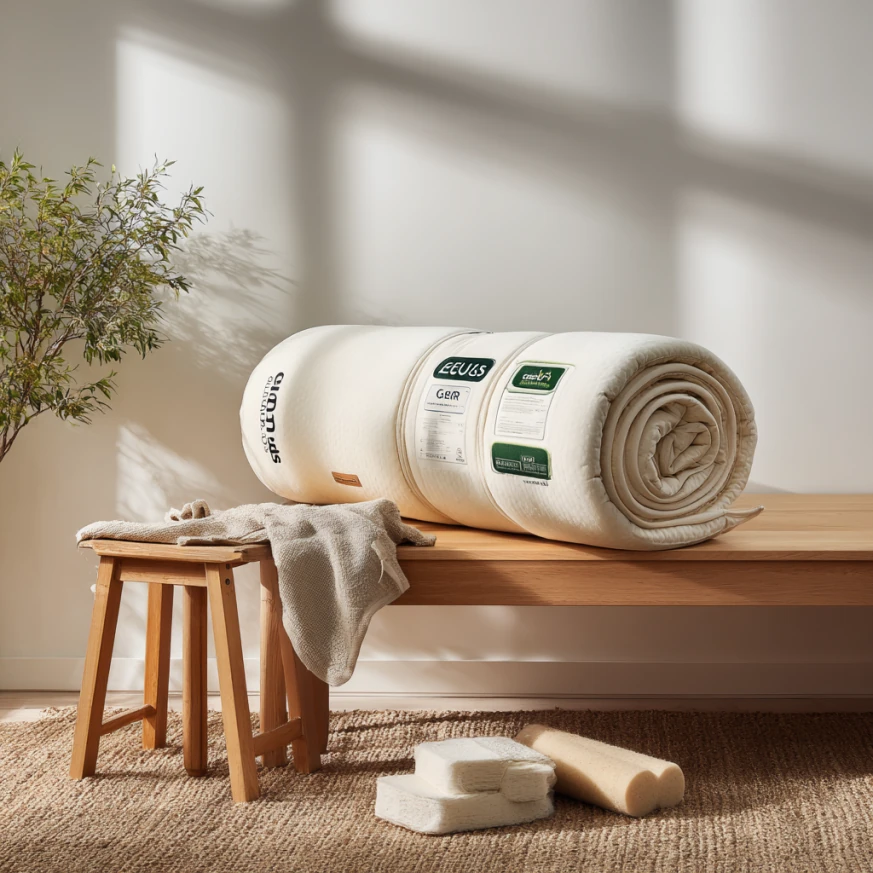
- Ask how it ships. Flat-packed, or roll-packed and shipped within a week of manufacture, usually smells less than one compressed in a warehouse for months.
- Ask what the fire barrier is. Wool or a fiberglass-free rayon/silica barrier avoids sprayed treatments, and it’s worth asking about fiberglass anyway — it’s a separate headache if the cover gets unzipped.
- Favor wool, cotton and natural latex comfort layers if anyone at home is sensitive.
- Smell the floor model in a store when you can, especially with latex.
If you’re still narrowing down builds, our guides to choosing a mattress for your sleep style and eco-friendly sleep setups both cover material trade-offs in more detail, and timing matters too — see the best time of year to buy a mattress if you can wait for a sale window.
When the smell isn’t normal off-gassing
Call the company if any of this shows up:
- A strong odor still there after four weeks of a ventilated room.
- A musty or sour smell rather than a chemical one, which points to moisture in the foam.
- A fishy or burnt-plastic smell, which isn’t typical of new foam.
- Headaches, coughing or a scratchy throat that clear when you sleep elsewhere.
Many boxed brands run sleep trials of 100 nights or more, and odor complaints inside that window are usually handled as a return or replacement. Document it early: note the delivery date, photograph the law tag, and email instead of calling so there’s a record. Persistent symptoms deserve a word with your doctor, and a strange smell in a bed you’ve had for years may just mean it’s worn out — how your mattress affects sleep quality covers the other warning signs.

Mattress off-gassing FAQ
Can I sleep on a new mattress the same night?
Usually yes, and most people do. Give it 24 hours with a fan and an open window and that first night is far more pleasant. Anyone with asthma or a strong reaction to smells should wait the full 48 to 72 hours.
Do all mattresses off-gas?
Everything emits something, wool and cotton included. The difference is how much and how harsh: foam-heavy beds emit the most, innersprings with natural fiber padding the least.
Does an organic mattress skip this entirely?
No. Natural latex and wool smell milder and different, and organic-fiber standards limit chemical treatments, but a latex bed can still smell rubbery for a week.
Will spraying fabric refresher help?
It masks the odor and adds VOCs of its own. Skip it — airflow, time and a baking soda pass do more.
Does sunlight help?
Fresh air does the work, not UV. Direct sun yellows and degrades foam, so air it out in bright shade or indoors with a fan rather than dragging it onto the lawn.
Updated September 2026.