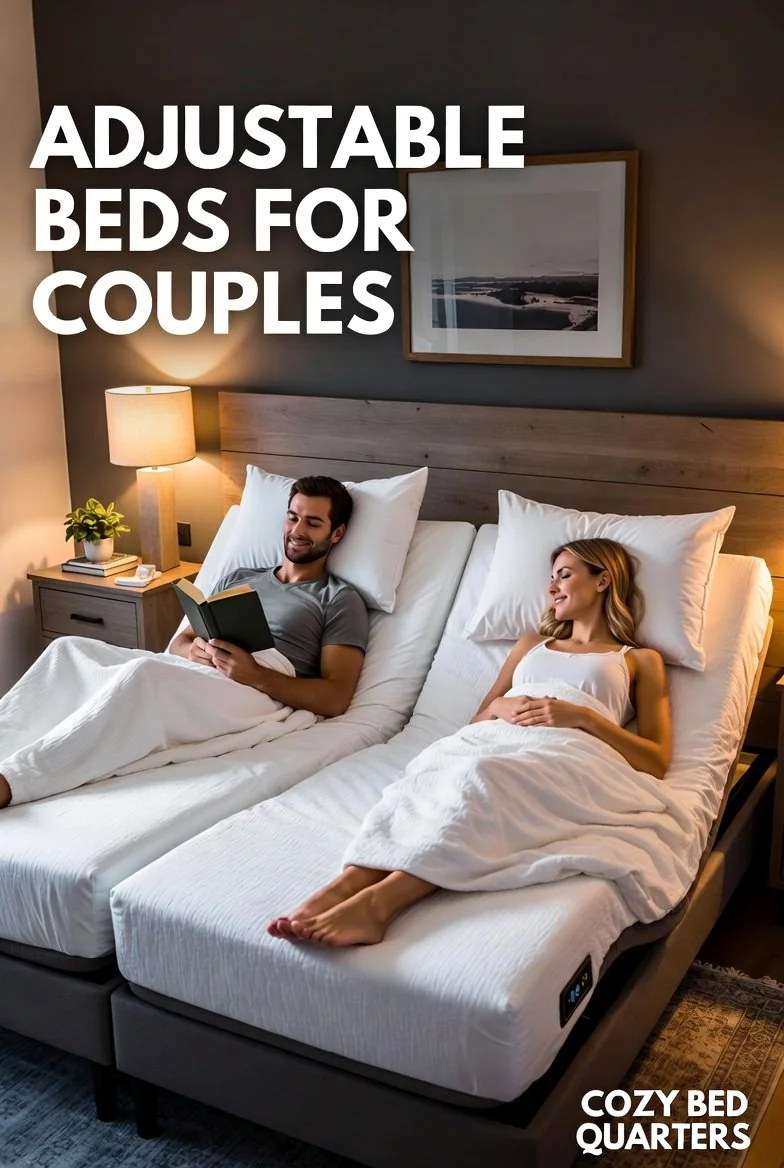
Adjustable beds for couples are worth it if one of you sleeps better propped up and the other doesn’t — a split base lets each side move independently, so nobody has to compromise. They’re a poor use of money if you both sleep flat and comfortably already, because you’re paying several hundred to a few thousand dollars for motors you won’t use. The decision usually comes down to three things: snoring or reflux, sizing (split versus one piece), and whether your mattress can bend.
What an adjustable bed actually does
An adjustable base is a motorized foundation that raises the head section, the foot section, or both. Your mattress sits on top and bends with it. Instead of one fixed angle for two people, you get a range: sitting upright, a slight head lift for sleeping, legs raised, or a reclined position with both ends up.
It replaces your foundation or box spring, not your mattress. Most bases either stand on their own legs or drop into an existing bed frame, and many come with brackets so you can keep your headboard.
Are adjustable beds for couples worth it? The honest verdict
Adjustable beds for couples earn their keep in a few specific situations:
- One of you snores and the other is a light sleeper. A raised head position is the most common reason couples buy one.
- Nighttime heartburn. Sleeping on an incline is a standard, low-risk thing to try.
- Different bedtimes or routines. One reads or watches something sitting up; the other is flat and asleep by 10.
- Swollen legs, recovery from surgery, pregnancy, or limited mobility. Raising the foot end, or using the head lift to get in and out of bed, is genuinely easier than stacking pillows.
Skip it if you both sleep flat without complaints, if you’re a committed stomach sleeper (bending the bed pushes your lower back the wrong way), or if the budget would be better spent on the mattress itself. A great mattress on a plain frame beats a mediocre mattress on a fancy base every time. Our comparison of what’s actually worth paying for in a king mattress covers where the money does the most good.

Split or one piece? The sizing decision that matters most
This is where couples get tripped up. A single king-size base moves as one unit — if one of you sits up, you both do. Independent control requires two separate bases and two separate mattresses.
- Split king: two twin XL mattresses (38 by 80 inches each) side by side, 76 by 80 inches total — the same footprint as a standard king.
- Split California king: two halves of 36 by 84 inches.
- Split queen: two halves of 30 by 80 inches, useful when a king won’t fit the room.
- One-piece king or queen: cheaper, no seam down the middle, but you share every position.
If you’re still choosing a size, our king vs California king breakdown walks through the dimensions and room clearances. Also measure your ceiling fan and nightstands: when the head section rises, a standard base pushes the sleeper forward and away from the wall unless it has a “wall hugger” design that slides back as it lifts. Leave a few inches behind the bed either way.
Two more split-king realities worth knowing before you commit: you need two twin XL fitted sheets (or a purpose-made split-king sheet set), and there’s a gap down the middle. A foam gap filler and a king-size flat sheet or duvet over the top mostly hide it, but it never fully disappears.
What the health evidence actually says
Adjustable bed marketing tends to promise a lot. Here’s what’s reasonably supported and what isn’t.
Nighttime reflux: the strongest case
Raising the head of the bed is a standard recommendation in the American College of Gastroenterology’s GERD guideline, which notes that several randomized trials found improvement in nocturnal reflux symptoms and acid exposure with head-of-bed elevation or a wedge. The same guideline is candid that evidence for lifestyle changes in general is limited and variable. Gravity keeping stomach acid where it belongs is simple physics, and an adjustable base does it without a pile of pillows sliding out from under you.
Snoring and sleep apnea: promising, not a cure
Sleeping propped up can reduce snoring and apnea events for some people. A small experimental study on head-of-bed elevation found that a 30-degree incline improved sleep apnea measures in participants tested. That’s encouraging, but the studies are small, and an adjustable base is not a replacement for CPAP or a diagnosis. If your partner gasps, chokes, or stops breathing at night, that’s a doctor conversation first and a furniture purchase second.
Swelling and circulation
Raising your legs so they sit above heart level helps fluid drain back out of them, which is why the advice shows up after surgery, long shifts on your feet, and in pregnancy. An adjustable base does it comfortably for a whole night. A modest foot lift won’t do much for a serious vascular problem, so get medical advice for ongoing swelling.
Back pain: thinner evidence than the ads suggest
Plenty of people say a slight head-and-knee lift takes pressure off their lower back, and the position is easy to try. But there’s no strong clinical research showing adjustable bases treat back pain, and anyone claiming otherwise is selling something. Treat pain relief as a possible bonus, not the reason to buy. If a bad mattress is the real culprit, our guide to the best mattresses for couples who toss and turn is the better starting point.
And the relationship angle
Sleeping apart because of a partner’s snoring or restlessness is common — the American Academy of Sleep Medicine’s survey data puts the number of U.S. adults who’ve done it at roughly a third. A split base won’t fix every mismatch, but for couples whose main conflict is “you need to be propped up and I don’t,” it removes the reason to split up the bedroom.
Adjustable base vs a standard platform frame
| Feature |
Adjustable base |
Standard frame |
| Positions |
Head and foot angles, presets |
Flat only |
| Per-partner control |
Yes, with a split size |
No |
| Mattress options |
Foam, latex, hybrid, flexible innerspring |
Any mattress |
| Extras |
Massage, USB, under-bed light, app or remote |
None |
| Cost and weight |
Higher; heavy, and a pain to move |
Lower; easy to move |
| Things that can break |
Motors, remotes, control boxes |
Essentially nothing |
If you want a deeper cost-versus-benefit look before you shop, we’ve covered that separately in are adjustable bed bases worth the investment.
The downsides nobody mentions in the showroom
- Price. Basic bases are a few hundred dollars; split king setups with massage, app control, and wall-hugging run well into four figures. And a split king means buying two mattresses.
- Weight. These are heavy, awkward objects. Moving day is harder, and so is vacuuming under them.
- Motor noise. Quiet isn’t silent. Cheap motors whine, and that matters at 2 a.m. if your partner adjusts their side.
- Sleeping position. Stomach sleepers usually hate any incline. Side sleepers are fine at gentle angles but can feel a pinch at the waist when the head is up steeply.
- Sheets and bedding. Flat bedding slides down an inclined mattress. Deep-pocket sheets with good elastic, or straps, solve it.
- Repairs. Motors, hand controls, and control boxes fail eventually. Warranty coverage is usually tiered — long on the frame, short on the electronics. Read that part.
Are adjustable beds good for sex?
People search this, so let’s answer it plainly. The positioning itself is a plus — being able to raise the head or foot section gives you options a flat bed doesn’t, and it’s easier on backs, hips and knees. The practical catches are the split and the frame. On a split king, two mattresses can shift apart, and the seam runs right down the middle; a connector strap and a gap filler help a lot, and a one-piece king base avoids it entirely if independent control isn’t a must.
Beyond that, look for a sturdy base with a decent weight capacity and legs that don’t wobble, since motorized bases sit on fewer contact points than a solid platform. Retractable or stowable remotes are nice too — flying hand controls are a real thing.
Mattress compatibility: check this before you order
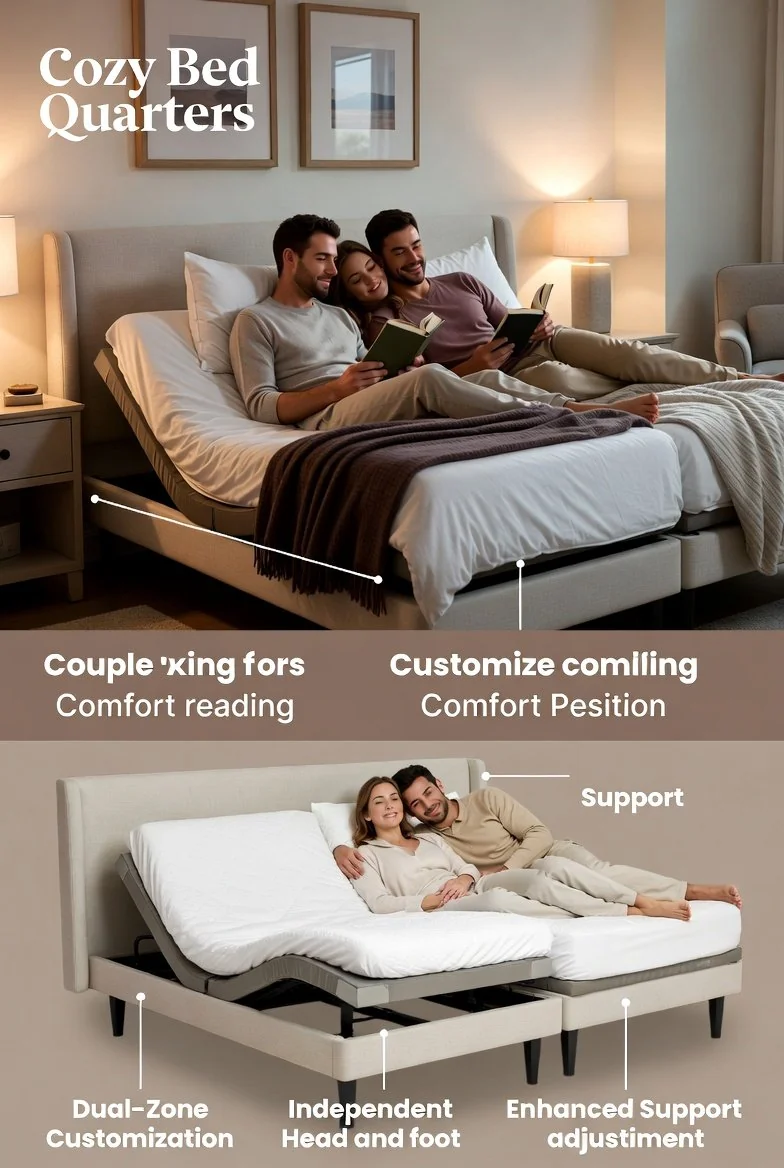
Not every mattress bends. Memory foam, latex, and most hybrids flex fine. Traditional innersprings with rigid connected coils can be damaged by repeated bending, though some spring mattresses are specifically built to be adjustable-friendly — the spec sheet will say so.
Three things to confirm:
- The mattress warranty. Some warranties are voided by use on an unapproved base. Check before, not after.
- Thickness and weight. Very thick or very heavy mattresses can resist the bend and stress the motors. Most bases list a supported range.
- Retainer bar. You need something at the foot to stop the mattress creeping down the incline over time.
Our full adjustable bed mattress compatibility guide goes through construction types one by one. If you like the idea of an incline but not motors, the alternative is tilting the whole bed frame — see beds for inclined bed therapy.
Features worth paying for (and the ones that gather dust)
Actually useful:
- Independent dual controls — the entire point for couples.
- Memory presets — saving “my reading position” and “my sleep position” beats fiddling with buttons nightly.
- Quiet motors — listen to one in person if you can.
- Zero gravity preset — head and knees raised slightly. The name borrows from NASA’s “neutral body posture”, the relaxed shape a body takes in microgravity. It’s a comfortable angle, not a medical treatment.
- Wall-hugger movement — keeps your nightstand within reach.
- Anti-snore preset — a small head lift at the touch of a button, which is all most snoring nudges need.
- Emergency lower / battery backup — so a power cut doesn’t leave you stuck sitting upright.
Nice but rarely decisive: massage motors (pleasant, no strong evidence they improve sleep), under-bed lighting, USB ports, Bluetooth speakers, and app control. Don’t let them drive the price up if a simple remote would do. For king-specific picks and mechanisms, see our roundup of adjustable bed frames for king mattresses.
How to shop for one as a couple
- Name the problem first. Snoring? Reflux? Reading in bed? The problem decides whether you need a split base or a single one.
- Decide split or not. Split costs more and adds a center seam; one piece is cheaper and simpler. Pick honestly.
- Measure the room. Frame footprint, clearance behind the headboard, nightstand height, and the path through your doorways and stairs.
- Check your mattress. Flexibility, thickness, warranty terms.
- Try both sides in a store. Lie down, raise the head, listen to the motor, and see how it feels at the waist.
- Read the warranty tiers and the trial terms. Bases often can’t be returned once assembled, unlike mattresses. Ask before you buy.
- Time it. Base-and-mattress bundles get discounted around major sale weekends; our month-by-month mattress buying calendar shows when.
Bedding that stays put on an incline
Standard sheets fight gravity and lose. Use deep-pocket fitted sheets sized for your mattress depth, with all-around elastic rather than corner-only. For split king, buy two twin XL fitted sheets, then cover both with one king flat sheet, duvet, or comforter so the bed reads as one. Sheet straps or suspenders are cheap insurance. Breathable cotton, linen, or bamboo viscose all work fine — nothing about an adjustable base changes what fabric you should like.
Quick answers
Can we keep our existing headboard?
Usually yes. Most bases include headboard brackets; check the bolt pattern matches yours.
Do we need two mattresses?
Only for a split setup. One-piece king and queen bases take a single mattress but move as one.
Will it help with snoring?
Often it helps, sometimes it doesn’t, and it doesn’t treat sleep apnea. Get the snoring assessed if it’s loud, nightly, or comes with daytime exhaustion.
How long do they last?
The frame typically outlives the electronics. Expect the remote or control box to be the first thing you replace, and buy from a brand that sells spare parts.
Is a cheap base fine?
For a spare room or a light-use setup, yes. For nightly use by two adults, spend enough to get quiet motors, a real weight capacity, and a warranty with named coverage periods.
The short version: if there’s a mismatch in how you two need to sleep, a split adjustable base fixes it more elegantly than a wall of pillows or separate bedrooms. If there’s no mismatch, put the money into the mattress.
Updated September 2026.