The best space saving bedroom furniture does two jobs at once and keeps your walking paths open: a bed with drawers or a lift-up base, a tall shallow wardrobe, a floating nightstand, and wall storage instead of another floor-standing unit. Measure your clearances before you buy anything, because a drawer that can’t open is worse than no drawer at all. Below is how to choose each piece, what to measure, and the safety rules that actually matter.
Measure before you shop (this is the step people skip)
Grab a tape measure and painter’s tape. Outline the bed’s footprint on the floor, then mark how far the drawers or doors swing out. You’ll learn in five minutes what a return policy would otherwise teach you in two weeks.
Write down these numbers:
Bed length and width , including the headboard and any footboard.Under-bed height from floor to the underside of the frame or slats.Distance from the bed sides to walls, radiators and nightstands. Door swing for the bedroom door, closet doors and the wardrobe you’re eyeing.Ceiling height , if a loft bed, bunk or lift-up base is on your list.
Designers generally aim for roughly 30 to 36 inches of walking space beside a queen bed , more for a king. In a genuinely tiny room you may not get that on both sides, and that’s fine — pick one generous side for daily traffic and push the other side closer to the wall. If you go that route, a lift-up base beats side drawers, since side drawers need clear floor to open.
For a full walkthrough of fitting pieces into an awkward footprint, our bedroom furniture and layout guide covers floor plans in more detail.
Space saving bedroom furniture that earns its footprint
A piece deserves floor space if it stores something, supports something, or does both. Here’s the short list worth your money in a small room.
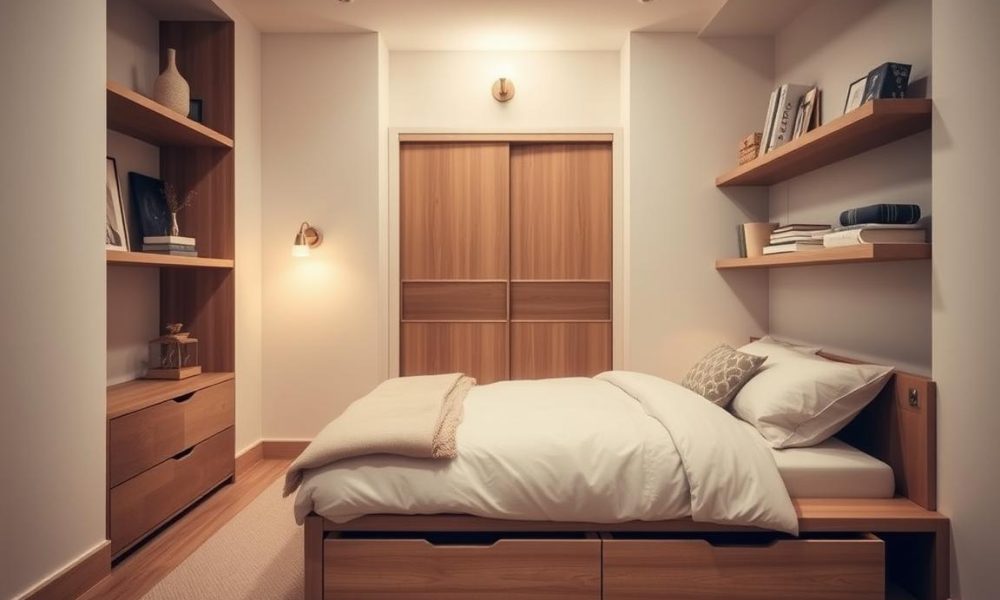
Storage beds and under-bed drawers
The area under your mattress is the cheapest storage in the house, and most people waste it. A bed with built-in drawers or a lift-up platform can replace a whole dresser, which is usually the bulkiest thing in a small bedroom.
Built-in drawer beds: best for clothes you reach for daily. You need side clearance for the drawers to clear fully.Lift-up (hinge-top) bases: the mattress platform raises on gas struts to reveal one big cavity. Ideal when the bed sits tight to a wall. Load it evenly and check that the lid clears any sloped ceiling, shelf or wall light when open.Add-on drawer modules: rolling units that slide under a standard frame. Cheapest option, and you can move them.Low-profile bins: if your frame sits close to the floor, split-lid or shallow bins still work. Measure the gap first and subtract an inch so nothing drags.
Match the container to how often you reach in. Hard drawers for daily wear, soft fabric bins for bulky quilts and off-season clothes. Skip storing anything fragile, liquid or moisture-sensitive down there; textiles do better in sealed bags, especially in a damp room.
Shopping for a frame? Compare styles in our roundups of platform and storage beds and space-saving bed frames .
Wall beds and loft beds
These free up the biggest chunk of floor area in the room, because the bed simply isn’t there during the day.
A wall bed with a desk turns a studio or spare room into a real workspace. Manual mechanisms cost less and hold up well; motorized ones cost more and mostly buy convenience. Either way, confirm the unit is fixed into studs, check the manufacturer’s mattress weight and thickness limits, and use the locking hardware every time.
A loft bed raises the mattress so a desk, dresser or small sofa fits underneath. Ceiling height decides whether it’s comfortable or claustrophobic. A common rule of thumb is around 30 inches between the top of the mattress and the ceiling so you can sit up without ducking — that’s guidance from furniture makers and universities rather than a federal requirement, so treat it as a comfort target and test it with a tape measure against your own ceiling.
If it’s a bunk rather than a loft, the safety rules are real. The U.S. Consumer Product Safety Commission defines a bunk bed as one whose mattress foundation sits more than 30 inches above the floor , and upper bunks need guardrails on both sides with the tops of the rails no less than 5 inches above the mattress. Lower bunks 30 inches or less from the floor don’t need them.
Not sure which bed type suits your room? Our guide to the best beds for small rooms compares Murphy beds, daybeds and low platforms side by side.
Slim wardrobes and smarter closet insides
Tall and shallow beats short and deep. A wardrobe that’s 20 to 24 inches deep holds hanging clothes fine and steals far less floor than a chunky armoire. Sliding doors remove the swing clearance problem entirely, which can be the difference between a wardrobe fitting and not fitting.
Inside, small changes add capacity fast:
Modular drawers — shallow for socks and underwear, deeper for folded tees.Shelf dividers to stop stacks from toppling into each other.A second hanging rail under shirts and jackets, since that lower half is usually dead air.Labelled baskets on the top shelf for things you touch twice a year.
Nightstands, benches and desks that pull double duty
A floating nightstand or a wall-mounted cubby keeps the floor visible, which makes the room read as bigger. Set the top roughly level with your mattress so you can reach a glass of water without sitting up. If you’d rather have drawers, look at slim vertical designs — see our nightstand ideas for shapes that work in tight corners.
Other pieces worth the space:
Lift-top bench at the foot of the bed: seat, blanket storage, and a place to put a suitcase. Keep a clear path past it.Fold-down wall desk: a real work surface that disappears at 6 p.m. Anchor it to studs.C-table: slides over the mattress edge for a lamp and a book, then tucks away.Storage stool or ottoman: seating plus a hidden box for chargers, hair tools or kids’ toys.
Go vertical: shelves, ledges and door-back storage
Walls are the storage you already own. Using them clears low surfaces and protects walking lanes.
Wall shelves: choose a shallow depth so nothing juts into the path beside the bed.Picture ledges: current book, glasses, phone — no bulk.Over-the-door racks: shoes, bags, hats, caught on the way out. Check the door still closes.Pegboard: reconfigurable hooks and trays, good above a desk or inside a closet door.Corner shelves: corners are almost always wasted and are fine for light storage or plants.
If your room has no closet at all, our list of storage ideas for small bedrooms with no closets goes further on wall systems and freestanding rails.
Layout choices that make the room feel bigger
Furniture placement changes how big a room feels as much as the furniture itself does.
Keep one uninterrupted walking path from door to bed.
Put the tallest pieces against walls, ideally the wall you see last when you walk in.
Don’t block windows — daylight does more for perceived space than any paint colour.
Group by function: sleeping zone, work zone, storage zone. Fewer trips across the room.
Leave a little breathing room between pieces instead of lining them up wall to wall.
Lift things off the floor. Legs on a bed or dresser let you see floor underneath, and that reads as space.
A tall mirror opposite or beside a window bounces light deeper into the room; a full-length mirror on the back of the door costs zero floor space. More of these visual tricks are in our post on decorating tricks to make a small bedroom look bigger .
Safety: anchor it, and check the labels
Tall storage in a small room means tip-over risk, especially with kids around. Anchoring is quick and cheap, and the CPSC’s Anchor It! campaign is blunt about it: anchor anything with drawers, doors or shelves to the wall.
Two things worth knowing before you buy a dresser or wardrobe:
Also check weight limits on wall shelves and floating nightstands, and use the fixings rated for your wall type — plasterboard, plaster-and-lath and masonry all behave differently.
Five changes you can make this week
Swap a bulky nightstand for a floating one so the bed drawers open fully and the floor stays visible.Put flexible bins under the bed for off-season bedding, labelled by season so you don’t rummage.Add hooks near the door for robes and bags, so the chair stops being a clothes pile.Clip the cables along the bed frame or use a slim raceway. Visible cords make a room look messy for no reason.Empty one drawer completely and re-sort with dividers. You’ll usually free up more room than you expected.
Small resets help more than they sound like they should. A room you can tidy in three minutes tends to stay tidy, and a calm room is easier to wind down in — useful given that adults aged 18 to 60 are advised to get at least seven hours of sleep a night .
Pros and cons at a glance
Piece Pros Cons
Storage bed with drawers
Can replace a dresser; easy daily access
Heavy to move; needs side clearance
Lift-up (hinge-top) base
Huge single cavity; works tight to a wall
Awkward for daily items; needs headroom to open
Loft bed
Frees a whole desk or lounge zone below
Needs ceiling height; climbing in and out
Wall bed with desk
Two rooms in one footprint
Higher cost; must be fixed to studs
Floating shelves and nightstands
Clear floor, light look
Weight limits; needs secure fixings
Slim sliding-door wardrobe
No swing clearance; lots of vertical capacity
Shallow depth; top shelf hard to reach
Over-the-door organizer
Zero floor space used
Can look cluttered; may block the door
FAQ
How much clearance do I need for an under-bed drawer?
At least the drawer’s height plus about an inch of breathing room underneath, and enough floor in front for the drawer to pull out fully. Watch for bed skirts and footboard rails that quietly eat the opening.
Are lift-up storage beds safe for everyday use?
Yes, when assembled to the instructions and used within the stated weight limit. Look for gas struts or counterbalance hardware, keep hands clear of the hinge line, and don’t let small children open or close the lid on their own.
Can I make a small bedroom feel bigger without buying anything?
Often, yes. Declutter, move the tallest piece against a wall, clear the window, and add a mirror you already own. Rearranging costs nothing and tells you what you actually need to buy.
Do I need a matching furniture set?
No. In a small room, sets usually include a piece that doesn’t fit. Buy a bed and one storage piece that suit the space, then match by colour or finish instead of by collection.
Drawers or rolling bins for a kid’s room?
Rolling bins are lighter and easier for young children to handle on their own; built-in drawers make cleanup faster once they’re bigger. Label the fronts either way.
What’s the single highest-impact swap?
For most small bedrooms, replacing a standard frame plus a dresser with one storage bed. It removes a large floor-standing object and keeps the same amount of storage.
Updated September 2026.