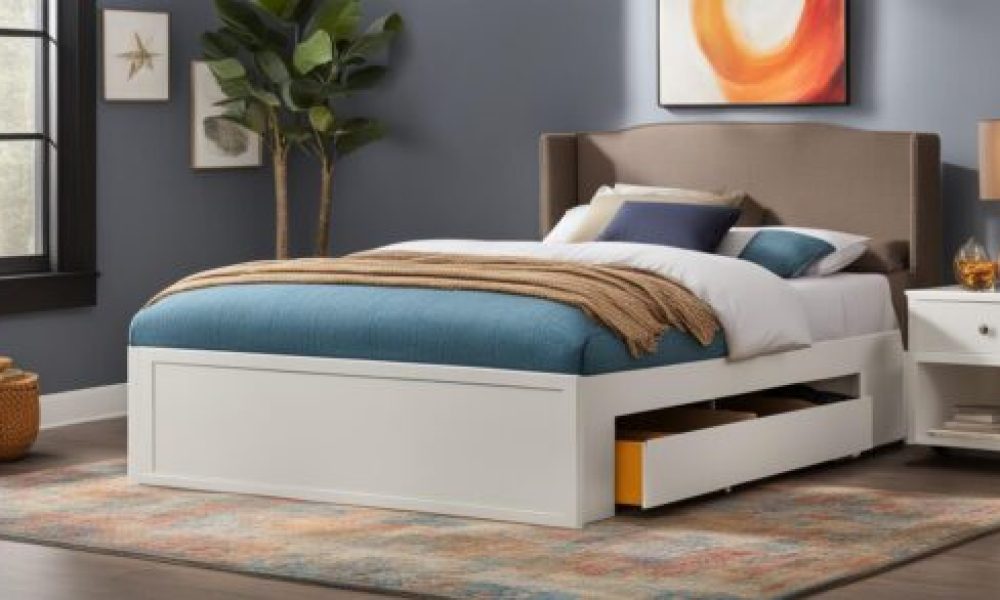
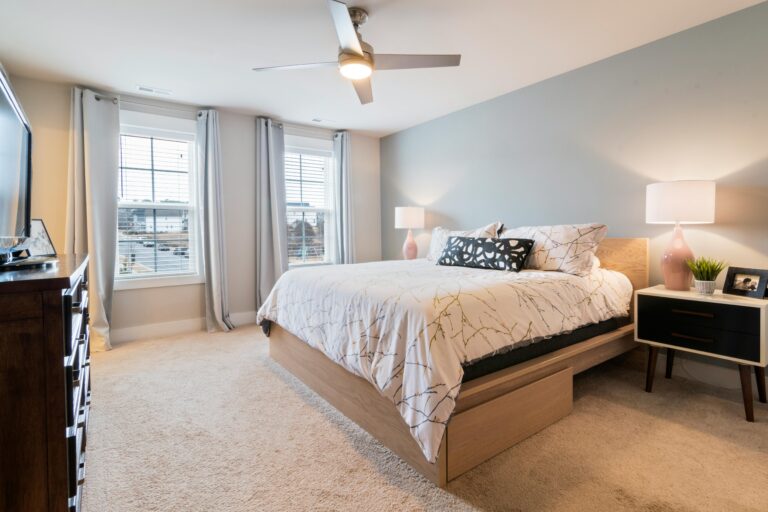
Hidden storage beds tuck drawers, a lift-up platform, or headboard cubbies into the bed frame itself, so you get dresser-level storage without giving up another square foot of floor. A lift-up queen hides roughly 25 to 30 cubic feet underneath; four side drawers usually land closer to 8 to 10. The right pick depends on how much clearance you have around the bed, not on which one looks best in the photo.
The three main styles, and who each one suits
| Style |
Rough capacity (queen) |
Needs clearance |
Best for |
| Drawer bed |
8–10 cu ft in four drawers |
Floor space equal to drawer depth plus room to stand |
Daily items: pajamas, kids’ clothes, spare sheets |
| Lift-up (ottoman) bed |
25–30 cu ft in one cavity |
Vertical swing room; nothing heavy on top |
Bulky, rarely used stuff: duvets, suitcases, decor |
| Headboard storage |
2–5 cu ft in shelves and cubbies |
A few extra inches of wall depth |
Books, chargers, glasses when there’s no nightstand |
Drawer beds
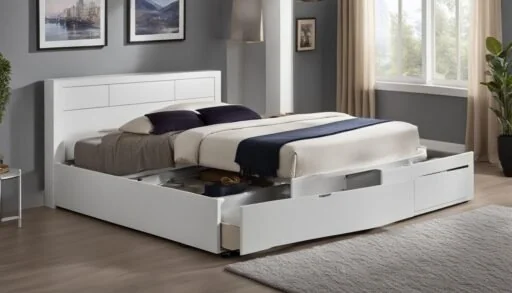
Drawers pull out from the sides, the foot, or both. They’re the easiest to live with day to day because you can open one with a knee and a coffee in hand.
The catch is floor space. A drawer that’s 18 inches deep needs 18 inches of clear floor to open, plus about a foot for you to stand in. Put a 20-inch drawer on the side facing a wall three feet away and you’ll be fine; put it facing a dresser two feet away and you’ll open it halfway forever.
- Side drawers suit long, narrow rooms. Footboard drawers suit rooms where the bed sits against a side wall.
- Full-extension metal glides let you reach the back of the drawer. Cheap roller glides usually stop at about two-thirds and sag once loaded.
- Some budget frames use fabric-lined drawers that roll on casters directly across your floor. They glide fine on hardwood and stick on thick carpet.
- Look at the drawer bottom. Thin hardboard bows under a stack of jeans; plywood doesn’t.
Lift-up platform beds
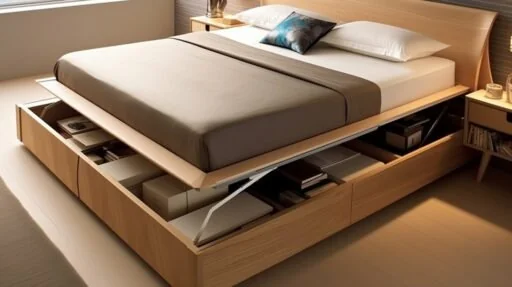
Gas struts raise the whole mattress deck, and the entire footprint underneath becomes one big box. That’s why capacity jumps so much compared to drawers, and why it’s the better answer for duffel bags, winter coats, and the holiday bins.
Two things to check before you commit. First, which way it opens: end-lift models swing the mattress toward the headboard and need ceiling and wall room, while side-lift models need clearance beside the bed. Second, the strut rating. Struts are matched to the weight of the platform plus a mattress, so a 100-pound hybrid on a frame speced for a light foam mattress will feel heavy on the way up and may drop faster than you’d like. The manufacturer’s max mattress weight is usually buried in the assembly manual, so ask before you buy.
Never open or close one while someone is sitting or lying on the bed, and keep kids clear of the gap when the platform is up.
Headboard storage beds
Cubbies, sliding panels, or a shallow cabinet built into the headboard replace the nightstand you don’t have room for. Handy in guest rooms and dorms, and they pair well with drawers below.
Measure the wall side too. A storage headboard can add 6 to 10 inches to the bed’s total length, which matters when the room is already tight at the foot. If the headboard has built-in outlets or USB ports, check whether the cord reaches your actual wall socket, since many run only about 6 feet.
How much can hidden storage beds actually hold?
Do the math instead of trusting the listing photo. Multiply the cavity’s length × width × depth in inches, then divide by 1,728 to get cubic feet.
A queen mattress is 60 by 80 inches, so a lift-up queen with an 11-inch-deep cavity gives you roughly 27 cubic feet once you subtract the frame walls. That’s about six large storage bins. A king (76 by 80 inches) gets you closer to 35.
Drawers lose volume to the glides, the drawer walls, and the center support rail. A typical under-bed drawer runs about 30 inches wide, 18 deep, and 7 tall, which is a little over 2 cubic feet each. Four of them is genuinely useful, but it’s a dresser’s worth, not a closet’s worth.
One more limit people forget: drawer height caps what you can store. Seven inches swallows folded t-shirts and flat sheets. It won’t take a rolled duvet or winter boots, which is where the lift-up platform wins.
Measure your room before you shop
- Walking space. Leave about 24 to 30 inches on the sides you use, and 36 inches on the main path to the door if you can.
- Drawer swing. Stand where the drawer will open and measure to the nearest obstacle. You need drawer depth plus roughly 12 inches.
- Door and closet swing. Mark where your bedroom and closet doors land. A footboard drawer that fights the closet door is a daily annoyance.
- Getting it in. Storage frames ship in several heavy boxes. Check the longest box length against your stairwell turn and doorway width, especially in older buildings.
- Mattress height. Storage platforms sit taller than standard frames. Add your mattress height and see whether your feet still reach the floor comfortably when sitting.
If your room is under about 10 by 10 feet, a lift-up bed often beats drawers purely because it needs no side clearance. Our roundup of space-saving bedroom ideas for tiny rooms goes deeper on laying out a small floor plan.
What to check on the frame itself
- Slat spacing. Most foam and hybrid mattress warranties want slats no more than about 3 inches apart, with a center support leg on queen and larger. Wider gaps can void coverage.
- Center rail and legs. Storage frames carry your weight plus whatever’s stored. A queen or king should have at least one center leg touching the floor.
- Deck material. Solid MDF decks are heavier and trap more moisture than slatted decks. Particleboard swells permanently if it ever gets wet.
- Hardware. Metal-to-metal bolted joints hold up better than cam locks in particleboard, which loosen after a couple of moves.
- Reassembly. Ask whether the frame can be taken apart and rebuilt. Some glued storage bases are basically one-move furniture.
For size-specific picks and frame construction details, see our guides to under-bed storage frames, king-size bed frames with storage, and the twin bed with storage underneath for kids’ rooms.
Keeping the mattress dry under a closed base
You lose about a pint of moisture a night through breathing and sweating, and a sealed storage cavity gives it fewer places to go than an open frame. It’s not a reason to skip a storage bed, but it is a reason to pay attention if you live somewhere humid or sleep hot.
The EPA advises keeping indoor humidity below 60 percent, ideally between 30 and 50 percent, which is the single most useful number here. A cheap hygrometer on the nightstand tells you whether you need a dehumidifier or just a cracked window.
Practical habits that help:
- Pick a slatted deck over a solid one when you have the choice.
- Pull the sheets back for 20 minutes while you shower instead of making the bed immediately.
- Strip the bed and stand the mattress up once or twice a year, and vacuum the cavity while it’s open.
- If you spot condensation on the underside of the mattress, air the room more and consider a breathable mattress protector rather than a vinyl one.
What to store down there, and what not to
Good candidates: off-season clothing, spare bedding, suitcases, gift wrap, camping gear, photo boxes, shoes in bins.
Skip anything sensitive to heat, humidity, or that you need in a hurry. Important documents and electronics do better in a closet. So does anything you reach for weekly, since climbing over a lifted platform gets old fast.
Wool and cashmere need a little care. The National Pesticide Information Center recommends cleaning items before storage and keeping them in airtight bags or containers, because clothes moth larvae feed on soiled natural fibers. Vacuum-seal bags handle both the moths and the bulk. Clear bins with labels beat black trash bags, which turn into mystery lumps by February.
Hidden storage beds vs. the cheaper workarounds
A storage frame costs more than a plain platform, weighs a lot more, and is a pain to move. If you’re renting year to year, that matters.
The budget route is a standard frame plus risers and rolling bins. You get similar capacity for a fraction of the price, but the storage is visible unless you add a bed skirt, and the bed sits noticeably higher. Our guide to bed risers for storage covers weight limits and stability, and storage ideas for bedrooms with no closets covers everything that doesn’t live under the bed.
The middle ground: a drawer bed on the side you actually walk past, plus vertical storage on the wall. That usually clears more clutter than a lift-up bed you’re too lazy to open.
Common questions
Can you use a box spring with a storage bed?
Almost never. Storage frames are designed as platforms, and adding a box spring raises the mattress another 5 to 9 inches. Use the mattress directly on the slats or deck.
Do lift-up beds work with heavy mattresses?
Up to the frame’s stated limit. Thick innerspring and hybrid mattresses are the usual problem, and an overloaded strut makes the platform hard to raise and quick to fall. Weigh your mattress or check its spec sheet first.
Will the drawers work on carpet?
Caster-style drawers that roll on the floor struggle on plush carpet and thick pads. Drawers mounted on rails inside the frame don’t care what’s underneath.
Are they safe in a kid’s room?
Drawer beds, yes, and low ones are great for toy cleanup. Lift-up platforms are an adult-operated mechanism. If you go that route, teach the rule that nobody opens it alone.
How long does assembly take?
Plan on two to four hours for a drawer bed and expect a second pair of hands for the lift-up deck. Build it in the room where it’s staying, because a finished storage frame rarely fits back through a doorway.
A quick buying checklist
- Measured clearance on every side that opens
- Cavity or drawer dimensions listed in inches, not just “spacious”
- Slat spacing of about 3 inches or less, with center support
- Max mattress weight for lift-up models
- Full-extension glides on drawers
- Plywood or solid wood at the stress points rather than bare particleboard
- Replacement parts available for struts, glides, and slats
Get those seven right and the bed disappears into the room, which is the whole point. For more furniture that pulls double duty, browse our space-saving bedroom furniture picks.
Updated September 2026.