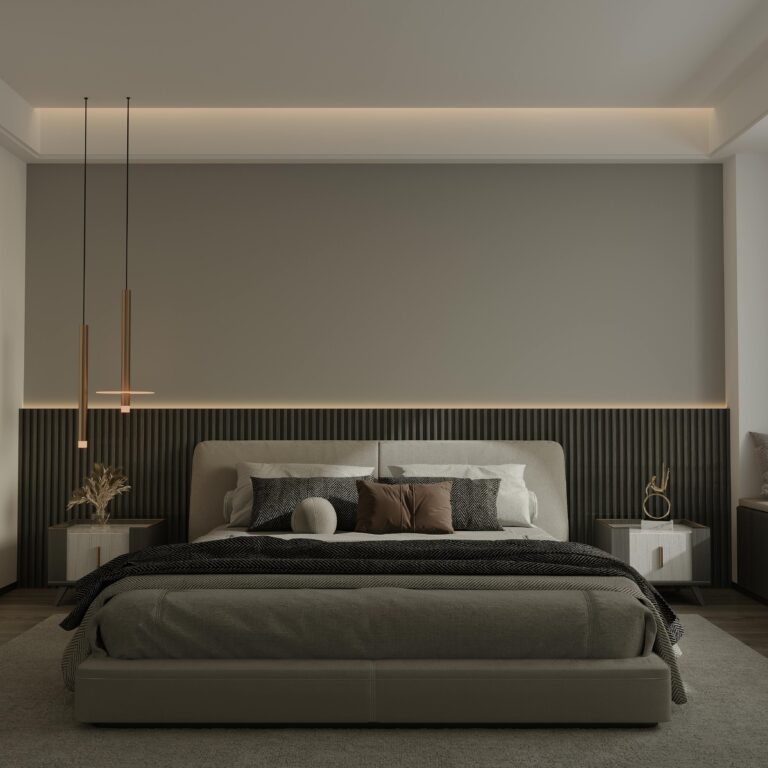
Pick an ivory night stand whose top lands within about 2 inches of your mattress surface — usually 24 to 28 inches tall — and leave a 2 to 6 inch gap between it and the bed so you can reach a glass of water without knocking it over. Width of 18 to 24 inches suits most bedrooms, and a warm ivory finish (a white with a yellow or beige base) reads softer next to wood tones than a bright, blue-based white. Everything else — drawers versus open shelf, solid wood versus veneer, knobs versus pulls — follows from those numbers.
Ivory, white or cream: what the color actually does
Ivory is white with a drop of yellow in it. That tiny shift changes how the piece behaves in a room.
Next to warm woods — walnut, cherry, oak, pine — a cool bright white can look chalky, almost like a primer coat. Ivory picks up the same yellow undertone as the wood, so the two stop fighting. Against a crisp white wall or white trim, though, an ivory piece can look slightly dingy if the contrast is strong. Hold a paint chip or a fabric swatch against your trim before you commit.
Quick way to tell what you’re looking at: put the finish beside a sheet of printer paper in daylight. Printer paper is brutally cool white. If your sample looks warm and buttery, it’s ivory or cream. If it disappears, it’s a true white and will sit differently in the room than you expect.
One more thing about photos online: white furniture is notoriously hard to photograph accurately. Listings shot under warm studio lights make true white look ivory. Look at customer photos taken in real bedrooms, or order a sample door or finish chip if the maker offers one.

How to size an ivory night stand to your bed
Height: measure the mattress, not the bed frame
Grab a tape measure and measure from the floor to the top of your mattress — with the sheets on, since a thick mattress pad adds an inch or two. That number is your target.
- Ideal: nightstand top within 2 inches above or below the mattress top.
- Typical range sold: 24 to 28 inches tall.
- Platform beds and low frames: mattress tops often sit 18 to 24 inches up, so a 28-inch nightstand looms. Look for 22 to 24 inches.
- Tall beds, pillow-tops, adjustable bases: mattress tops can reach 30 inches or more. An adjustable base that lifts the head section also changes what you can reach, so measure with the base flat.
A nightstand that’s too low means fumbling downward for the lamp switch in the dark. Too high, and the top edge cuts into the bed’s profile and blocks light from a table lamp.
Width, depth and the walkway
Width is mostly about balance. A 16-inch pedestal beside a king bed looks like an afterthought; a 30-inch chest beside a twin swallows the wall. Rough guide:
| Bed size |
Nightstand width that looks right |
| Twin / full |
16-20 inches |
| Queen |
20-24 inches |
| King / California king |
24-30 inches |
Depth of 15 to 20 inches covers most designs. Deeper than 20 and the front edge starts sticking past the mattress into the walkway.
Speaking of walkways: keep at least 24 inches of clear floor between the bed and any wall or dresser, and 30 to 36 inches if two people pass on the same side or you need room to make the bed. Measure your wall before you shop — bed width plus two nightstands plus a couple of inches of breathing room has to fit, and king beds are the ones that blow the budget. If you’re still deciding on the frame, our king vs. California king comparison lays out the footprint difference.

When you can’t fit a pair
Tight room? A single nightstand on the side you sleep on, plus a wall-mounted shelf or a swing-arm sconce on the other, reads intentional rather than cramped. Floating nightstands free up the floor and make vacuuming easy. Asymmetry works as long as the two sides have similar visual weight — a nightstand on one side and a chair or narrow plant stand on the other, say.
Finishes and materials: what holds up in ivory
Light painted finishes show every ding, so construction matters more here than with a dark stain.
- Painted solid wood: heaviest and most repairable. A chipped corner can be touched up with matching paint. Poplar and rubberwood are common under paint; both are fine.
- MDF or particleboard with a painted or laminate finish: smoother and cheaper, and paint sits beautifully on MDF. But chipped edges expose brown core that you can’t sand out, and water damage swells the board permanently.
- Veneer over engineered core: a middle ground. Check the edges — a thin veneer wrapped around a corner is the first place to peel.
- Distressed or “antique ivory” finishes: rubbed-through edges hide future scuffs, which is genuinely practical in a kid’s room or a busy household.
If the piece uses MDF or particleboard, look for the compliance label. Composite wood products and the finished furniture made from them that are sold in the US must be labeled as TSCA Title VI compliant under EPA rules, which cap formaldehyde emissions. It’s a sticker or stamp, often inside a drawer or on the back panel. Airing a new piece out in a ventilated room for a few days before it goes next to your pillow isn’t a bad habit either.
Ask about the topcoat, too. A catalyzed lacquer or conversion varnish resists the oils and lotions that end up on a bedside surface; a thin water-based paint with no clear coat will pick up marks from a moisturizer bottle within months. Strong, direct sun can also yellow some white and ivory finishes over time, so if your nightstand sits in a sunny window, a sheer shade helps.
Drawers, doors or open shelf
Decide by what actually lives on your bedside table tonight.
| Style |
Best for |
Trade-off |
| Two drawers |
Medication, chargers, reading glasses, small clutter |
Less vertical space; cheap glides stick |
| One drawer + open shelf |
Books and a stack of magazines plus hidden bits |
The shelf gets messy fast |
| Cabinet door |
Bulky items, a tissue box, a CPAP or humidifier |
Door swing needs clearance beside the bed |
| Open pedestal or table |
Small rooms, minimal setups |
Nowhere to hide anything |
Drawer hardware is where budget pieces give themselves away. Full-extension ball-bearing slides let you reach the back of the drawer and usually carry 75 to 100 pounds; soft-close versions stop the 2 a.m. slam. Plain wood-on-wood runners swell in humid rooms. Pull a drawer all the way out in the store if you can — if it tips forward when it’s three-quarters open, it has no stop.
Also check for a cord notch in the back panel. A nightstand that hides a charging brick inside a drawer, with the cable running out a grommet, keeps the top clear.

What to check before you buy
- Weight. Shipping weight tells you a lot. A 24-inch two-drawer piece at 25 pounds is thin board; 45 to 60 pounds suggests solid parts.
- Back panel. A stapled cardboard back racks and wobbles. A fitted plywood back keeps the box square.
- Top surface. Run your hand across it. Bumps under the paint mean filler that will telegraph more as it ages.
- Leg joints. Screw-in legs on a painted piece loosen; corner blocks or a solid apron hold up.
- Finish match. If you’re buying two, confirm they ship from the same batch. Ivory varies between production runs.
- Return window and parts. Painted furniture arrives chipped more often than stained. Check whether the maker ships a touch-up pen and replacement drawer slides.
- Stability. The federal tip-over rule for clothing storage units applies to pieces 27 inches and taller, which leaves most nightstands outside its scope. If kids climb, follow the CPSC’s Anchor It! guidance and strap it to a stud anyway.
Pairing an ivory night stand with wood, metal and paint
Ivory gets along with almost everything, which is why it’s easy to overdo. Two guidelines keep it from looking flat:
- Don’t match everything. Two ivory nightstands plus an ivory dresser plus an ivory bed is a lot of one note. Let one piece be wood or upholstered. Our guide to choosing a dresser for your room size and style covers how to balance the bigger piece.
- Pick a hardware metal and stick to it. Aged brass and antique bronze pull out ivory’s warmth; polished chrome or nickel pushes it cooler and more modern. Swapping knobs is the cheapest upgrade there is — just measure the existing hole spacing (3 inches and 96 mm are the usual centers, and they’re close but not interchangeable).
Specific pairings that tend to work:
- Walnut or cherry frame: ivory lightens the room without the hard contrast of true white.
- White oak or weathered pine: both sit in the same warm family, so the look stays calm and coastal.
- Black or dark-stained bed: ivory breaks up the mass. Repeat the black somewhere else — a lamp base, a picture frame — so the nightstands don’t look orphaned.
- Upholstered or tufted headboard: a curved or fluted ivory nightstand echoes the soft lines better than a hard-edged box.
Flooring matters too. Over a dark floor, ivory pops; over honey-toned wood or beige carpet, it can vanish. That’s where a rug earns its keep — see our notes on rug size for a king bed for the placement that actually anchors the nightstands too.

Styling the top without burying it
Leave at least a third of the surface empty. You need somewhere to set a phone and a glass.
- Lamp: aim for the bottom of the shade to sit near eye level when you’re sitting up reading — on a 26-inch nightstand, that usually means a lamp 24 to 27 inches tall overall. Too tall and the bulb glares straight into your eyes.
- One tall, one short, one flat: lamp, small plant or candle, stacked books or a tray. Odd numbers look less staged.
- A small tray corrals jewelry, lip balm and earplugs and makes dusting a two-second job.
- Warm, dimmable light. A bulb around 2700K with a dimmer or a low-lumen setting is friendlier at bedtime than an overhead fixture at full blast. If overheads are the bigger issue in your room, our take on bedroom ceiling fixtures gets into layering.
Cleaning and keeping ivory looking ivory
Dust weekly with a dry microfiber cloth — grit is what scratches painted tops. For marks, a barely damp cloth with a drop of mild dish soap, then dry immediately. Skip bleach wipes and ammonia glass cleaners on painted finishes; they dull the sheen and can leave lighter patches you can’t blend back.
For scuffs on a satin finish, a melamine foam eraser works but also abrades the topcoat, so use it lightly and only on the mark. Coasters under water glasses and a felt pad under a lamp base prevent the two most common rings.
FAQ
What height should an ivory night stand be?
Within about 2 inches of your mattress top, which puts most people in the 24 to 28 inch range. Measure with bedding on, since a mattress topper can add 2 to 4 inches.
Do both nightstands have to match?
No. Matching pairs look tidy and traditional; two different pieces of similar height and visual weight look collected. Keeping the heights within an inch or two is what makes mismatched pairs read deliberate.
Is ivory better than white?
It depends on your wood tones and trim. Ivory is more forgiving beside warm woods and warm-toned walls, hides dust slightly better, and won’t compete with cream bedding. Next to bright white trim, a true white often looks cleaner.
Will an ivory finish yellow over time?
Some painted finishes shift with long, direct UV exposure, especially oil-based topcoats. Sheers or blinds on a sunny window help, and rotating a pair of nightstands occasionally evens out any change.
How far should the nightstand sit from the bed?
Two to six inches. Any farther and you’re leaning out of bed to reach the lamp; flush against the frame and you’ll scrape the finish every time the bed shifts.
Can a nightstand double as storage in a small room?
Yes — a two-drawer model with a cabinet base holds more than it looks like it should. If floor space is the real problem, built-in headboard storage may beat a freestanding piece entirely; see our guide to the bookcase storage bed.
Updated September 2026.