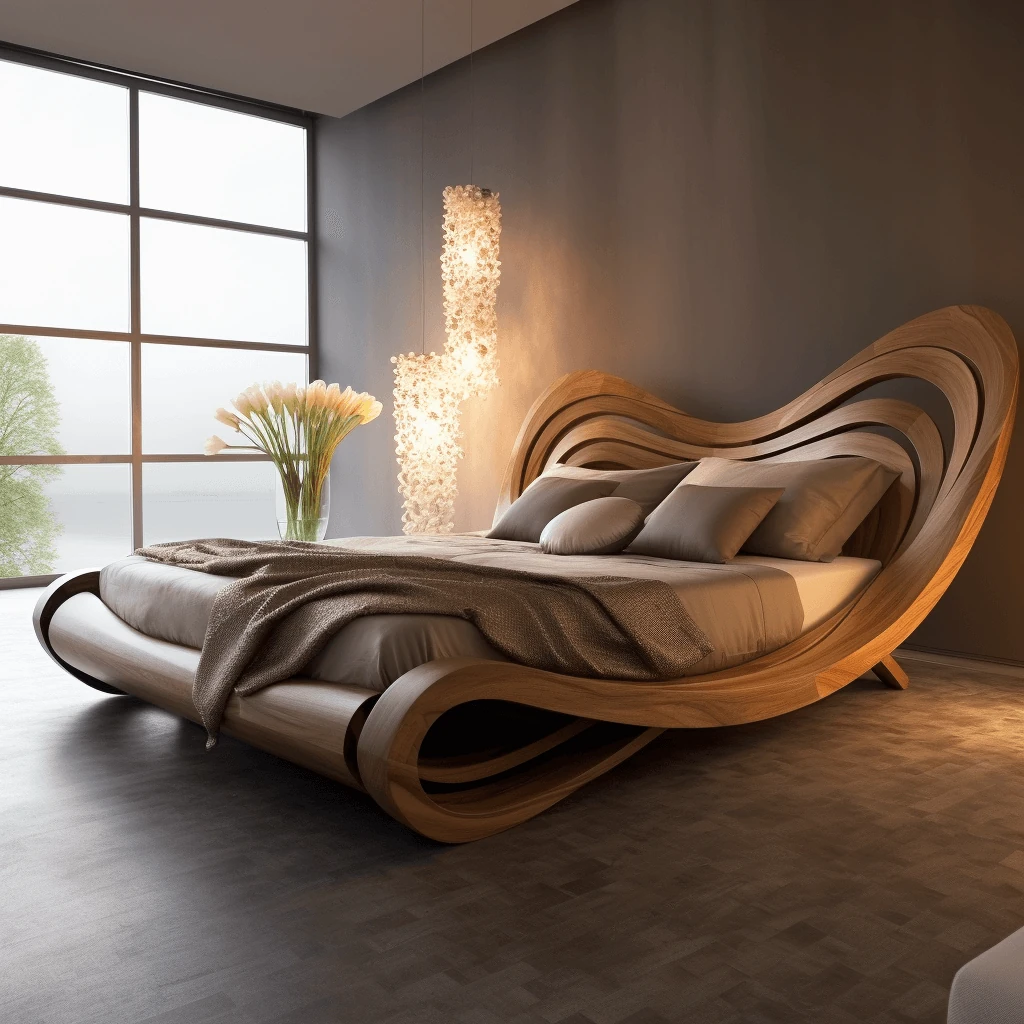
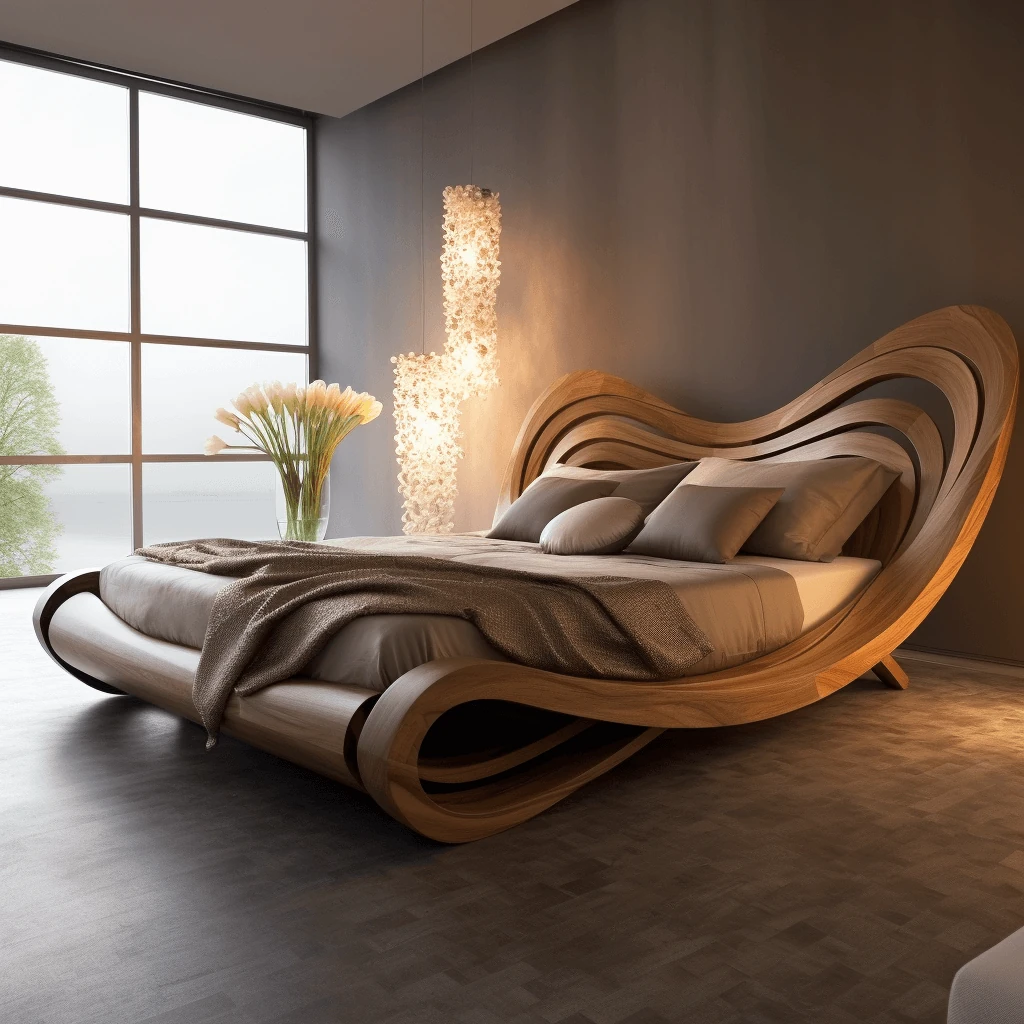
A unique wood bed is a solid frame with one distinctive move: a live-edge slab headboard, visible joinery, a canopy, hidden drawers, or a grain pattern you won’t see in a chain-store showroom. The best unique wood beds back that character with unglamorous fundamentals — hardwood construction, tight joints, slats close enough to support your mattress, and a finish you can repair. Here’s what the main styles look like, which woods hold up, and what to check before you hand over your money.
What actually makes unique wood beds unique
Three things, mostly. First, the material itself: no two boards share a grain pattern, and species like walnut, white oak and cherry each age differently. Second, the making — hand-cut joints, a shaped headboard, a chamfered post or a hand-rubbed oil finish all read as “someone thought about this.” Third, the form: canopies, platforms, lofts and storage bases change how a room feels, not just how the bed looks.
What does not make a bed unique is a marketing word. “Artisan,” “heirloom” and “hand-finished” are unregulated terms. Ask what the frame is made of, how it’s joined and whether the finish can be touched up — those answers tell you more than any product description.
Standout wood bed styles
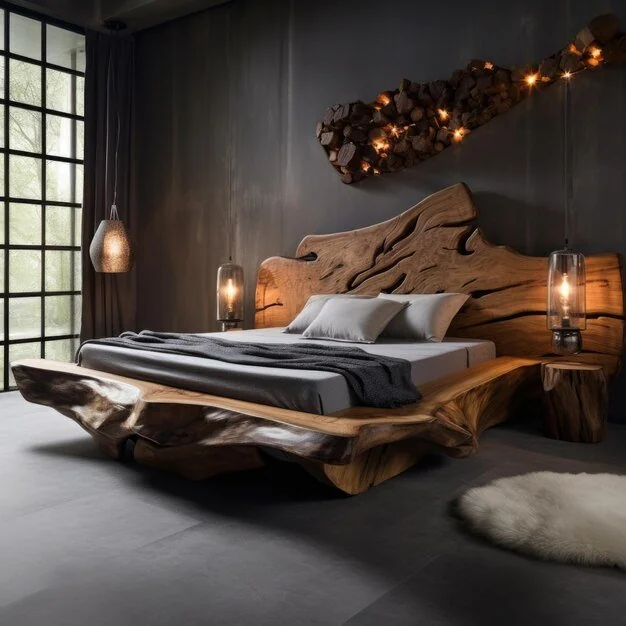
Live-edge beds
A live-edge headboard keeps the natural outer contour of the tree, bark removed and edge sanded smooth. Every one is genuinely one-off, which is the appeal — and also the catch, since you’re buying a shape you can’t compare against a catalog photo. Slabs are heavy, so check that the headboard attaches to the frame with bolts rather than screws into end grain, and look for butterfly keys or epoxy fills across any checks in the slab. These sit happily in both rustic and stripped-back modern rooms.
Canopy and four-poster beds
Four tall posts, sometimes joined by a top frame, draw the eye upward and give a bedroom instant architecture. They need ceiling height and breathing room to work — a tall canopy in a low room feels cramped rather than grand. Wooden versions range from chunky reclaimed timber to slim square posts barely thicker than a broom handle. If you’re weighing proportions, our guide to canopy bed frames covers sizes and ceiling clearance in more detail.
Platform beds
A platform frame supports the mattress on a slatted or solid deck, so you skip the box spring entirely. That keeps the profile low and the lines clean, which helps a small room feel less crowded. Solid-wood platforms in oak, ash or walnut are the workhorse of modern bedrooms for a reason: fewer parts, fewer squeaks, less to go wrong.
Storage beds
Drawers in the base, a lift-up deck on gas struts, or shelving built into a thick headboard. Wood suits storage beds well because the frame is already substantial enough to carry drawer boxes without looking bulky. Measure your clearance first — side drawers need floor space to pull out, and a lift-up deck needs room to swing. If storage is the main reason you’re shopping, compare options in our roundup of king-size bed frames with storage.
Lofted and raised beds
Lifting the sleeping surface frees up the footprint underneath for a desk, drawers or a reading nook. Solid timber lofts feel far steadier than tubular metal ones, but height brings safety rules: guardrails on all open sides, a fixed ladder, and a ceiling gap that lets you sit up. Bunk-style and loft beds sold in the US fall under federal safety rules covering guardrails and openings, so check that any frame you buy — especially secondhand — still meets them. More small-room layouts here: the best beds for small rooms.
Rustic and reclaimed-timber beds
Knots, saw marks, nail holes, weathered patina. Reclaimed beams and barn boards carry visible history, and the wood has usually spent decades acclimating, so it tends to be dimensionally settled. Ask the maker whether old paint was tested or fully removed — paint on pre-1978 US buildings may contain lead, and sanding it is the risky part. A sealed, clear-finished frame from a reputable builder is the safe version of this look.
Mid-century modern frames
Tapered legs, a low headboard, warm walnut or teak tones, minimal ornament. These frames are compact for their mattress size, which makes them useful in rooms where a heavy rustic bed would dominate. They also mix easily with other eras, since the shapes are quiet.
Carved and traditional beds
Turned posts, paneled headboards, molded rails, sometimes inlay. Traditional wooden beds have gone in and out of fashion for two centuries and keep coming back because the proportions are generous and the joinery on good examples is excellent. Secondhand is often the smart buy here.
Choosing the wood
Species affects color, hardness, weight and price. Hardness is measured with the Janka test, which presses a steel ball into the wood and records the force needed; published Janka figures put sugar (hard) maple around 1,450 lbf and white oak around 1,360 lbf, while softwoods like pine sit far lower. For a bed, hardness matters less than it does for flooring — nobody walks on a headboard — but it does predict how easily rails and posts pick up dings.
| Wood |
Look |
Good to know |
| White oak |
Pale gold, strong open grain |
Hard, stable, takes stain well; quarter-sawn shows ray flecks |
| Walnut |
Chocolate brown, sometimes purple undertones |
Softer than oak but very stable; lightens with sun exposure |
| Maple |
Creamy, tight and subtle grain |
Very hard; can look flat if you want visible character |
| Cherry |
Pinkish when new, deep red-brown later |
Darkens noticeably over the first year or two |
| Teak / acacia |
Warm, oily, golden brown |
Naturally durable; teak is costly, acacia is the budget cousin |
| Pine / fir |
Light, knotty, casual |
Affordable and easy to repaint, but dents easily |
| Mango / rubberwood |
Mid-brown, varied |
Fast-growing plantation species, common in mid-price frames |
Solid wood, veneer or engineered panels?
Solid wood is not automatically better everywhere. Wide panels made from solid boards move with the seasons and can crack; a quality hardwood veneer over a stable core stays flatter and is what plenty of high-end furniture uses. What you want to avoid is a frame where the load-bearing rails and posts are thin engineered board dressed up with a printed wood-look foil.
If a frame uses plywood, MDF or particleboard, US-market products are required to be labelled as compliant with the EPA’s formaldehyde emission standards for composite wood products, which have applied to finished goods since March 2019. Look for that label, and air out a new frame for a few days before you sleep on it. For a wider comparison of frame materials, see wood vs metal vs upholstered bed frames.
What to check before you buy
- Joinery. Mortise-and-tenon or dowelled joints at the posts beat staples and plastic corner blocks. Bolt-together rail hardware is fine and makes the bed movable.
- Slat spacing and center support. Many mattress warranties specify a maximum gap between slats (commonly around 3 inches) and a center rail with legs on queen and larger sizes. Check your mattress paperwork rather than assuming — the requirements vary by brand, and an unsupported foam mattress will sag between wide slats.
- Squeak risk. Wood-on-wood contact plus loose bolts equals noise. Felt pads between slats and rails, and a re-tighten every six months, fix most of it.
- Weight and access. Solid hardwood beds are heavy. Confirm the frame disassembles and that the largest single piece fits through your doorway and up your stairs.
- Finish type. Oil and wax finishes are easy to spot-repair but need refreshing. Lacquer and catalyzed finishes resist spills better but are harder to touch up invisibly.
- Room fit. Leave roughly 24–30 inches of walking space on the sides you use, and remember that posts, sleigh curves and footboards add to the mattress footprint.
Sustainable and reclaimed options
If the environmental side matters to you, the clearest signal is third-party certification. The Forest Stewardship Council is a non-profit that certifies responsibly managed forests worldwide and runs a chain-of-custody system so a finished product can be traced back through the supply chain. An FSC label on a bed means that paper trail exists; a vague “sustainably sourced” claim on a product page means nothing in particular.
Reclaimed timber is the other route, and it’s a genuinely low-impact one since the wood already exists. Buy from a maker who can say where the material came from and how it was cleaned up. The honest caveat: reclaimed stock varies enormously, so judge the individual piece, not the category.

Styling a wood bed so it reads as the centerpiece
- Contrast your bedding. Warm-toned oak and teak sit well against white, oatmeal and sage; cool walnut takes deeper colors. Mixing linen with a chunkier woven throw stops the bed looking flat in photos and in person.
- Ground it with a rug. A rug that runs past the foot and both sides softens hard frame edges. Sizing is the part people get wrong — our bedroom rug guide has the measurements.
- Light it warmly. Warm bulbs on a dimmer bring out the red and amber in wood grain; cool white light flattens it. Wall sconces also free up your nightstands. See cozy bedroom lighting for layering ideas.
- Don’t match everything. A bedroom where every piece is the same finish looks like a showroom set. One or two contrasting tones — painted nightstands, a cane dresser, black metal lamps — make the bed stand out more, not less.
Caring for a wooden bed
Wood is hygroscopic: it takes on and gives up moisture as the air around it changes. Very dry indoor air makes furniture shrink, which is what loosens joints and opens cracks, so keeping indoor humidity in a moderate range — roughly 40–50% is the usual target for a home — does more for a bed frame than any polish. A humidifier in winter or a dehumidifier in a damp room is the practical fix.
- Dust with a dry or barely damp microfiber cloth. Skip silicone sprays, which build up and complicate future refinishing.
- Refresh oiled surfaces when the wood starts looking thirsty, typically once or twice a year. Lacquered frames just need cleaning.
- Keep it out of direct sun. UV fades stains and shifts natural color unevenly — cherry darkens, walnut lightens.
- Re-tighten the hardware every six months, and every time you move the bed.
- Inspect when you strip the bed. The EPA notes that bed bugs hide in cracks on the bed frame and headboard, so a quick look at joints and slat pockets is worth the thirty seconds.
- Lift, never drag. Dragging a loaded frame puts all the stress on the rail joints.
Pair the frame with nightstands that suit its scale rather than its exact finish — there are ideas in our nightstand guide.
FAQ
What’s the best wood for a bed frame?
Oak, maple, walnut, cherry and teak are the usual picks because they’re dense, stable and repairable. Pine costs less and looks great in a casual room, but expect dents.
Is reclaimed wood durable enough for a bed?
Generally yes. Old timber has had decades to reach equilibrium with indoor conditions, so it moves less than freshly kiln-dried stock. Quality depends on the individual boards and the maker’s prep work, not on the age alone.
Do I need a box spring with a wooden platform bed?
No. A platform deck or closely spaced slats supports the mattress directly. Confirm the slat gap meets your mattress manufacturer’s requirement before you buy.
Can I have a wood bed custom-made?
Yes, and it’s often the answer for odd room shapes, non-standard mattress sizes or built-in storage. Expect to discuss species, finish, headboard height and whether the frame breaks down for moving. Costs vary too widely by region and maker to quote a useful figure.
Are wooden beds noisier than metal ones?
Not inherently. Noise comes from loose fasteners and from parts rubbing, so it helps to know how to track down a squeak and silence it. A well-joined hardwood frame with felt-padded slats is usually quieter than a thin metal frame with bolted brackets.
Updated September 2026.