Nuptial bedding ceremonies were the old European custom of escorting a newly married couple to bed in front of family, friends and neighbours, so the community could vouch that the marriage had really begun. In most cases the guests blessed the bed, sang, joked and then withdrew before anything private happened — the point was public proof, not voyeurism. The ritual was widespread through the Middle Ages, thinned out across the 1600s and 1700s, and had largely disappeared from elite weddings by the early nineteenth century.
Key takeaways
- The bedding rite turned a private act into a matter of public record, which mattered when inheritance and alliances hung on it.
- Witnessing the couple into bed was normal; witnessing sex itself was rare and mostly reserved for high-stakes royal matches.
- Clergy often blessed the bed, and food, drink and noise were part of the fun.
- There is no single end date. The custom faded unevenly — earlier at court, later in rural communities.
What actually happened at a bedding
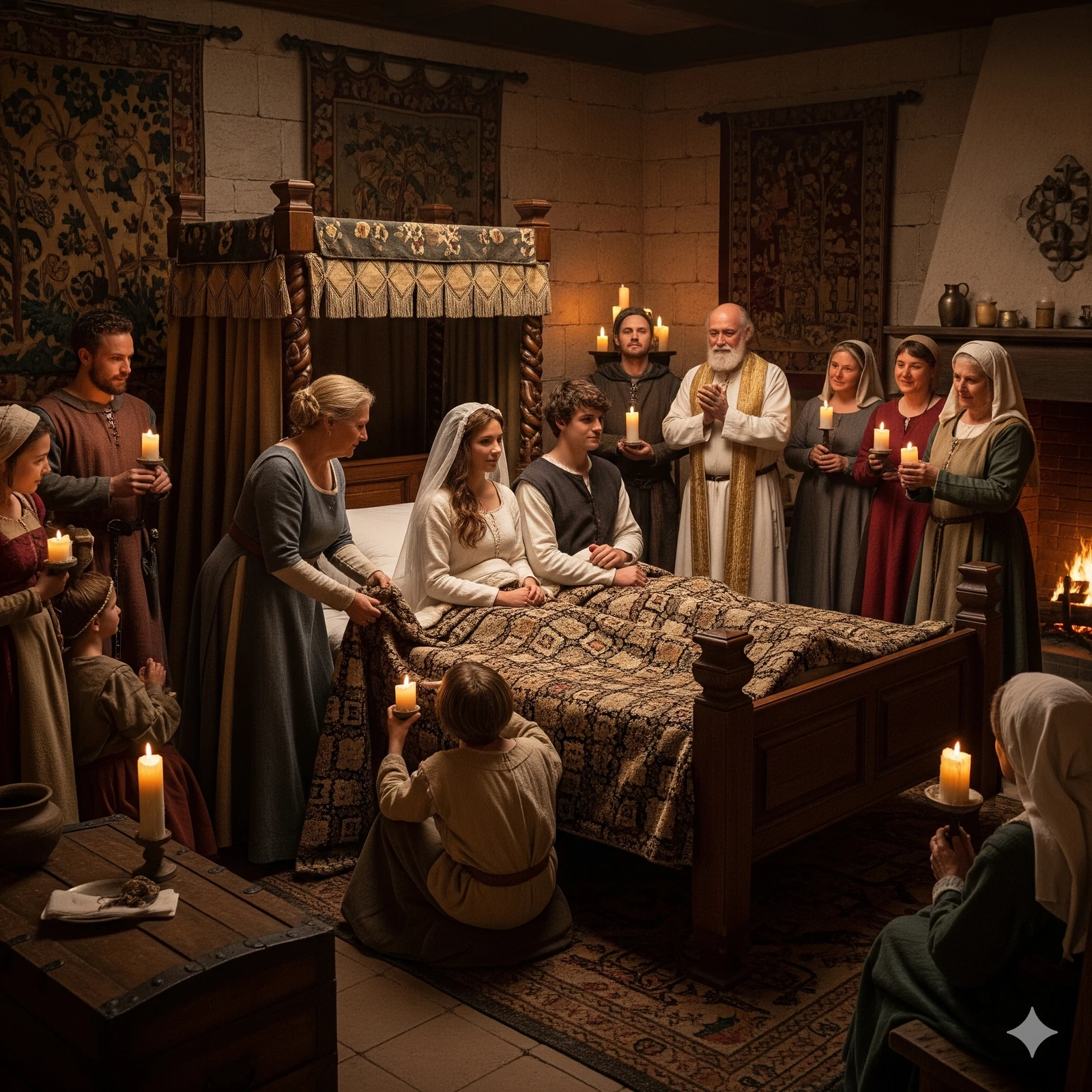
Strip away the television versions and the rite follows a fairly consistent shape. The wedding feast wound down, and the couple were led upstairs by a crowd — family, friends, servants, whoever had been eating and drinking all afternoon. Bride and groom were usually undressed in separate rooms and brought together in the marriage bed, which was often decorated with flowers. A priest might bless the bed. In England, the blessing was followed by a benediction posset, a cup of sweetened spiced wine shared by the couple, according to the reference entry on rituals of the marriage bed.
Then came the horseplay. In Shakespeare’s England, guests played “fling the stocking” — the bride threw a stocking into the crowd and whoever caught it was promised good luck, a clear ancestor of the bouquet toss. Historian Katie Barclay notes that in sixteenth-century Germany couples were put to bed to pipes, drums and deliberately rowdy noise, with the party carrying on loudly outside the chamber afterwards so nobody could hear what was happening inside. That detail says a lot: the racket was a courtesy as much as a joke.
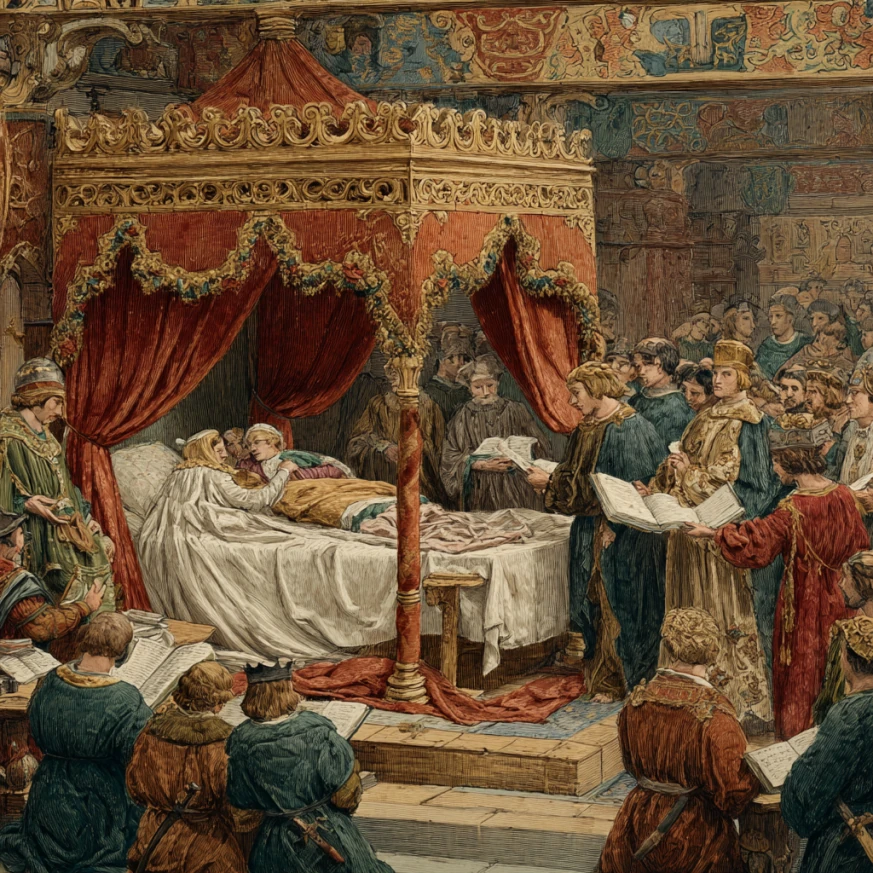
Finally the bed curtains were pulled shut and the guests filed out. Heavy hangings on a four-poster bed did real work here — they were the closest thing a crowded medieval household had to a bedroom door.
Why a bed ritual carried legal weight
Before the Catholic Church tightened its rules, a marriage could be made by the couple’s consent alone. Secret or “clandestine” marriages were disapproved of, but they were generally held to be valid, which left endless room for argument about who was married to whom. That changed with the decree Tametsi, issued by the Council of Trent in November 1563, which required a marriage to take place before the parish priest and two or three witnesses to be valid.
In that world, a room full of people who saw a couple put to bed was useful evidence. If a family later tried to wriggle out of an inconvenient match, or a cousin challenged a child’s legitimacy, witnesses could speak. Consummation was the other half of the equation: an unconsummated marriage was far easier to annul, so proving it had happened protected the bride’s position as much as anyone’s.
The most famous example is Katherine of Aragon. She married Arthur, Prince of Wales, at Old St Paul’s in November 1501 and was widowed five months later. Decades on, Henry VIII’s lawyers argued his own marriage to her was invalid because she had consummated her first one — a claim she denied to the end of her life. Whole dynasties turned on the question of what happened in a bedchamber, which is exactly why people wanted witnesses in the room.
Blessings, fertility and the things we can’t prove
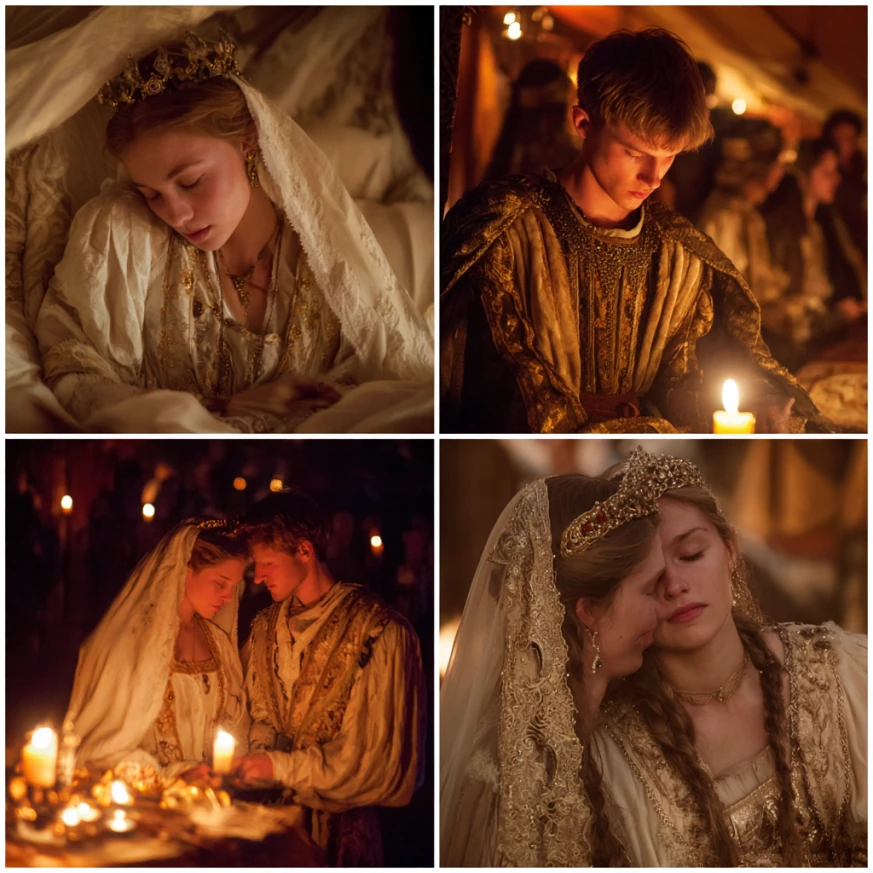
Clergy involvement was real and well documented: in Catholic Europe a priest or bishop commonly blessed the bed and prayed over the couple, framing the wedding night as a sacred duty rather than a private indulgence. For noble houses hoping for an heir, that blessing was insurance as much as piety.
You will also read confident lists of herbs supposedly strewn on the sheets — lavender for calm, rosemary for remembrance, myrtle for love — plus charms tucked under pillows and white linens standing for purity. Herbs and flowers in bedding are genuinely old, and beds were decorated for weddings. But the tidy symbolic key you see repeated across the internet is mostly modern folklore reasoning rather than documented ritual practice. Treat it as atmosphere, not evidence.
How the custom varied across Europe
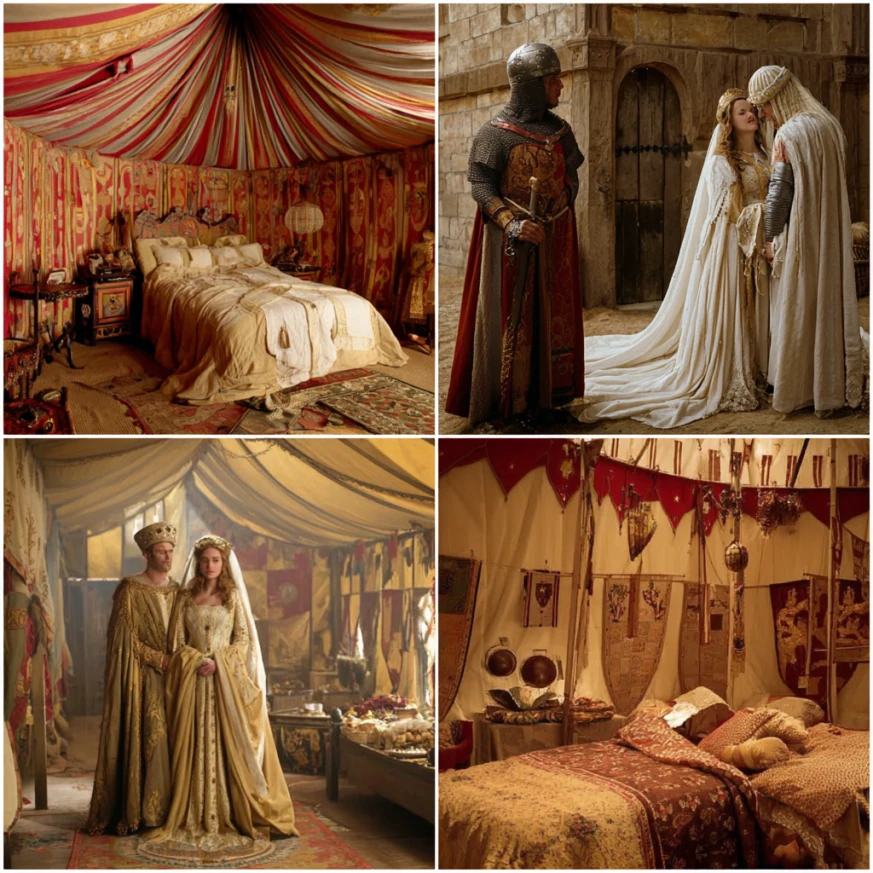
There was never one script. The rite bent to local humour, local law and local housing.
- England: priestly blessing, the spiced posset, stocking throwing, and at court a heavy political overlay — a royal bedding announced that an alliance was sealed.
- German-speaking lands: musicians, bawdy songs and noise outside the door, with the couple dressed for bed separately beforehand.
- Scotland: Barclay’s work shows the bedding was common well beyond the nobility, with neighbours putting ordinary couples to bed as a sign of community approval.
- France: the court version was pure protocol, while a rowdier village tradition of bringing the couple a drink in the small hours — jokes included — survived long after the formal rite died.
Our deeper regional breakdown lives in the changing face of nuptial bedding ceremonies in medieval and early modern Europe.
Versailles, 1770: the ritual at its most formal
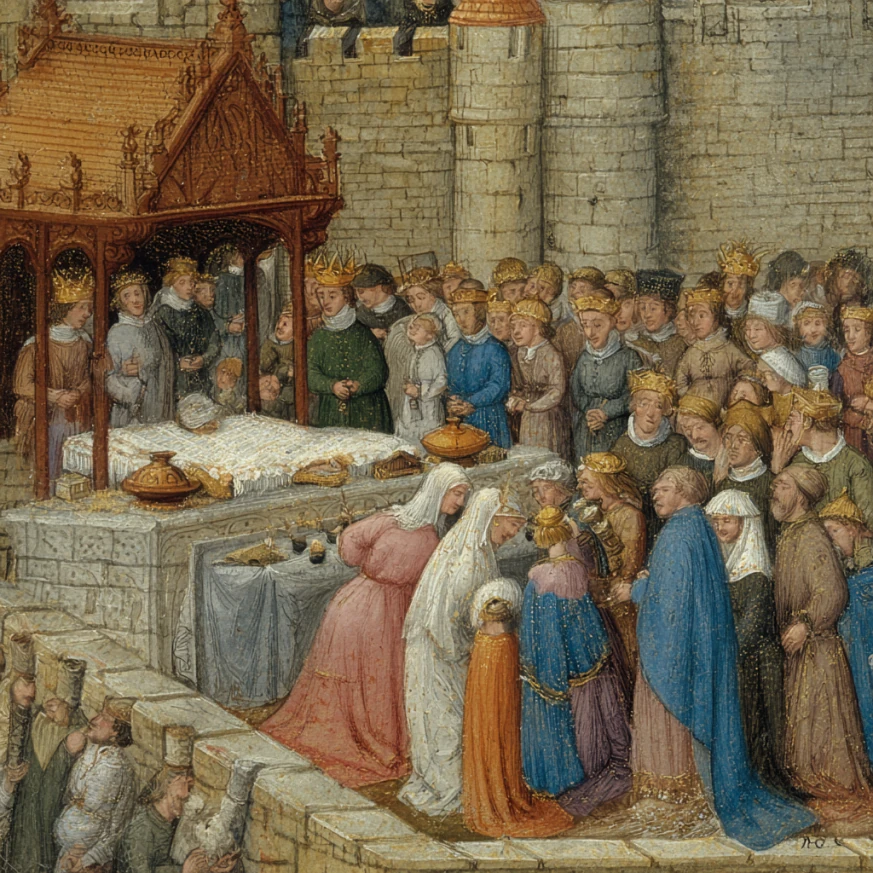
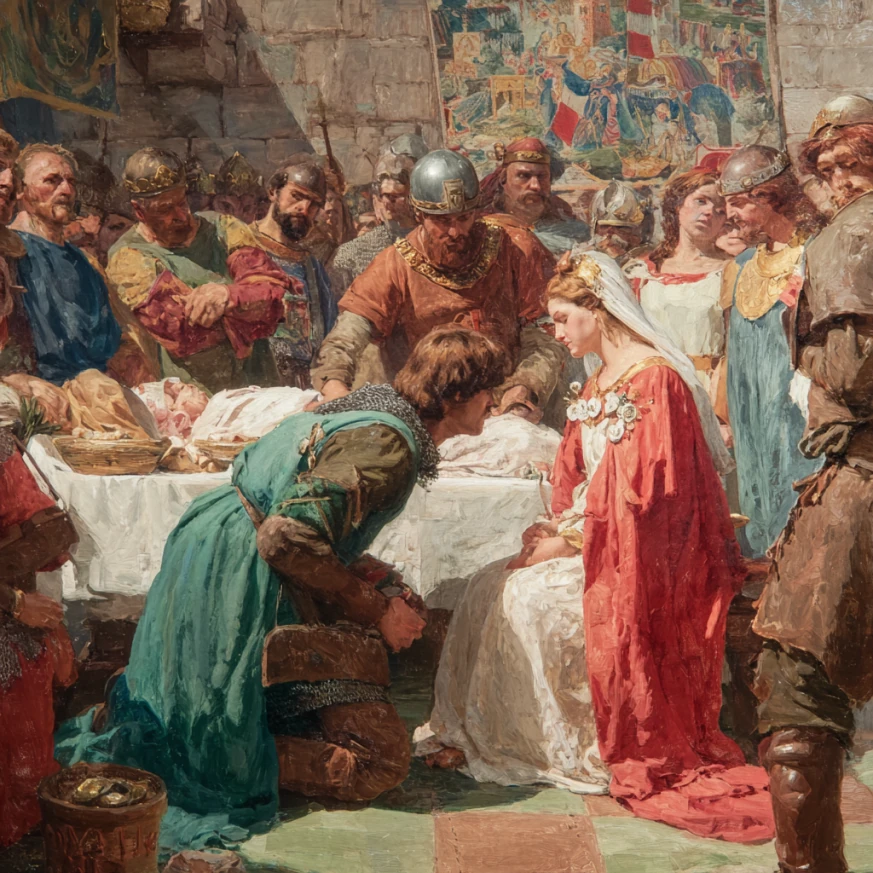
The best-documented bedding of them all happened late in the tradition’s life. When the future Louis XVI married Marie Antoinette at Versailles on 16 May 1770, the Archbishop of Reims blessed the bed, the king handed his grandson his nightshirt, the Duchess of Chartres handed the dauphine hers, and the couple lay down in front of the assembled court to show they shared the same bed.
Two things stand out. First, this was theatre of state, not a peep show — the courtiers bowed and left. Second, it worked as ritual and failed as biology: the marriage famously went unconsummated for years, which is a decent reminder that the ceremony proved a couple had been put to bed, and nothing more.
When did nuptial bedding ceremonies end?
Gradually, and at different speeds for different people. Charles I of England reportedly barred his bedroom door against the wedding party, yet the custom carried on for roughly another century across social classes, royalty included. Several historians of English royal weddings place the death of the public royal bedding around the end of the 1600s, while the French court was still performing it in 1770. In rural communities, versions of neighbours putting a couple to bed lingered into the nineteenth century.
Three forces pushed it out:
- Paperwork replaced people. As parish registers, marriage licences and civil records became the proof of a valid marriage, eyewitnesses in the bedroom stopped being necessary.
- Houses changed. Corridors, separate bedrooms and the idea of personal privacy made a crowd in the bedchamber feel like an intrusion rather than a compliment.
- Manners changed. Enlightenment politeness and then Victorian propriety recast the wedding night as the couple’s own business. The wedding stayed public; the night went behind a closed door.
If you want the dates and the arguments laid out in full, see our guide to when bedding ceremonies ended.

Myth versus record
Fantasy drama has done the bedding ceremony’s reputation no favours. The version where a jeering crowd carries the bride off and stays to watch is the exception, not the rule. Sources describing the rite across Europe agree that the witnessing was usually of the couple being placed in bed together, after which everyone left; actual observed consummation shows up in a handful of high-stakes dynastic cases, not in ordinary weddings.
A few other claims deserve a shrug. The idea that grooms carry brides over the threshold because of Roman or medieval bedding custom is repeated everywhere and pinned down almost nowhere; it may be genuinely old, but the chain of evidence is weak. Same with neat symbolic meanings assigned to bedding colours. We go through the shaky bits in were bedding ceremonies real.
Then and now
| Element |
Then |
Now |
| Purpose |
Public proof the marriage had begun |
Private start to married life |
| Audience |
Family, neighbours, courtiers |
Nobody, by design |
| Proof of marriage |
Witnesses and consummation |
Signed register or licence |
| What’s at stake |
Inheritance, alliances, legitimacy |
The relationship itself |
| Ritual objects |
Blessed bed, spiced posset, flowers |
Fresh linens and a decorated room |
What survives today
The closest living relative is the Jewish practice of yichud, when the couple withdraw alone to a private room immediately after the ceremony, with witnesses confirming the seclusion. In traditional law this publicly signals their new status as husband and wife — the same logic as the old bedding rite, minus the audience and the drinking songs.
Elsewhere the echoes are softer: the decorated honeymoon suite, guests seeing the couple off at the end of the night, the bouquet toss standing in for the flung stocking. Some couples have revived a gentle, consent-first version of the escort as a bit of wedding theatre, which we cover in is the bedding ceremony still practised today.
FAQ
Were nuptial bedding ceremonies real?
Yes. They are documented across medieval and early modern Europe, in royal accounts, church records and folklore collections, among ordinary families as well as the nobility.
Did guests really watch the couple have sex?
Almost never. The standard pattern was to see the couple into bed, bless them, tease them and leave. Observed consummation appears only in rare, politically loaded royal cases.
Was the ceremony legally required?
No single law demanded it, but it functioned as evidence. After the Council of Trent’s 1563 decree, a priest and witnesses were required for a valid Catholic marriage, and consummation made a union far harder to annul.
When did the tradition stop?
There is no clean end date. It faded from courts between the late 1600s and the late 1700s and survived in some rural communities into the 1800s.
Why did the custom disappear?
Written records replaced eyewitnesses, houses became more private, and social manners turned sharply toward modesty.
Updated September 2026.