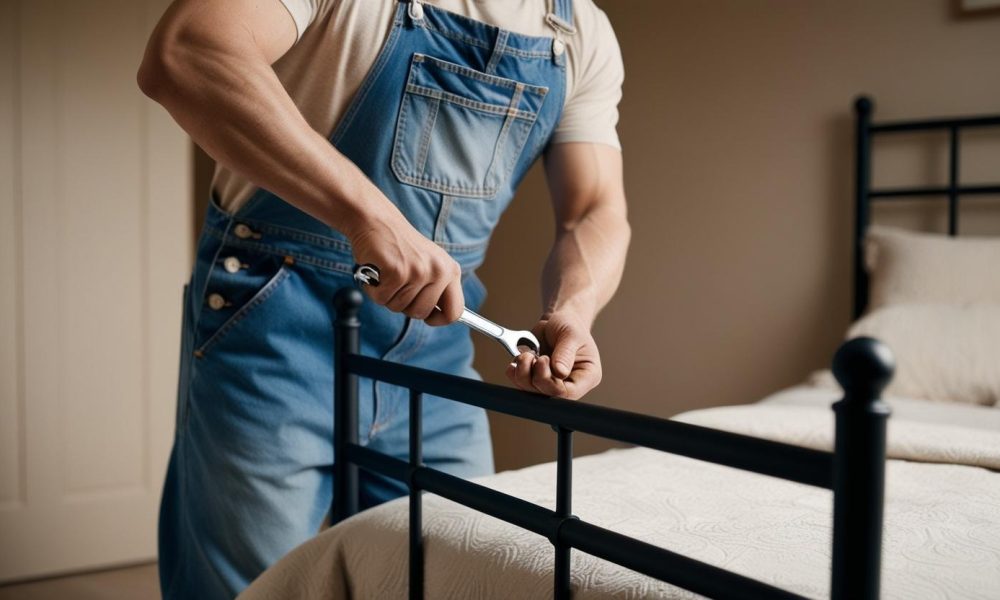
Most squeaky metal bed frames are fixed by tightening every bolt and screw, then padding the spots where metal touches metal. If noise remains, lubricate the joints with a silicone or dry PTFE spray, secure loose slats, level the legs, and add a center support bar so the frame stops flexing under load. Nearly all of this takes one hour, basic hand tools and under $25 of felt pads, washers and lubricant. If you’re not sure what’s making the sound, start by tracking down the noise source .
First: Find the Noise, Then Fix It
Guessing wastes time and materials. Strip the bedding, lift the mattress (and box spring, if you use one) off the frame, and set them aside so you can see and reach every joint. Then work through this quick diagnosis:
Press down on the bare frame at the head, middle and foot. If it creaks with nothing on it, the frame or its hardware is the problem.Put the mattress on the floor for a night. If the noise disappears, the frame or foundation is at fault. If it follows the mattress, the coils or the box spring are the source.Rest a hand on different parts while someone else shifts their weight on the bed. You can usually feel the vibration at its source — a side rail bracket, a slat end, or a leg on a hard floor.Look for shiny, rubbed patches on the metal. Polished spots mark exactly where two parts are grinding.
Checking and tightening bolts is the first step to a stable metal bed frame. 1. Tighten Every Fastener
Loose hardware is the most common cause of bed frame noise, because nightly movement slowly backs bolts out. Work systematically from headboard to footboard with a screwdriver, hex key and wrench or socket set: headboard and footboard mounts, side-rail bolts, corner brackets, center-beam hardware and any slat screws. Hand-snug plus a small extra turn is enough — over-tightening strips threads and deforms thin brackets.
For bolts that loosen again and again, a dab of medium-strength (blue) threadlocker helps. Blue threadlockers are designed to stop fasteners loosening from vibration while still being removable with ordinary hand tools, which is exactly what you want on furniture you may disassemble later.
If a bolt hole has gone oval or a screw spins without biting, replace the fastener with the next gauge up or fit a new washer; a bolt that can’t be tightened will keep creaking no matter what else you do.
Rubber pads help reduce both squeaks and unwanted movement. 2. Pad Every Contact Point
Once hardware is tight, the remaining noise is friction. A compressible barrier between two hard surfaces removes it almost instantly. Useful placements:
Rubber or nylon washers under bolt heads and between bracket faces
Self-adhesive felt pads between slats and the rails they sit on
Felt or rubber pads under the feet, where the frame meets hardwood or tile
Strips of old cotton fabric or cut yoga mat wedged into gaps you can’t reach with pads
Thick industrial felt lasts longer than thin craft felt, and rubber outperforms felt anywhere the joint carries real load. Padding the feet has a second benefit: it stops the frame skating across a smooth floor and protects the finish underneath.
3. Lubricate Metal Joints — With the Right Product
For metal-on-metal squeaks in hinges, brackets and rail hooks, a light silicone spray or a dry PTFE lubricant is the best choice: both reduce friction without leaving a sticky film that collects dust. Spray sparingly onto the contact surface, wipe the excess, and keep it off bedding and flooring. White lithium grease is an option for heavy, older frames where a spray keeps wearing off.
Two cautions worth stating plainly. First, penetrating oils such as WD-40 will quiet a metal joint, but they are thin, evaporate over time and can stain porous surfaces, so they need reapplying and shouldn’t be used near fabric or bare wood. Second, we couldn’t find independent lab testing that ranks lubricants specifically for bed frames — the guidance above reflects what each product type is formulated to do, not a controlled test. If you’re unsure, test on a hidden section first.
Extra slats prevent sagging and improve mattress support. 4. Secure, Space and Replace the Slats
Slats that shift produce both clicks and thuds, and slats that are too far apart let the mattress sag into the gaps — which puts uneven load on the frame and creates new noise. Fixes, in order of effort:
Stop the movement: non-slip tape, hook-and-loop strips or small screws (where the frame allows) hold slats in position.Replace what’s failing: swap cracked, warped or bowed slats for straight, sturdier boards.Close the gaps: add extra slats, or lay a bunkie board or plywood panel across the existing ones for uniform support.
On spacing, follow your mattress manufacturer rather than a blanket rule. Foam and latex beds typically require closely spaced slats — often around three inches or less — and exceeding the stated gap can void the warranty, but the exact figure is set by the mattress maker, so check the warranty card or care label for your model. If you’re weighing up bed bases, our guide to the main mattress types explains which constructions need the firmest, flattest support.
5. Level the Frame and Quiet the Feet
A frame that rocks makes micro-movements all night, and every one of those movements is a chance for a joint to chirp. Check the frame with a spirit level, then shim low legs with thin cork, hardwood wedges or adjustable furniture pads until there is zero rock in any direction. On very hard or very slippery floors, furniture cups or a thin rug under the legs isolate the frame from the surface. If your frame has a center beam with its own feet, make sure those feet actually reach the floor — a floating center foot is a classic hidden squeak.
A center support bar strengthens large frames like queen and king sizes. 6. Add a Center Support Bar
Many budget metal frames have no center beam, so the middle of the bed flexes with every movement. A steel or wooden center support bar with its own leg spreads the load and removes that flex, which is often the single biggest improvement on queen and king frames. Universal adjustable support kits fit most rail widths and install with basic tools. If your frame already has a beam, confirm the bracket bolts are tight and the leg is padded at the floor.
7. Reinforce Corners With Brackets or Cross-Bracing
If the frame still shifts when you push sideways on a corner, the joints have too much play. Two options:
Corner brackets or L-braces bolted to the inside faces of each corner joint, which stop the rails pivoting against the head and footboard.Cross-bracing — angled metal straps or flat bar running diagonally across the underside of the frame. Triangles resist racking far better than rectangles, which is why the technique is standard in construction and furniture making.
This is the most involved fix, so do it last and only if noise persists. Use hardware rated for the load, drill carefully into existing holes where possible, and re-check the bolts after a week of use.
Don’t Forget the Mattress and Box Spring
Sometimes the frame is innocent. Aging innerspring mattresses creak as coils and border rods wear, and a tired box spring flexes and clicks under load. Rotate the mattress (or flip it, if it’s two-sided) and retest. If the noise is inside the mattress or foundation, no amount of frame work will fix it — foam, latex and solid platform bases have no moving parts and stay quiet by design. A platform bed is generally the quietest setup available because it removes the box spring from the equation altogether.
Metal vs Wood: Why They Sound Different
The material changes the noise and the fix. Metal frames tend to squeak and rattle at fasteners and brackets, and can pop slightly as temperature changes. Wood frames creak more deeply, and swell and shrink with humidity, which loosens joinery seasonally.
Aspect
Metal frame
Wood frame
Typical noise
High-pitched squeak, rattle, clank at joints
Lower creak or groan as parts flex
Main cause
Loose bolts, metal-on-metal friction
Wood-on-wood friction, humidity movement
Best lubricant
Silicone spray, dry PTFE, lithium grease
Paste wax, beeswax or dry bar soap
Best reinforcement
Brackets, cross-bracing, center support bar
Corner brackets, wood glue on hairline splits, shims
Avoid oil-based sprays on wood — they can darken bare or finished timber and they soak in rather than sitting on the surface. Wax is the safer choice there. If you’re deciding between materials for a new bed, compare the trade-offs in our guides to wood vs metal bed frames and the pros and cons of a metal bed frame .
Does a Squeak Really Matter for Sleep?
A creak is not just an annoyance. Sleep disturbance is one of the most significant health effects of environmental noise, and the World Health Organization recommends keeping bedroom sound levels below 30 A-weighted decibels at night for good-quality sleep. Most of that research looks at traffic and aircraft noise rather than furniture, so treat it as context, not a measurement of your bed. What is fair to say: a noise you make yourself every time you roll over can keep you lying still to avoid it, and it affects anyone sharing the bed. For the wider picture, see our tips on creating a quieter sleep environment .
Which Fix Solves What
Method
Best for
Effort
Tighten all fasteners
Most squeaks, rattles and wobble
15 minutes
Felt or rubber padding
Friction noise, floor scuffing, sliding
15 minutes
Silicone or dry PTFE lubricant
Metal-on-metal squeal at brackets
10 minutes
Secure or add slats
Clicks, thuds, mattress sagging
30 minutes
Level and shim the legs
Rocking frames, uneven floors
15 minutes
Center support bar
Middle sag on queen and king frames
30–45 minutes
Brackets and cross-bracing
Persistent flex and sideways movement
1 hour+
Keeping It Quiet: Maintenance Schedule
Every 3–6 months: re-tighten all hardware, check pads are still in place, confirm the frame doesn’t rock.Twice a year: wipe dust from joints and slat ends — grit increases friction — and refresh lubricant on metal contact points.Annually: inspect slats for cracks or excessive flex and check for rust; treat any rust promptly, since corroded surfaces grind.After every move or reassembly: renew threadlocker and fit fresh pads at friction points before the bed is loaded again.
Keeping a screwdriver, hex keys, a few felt pads and a small can of lubricant in a drawer makes this a five-minute job rather than a project.
Mistakes to Avoid
Over-tightening. Stripped threads and bent brackets create permanent play.Over-lubricating. Excess spray attracts dust and drips onto floors and bedding.Fixing before diagnosing. Treat the joint that’s actually making the noise, not all of them at once.Ignoring the center. Queen and larger frames need proper middle support; padding the corners won’t compensate.
Repair or Replace?
Repair when the noise comes from loose hardware, friction, slats or levelling — that covers the large majority of cases. Replace when the frame shows cracked welds, bent rails or legs, widespread rust, or when several rounds of fixes only buy a few weeks of quiet. Bolt holes that have worn oval are also a strong signal, since nothing will hold tight in them. For a thin, well-used budget frame, a sturdier replacement often costs less than repeated repairs; a solid frame is usually worth fixing. If you’re shopping, our guide to choosing the best bed frame for your mattress and style covers what to prioritise, and looking for “noise” or “squeak” in owner reviews is a genuinely useful filter.
FAQ
How do I stop my metal bed frame from squeaking fast?
Remove the mattress, tighten every bolt and screw, add felt pads or rubber washers wherever metal touches metal, then spray a little silicone lubricant on the brackets. That sequence resolves most squeaks in well under an hour.
What can I put under my metal bed frame for support?
Extra slats, a bunkie board or a plywood panel for mattress support, plus a center support bar with its own leg for queen and king sizes. Non-slip tape keeps slats from shifting.
Can I use a metal bed frame without a box spring?
Yes, as long as the mattress has continuous, closely spaced support — slats within your mattress maker’s specified gap, or a solid panel. Foam and latex mattresses in particular need a flat, firm base rather than a flexible foundation.
Is WD-40 safe on a bed frame?
It works on metal joints, but it’s a thin penetrating oil that needs reapplying and can stain porous materials. A silicone or dry PTFE spray is a better long-term choice for metal, and wax is the safer option on wood.
Does humidity make bed frames squeak?
It mainly affects wood, which swells in humid weather and shrinks in dry air, loosening joints seasonally. Metal frames are far less sensitive, though they can expand and contract slightly with temperature.
Is it normal for a brand-new frame to squeak?
It happens, and age is not the only factor. New frames often squeak because hardware wasn’t fully tightened during assembly or because parts have settled — retighten everything after the first week or two of use.
Is it safe to keep sleeping on a squeaky frame?
Usually yes, but a persistent noise can indicate loose joints or a weakening support. Deal with it early rather than waiting for a slat or bracket to fail.
The Short Version
Tighten, pad, lubricate, secure the slats, level the legs, support the middle, then brace the corners — in that order, testing after each step. Most metal frames go from creaky to silent for the price of a bag of felt pads, and a twice-yearly ten-minute check keeps them that way.
Updated September 2026.