The Definitive Bedroom Rug Guide: Size, Placement & Style

bedroom rug guide - definitive bedroom rug

A Practical Guide to Choosing Bedroom Rugs

Updated: August 30, 2025

Bedroom rug guide: Ever notice how some rooms feel calm the second you walk in? The right textile underfoot fixes scale and style at the same time. This friendly bedroom rug guide gives you fast rules, mattress-by-mattress sizes, and small-space workarounds so you step onto softness every morning. For a full-room approach, also see our living room rug size rules.

Key Takeaways

  • Follow the two-foot rule: leave ~24″ of rug on the two long sides and the foot of the bed.
  • Queen = 8’x10’, King = 9’x12’; use 6’x9’ for tight queen rooms pulled slightly past the footboard.
  • Float living room pieces so at least front legs sit on the rug; extend dining rugs 24–36″ past the table.
  • Pick pile height for lifestyle: plush for comfort, low pile for easy cleaning and door clearance.
  • Measure first. A bedroom rug guide mindset prevents the “too small” look and saves returns.
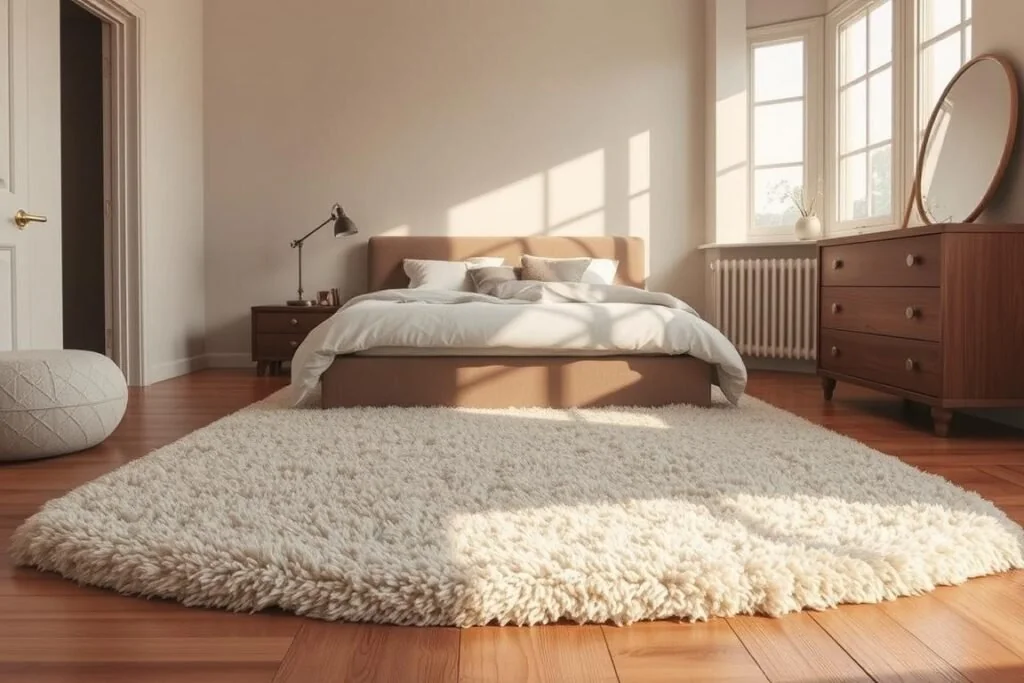
Bedroom rug size guide showing an 8x10 rug under a queen bed with 24-inch borders

A quick visual: an 8’x10’ under a queen, leaving ~24″ around the sides and foot.

Bedroom Rug Guide at a Glance: Sizes That Always Work

You don’t need guesswork. Use these dependable dimensions and you’ll get balanced proportions in most bedrooms.

Quick bedroom rug guide: Twin 5’x8’, Full 6’x9’, Queen 8’x10’, King 9’x12’

Start here to shortlist options. These sizes anchor the bed and keep nightstands and benches reading as one composition.

The 2-foot rule: Leave about 24 inches on three sides of the bed

Plan for roughly 24″ of soft surface on the two long sides and at the foot. In a tight queen room, a 6’x9’ can still work if you pull it a quarter past the footboard.

  • Prioritize width so the rug extends slightly beyond nightstand edges.
  • Avoid matching rug width too closely to the mattress—it looks squished.
  • Planning an upgrade? Choose a size that can scale with a larger mattress later.

Quick tip: Note bed, nightstand, and room measurements before you shop. It turns buying into a one-step decision.

How to Place an Area Rug Under Your Bed for the Right Look

Placement changes how the whole room reads. Test these four layouts and pick what fits your space and habits best.
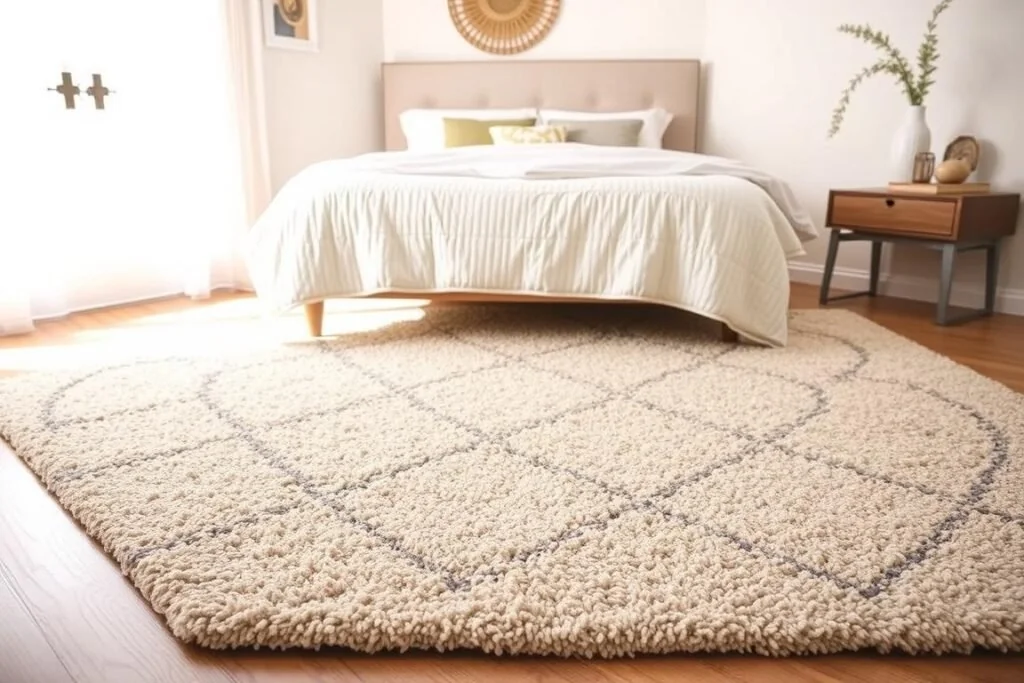
Four classic layouts from the bedroom rug guide showing rug placement under bed - definitive bedroom rug

Four classic placements: full coverage, two-thirds under, side accents, or a runner at the foot.

All the way under

Go hotel-plush: the bed, nightstands, and bench sit fully on the rug. The result is cohesive, quiet, and anchored.

Two-thirds under

Slide the rug so the top third stays in front of nightstands and pull it a bit past the footboard. You’ll see more pattern where it counts.

Side-by-side accents

In very tight rooms, use two 2’x3’ mats for soft landings on each side. Align their front edges with the nightstands for symmetry.

Runner at the foot

A runner warms the aisle without bulk on the sides. If possible, rest footboard legs on the runner for a finished edge. Layer a favorite small rug over a larger neutral base when you need extra scale.

  • Center the layout on the room’s main axis for cleaner sightlines.
  • Check doors and drawers—leave clearance so nothing scrapes the pile.
  • Mark edges with painter’s tape to preview coverage before committing.

According to the Sleep Foundation, a calming, well-designed sleep space supports rest—and soft rugs underfoot contribute to that restful environment.

Bed-By-Bed Rug Size Breakdown: Twin, Full, Queen, and King

This section of the bedroom rug guide matches real room constraints with sizes that feel right the moment you step out of bed.

Twin

A 5’x8’ usually provides generous side coverage in kids’ or guest rooms. In narrow layouts, try a long runner on one side or two shorter runners for targeted softness.

Full

For a full bed, 6’x9’ hits the sweet spot. If space is tight, flank with runners aligned to nightstand fronts so feet land on cushioned surfaces.

Queen

Choose an 8’x10’ for balanced proportions. If a 6’x9’ is all that fits, pull it down so at least a foot of rug shows at the end of the bed.

King

A 9’x12’ feels properly scaled. Keep ~8″ between rug edges and nightstands and aim for ~12″ beyond the foot so the setup reads finished.

  • Footboard detail: If your frame has feet, place them on the rug for an intentional look.
  • Low-profile platform frames can sometimes size down and still feel balanced.
  • Check vents and heater registers so nothing blocks airflow.

Materials That Feel Great Barefoot: Wool, Viscose, and Synthetics

Fiber choice changes the first step of your day. Pick what matches comfort, care, and budget.
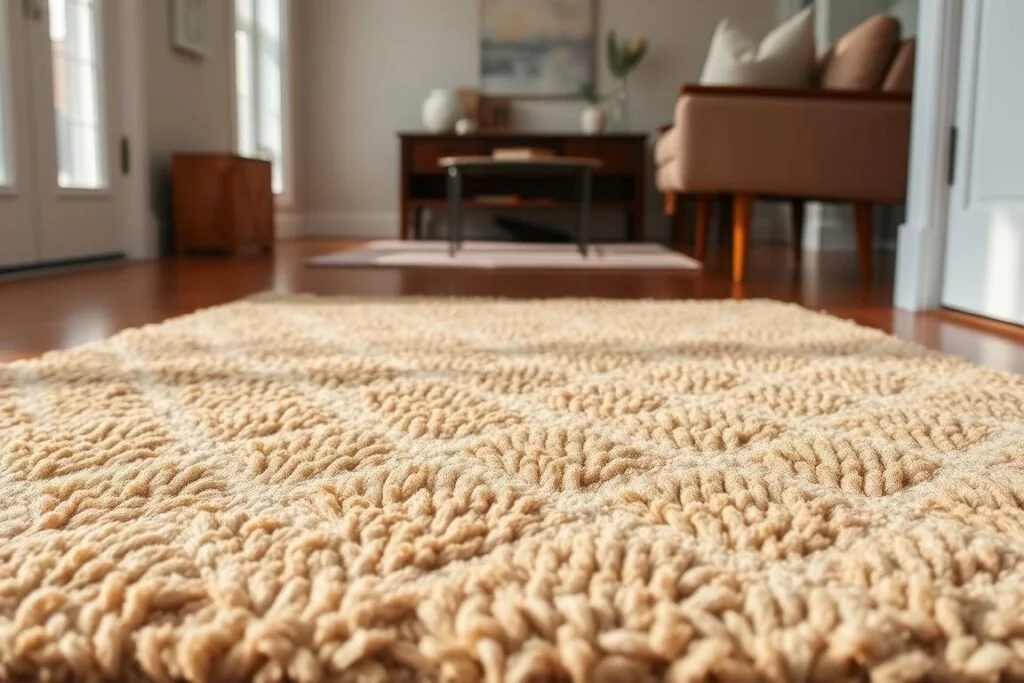
Different rug materials from the bedroom rug guide including wool, vis featuring definitive bedroom rug

Wool for cozy durability, viscose for sheen in low-traffic rooms, synthetics for value and easy care.

Wool: Naturally soft, insulating, and great at hiding footprints. A top pick for cozy bedrooms.

Viscose (silk blends): Velvety sheen and luxe look, but gentler care—best for low-traffic primary suites.

Synthetics (nylon, polyester, PET): Budget-friendly and easy to clean. PET resists stains and holds color well.

For responsible shopping, review textile standards with Ethical Bedding’s certification guide before you buy.

  • Tip: Check door clearance, rotate rugs for even fading, and filter by material when shopping to save time.

Color and Style: From Neutral Bedroom Rugs to Statement Patterns

Color sets the mood in seconds. Use this bedroom rug guide mindset: calm where you rest, character where you want energy.

Neutral tones for a calm, sophisticated look

Beige, gray, and ivory play nicely with changing bedding and paint. Wool adds warmth without shouting; viscose blends give a subtle, dressy sheen.

Bold colors and patterns that won’t overwhelm

Let the rug be the statement. In smaller rooms, pick tighter motifs or tone-on-tone patterns so the eye can rest. On hardwood, layer a flatweave under a patterned top piece for depth without bulk.

  • Echo a hue from the rug in pillows or art for cohesion.
  • Test swatches in daylight and lamplight—colors shift after dark.
  • Lighting matters. See our Bedroom Lighting Guide.

Small Bedrooms and Apartments: Smart Rug Layouts That Maximize Space

Small floor plans benefit from layered solutions that make the room read larger and calmer.
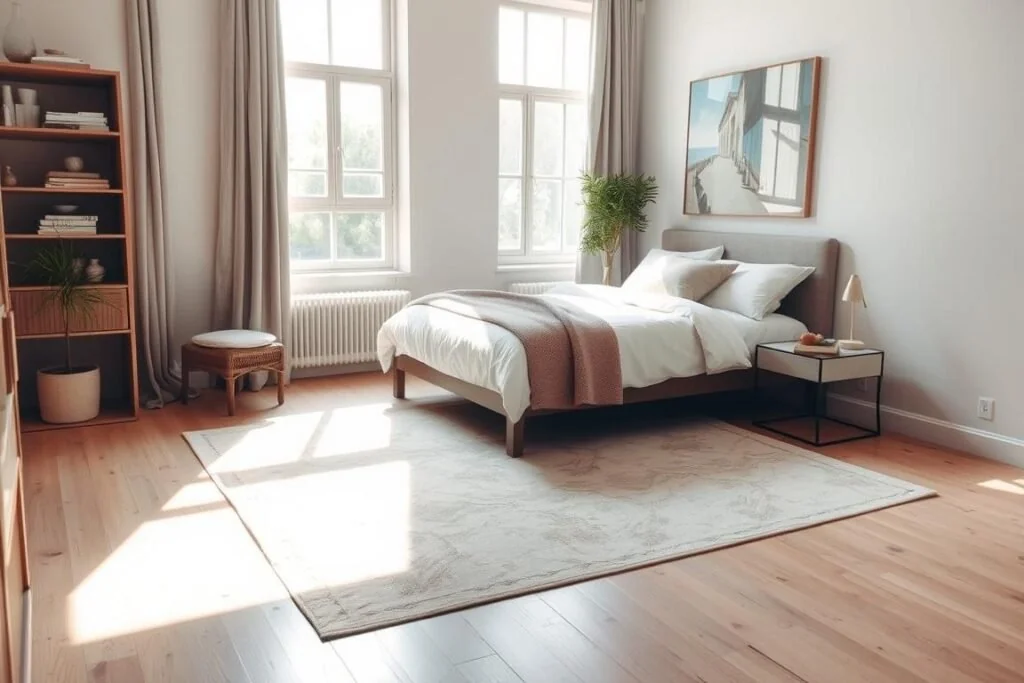
Bedroom rug guide example for small room rug layouts using layering - definitive bedroom rug

Layer a natural jute base, then center a smaller patterned rug for scale without overspending.

When smaller textiles work

If your bed sits against a wall, float a smaller rug in front to keep the footprint tidy. When furniture floats, size up so legs land on the rug and the floor reads as one field.

  • Keep 3–6 inches between rug edges and baseboards in very tight rooms.
  • Prefer light tones to expand visual space; avoid heavy borders that box the area.
  • Use low pile to clear doors and reduce trip edges.

Try these space-smart strategies:

  • Layered base + top: 9’x12’ jute with a smaller showpiece on top for scale.
  • Small float: A compact rug in front of a wall-anchored sofa or bed.
  • Upsized field: Choose the next standard dimension when furniture floats.

For whole-home flow, see our Dining Room Rug Size Guide.

Runners and Side Rugs: Cozy Alternatives to Full Area Rugs

Not every room needs a giant rug. Place softness exactly where you step and keep the center open and airy.

Two 2’x3’ accents for warm landings

Set a 2’x3’ on each side and align their front edges with your nightstands. It feels intentional from both sides of the bed.

2.5’x8’ runners for narrow layouts

Great in tight aisles or along a king. Pick low pile so doors and closet swings clear the surface.

  • Side mats give softness where you need it without crowding the room.
  • A long runner warms the path at the foot of the bed.
  • Leave ~3″ from baseboards to avoid curling and ease cleaning.
  • Use cushioned pads under runners for extra comfort and grip.
  • Match pieces from one collection to repeat pattern across the room.

Common Rug Mistakes to Avoid in the Bedroom

Small scale choices can make a good design feel piecemeal. Fixes are simple when you know what to look for. Prefer a video walk-through? Watch this concise explainer: How to choose the right rug size.

Buying too small: Why chopped-up rooms look accidental

Undersized pieces leave skinny strips on the sides of the bed. Aim for at least ~24″ on three sides so the bed ties to the floor.

Rug width too close to bed width: The “squished” effect

When widths match, the outline feels tight. If you love a smaller piece, layer it over a larger natural-fiber base for proper scale.

Legs on or off: Be consistent

Pick a lane—either all legs on or all off. Mixed legs look awkward and make zones feel incomplete.

Orient to the room, not just the bed

  • Run the rug with the room’s long axis in narrow spaces.
  • Maintain clear walkways to closets, baths, and doors.
  • Preview with painter’s tape; it catches scale issues fast.

Quick tip: In multi-use bedrooms, one larger rug usually beats several small ones for unity.

Beyond the Bedroom: A Quick Room-to-Room Rug Size Guide

Use these simple sizing rules to make every space feel intentional and easy to move through.

Living room essentials: Start with 8’x10’ or 9’x12’. Keep 30–36″ of walkway around major furniture and set at least front legs of seats on the rug. See our living room size rules.

Dining room math: Add 24–36″ beyond table edges so chairs stay on the rug when pulled out. Choose low pile for easy movement. Learn more in our dining room rug guide.

Hallways & entryways: Use runners with ~3″ wall clearance. Avoid seams at doorways on very long corridors.

Kitchen & bath: Place runners or 2’x3’ accents at sinks and vanities for traction and comfort.

Want fiber deep-dives? Try Rug Materials 101 next.

FAQ

What size rug works best under a queen bed?

An 8’x10’ is the most reliable pick. In tight rooms, a 6’x9’ can work if you pull it down so at least a foot of rug shows at the end.

Should nightstands sit on the rug?

It’s optional. For a plush, hotel feel, place them fully on. For flexibility, keep the top third of the rug in front of the nightstands.

Do I need a rug pad in the bedroom?

Yes. Pads add cushion, reduce slipping, and help rugs last longer—especially helpful on hardwood and with runners.

What if my rug is a bit too small?

Layer it over a larger jute or sisal base. You keep the pattern you love and gain the scale the room needs.

Conclusion

Wrap up your layout with sizes that fit how you live. This bedroom rug guide boils it down: Twin 5’x8’, Full 6’x9’, Queen 8’x10’, King 9’x12’, plus the ~24″ rule for comfy step-offs. Pick wool for warmth, viscose for low-traffic sheen, or PET for easy care. Anchor living and dining furniture (front legs on; chairs fully on), keep measurements handy, and you’ll build calm, cozy rooms that work every day. For more cozy, practical ideas, visit Cozy Bed Quarters.

Other reading we found popular

30 Bedroom Wall Decor Ideas to Elevate the Space Above Your Bed

Cozy bedroom with a gallery wall above the bed, layered pillows, and s featuring bedroom wall decor elevate

Wall Accessories That Add Personality to Bedrooms

If you’ve been wondering how to decorate that big blank space above your bed, bedroom wall accessories are the answer. With the right mix of style, scale, and personal touches, you can turn your room into a warm, inviting retreat (Updated 2025). Whether you lean modern, rustic, or cozy cottage, these 30 above-the-bed ideas will help you style your space beautifully. For broader inspiration, see our bedroom lighting guide for finishing touches.


30 Bedroom Wall Decor Ideas to Elevate the Space Above Your Bed - bedroom wall decor elevate

Bedroom wall accessories instantly bring style and warmth to a space that often feels bare.

Key Takeaways

  • Bedroom wall accessories add personality and warmth to any blank space.
  • Above-the-bed decor can be simple, bold, or layered depending on your style.
  • Large-scale pieces create a striking focal point without clutter.
  • Mix textures, colors, and personal touches for a cozy, collected look.

Statement Art for Above the Bed

Big art makes big impact. A single oversized piece centers your bed and sets the tone the moment you walk in.

Oversized Canvas

An oversized canvas creates drama with minimal effort. It shines in modern or minimalist rooms where clean lines matter.

30 Bedroom Wall Decor Ideas to Elevate the Space Above Your Bed - bedroom wall decor elevate

Try a calming landscape for serenity, or a bold abstract for energy. Example: In a neutral primary bedroom, a 48×36 canvas adds instant presence without a gallery wall.

Framed Prints

Prefer flexibility? Pair two or three coordinated prints for symmetry, or mix styles for a gallery feel you can tweak over time. Example: Black-and-white photos above a walnut headboard keep things crisp yet personal.

Cozy Textures and Soft Touches

Textile accents soften sharp lines and make the room feel welcoming. They add movement, depth, and a handcrafted vibe.

Woven Wall Hangings

Macramé and woven hangings suit boho and farmhouse looks. For a cohesive style, layer them with picks from our modern farmhouse bedroom guide.

30 Bedroom Wall Decor Ideas to Elevate the Space Above Your Bed - bedroom wall decor elevate

Mini-scenario: In a small apartment, a light, fringed hanging keeps things airy while adding texture over a low headboard.

Decorative Quilts

Hanging a quilt brings color, pattern, and cozy nostalgia. It’s great for rustic rooms or anywhere you want softness without bulk. Tip: Use a sleeve or rod so the fabric hangs evenly.

Mirrors That Brighten the Space

Mirrors bounce light and make small rooms feel open. They’re stylish and practical, especially near multi-use setups like a sofa bed.

Round Statement Mirror

A round mirror softens straight furniture lines and adds balance. Place it a few inches above the headboard for a tailored look.

30 Bedroom Wall Decor Ideas to Elevate the Space Above Your Bed - bedroom wall decor elevate

Example: In a narrow room, a 30- to 36-inch round mirror lifts the eye and spreads morning light across the bed wall.

Antique Frames

Love vintage? An ornate mirror adds instant character. Hunt flea markets for patina and detail, then secure it safely to studs.

Nature-Inspired Wall Decor

Nature cues calm. Greens, botanicals, and organic textures help your bedroom feel like a retreat. According to the CDC, adults need at least seven hours of sleep per night; creating a soothing environment supports that routine. If you’re shopping for safer materials, look for certified bedding labels for added peace of mind, and explore gentle palettes in our light green bedroom ideas.

Botanical Prints

Botanical art is timeless and easy to style. A trio above the bed adds symmetry and color without maintenance.

30 Bedroom Wall Decor Ideas to Elevate the Space Above Your Bed - bedroom wall decor elevate

Scenario: Mix two leafy prints with one floral to keep the look coordinated but not matchy-matchy.

Dried Flower Arrangements

Pressed florals, pampas, or dried stems bring organic texture that lasts. Keep compositions simple so they don’t compete with bedding patterns.

Creative and Personalized Options

Your bed wall is prime storytelling space. Blend sentimental pieces with art so the room feels personal and collected.

Gallery Wall

Combine family photos, art prints, and quotes with consistent spacing for a polished look. Tip: Tape paper templates first to test your layout before you hang.

Floating Shelves

Floating shelves are practical and pretty. Display candles, small plants, and travel mementos—and swap items seasonally for a refresh. For tight rooms, borrow ideas from small bedroom wall decor.

Large Bedroom Wall Accessories & Decor Ideas

High ceilings or wide walls need larger scale. Aim for pieces that span at least two-thirds of your bed’s width for balance and intention.

Oversized Headboard Art

Choose artwork that runs close to the bed’s width. It anchors the room and draws the eye upward for strong proportion.

Wall Murals

A mural turns your bed wall into a statement. Try soft landscapes for serenity or geometric patterns for modern edge.

  • Oversized Headboard Art — Best for wide rooms; anchors the bed and fixes scale.
  • Wall Murals — Best for feature walls; dramatic and highly personal.

Bonus tip: Soft, indirect lighting over art is a game-changer. See our bedroom lighting ideas to finish the look.

Healthy-sleep note: Gentle, low-glare lighting and calm imagery help routines recommended by the American Academy of Sleep Medicine.

FAQ

What should I put above my bed?

Pick pieces that fit your style and scale: oversized art for bold impact, mirrors for light, shelves for flexibility, or textiles for softness.

Is it safe to hang heavy decor above the bed?

Yes—if you mount securely. Use studs or proper anchors and verify weight limits. Prefer lightweight fabric art or decals for extra peace of mind.

How do I decorate a large empty wall in the bedroom?

Go big on scale. Try a wide canvas, a balanced gallery wall, or a mural to fill space without visual clutter.

Conclusion

Decorating with bedroom wall accessories is one of the easiest ways to add personality, warmth, and polish. From oversized canvases and woven hangings to mirrors and personalized galleries, these above-the-bed ideas can spark your next refresh. For more cozy inspiration, browse Cozy Bed Quarters.

Related reading from Cozy Bed Quarters

Other reading we found popular

Vintage Mirrors for Bedroom Walls: How to Size, Hang, and Style Them

Oval vintage mirrors for bedroom with pastel accents.

Vintage mirrors for bedroom walls work best when the size matches the furniture below them and the glass reflects something worth looking at. A good rule: make the mirror about two-thirds the width of the dresser or vanity it hangs over, leave 4 to 8 inches of wall between the two, and hang it where it catches daylight from a window rather than a blank wall. Everything after that — gilt, oval, sunburst, rustic — is taste.

Sizing: the measurements that actually matter

Most mirror mistakes are scale mistakes. The frame is gorgeous, the proportions are off, and the wall looks unbalanced forever. Measure before you buy.

Over a dresser or vanity

Aim for a mirror roughly 60–75% of the furniture’s width. A 60-inch dresser takes a mirror around 36–45 inches wide. Anything narrower reads like a postage stamp; anything wider than the dresser looks like it wandered in from another room.

Leave 4 to 8 inches between the top of the dresser and the bottom of the frame. Six inches is the sweet spot — close enough to read as one unit, high enough that a lamp or a stack of books doesn’t knock the glass.

For a seated vanity, hang the center of the glass around 42–48 inches off the floor so you’re looking at your face, not your hairline.

Standalone on a wall

Center the mirror about 57–60 inches from the floor. That’s standard gallery eye level, and it’s the height that stops a mirror from floating awkwardly near the ceiling.

Full-length and leaners

You need at least 48 inches of glass height to see yourself head to toe, and 12–16 inches of width to see your outfit without shuffling backward. Most antique cheval and pier mirrors run 60–70 inches tall, which is plenty. If you lean one, set the base 3–5 inches out from the baseboard and strap the frame to a stud with a furniture anchor — a tall mirror is a tip-over risk around kids and dogs.

Above the bed

Keep the mirror no wider than two-thirds of the bed. A queen headboard (60 inches) takes a mirror up to about 40 inches wide, with 8–10 inches of breathing room above the headboard. Honestly, though: heavy antique glass above a sleeping head makes a lot of people nervous, and it should. If the frame weighs more than about 20 pounds, put it on a different wall and use lighter wall decor above the bed instead.

Vintage mirrors for bedroom walls: ornate gilt frame reflecting daylight from a window

Where to hang vintage mirrors for bedroom light

A mirror doesn’t create light, it moves it. So point it at something bright.

  • Opposite a window — bounces daylight into the darkest corner. Best single move in a north-facing room.
  • Perpendicular to a window — softer effect, less glare, and it reflects the view instead of the sky.
  • Behind a lamp or candles — doubles warm light at night. Pairs well with layered bedroom lighting.
  • Facing a closet door or a pile of laundry — don’t. You’ll see it twice.

Stand where you’ll actually be — in bed, at the door, at the vanity chair — and have someone hold the mirror up before you drill. What it reflects at your eye height is the whole point. Some people also sleep badly with a mirror facing the bed; if that’s you, angle it or move it. No study needed, just pay attention to how the room feels.

Which vintage style suits your room

Style Reads as Best spot Watch for
Gilt gesso (carved, gold leaf) Formal, French, a bit grand Over a dresser or fireplace wall Chipped gesso, flaking leaf, heavy weight
Venetian etched Glamorous, light, feminine Above a vanity Cracked glass borders are near-impossible to replace
Sunburst / starburst Mid-century, playful Above a low dresser or between windows Bent or missing rays on gilt-wood versions
Oval walnut or mahogany Victorian, soft, romantic Narrow wall, entry to the room Loose frame joints, veneer lifting
Painted farmhouse / salvaged window Rustic, casual Gallery grouping, above a bench Old paint (see the lead section below)
Arched or Deco stepped Clean, graphic, modern-friendly Small bedrooms and rentals Frameless edges chip easily

Mixing eras is fine and usually looks better than matching. One ornate gold frame against plain white walls does more work than five coordinated mirrors. If your room already runs loud — pattern on pattern, saturated walls — a simple oval keeps things from tipping over into chaos. That balance matters even more with maximalist bedding and bold decor.

Gold-framed antique mirror hung six inches above a wooden bedroom dresser

Gallery walls of small mirrors

Lay the whole arrangement on the floor first, then trace each frame onto kraft paper and tape the shapes to the wall. Keep 2–3 inches between frames — tighter than you’d space art, because mirrors read as one reflective surface. Odd numbers, one clearly biggest piece, mixed finishes but a repeated shape or metal to tie it together.

How to tell if a vintage mirror is genuinely old

Reproductions are everywhere, and some are honest, good-looking furniture. But if you’re paying antique money, check these:

  • The glass itself. Pre-1900 plate glass is often thinner and slightly wavy. Look at a straight line — a door frame, a window mullion — reflected in it. Ripples and distortion suggest age; a perfectly flat reflection suggests modern float glass.
  • The bevel. Old bevels were ground by hand: shallow, sometimes uneven in width, with a soft transition. Modern bevels are crisp, uniform, and usually exactly 1 inch.
  • The back. Original backs show thin wood boards, hand-cut or square nails, oxidized hardware, and genuine grime. Staples, MDF, and clean kraft paper mean the mirror has been reworked — or made last year.
  • The foxing. Real silver deterioration starts at the edges and around fixing points where moisture crept in, and it’s irregular. Faux-antiqued glass has evenly scattered spots across the whole surface, including the middle.
  • The frame material. Tap it. Carved wood with gesso sounds and feels dense; resin castings are light, warm to the touch, and often show a mold seam on the back edge.

Two quick dating anchors help. Mirrors backed with tin-mercury amalgam were the norm for centuries — Winterthur Museum notes these amalgams were used from the end of the 15th century to the mid-19th century, and that the coating is unstable, corroding into dark spots and a duller surface over time. Silvered glass largely replaced it after the 1830s. So a grey, slightly crystalline, sparkly-looking reflective layer points to a genuinely early piece — and to a mirror that needs careful handling.

Safety checks before you hang anything old

Mercury-backed glass

If you think you have an early amalgam mirror, don’t scrape the back, don’t store it flat, and don’t try to “fix” the spots. Winterthur’s conservators handle these with nitrile gloves and keep them in display orientation, because laying them down can let liquid mercury migrate. Hang it, enjoy it, leave the back alone.

Old painted frames

Thinking of repainting a chippy frame? Check the age first. The U.S. EPA notes that lead-based paint for homes was banned in 1978 and that sanding or scraping pre-1978 paint creates hazardous dust. A frame isn’t a wall, but the dust behaves the same way in a bedroom. Use a lead test swab, work outdoors, skip dry sanding, and if it tests positive, clean it gently and paint over it rather than stripping it.

Weight and anchors

Plate glass alone runs about 3.3 pounds per square foot at 1/4 inch thick. A 30 x 40-inch mirror is roughly 27 pounds of glass before you add a carved frame — so 40 to 60 pounds total is normal for a decent antique.

  • Weigh it on a bathroom scale. Guessing is how drywall gets holes.
  • Studs are usually 16 inches on center (sometimes 24 in newer builds). Anything over 20 pounds should hit at least one stud.
  • Use two hanging points, not a single wire — it spreads the load and keeps the mirror level.
  • No stud where you need it? Toggle bolts rated at three to four times the mirror’s weight, never plastic cone anchors.
  • Over about 40 pounds, a French cleat is the calmest option. It carries the load along a strip screwed into two studs.
  • Replace old hanging hardware. Hundred-year-old wire and screw eyes have earned their retirement.

Gallery wall of mixed antique mirrors in oval, rectangular, and sunburst shapes

Cleaning old mirror glass without ruining it

The silvering lives on the back, and liquid creeping under the frame edge is what causes black creeping damage. So:

  1. Spray cleaner onto the cloth, never onto the mirror.
  2. Use distilled water with a drop of dish soap on a microfiber cloth. Skip ammonia and vinegar on antique glass.
  3. Dry the edges immediately with a second cloth.
  4. Dust gilded gesso with a soft brush only — water dissolves old gesso and lifts gold leaf.
  5. Keep antique mirrors out of steamy rooms and off exterior walls that sweat in winter.

Foxing and cloudy patches can’t be reversed at home. Resilvering means removing the old coating entirely, which erases the age you paid for. Most people learn to love the spots.

Small bedrooms: getting more from less wall

In a tight room, one large mirror beats four small ones — it reflects a bigger, uninterrupted chunk of the space instead of chopping it up. Lean a tall mirror in the corner opposite the door, or put mirrored panels on wardrobe doors so the storage does double duty. That trick pairs neatly with other space-saving bedroom ideas, and it keeps floor space clear.

One more thing worth checking: what the mirror does to your bed frame and headboard. A reflected headboard can look twice as bulky in a small room. Angle the mirror so it catches the window and the ceiling instead.

Bedroom wardrobe with antique-finish mirrored doors reflecting the room

Where to look

Estate sales and auction house previews let you inspect the back and the bevel in person, which online listings rarely show. Ask sellers for photos of the reverse, the hanging hardware, and the edges before you commit to shipping — shipping is where antique glass dies. Architectural salvage yards are good for big pier mirrors and old window sashes. Bring a tape measure and a photo of your wall with the dimensions written on it.

FAQ

Are vintage mirrors good for small bedrooms?

Yes, if placed where they reflect a window or a lamp. A mirror facing a blank wall just adds another blank wall.

How high should I hang a mirror over a dresser?

Bottom edge 4 to 8 inches above the dresser top, with the mirror roughly two-thirds the dresser’s width.

Can vintage mirrors work in a modern bedroom?

They usually work better there. One ornate frame against plain walls and simple bedding gives a room the character that flat-pack furniture can’t. Same principle behind mixing eras in a colorful bedroom scheme.

Is it safe to hang a heavy mirror over the bed?

Only into studs, with hardware rated well above the mirror’s weight, and ideally with a French cleat. If you’re not confident, hang it elsewhere.

Should I repaint a chipped antique frame?

You can, but the chips are usually the charm. If the frame predates 1978 and has old paint, test for lead before sanding and consider painting over it instead of stripping.

Updated September 2026.