Rug Size for a Queen Bed: 6×9, 8×10 or 9×12?

rug size for queen bed - size rug need queen

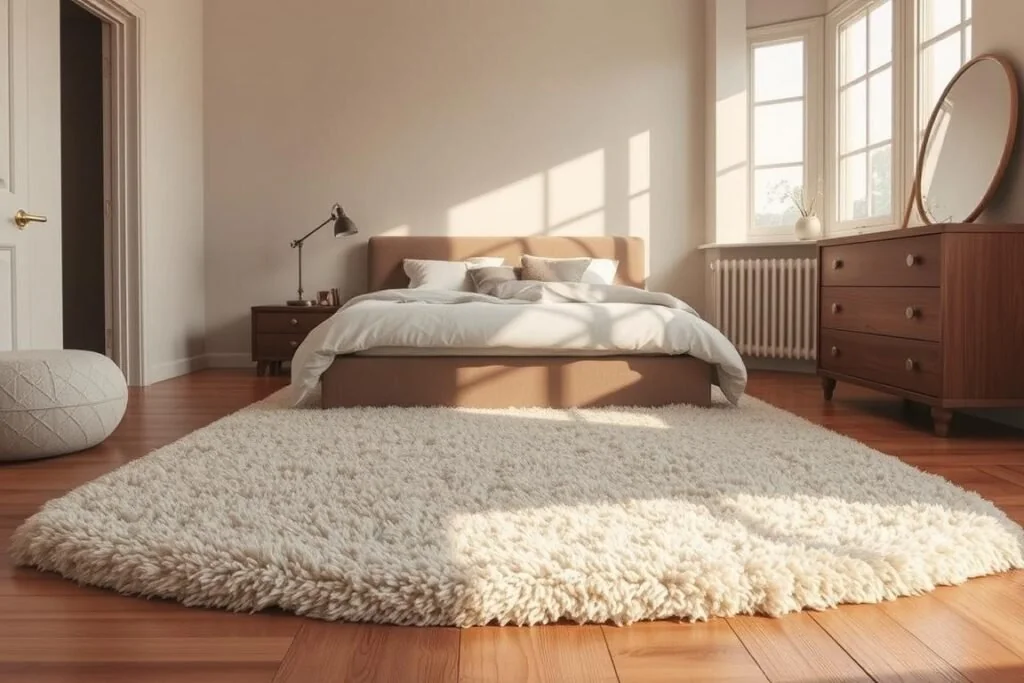
An 8×10 is the safe default rug size for queen bed layouts: it clears the sides of a 60-inch-wide mattress by about 18 inches and fills a typical 12×14 room without crowding the walls. Drop to a 6×9 in a small room where the rug tucks under the bottom two-thirds of the bed, or step up to a 9×12 if you want the bed, both nightstands and a bench sitting on one surface. Aim for roughly 18 to 24 inches of rug showing along both sides and past the foot, and you’ll get the look right on the first try.

Quick size chart

Room size Rug size Usual placement What it looks like
About 10×11 or 10×12 5×8 or 6×9 Bottom two-thirds, run crosswise Soft landing on both sides; nightstands stay on bare floor
About 11×13 7×10 or 8×10 Two-thirds or full Room for a bench at the foot without blocking the walkway
About 12×14 8×10 Full, bed centered Bed and nightstands on the rug, ~18 inches showing per side
13×15 and up 9×12 Full, everything on the rug ~24 inches per side; anchors a chair or dresser too

Those room sizes assume a normal amount of furniture and a door that swings into the room. If your bedroom is an odd shape, trust the tape test further down this page over any chart.

Rug size for queen bed: start with the mattress footprint

A standard queen mattress is 60 inches wide by 80 inches long — 5 feet by 6 feet 8 inches, or about 152 by 203 cm. That footprint, not the bed frame, is what your rug has to work around. Add a frame with a chunky base or a headboard with feet and the outline grows by a few inches on each side, so measure the frame too if it’s wider than the mattress.

Two variants change the math. An Olympic queen is 66 by 80 inches (6 inches wider), and a California queen is 60 by 84 inches (4 inches longer). With either one, size up rather than down — a 6×9 that looked generous under a standard queen suddenly looks skimpy. Our queen size bed dimensions guide has the full numbers in inches, feet and centimeters, and the standard bed size chart is handy if you’re comparing a queen against a full or king before you commit.
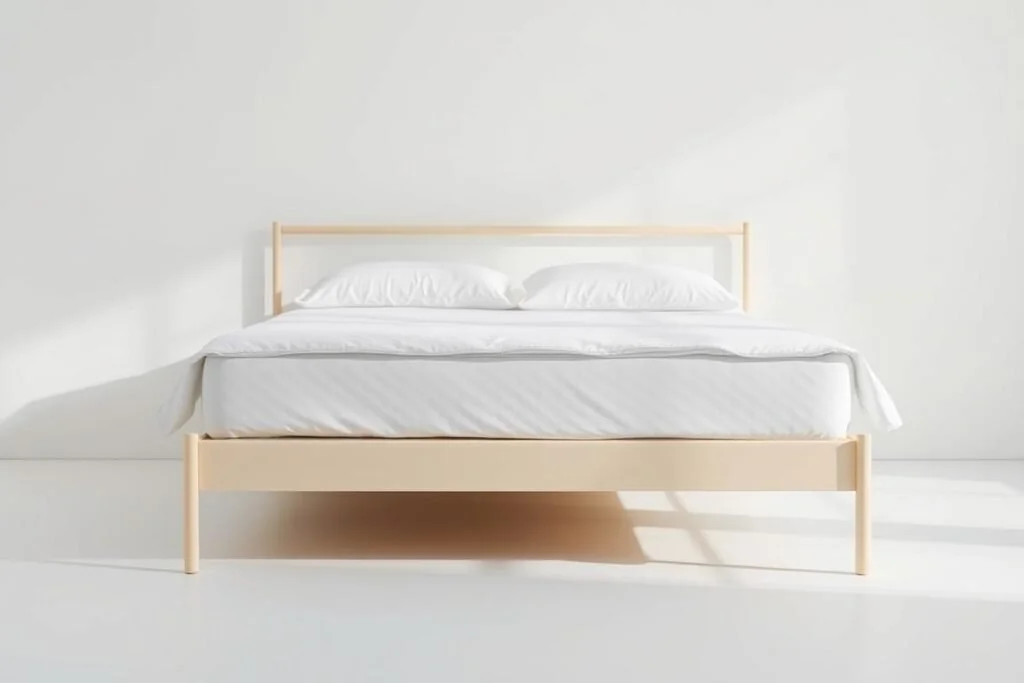
Diagram of a 60 by 80 inch queen mattress footprint used to plan rug size for a queen bed

How much rug should show around the bed

Designers usually call for 18 to 24 inches of visible rug along both long sides and past the foot. There’s no standards body setting that number — it’s a convention, not a rule — but it holds up for a practical reason: it’s roughly the width of a step, so both feet land on something soft when you get out of bed. Under about 12 inches per side and the rug starts reading like a bath mat that wandered into the wrong room.

The other half of the equation is the wall. Leave 12 to 18 inches of bare floor between the rug edge and the baseboards so the room still has a frame. In a tight bedroom you can shrink that gap to 8 inches, but a rug that runs wall to wall stops looking like a rug and starts looking like a bad carpet install.

Orientation matters as much as size

Same rug, two very different results. Turn a 6×9 so the 9-foot side runs across the bed and you get 24 inches of overhang on each side, with the rug covering the bottom two-thirds of the mattress and extending about 19 inches past the foot. Turn that same 6×9 the other way — 9 feet running head to foot — and you’re left with only 6 inches showing on each side, which is barely worth having.

Rules of thumb by size:

  • 5×8 and 6×9: run the long side across the bed, under the lower half to two-thirds of the mattress.
  • 8×10 and 9×12: run the long side head to foot and center the bed on it, so the whole bed plus nightstands sit on the rug.
  • 7×10: the awkward middle child. Head to foot it leaves only 12 inches per side; crosswise it gives a generous 30 inches per side but only 7 feet of depth. Check both with tape before you order.

Three placement methods that work

Full placement

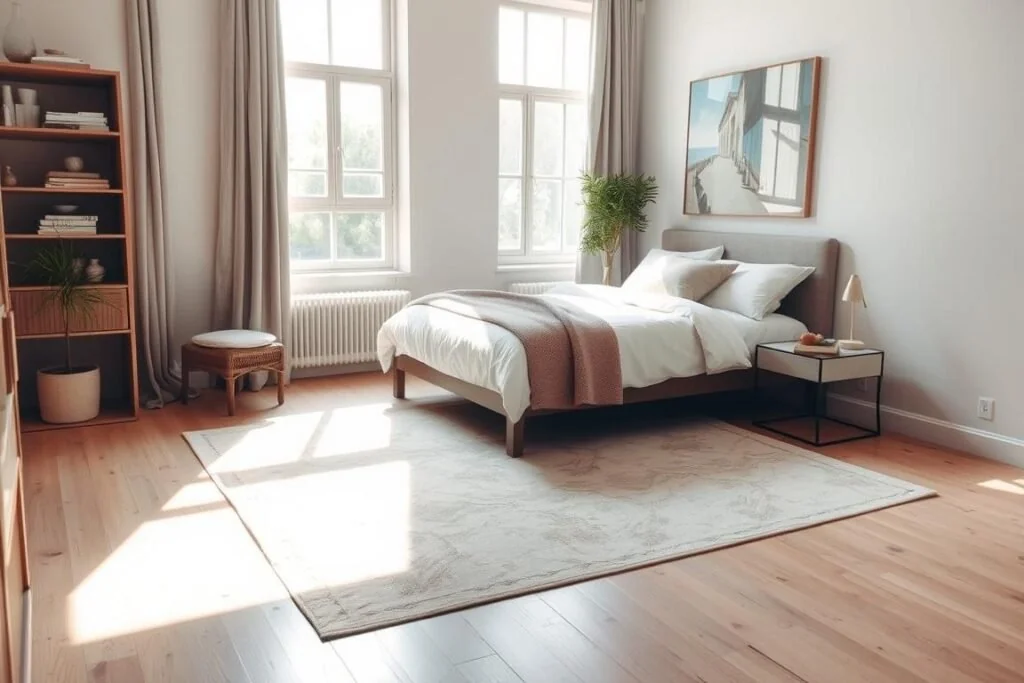
The bed, both nightstands and any bench sit entirely on the rug, with 18 to 24 inches extending past the furniture. It’s the hotel-room look, it keeps nightstand legs from wobbling on a rug edge, and it needs an 8×10 or 9×12. Best in rooms 12×14 and up.

Two-thirds (partial) placement

The rug starts about a third of the way down from the headboard, so the lower two-thirds of the bed sits on it and the nightstands stay on bare floor. This is the workhorse for small and medium rooms because you buy less rug and still get softness where your feet land. Works with 5×8, 6×9 and 8×10.

Foot-of-bed placement

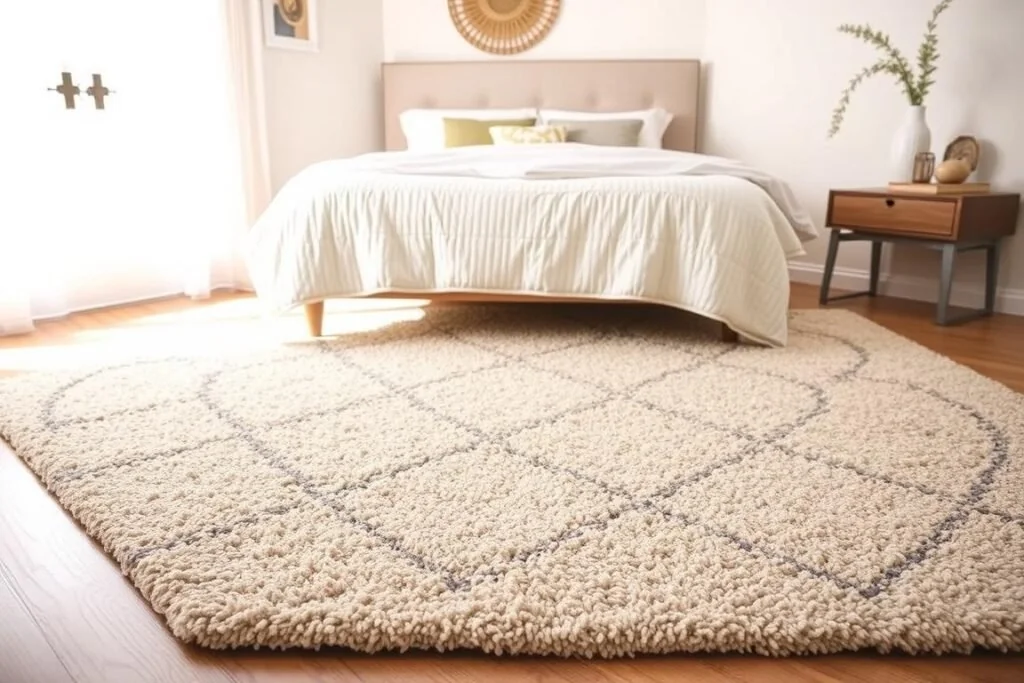
A smaller rug — 4×6 or 5×7 — sits across the foot of the bed, covering a quarter to a third of the mattress length or none of it at all. Good for adding pattern without moving heavy furniture, and good for layering a bold rug over a plain base. It won’t give you side comfort, so treat it as decoration rather than the main event.

Small rug placed across the foot of a bed as an accent layer in a bedroom

A fourth option deserves a mention: two runners, one on each side of the bed. In a narrow room, or where a big rug would cover a floor vent or block a closet door, a pair of 2.5×8 runners gives you the soft landing without the bulk. We walk through each of these layouts step by step in how to place a rug under a bed.
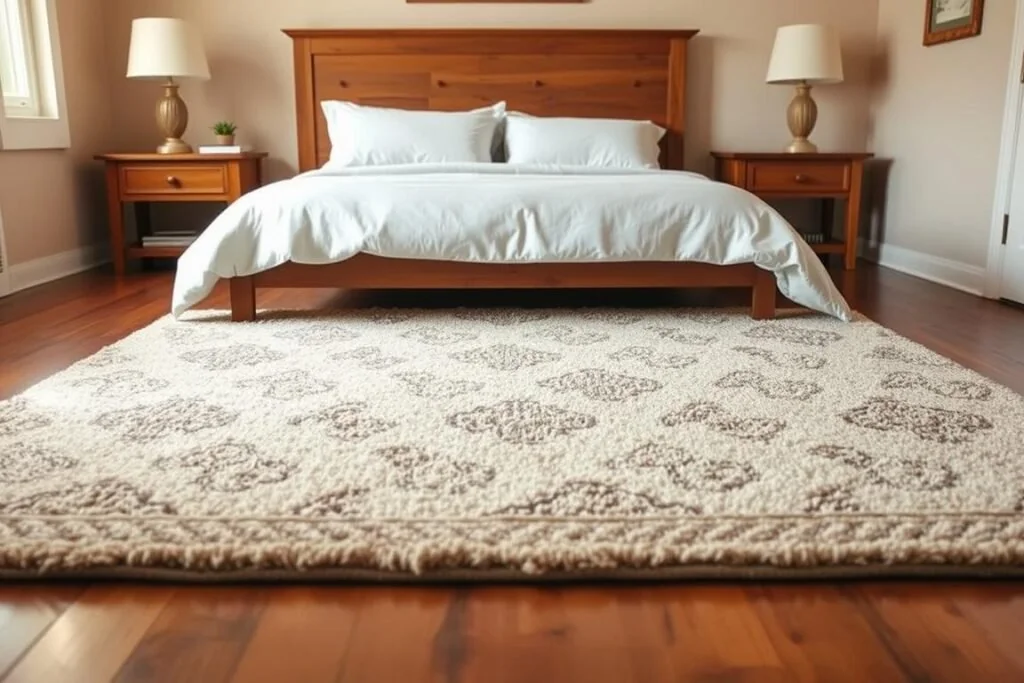
Bedroom showing a large area rug centered under a queen bed with nightstands on the rug

Awkward rooms and how to handle them

  • Bed pushed into a corner: skip symmetry. Run the rug out from the two exposed sides instead of centering it, and let it slide under the bed rather than wrapping the wall side.
  • Under-bed storage drawers: a thick pile plus a rug pad can stop drawers from opening. Choose low pile — under about half an inch — or keep the rug clear of the drawer side.
  • Carpeted bedroom: a rug still works and still defines the bed. Layer a flat weave or low pile over the carpet and use a pad made for carpet-over-carpet so it doesn’t creep.
  • Door and closet swings: a bifold or standard door clearing a thick rug by a quarter inch today will drag on it once the pad compresses. Open every door over the taped outline before you buy.
  • Floor vents: covering one with a rug cuts airflow to the room. Shift the layout or drop to runners.
  • Bench or chair at the foot: add its depth — usually 16 to 20 inches — to the length you need past the mattress, or the front legs will hang off the edge.

If you’re also rethinking what’s beside the bed, the nightstand sizing guide covers how much clearance to leave between the mattress and a bedside table.

Materials, pile and pads

Fiber matters less than most guides suggest, but there are real differences:

  • Wool: springy, warm and naturally soil-resistant. It costs more and can shed for the first few months.
  • Nylon: the toughest of the common synthetics and holds its color well, which suits a path that gets walked every day.
  • Polypropylene (olefin): cheap, stain-resistant and easy to clean, though it flattens under heavy furniture faster than wool or nylon.
  • Cotton and jute: casual and affordable. Cotton flat weaves are often machine washable in smaller sizes; jute is rough underfoot, so it’s better at the foot of the bed than beside it.
  • Washable rugs: genuinely useful with pets or small kids. Check the size against your washer drum before you assume an 8×10 will fit — most won’t.

Two practical notes. First, a rug pad is not optional under a bedroom rug: it adds cushion, keeps the edges from curling and stops the rug sliding when you step out of bed. Health organizations that cover fall prevention, including Mayo Clinic, specifically recommend securing loose rugs with slip-resistant backing or tape — worth doing anywhere someone gets out of bed half-asleep. Second, rugs sold in the US have to meet federal surface-flammability requirements under 16 CFR Part 1631; small rugs that don’t pass can only be sold if they’re permanently labeled as flammable, so read the tag on bargain finds.

Patterned rug layered over a larger neutral rug in a bedroom for added texture

Tape it out before you buy

Fifteen minutes with painter’s tape beats any online visualizer.

  1. Mark the mattress footprint on the floor first — 60 by 80 inches — even if the bed is already in place.
  2. Tape the outline of your two best rug candidates, in the orientation you plan to use.
  3. Measure the gap from the tape to each wall and to the mattress edges. You’re looking for 18 to 24 inches past the bed and 12 to 18 inches to the walls.
  4. Open the bedroom door, closet doors and any under-bed drawers over the outline.
  5. Walk the route from the bed to the door and to the closet in bare feet. Then photograph the room from the doorway so you can compare options side by side.
  6. If you’re torn between two sizes, leave the tape down overnight and decide in the morning. Bigger usually wins.

For layout, style and colour decisions beyond sizing, our bedroom rug guide covers the rest of the room.

FAQ

Will a 5×7 rug work under a queen bed?

Not as the main rug. A 5×7 is narrower than the bed is long and barely wider than the mattress, so you get no usable side overhang. Use it at the foot of the bed or layered over a larger neutral base.

Is a 6×9 big enough for a queen?

Yes, in a small room, as long as you run the 9-foot side across the bed and slide it under the bottom two-thirds. You’ll get around 24 inches of rug on each side. It won’t reach the nightstands, which is fine.

Should the nightstands sit on the rug?

Either is correct. All-on looks more finished and needs an 8×10 or 9×12; nightstands off the rug saves money and suits two-thirds placement. What looks unfinished is a rug edge that runs under only the front legs of a nightstand.

8×10 or 9×12 for a queen?

Room size decides it. Under about 12×14, an 8×10 gives the better proportions; in a 13×15 or larger bedroom, a 9×12 keeps the rug from floating in the middle of the floor.

Can I layer rugs under a queen bed?

Yes. Put a large, plain low-pile rug down as the base and a smaller patterned one on top, usually across the foot of the bed or on one side. Keep total thickness low if you have under-bed drawers or a door that swings close to the floor.

Does the rug have to be centered on the bed?

Center it on the bed, not on the room — that’s the detail people get wrong. If the bed isn’t centered on its wall, a rug squared to the room will look crooked even though it’s perfectly straight.

Before you order

  • Measure the frame, not just the mattress, if the frame is wider.
  • Confirm the orientation you plan to use, not just the size.
  • Add a rug pad cut about an inch smaller than the rug on all sides.
  • Check the return policy — rug returns on big sizes can be expensive to ship back.

Updated September 2026.

The Definitive Bedroom Rug Guide: Size, Placement & Style

bedroom rug guide - definitive bedroom rug

A Practical Guide to Choosing Bedroom Rugs

Updated: August 30, 2025

Bedroom rug guide: Ever notice how some rooms feel calm the second you walk in? The right textile underfoot fixes scale and style at the same time. This friendly bedroom rug guide gives you fast rules, mattress-by-mattress sizes, and small-space workarounds so you step onto softness every morning. For a full-room approach, also see our living room rug size rules.

Key Takeaways

  • Follow the two-foot rule: leave ~24″ of rug on the two long sides and the foot of the bed.
  • Queen = 8’x10’, King = 9’x12’; use 6’x9’ for tight queen rooms pulled slightly past the footboard.
  • Float living room pieces so at least front legs sit on the rug; extend dining rugs 24–36″ past the table.
  • Pick pile height for lifestyle: plush for comfort, low pile for easy cleaning and door clearance.
  • Measure first. A bedroom rug guide mindset prevents the “too small” look and saves returns.

Bedroom rug size guide showing an 8x10 rug under a queen bed with 24-inch borders

A quick visual: an 8’x10’ under a queen, leaving ~24″ around the sides and foot.

Bedroom Rug Guide at a Glance: Sizes That Always Work

You don’t need guesswork. Use these dependable dimensions and you’ll get balanced proportions in most bedrooms.

Quick bedroom rug guide: Twin 5’x8’, Full 6’x9’, Queen 8’x10’, King 9’x12’

Start here to shortlist options. These sizes anchor the bed and keep nightstands and benches reading as one composition.

The 2-foot rule: Leave about 24 inches on three sides of the bed

Plan for roughly 24″ of soft surface on the two long sides and at the foot. In a tight queen room, a 6’x9’ can still work if you pull it a quarter past the footboard.

  • Prioritize width so the rug extends slightly beyond nightstand edges.
  • Avoid matching rug width too closely to the mattress—it looks squished.
  • Planning an upgrade? Choose a size that can scale with a larger mattress later.

Quick tip: Note bed, nightstand, and room measurements before you shop. It turns buying into a one-step decision.

How to Place an Area Rug Under Your Bed for the Right Look

Placement changes how the whole room reads. Test these four layouts and pick what fits your space and habits best.

Four classic layouts from the bedroom rug guide showing rug placement under bed - definitive bedroom rug

Four classic placements: full coverage, two-thirds under, side accents, or a runner at the foot.

All the way under

Go hotel-plush: the bed, nightstands, and bench sit fully on the rug. The result is cohesive, quiet, and anchored.

Two-thirds under

Slide the rug so the top third stays in front of nightstands and pull it a bit past the footboard. You’ll see more pattern where it counts.

Side-by-side accents

In very tight rooms, use two 2’x3’ mats for soft landings on each side. Align their front edges with the nightstands for symmetry.

Runner at the foot

A runner warms the aisle without bulk on the sides. If possible, rest footboard legs on the runner for a finished edge. Layer a favorite small rug over a larger neutral base when you need extra scale.

  • Center the layout on the room’s main axis for cleaner sightlines.
  • Check doors and drawers—leave clearance so nothing scrapes the pile.
  • Mark edges with painter’s tape to preview coverage before committing.

According to the Sleep Foundation, a calming, well-designed sleep space supports rest—and soft rugs underfoot contribute to that restful environment.

Bed-By-Bed Rug Size Breakdown: Twin, Full, Queen, and King

This section of the bedroom rug guide matches real room constraints with sizes that feel right the moment you step out of bed.

Twin

A 5’x8’ usually provides generous side coverage in kids’ or guest rooms. In narrow layouts, try a long runner on one side or two shorter runners for targeted softness.

Full

For a full bed, 6’x9’ hits the sweet spot. If space is tight, flank with runners aligned to nightstand fronts so feet land on cushioned surfaces.

Queen

Choose an 8’x10’ for balanced proportions. If a 6’x9’ is all that fits, pull it down so at least a foot of rug shows at the end of the bed.

King

A 9’x12’ feels properly scaled. Keep ~8″ between rug edges and nightstands and aim for ~12″ beyond the foot so the setup reads finished.

  • Footboard detail: If your frame has feet, place them on the rug for an intentional look.
  • Low-profile platform frames can sometimes size down and still feel balanced.
  • Check vents and heater registers so nothing blocks airflow.

Materials That Feel Great Barefoot: Wool, Viscose, and Synthetics

Fiber choice changes the first step of your day. Pick what matches comfort, care, and budget.

Different rug materials from the bedroom rug guide including wool, vis featuring definitive bedroom rug

Wool for cozy durability, viscose for sheen in low-traffic rooms, synthetics for value and easy care.

Wool: Naturally soft, insulating, and great at hiding footprints. A top pick for cozy bedrooms.

Viscose (silk blends): Velvety sheen and luxe look, but gentler care—best for low-traffic primary suites.

Synthetics (nylon, polyester, PET): Budget-friendly and easy to clean. PET resists stains and holds color well.

For responsible shopping, review textile standards with Ethical Bedding’s certification guide before you buy.

  • Tip: Check door clearance, rotate rugs for even fading, and filter by material when shopping to save time.

Color and Style: From Neutral Bedroom Rugs to Statement Patterns

Color sets the mood in seconds. Use this bedroom rug guide mindset: calm where you rest, character where you want energy.

Neutral tones for a calm, sophisticated look

Beige, gray, and ivory play nicely with changing bedding and paint. Wool adds warmth without shouting; viscose blends give a subtle, dressy sheen.

Bold colors and patterns that won’t overwhelm

Let the rug be the statement. In smaller rooms, pick tighter motifs or tone-on-tone patterns so the eye can rest. On hardwood, layer a flatweave under a patterned top piece for depth without bulk.

  • Echo a hue from the rug in pillows or art for cohesion.
  • Test swatches in daylight and lamplight—colors shift after dark.
  • Lighting matters. See our Bedroom Lighting Guide.

Small Bedrooms and Apartments: Smart Rug Layouts That Maximize Space

Small floor plans benefit from layered solutions that make the room read larger and calmer.

Bedroom rug guide example for small room rug layouts using layering - definitive bedroom rug

Layer a natural jute base, then center a smaller patterned rug for scale without overspending.

When smaller textiles work

If your bed sits against a wall, float a smaller rug in front to keep the footprint tidy. When furniture floats, size up so legs land on the rug and the floor reads as one field.

  • Keep 3–6 inches between rug edges and baseboards in very tight rooms.
  • Prefer light tones to expand visual space; avoid heavy borders that box the area.
  • Use low pile to clear doors and reduce trip edges.

Try these space-smart strategies:

  • Layered base + top: 9’x12’ jute with a smaller showpiece on top for scale.
  • Small float: A compact rug in front of a wall-anchored sofa or bed.
  • Upsized field: Choose the next standard dimension when furniture floats.

For whole-home flow, see our Dining Room Rug Size Guide.

Runners and Side Rugs: Cozy Alternatives to Full Area Rugs

Not every room needs a giant rug. Place softness exactly where you step and keep the center open and airy.

Two 2’x3’ accents for warm landings

Set a 2’x3’ on each side and align their front edges with your nightstands. It feels intentional from both sides of the bed.

2.5’x8’ runners for narrow layouts

Great in tight aisles or along a king. Pick low pile so doors and closet swings clear the surface.

  • Side mats give softness where you need it without crowding the room.
  • A long runner warms the path at the foot of the bed.
  • Leave ~3″ from baseboards to avoid curling and ease cleaning.
  • Use cushioned pads under runners for extra comfort and grip.
  • Match pieces from one collection to repeat pattern across the room.

Common Rug Mistakes to Avoid in the Bedroom

Small scale choices can make a good design feel piecemeal. Fixes are simple when you know what to look for. Prefer a video walk-through? Watch this concise explainer: How to choose the right rug size.

Buying too small: Why chopped-up rooms look accidental

Undersized pieces leave skinny strips on the sides of the bed. Aim for at least ~24″ on three sides so the bed ties to the floor.

Rug width too close to bed width: The “squished” effect

When widths match, the outline feels tight. If you love a smaller piece, layer it over a larger natural-fiber base for proper scale.

Legs on or off: Be consistent

Pick a lane—either all legs on or all off. Mixed legs look awkward and make zones feel incomplete.

Orient to the room, not just the bed

  • Run the rug with the room’s long axis in narrow spaces.
  • Maintain clear walkways to closets, baths, and doors.
  • Preview with painter’s tape; it catches scale issues fast.

Quick tip: In multi-use bedrooms, one larger rug usually beats several small ones for unity.

Beyond the Bedroom: A Quick Room-to-Room Rug Size Guide

Use these simple sizing rules to make every space feel intentional and easy to move through.

Living room essentials: Start with 8’x10’ or 9’x12’. Keep 30–36″ of walkway around major furniture and set at least front legs of seats on the rug. See our living room size rules.

Dining room math: Add 24–36″ beyond table edges so chairs stay on the rug when pulled out. Choose low pile for easy movement. Learn more in our dining room rug guide.

Hallways & entryways: Use runners with ~3″ wall clearance. Avoid seams at doorways on very long corridors.

Kitchen & bath: Place runners or 2’x3’ accents at sinks and vanities for traction and comfort.

Want fiber deep-dives? Try Rug Materials 101 next.

FAQ

What size rug works best under a queen bed?

An 8’x10’ is the most reliable pick. In tight rooms, a 6’x9’ can work if you pull it down so at least a foot of rug shows at the end.

Should nightstands sit on the rug?

It’s optional. For a plush, hotel feel, place them fully on. For flexibility, keep the top third of the rug in front of the nightstands.

Do I need a rug pad in the bedroom?

Yes. Pads add cushion, reduce slipping, and help rugs last longer—especially helpful on hardwood and with runners.

What if my rug is a bit too small?

Layer it over a larger jute or sisal base. You keep the pattern you love and gain the scale the room needs.

Conclusion

Wrap up your layout with sizes that fit how you live. This bedroom rug guide boils it down: Twin 5’x8’, Full 6’x9’, Queen 8’x10’, King 9’x12’, plus the ~24″ rule for comfy step-offs. Pick wool for warmth, viscose for low-traffic sheen, or PET for easy care. Anchor living and dining furniture (front legs on; chairs fully on), keep measurements handy, and you’ll build calm, cozy rooms that work every day. For more cozy, practical ideas, visit Cozy Bed Quarters.

Other reading we found popular