Queen size bed dimensions are 60 inches wide by 80 inches long — that is 5 feet by 6 feet 8 inches, or 152.4 x 203.2 cm. Split between two people, it gives each sleeper 30 inches of width, which is narrower than a twin mattress per person. The mattress alone covers about 33 square feet of floor, and the frame around it usually adds another 2 to 8 inches in each direction, so the number you plan your room with is almost never 60 x 80.
Queen Size Bed Dimensions in Inches, Feet and cm
| Measurement |
Inches |
Feet |
Centimetres |
| Width |
60 in |
5 ft |
152.4 cm |
| Length |
80 in |
6 ft 8 in (6.67 ft) |
203.2 cm |
| Sleeping surface |
4,800 sq in |
33.3 sq ft |
3.1 sq m |
| Width per sleeper (two adults) |
30 in |
2.5 ft |
76.2 cm |
| Diagonal (for doorway and stair turns) |
100 in |
8 ft 4 in |
254 cm |
Those are the North American queen size bed dimensions, and the big brands all publish the same pair. Avocado lists a queen at 60 x 80 in (152.5 x 203 cm) with a 10 x 10 ft minimum room size; Saatva and Brooklyn Bedding print the same numbers. Rounding is why the centimetre figure wobbles between 152 and 153.
Two things are not standardised, and both cause problems after delivery:
- Tolerance. Finished mattresses can run up to roughly an inch under or over the nominal size, especially foam models that were compressed for shipping. Give a tight built-in alcove or a headboard-to-footboard frame at least an inch of slack.
- Height. Queen mattresses run anywhere from about 6 inches (a slim foam or RV model) to 16 inches (a pillow-top hybrid). Height decides your sheet depth, how high you sit when getting out of bed, and whether a footboard swallows the mattress edge.
How wide is a queen bed, and how long?
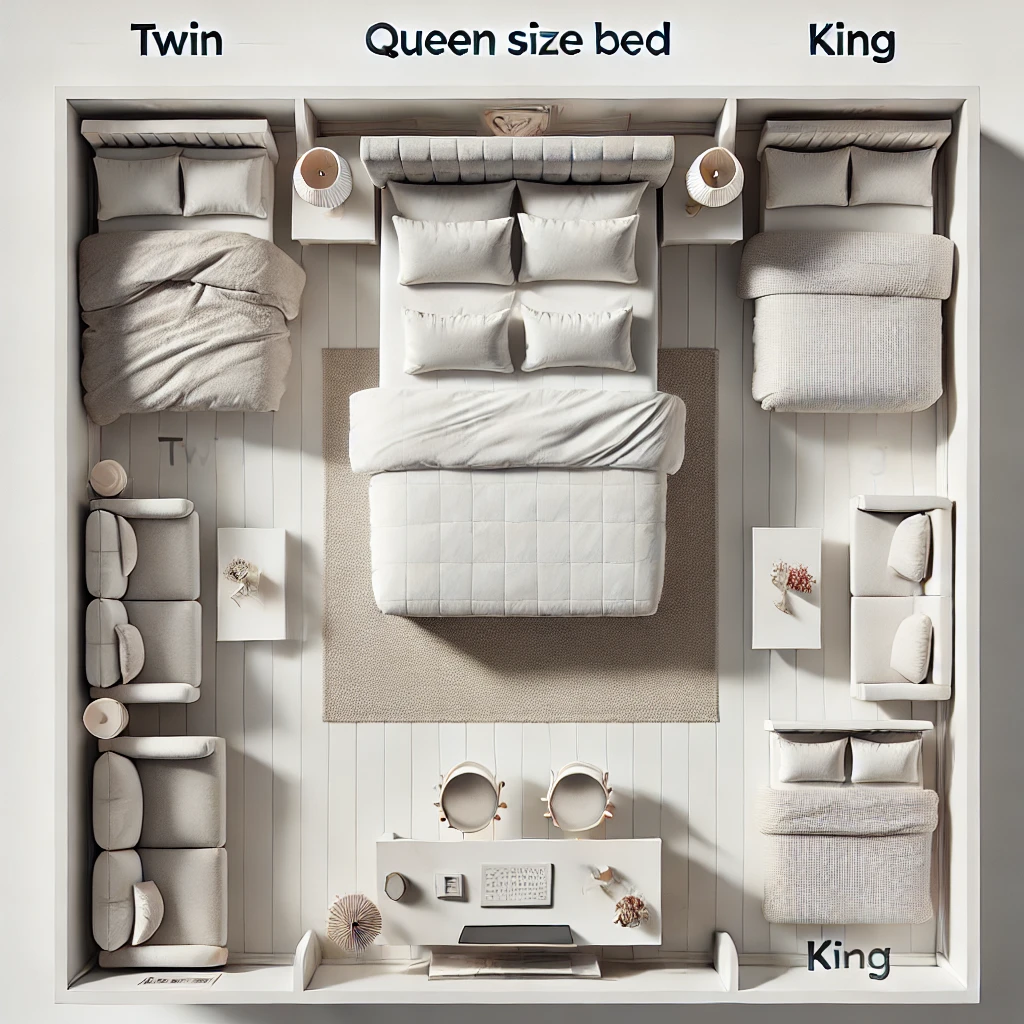
Wide: 60 in, 5 ft, 152.4 cm. Long: 80 in, 6 ft 8 in, 203.2 cm. A queen shares its 80-inch length with a twin XL and a king, so the only thing that changes when you step up to a king is width.
Queen Bed Size in Feet: Why You See 6.6, 6.67 and 6 ft 8 in
Eighty inches does not divide cleanly into feet, so queen size bed dimensions get written three ways: 6.6 ft, 6.67 ft and 6 ft 8 in. All three mean 80 inches. For a scale floor plan, use 5.0 x 6.67 ft.
Metric shoppers hit a different snag: a UK king is 150 x 200 cm and European “queen” sizes are often 160 x 200 cm. Neither matches a US queen, so sheets bought abroad will fight you. A 150 cm mattress is 2.4 in narrower than 60 in, and 200 cm is 1.2 in shorter than 80.
Queen Variants: Olympic, California, Split and RV Short Queen
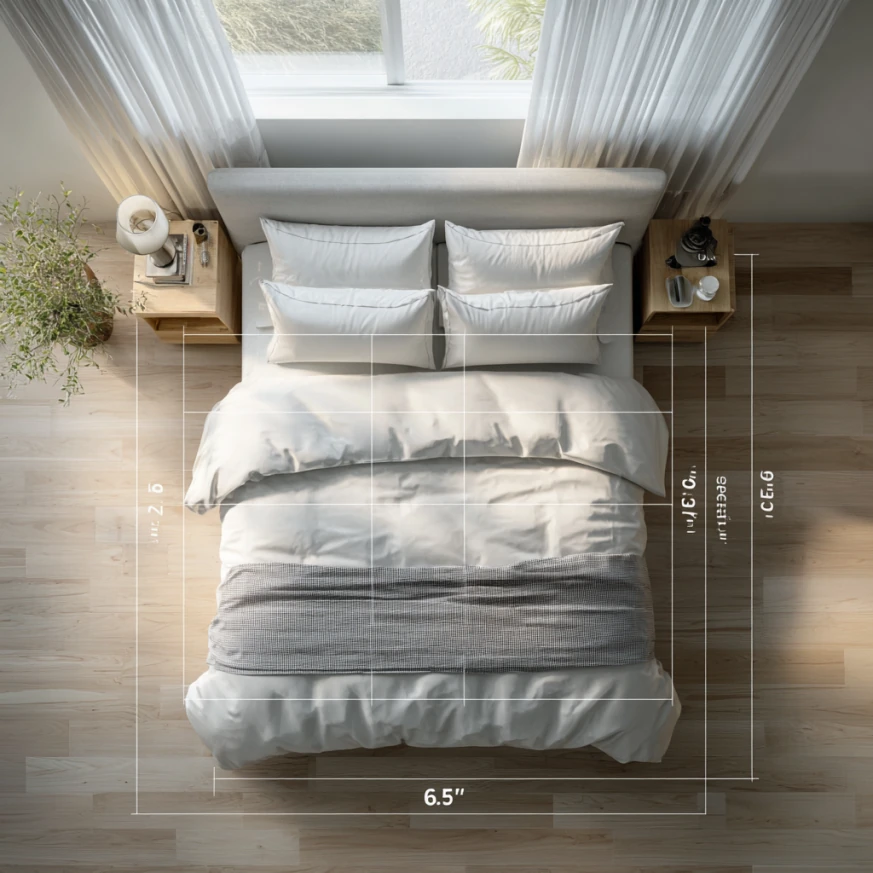
Not every mattress labelled queen uses the standard queen size bed dimensions. Four variants show up regularly, and each trades width or length for shopping convenience.
| Type |
Dimensions (in) |
Dimensions (cm) |
Suits |
Availability and catch |
| Standard queen |
60 x 80 |
152 x 203 |
Couples, guest rooms, solo sleepers who sprawl |
Sold everywhere; bedding is cheap and easy |
| Olympic queen |
66 x 80 |
168 x 203 |
Couples who want 33 in each without king width |
Specialty. Brooklyn Bedding builds these to order; sheets are a special-order item |
| California queen |
60 x 84 |
152 x 213 |
Sleepers over about 6 ft 2 in |
Rare in the US. Mattress Insider describes it as four inches longer than a standard queen |
| Split queen |
Two halves at 30 x 80 |
Two at 76 x 203 |
Adjustable bases, mismatched firmness, tight stairs |
Sold in pairs; there is a seam down the middle you can feel |
| Short queen (RV) |
60 x 75 |
152 x 191 |
RVs, campers, low-ceiling cabins |
Five inches shorter than a residential queen — measure before ordering sheets |
Honest trade-off: an Olympic or California queen buys you six or four extra inches and costs you the off-the-shelf bedding aisle. Sheets, protectors, frames and headboards in those sizes are special orders, and returns are often restricted on made-to-order sizes. If you share the bed with a partner and a dog, a standard king at 76 x 80 is usually the easier buy.
Split queens deserve one warning: two 30-inch halves work well on a split adjustable base, but on a flat frame they drift apart. Budget for a gap filler or a connector strap.

Queen vs Full vs King: the Space Each Sleeper Actually Gets
The per-sleeper column settles most arguments. It is just mattress width divided by two, and it is the honest way to compare queen size bed dimensions with the sizes either side.
| Size |
Inches (W x L) |
Feet |
cm |
Width per sleeper (two adults) |
| Twin |
38 x 75 |
3.2 x 6.25 |
97 x 191 |
Single sleeper only |
| Twin XL |
38 x 80 |
3.2 x 6.67 |
97 x 203 |
Single sleeper only |
| Full / Double |
53–54 x 75 |
4.5 x 6.25 |
135–137 x 191 |
27 in / 68 cm |
| Queen |
60 x 80 |
5 x 6.67 |
152 x 203 |
30 in / 76 cm |
| King |
76 x 80 |
6.33 x 6.67 |
193 x 203 |
38 in / 97 cm |
| California King |
72 x 84 |
6 x 7 |
183 x 213 |
36 in / 91 cm |
- Queen vs full: 6 to 7 inches wider and 5 inches longer. The length is the part people forget — a full stops at 75 inches, which is 6 ft 3 in, so anyone near 6 feet tall hangs their heels off once a pillow eats the top few inches. Our full size bed dimensions guide covers whether the smaller footprint is worth it.
- Queen vs king: identical 80-inch length, 16 inches more width. That is 8 extra inches per person and about 9 more square feet of floor. A king also needs a wider wall — 76 inches plus frame is close to 7 feet before nightstands. The king size bed dimensions guide runs the room maths.
- Queen vs California king: a Cal king is only 4 inches longer than a queen but 12 inches wider, and it is the wrong buy if length is your only problem.
Want every size on one page, including crib, bunk and split-king variations? The standard bed size chart lays them out together.
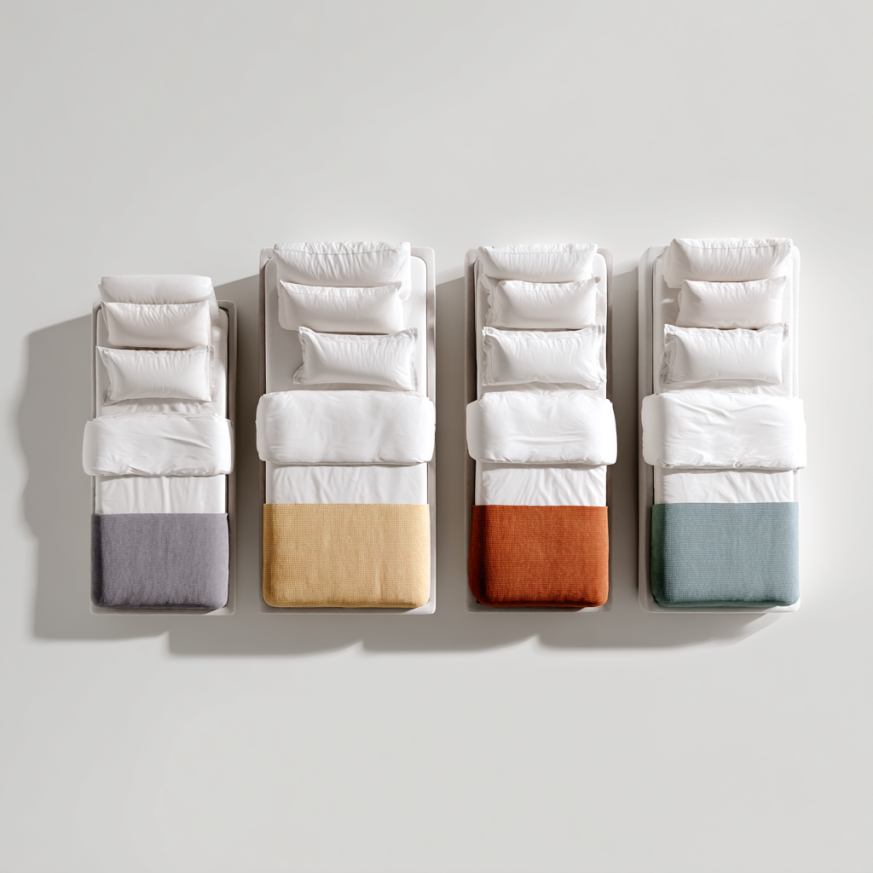
Smallest Bedroom a Queen Fits In
Queen size bed dimensions take 5 x 6.67 ft of floor. What decides whether the room works is the space left over to walk in.
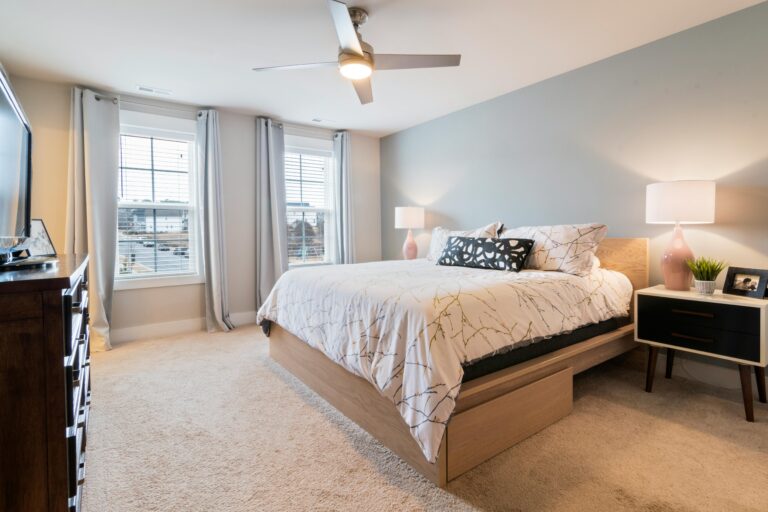
- 10 x 10 ft (3 x 3 m) — the practical minimum. Centre the bed on one wall and you keep roughly 30 inches on each side and about 3 ft at the foot. One slim nightstand fits; a dresser probably does not.
- 10 x 12 ft (3 x 3.7 m) — comfortable. Two nightstands, a dresser with room to open the drawers, and a clear path to the door.
- 12 x 12 ft (3.7 x 3.7 m) and up — generous. Add a bench, a chair or an 8 x 10 rug that runs well past the sides of the bed.
- 9 x 10 ft (2.7 x 3 m) — tight but possible. Push one long side against a wall, use a single nightstand or a floating shelf, skip the footboard, and accept that making the bed means climbing on it.
Clearance numbers worth taping onto the floor before you buy:
- 24 in (61 cm) — the bare minimum to sidle past the bed.
- 30 in (76 cm) — comfortable for walking and for tucking in sheets.
- 36 in (91 cm) — what you want where a door swings, a closet opens, or a walker or wheelchair has to pass. The US Access Board’s ADA guidance uses 36 inches as the minimum clear width for an accessible route, which is a sensible benchmark for anyone planning to age in the room.
- 36–42 in (91–107 cm) in front of a dresser — a deep drawer can extend 18 to 22 inches, and you still need to stand there.
Design guidance on bedroom clearances and spacing makes the same point: measure the paths people walk, not just the square footage.
Queen Bed Frame Footprint: Add This Before You Shop
Frames do not match the mattress. Add these to the queen size bed dimensions before you shop:
- Metal platform and low-profile frames: about 1–3 in (2.5–7.5 cm) total in each direction. Some fit flush.
- Wood platform with a headboard: 2–4 in of extra width for the side rails, plus 2–4 in of length behind the headboard panel.
- Headboard and footboard beds: commonly 4–8 in (10–20 cm) longer overall. Upholstered panels are the worst offenders.
- Sleigh and canopy frames: can push the outer footprint past 68 x 90 in. Measure the widest external point, never the mattress cut-out.
- Storage beds with side drawers: add the frame allowance, then 20–24 in of clear floor in front of the drawers so they can open fully.
Two more numbers to pull off the product page: headboard height (44–60 in from the floor is common, and it matters against a window sill or sloped ceiling) and weight capacity. Queen frames publish a limit covering mattress, foundation and occupants; figures in the 500–1,000 lb (227–454 kg) band are normal for steel and solid wood. Take the number from the listing rather than assuming, and if you add bed risers, check they are rated for the loaded weight too.
Under-bed clearance is the other spec nobody reads. Most platform frames leave 6–13 in (15–33 cm) of clear height, which sets whether standard under-bed boxes or vacuum bags will slide underneath. For frame styles side by side, see our roundup of queen size bed frames.
Will a queen fit through your door and up your stairs?
Usually, but check three things:
- Door width. Interior doors are typically 28–32 in wide and 80 in tall. A foam or hybrid mattress flexes through a 28-inch opening; a traditional innerspring resists bending and can be damaged if you force it.
- Stair turns and landings. The queen’s 100-inch diagonal is the number that fails on a tight half-landing. Measure the landing depth and the ceiling height above the turn.
- The foundation, not the mattress. A one-piece queen box spring is rigid at 60 x 80. If your stairwell is tight, order a split foundation (two 30 x 80 halves) or a bed-in-a-box mattress, which ships compressed in a carton roughly 20 x 20 x 45 in.
Flat-pack frames solve most access problems. A single-piece upholstered headboard does not — measure it separately, because it often arrives in its own oversized carton.
Queen Bedding Sizes and What Actually Fits
Queen size bed dimensions are only half the bedding equation. The other half is depth and drop.
- Fitted sheet: made to 60 x 80 in, but the pocket depth decides the fit. Standard pockets handle mattresses to roughly 12 in; deep pockets reach about 15 in; extra-deep go to 18 in or more. Measure your mattress height, add an inch, and buy to that.
- Flat sheet: queen flat sheets cluster around 90 x 102 in but vary by brand. Thicker mattress, longer drop needed.
- Duvet cover and comforter: queen covers usually land between 88 and 92 in wide. If one of you steals the covers, buying the king size (about 104 in wide) on a queen bed is the cheap fix.
- Pillows: two standard pillows (20 x 26) or two queen pillows (20 x 30) sit neatly across 60 inches. Two king pillows (20 x 36) total 72 inches and will overhang a queen headboard by a foot.
- Mattress protector: match the pocket depth to the sheet, or the protector bunches and drags the sheet loose.
Full and queen bedding are not interchangeable. A full fitted sheet is 6–7 in narrower and 5 in shorter, so it will not reach; queen bedding on a full bed sags and bunches at the corners. Our guide to using queen bedding on a full bed spells out the workarounds that hold up and the ones that do not.
Is a Queen Big Enough for Two Adults?
For most couples, yes. Thirty inches each is enough if you both sleep fairly still, and a queen is the sensible guest-room choice because one or two people fit and replacement bedding is sold everywhere.
A queen starts to feel small when:
- Both sleepers are broad-shouldered. Two people at 20+ inches across the shoulders leave almost no buffer at 30 inches each.
- One of you moves a lot. Motion transfer is the usual complaint here, and mattress construction matters as much as size — foam and pocketed-coil hybrids isolate movement better than a connected innerspring.
- A dog or a child joins you. A medium dog can claim 18 inches of length. That is where a king earns its price.
- Either sleeper is over about 6 ft 2 in. Eighty inches leaves roughly two inches of margin once pillows are in place. Look at a California queen, a king or a California king instead.
One caveat on co-sleeping: public health guidance in the US and UK is that infants should sleep on their own firm, flat surface rather than in an adult bed, whatever the mattress size. Bed size is not the variable that makes bed-sharing safe.
One claim you will see everywhere: that the queen is the best-selling mattress size in North America. It is probably true, but the numbers come from manufacturers and retailers reporting their own sales rather than independent auditing. Treat it as a strong trend, not a verified statistic.
What to Measure Before You Buy
- The wall. Queen mattress width plus frame allowance plus nightstands: 60 in + 4 in + two 20-inch tables is 104 in, or 8 ft 8 in of wall.
- Both walkways. Aim for 30 in where you walk; 24 in is survivable on a side you rarely use.
- Door swings and closet doors. Open everything and mark the arcs with tape before the bed arrives.
- Mattress height. This sets your sheet pocket depth and the finished sitting height (24–27 in from floor to mattress top is comfortable for most adults).
- The delivery route. Narrowest door, tightest stair turn, and the ceiling over that turn.
- The carton, not the product. Shipping dimensions are usually listed separately and are always bigger.
Tape 60 x 80 inches on the floor, add your frame allowance, then walk around it for a day. Ten minutes of tape catches almost every mistake people make with queen size bed dimensions.
Frequently Asked Questions
What are the exact dimensions of a queen size bed?
Queen size bed dimensions are 60 inches wide by 80 inches long — 5 ft x 6 ft 8 in, or 152.4 x 203.2 cm. Individual mattresses can run up to about an inch off that nominal size.
What is a queen bed size in feet?
5 feet by 6.67 feet, often written as 5 x 6.6 ft or 5 ft x 6 ft 8 in. That covers about 33 square feet of floor.
How wide is a queen bed per person?
30 inches (76 cm) each for two adults. That is 8 inches less per person than a king and 3 inches more than a full.
Can a queen bed fit in a 10 x 10 room?
Yes. Centred on one wall, a queen leaves roughly 30 inches on each side and 3 feet at the foot. It works for a bed, a nightstand and not much else — a footboard or a wide dresser will make the room feel jammed.
Do I need a box spring under a queen mattress?
Not with a modern slatted platform frame. If the slats sit more than about 3 inches apart, add a bunkie board or low-profile foundation, and check what your mattress warranty requires — some void if the support spacing is wrong.
Is a queen the same length as a king?
Yes. Both are 80 inches (203 cm) long. A king is 16 inches wider, so if you need extra length you want a California king, a California queen, or a custom-length mattress.
How much does a queen mattress weigh?
It varies a lot by construction, from light foam models to latex and hybrid builds that take two people to move. The spec sheet lists it — check before you plan a solo stair carry or buy a frame near its weight limit.
Updated September 2026.