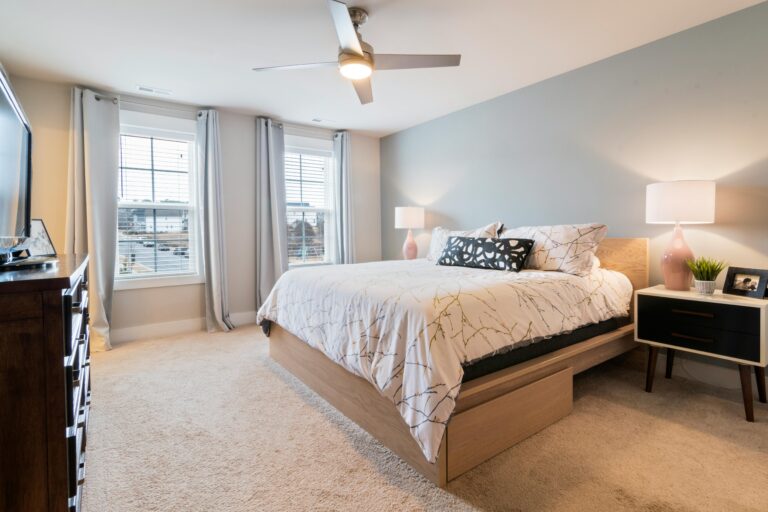
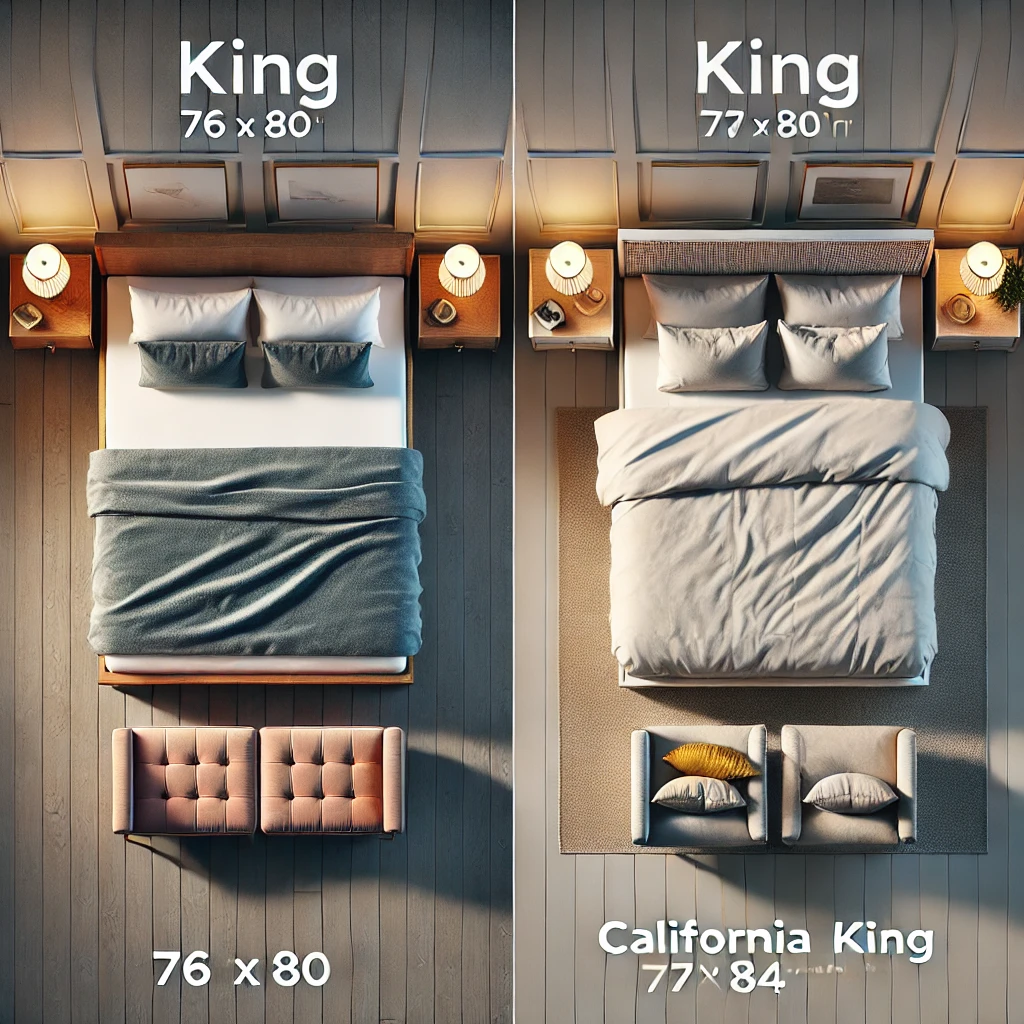
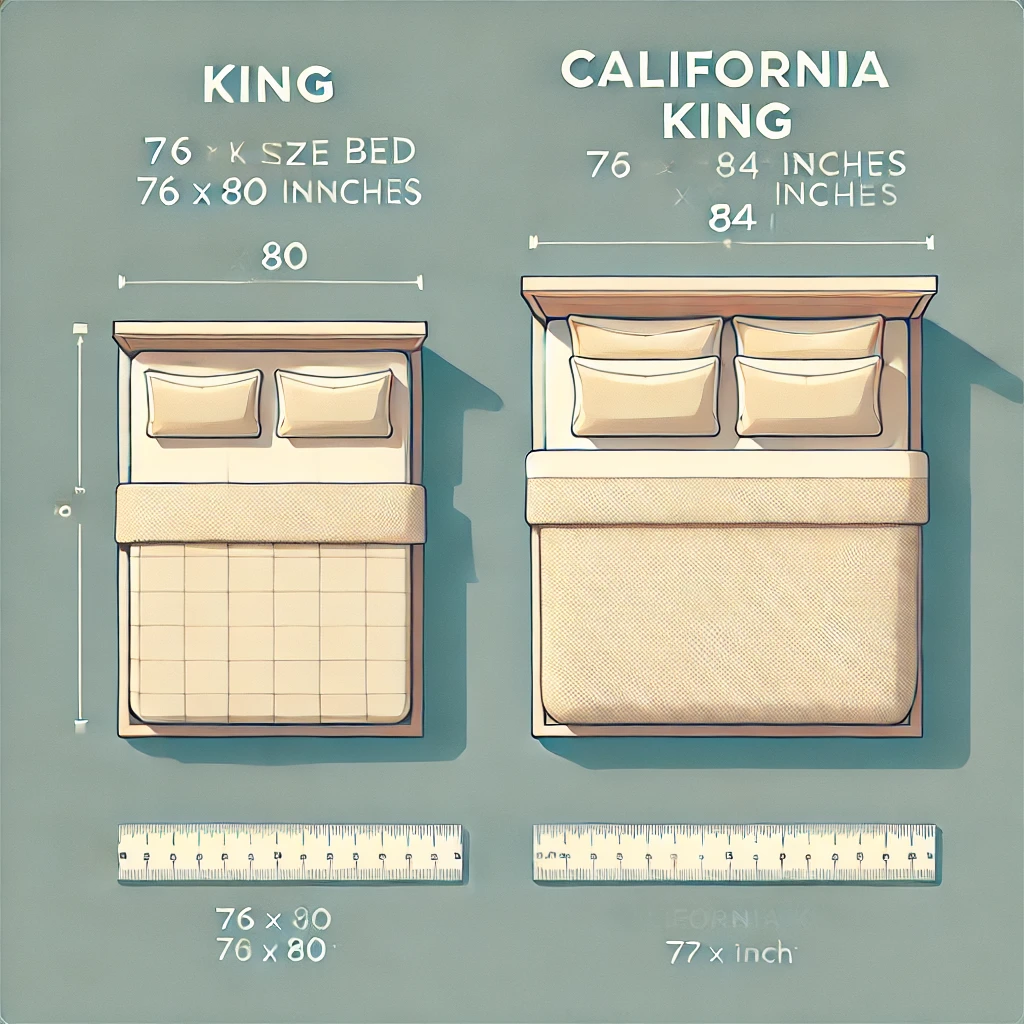
King size bed dimensions are 76 inches wide by 80 inches long in the US and Canada — that’s 6 ft 4 in by 6 ft 8 in, or 193 x 203 cm. A California king changes the shape rather than the size: 72 x 84 inches (183 x 213 cm), so it’s 4 inches narrower and 4 inches longer. Either one wants a bedroom of about 12 x 12 feet for a real walkway on three sides, and the frame around the mattress will sit 2–8 inches wider and longer than the mattress itself.
King Size Bed Dimensions at a Glance
| Size |
Inches (W x L) |
Feet |
Centimetres |
Width per sleeper |
Sleep surface |
| Standard / Eastern king |
76 x 80 |
6’4″ x 6’8″ |
193 x 203 |
38 in / 96.5 cm |
6,080 sq in (42.2 sq ft) |
| California / Western king |
72 x 84 |
6’0″ x 7’0″ |
183 x 213 |
36 in / 91.5 cm |
6,048 sq in (42.0 sq ft) |
| Split king (two twin XL) |
76 x 80 total (38 x 80 each) |
6’4″ x 6’8″ |
193 x 203 |
38 in |
6,080 sq in |
| Split California king |
72 x 84 total (36 x 84 each) |
6’0″ x 7’0″ |
183 x 213 |
36 in |
6,048 sq in |
| Queen (comparison) |
60 x 80 |
5’0″ x 6’8″ |
152 x 203 |
30 in |
4,800 sq in |
| Full / double (comparison) |
54 x 75 |
4’6″ x 6’3″ |
137 x 191 |
27 in |
4,050 sq in |
Look at the last two columns. The standard king is the widest mattress sold in mainstream sizes, and it has slightly more total surface than a California king despite being shorter. Against a queen, each person gains 8 inches of personal width — the difference between touching every time someone rolls over and having your own lane.
Why Your Mattress Might Not Measure Exactly 76 Inches
Published king size bed dimensions are industry convention, not a legally enforced standard, which is why brands word their specs as “approximately.” Quilted covers, tape edges and pillow tops all pull the tape measure around, so a king that reads 75.5 or 76.5 inches across is normal. Two consequences: order the frame and mattress to the same nominal size rather than to your own tape reading, and if you’re building a platform or DIY headboard, leave about half an inch of slack per side so a slightly oversized mattress still drops in.
How Wide Is a King Size Bed?
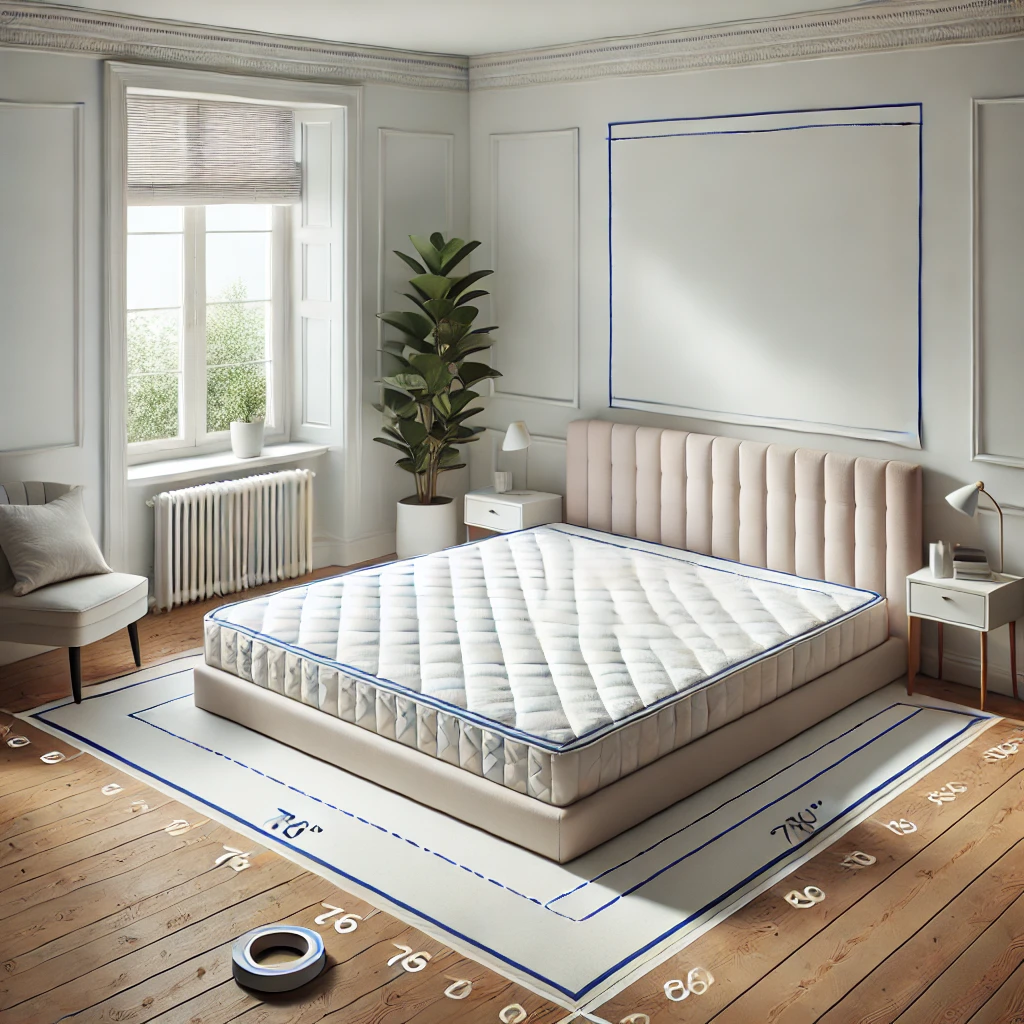
76 inches. In other units: 6 feet 4 inches, 193 cm, 1.93 metres. Width is the number most people want from king size bed dimensions, because it decides whether the bed fits your wall:
- It’s exactly two twin XL mattresses side by side (38 x 80 inches each).
- It’s 16 inches wider than a queen and 22 inches wider than a full.
- It’s more than double the width of a standard 36-inch exterior door — which is why delivery is about the mattress’s thickness, not its width.
- A UK “king size” is only 150 cm (59 in) wide, so don’t cross-shop the labels.
Length is the same 80 inches as a queen or twin XL. If you’re taller than about 6 ft 2 in, look at a California king, because once a pillow eats into the top of the mattress, 80 inches leaves very little margin at your feet.
King vs California King vs Split King
The most common misconception about king size bed dimensions is that a California king is “the bigger king.” It isn’t. It’s longer and narrower, with a hair less total area.
| |
Standard king |
California king |
Split king |
| Mattress |
76 x 80 in |
72 x 84 in |
Two pieces, 38 x 80 in each |
| Best for |
Width: couples, co-sleeping kids, dogs |
Height: sleepers over about 6’2″ |
Couples who disagree on firmness, or an adjustable base |
| Room shape it suits |
Wide, squarer rooms |
Long, narrow rooms |
Same footprint as a standard king |
| Bedding |
Widest selection |
Fewer options, often pricier |
Needs split fitted sheets |
| Delivery |
One large piece |
One large, longer piece |
Easiest — two carryable halves |
| Main drawback |
80 in feels short if you’re tall |
Loses 2 in of width per person |
Visible seam down the middle |
A split king isn’t a separate size. It’s the standard 76 x 80 footprint built from two twin XL mattresses, which is why the same bed can be a king one week and two guest beds the next. A split California king does the same with two 36 x 84 halves — and those halves are a custom width, so twin XLs won’t substitute.
If you’re torn between the two, our breakdown of king vs California king bed frames covers the frame footprints, not just the mattresses.

Oversized Kings: Wyoming, Texas and Alaskan
Specialist sizes exist above the two standard king size bed dimensions: Wyoming king at 84 x 84 inches, Texas king at 80 x 98 inches, Alaskan king at 108 x 108 inches. All are made to order. Frames, foundations, sheets and duvets have to come from suppliers who make that size, and an Alaskan king is 9 feet square — wider than many bedrooms are long.
Your Bed Frame Is Bigger Than Your Mattress
Published king size bed dimensions describe the mattress. What has to fit the room is the frame, and every style adds a different amount:
- Metal platform: roughly 1–2 in per side, so an external footprint near 78–80 x 82 in.
- Wood frame with side rails: 2–4 in per side, so about 80–84 in wide.
- Upholstered frame: padded rails are thick — add 4–8 in of total width, more on a heavily tufted design.
- Storage bed with drawers: similar width to wood, but add the drawer pull-out depth, usually 18–24 in of clear floor on the side they open.
- Headboard: 2–5 in of extra length, and bolt-on headboards push the mattress forward by that much.
- Four-poster or canopy: add the post footprint (often 3–5 in each) plus a total height of 80–90 in, which fights an 8 ft ceiling with a fan.
Plan for a real-world king footprint of about 80–84 inches wide by 84–88 inches long (203–213 x 213–224 cm) unless the spec sheet says otherwise. Pull the external dimensions from the manufacturer’s page; the good ones list overall width, overall length, height to the top of the headboard and deck height. Our king bed frame buying guide covers slat spacing and centre support, which matter as much as the outer numbers.
Minimum Bedroom Size for a King Bed
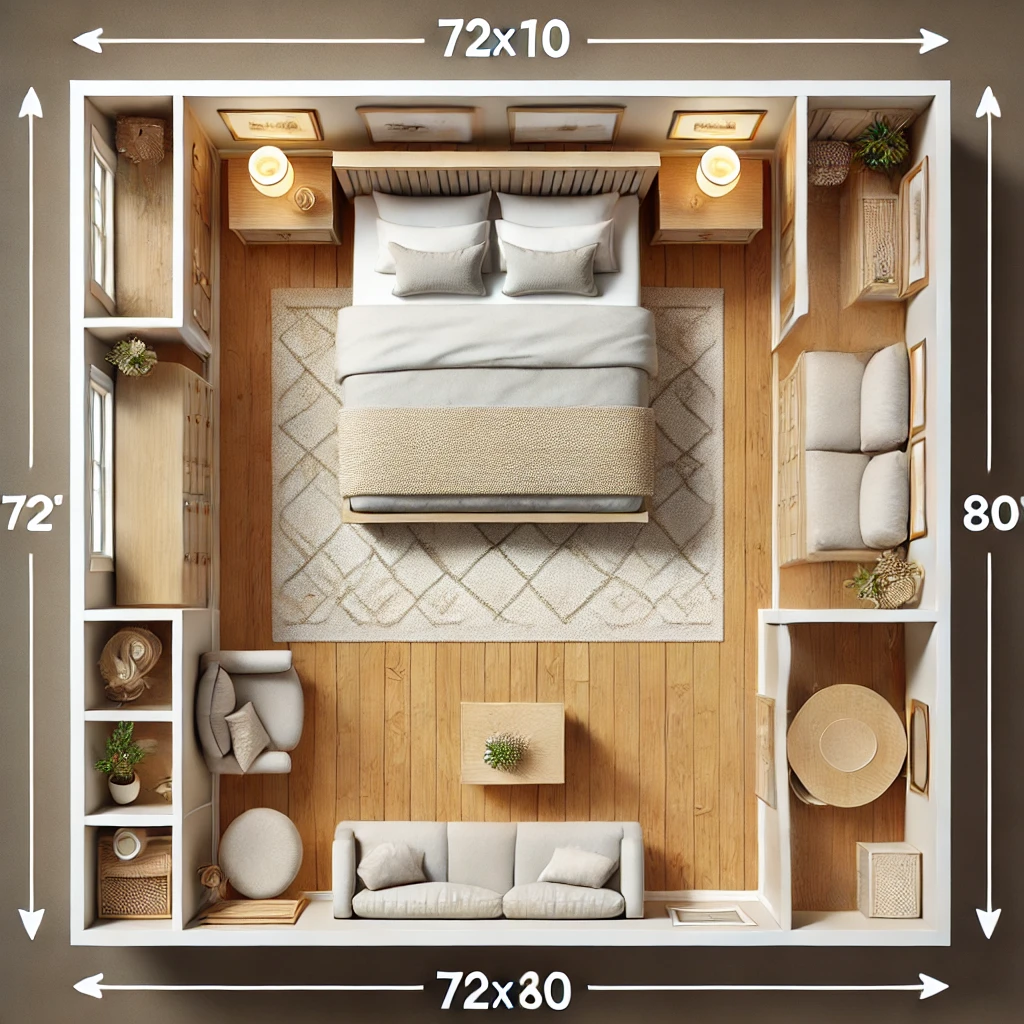
King size bed dimensions are only half the job; the other half is clearance. Designers generally advise at least 24 inches of clear floor at the sides and foot of a bed, and closer to 30–36 inches for a king. Run that against a typical 80-inch-wide frame:
- Comfortable: 80 in frame + 30 in each side = 140 in = 11 ft 8 in of wall-to-wall width. Length: an 86 in frame + 30 in at the foot = 116 in = 9 ft 8 in. A 12 x 12 ft room clears this easily.
- Workable: 80 in + 24 in each side = 128 in = 10 ft 8 in, so 11 x 12 ft is the honest practical minimum with nightstands.
- Tight: a 10 x 12 ft room leaves roughly 20 inches per side. You can sidle past; you can’t comfortably make the bed or open a wide drawer.
- Don’t: 10 x 10 ft. The king eats it, the door swing fights the mattress, and the room stops working.
Two clearances people forget: about 36 inches in front of a closet so you can stand and reach inside, and the door swing arc — a 30-inch door needs a 30-inch radius of clear floor unless it’s a slider.
The cheapest fit test costs nothing. Tape the full frame footprint on the floor, add a second outline for the clearance you want, then live with it for two days. If the rectangle blocks your route to the bathroom, a radiator or a heat vent, you have your answer before any money moves. A queen at 60 x 80 inches often makes a small room feel twice as usable.
Layout Moves That Buy Back Floor Space
- Centre the headboard on the longest unbroken wall, even if you give up the window view.
- Swap 24-inch nightstands for 14–16-inch ones, or go wall-mounted with sconces instead of table lamps.
- Give the wider walkway to the side you actually use and accept a narrow path on the other.
- Skip the footboard — it adds 2–4 inches of length and makes a tight room feel boxed in.

Measure the Delivery Route Before You Buy
A king mattress weighs roughly 85–180 pounds (39–82 kg) depending on construction, so it’s a two-person carry at minimum. Measure these before you order:
- Every doorway on the route. Interior doors are commonly 30 or 32 inches wide and the front door is usually 36. The mattress goes through on its side, so what has to clear is its thickness — 10–14 inches on most models — plus knuckle room.
- Stair turns and landings. Length is the killer, not width. Measure the diagonal across the landing and compare it to 80 inches (84 for a Cal king). All-foam mattresses bend; innersprings and hybrids barely do.
- Headroom over the stairs. A pivot needs height as well as floor.
- Elevator interior. Measure the car’s longest internal diagonal and its door width. A cab under about 7 feet on the diagonal won’t take a rigid king.
- Handrails, light fittings and hallway corners. Each steals 2–4 inches.
Two ways around a bad route: a compressed “mattress in a box” king arrives as one rollable carton and expands in the bedroom, or a split king goes up almost any staircase as two twin XL halves. If you want a traditional innerspring with a box spring, ask whether a split box spring (two 38 x 80 halves) is offered — that’s the standard fix for tight stairwells.
King Bedding Sizes: Sheets, Duvets and Protectors
Bedding follows the same king size bed dimensions as the mattress, and king and California king sets are not interchangeable. Buy by label, then check the depth number.
| Item |
King (typical) |
California king (typical) |
| Fitted sheet |
76 x 80 in |
72 x 84 in |
| Flat sheet |
about 108–110 x 102 in |
about 102 x 112 in |
| Comforter |
about 102 x 86 in |
about 102 x 96 in |
| Oversized comforter |
up to about 120 in wide |
up to about 120 in wide |
| Duvet cover |
about 96 x 109 in (varies by brand) |
about 96 x 109 in (varies by brand) |
| Pillowcases |
King, 20 x 40 in |
King, 20 x 40 in |
| Bed skirt deck |
76 x 80 in |
72 x 84 in |
Brand variation is real here — flat sheet and duvet sizes differ by several inches between makers, so treat the table as a range and read the product spec. Three things that catch people:
- Depth, not just size. Standard pockets fit about 12 inches of mattress; deep pockets run to roughly 15–18 inches. At 13 inches or more, or with a topper added, you need deep-pocket fitted sheets or the corners pop off at 3 a.m.
- Fitted sheets are the strict one. Flat sheets, duvets and comforters have enough drape to forgive a size swap; a fitted sheet never does.
- King pillowcases are their own size. Two standard pillows leave a gap across 76 inches. Three standard pillows, or two king pillows, fill the width.
For how a king relates to every other size, the standard bed size chart puts all the numbers in one place.
Who Should Size Up to a King — and Who Shouldn’t
Short version: size up if the problem is crowding, stay put if the problem is comfort.
A king earns its space if two adults share the bed and at least one is restless, children or a medium-to-large dog climb in, your schedules differ, or you just want the width of a twin each. At 38 inches per person versus 30 on a queen, that’s a measurable change rather than a feeling.
A queen is the smarter fit if your room is under about 11 feet on the short wall, you need a dresser or desk in the same room, you move house often, or one of you sleeps alone most nights. A queen also costs less across the board — frame, mattress, sheets, duvet, protector and delivery all step up with a king.
Where the evidence is thin: nobody can promise a wider mattress improves your sleep quality. Research on bed sharing is limited and mixed — one small lab study of couples found more REM sleep alongside more limb movements when partners slept together, which cuts against the idea that a partner in the bed is purely disruptive. What king size bed dimensions reliably deliver is space. If your complaints are pressure points, overheating or waking at 4 a.m., firmness and materials are the lever, not square inches.
On price: king prices swing so hard by brand, season and sale cycle that any figure quoted here would be stale within a month. Price the whole set — mattress, frame, foundation, protector, two sheet sets, duvet, delivery and old-mattress removal — and expect Cal king bedding to cost more and be harder to find.
Five King Sizing Mistakes Worth Avoiding
- Buying the rug too small. An 8 x 10 ft rug under a king leaves only a narrow border; 9 x 12 ft is the size that reads as anchored, starting ahead of the nightstands. Our guide to rug size for a king bed has the layout options.
- Ignoring bed height. Deck height plus a 12-inch mattress can put the sleep surface 28–32 inches up. Sitting on the edge, your feet should reach the floor with knees near 90 degrees.
- Forgetting ceiling height. Tall headboards run 48–60 inches from the floor and canopy frames 80–90 inches. Under a sloped ceiling or a fan, measure first.
- Mixing king and Cal king parts. Frames, foundations, headboards, fitted sheets, protectors and skirts are size-specific. Four inches is exactly enough to make nothing fit.
- Skipping centre support. A king-width frame without a centre rail and at least one central leg sags in the middle. Check the stated leg count and weight capacity.
UK and European “King” Sizes Are Different
Outside North America the names don’t transfer. UK king size bed dimensions are 150 x 200 cm (roughly 5 ft x 6 ft 6 in) — narrower than a US king and closer in width to a US queen. A UK super king is 180 x 200 cm, wider than a US standard king, and the EU grand king matches it at 180 x 200 cm. Imported bedding often won’t fit, so buy sheets in the same regional sizing as your mattress and ignore the word “king” on its own.
Frequently Asked Questions
What size is a king size mattress?
In the US and Canada, 76 inches wide by 80 inches long (193 x 203 cm), which is 6 ft 4 in by 6 ft 8 in. A California king is 72 x 84 inches (183 x 213 cm).
What are the dimensions of a king size bed in feet?
6 ft 4 in by 6 ft 8 in for a standard king, and 6 ft by 7 ft for a California king. The frame usually measures 6 ft 8 in to 7 ft wide, so use the frame number when you plan a wall.
Is a California king bigger than a king?
Longer, not bigger. A Cal king gains 4 inches of length and loses 4 inches of width, leaving it about 32 square inches less sleeping surface than a standard king.
Do two twin XL mattresses make a king?
Yes. Two twin XL mattresses at 38 x 80 inches each total 76 x 80 inches, identical to a standard king. That setup is sold as a split king and is far easier to carry upstairs.
What is the minimum room size for a king bed?
About 11 x 12 feet is the honest practical minimum and 12 x 12 feet is comfortable. A 10 x 12 ft room fits a king but leaves roughly 20 inches per side — too tight to make the bed easily.
Will a king mattress fit through a standard door?
Usually yes, because it goes through on its side and only its 10–14 inch thickness has to clear a 30–32 inch opening. Stair turns and landings cause far more failed deliveries than doorways. If your stairs are tight, choose a compressed boxed mattress, a split king, or a split box spring.
Updated September 2026.