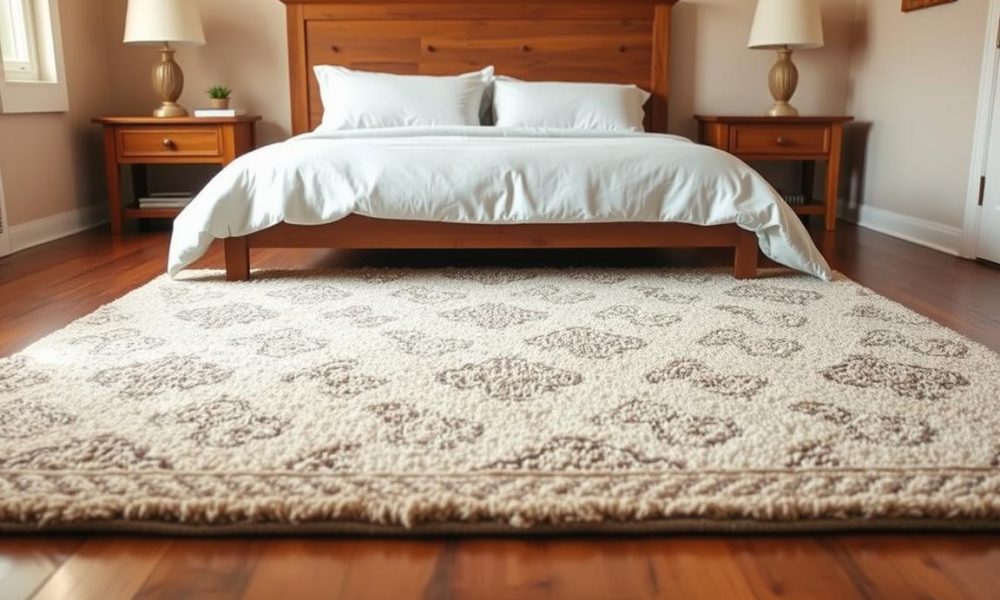
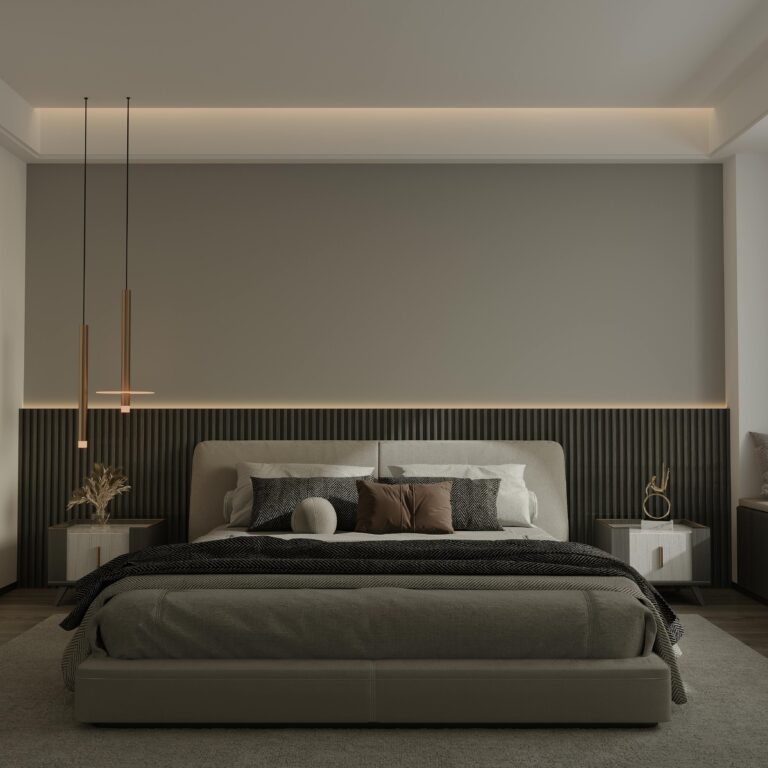
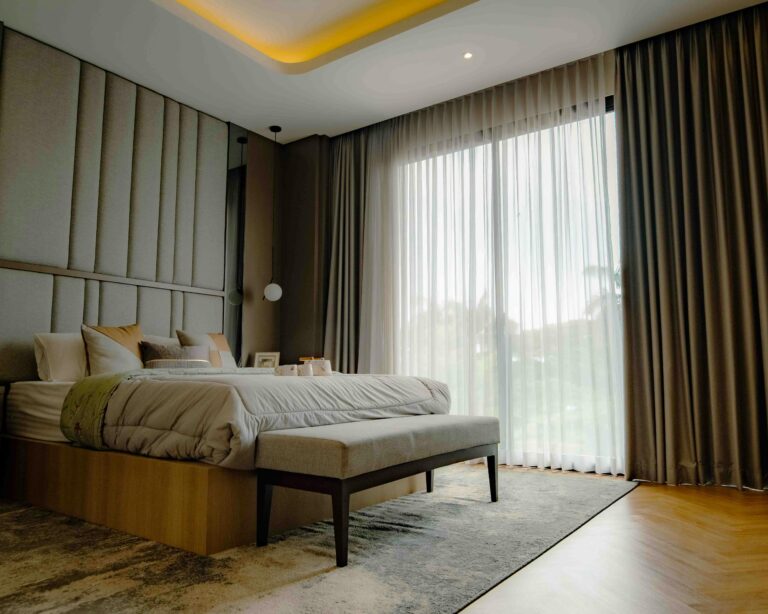
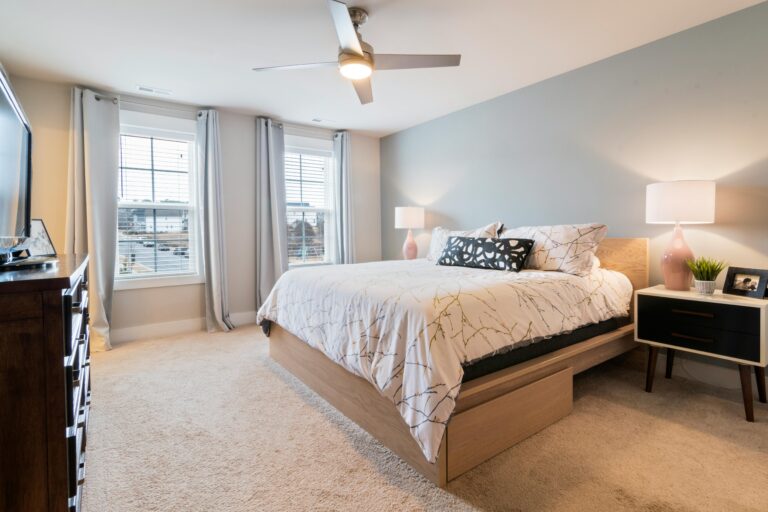
An 8×10 is the safe default rug size for queen bed layouts: it clears the sides of a 60-inch-wide mattress by about 18 inches and fills a typical 12×14 room without crowding the walls. Drop to a 6×9 in a small room where the rug tucks under the bottom two-thirds of the bed, or step up to a 9×12 if you want the bed, both nightstands and a bench sitting on one surface. Aim for roughly 18 to 24 inches of rug showing along both sides and past the foot, and you’ll get the look right on the first try.
Quick size chart
| Room size |
Rug size |
Usual placement |
What it looks like |
| About 10×11 or 10×12 |
5×8 or 6×9 |
Bottom two-thirds, run crosswise |
Soft landing on both sides; nightstands stay on bare floor |
| About 11×13 |
7×10 or 8×10 |
Two-thirds or full |
Room for a bench at the foot without blocking the walkway |
| About 12×14 |
8×10 |
Full, bed centered |
Bed and nightstands on the rug, ~18 inches showing per side |
| 13×15 and up |
9×12 |
Full, everything on the rug |
~24 inches per side; anchors a chair or dresser too |
Those room sizes assume a normal amount of furniture and a door that swings into the room. If your bedroom is an odd shape, trust the tape test further down this page over any chart.
Rug size for queen bed: start with the mattress footprint
A standard queen mattress is 60 inches wide by 80 inches long — 5 feet by 6 feet 8 inches, or about 152 by 203 cm. That footprint, not the bed frame, is what your rug has to work around. Add a frame with a chunky base or a headboard with feet and the outline grows by a few inches on each side, so measure the frame too if it’s wider than the mattress.
Two variants change the math. An Olympic queen is 66 by 80 inches (6 inches wider), and a California queen is 60 by 84 inches (4 inches longer). With either one, size up rather than down — a 6×9 that looked generous under a standard queen suddenly looks skimpy. Our queen size bed dimensions guide has the full numbers in inches, feet and centimeters, and the standard bed size chart is handy if you’re comparing a queen against a full or king before you commit.
How much rug should show around the bed
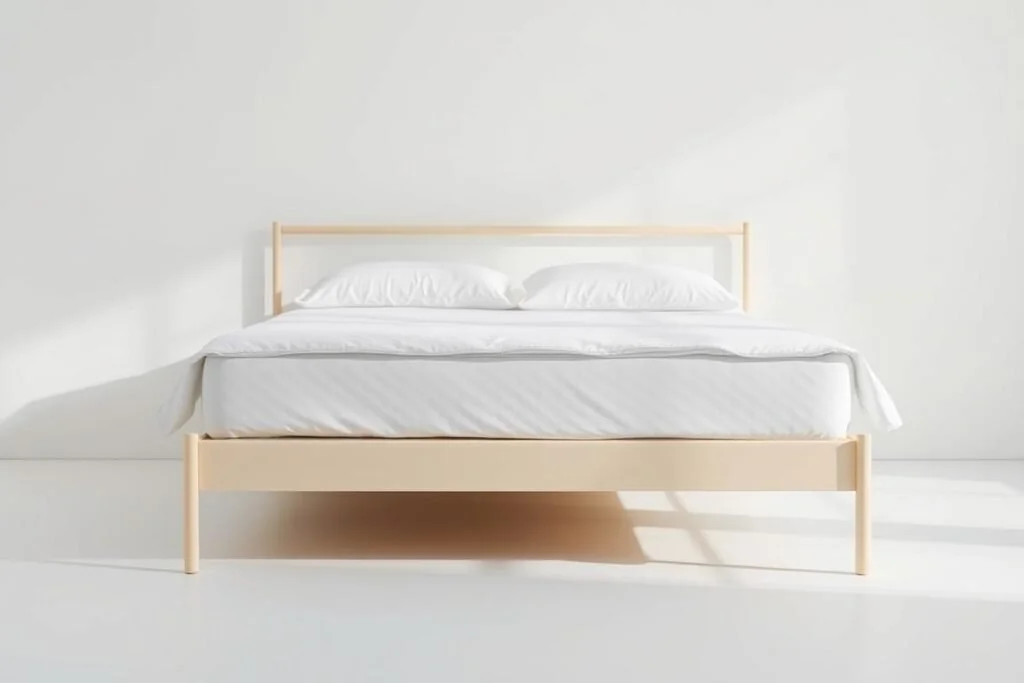
Designers usually call for 18 to 24 inches of visible rug along both long sides and past the foot. There’s no standards body setting that number — it’s a convention, not a rule — but it holds up for a practical reason: it’s roughly the width of a step, so both feet land on something soft when you get out of bed. Under about 12 inches per side and the rug starts reading like a bath mat that wandered into the wrong room.
The other half of the equation is the wall. Leave 12 to 18 inches of bare floor between the rug edge and the baseboards so the room still has a frame. In a tight bedroom you can shrink that gap to 8 inches, but a rug that runs wall to wall stops looking like a rug and starts looking like a bad carpet install.
Orientation matters as much as size
Same rug, two very different results. Turn a 6×9 so the 9-foot side runs across the bed and you get 24 inches of overhang on each side, with the rug covering the bottom two-thirds of the mattress and extending about 19 inches past the foot. Turn that same 6×9 the other way — 9 feet running head to foot — and you’re left with only 6 inches showing on each side, which is barely worth having.
Rules of thumb by size:
- 5×8 and 6×9: run the long side across the bed, under the lower half to two-thirds of the mattress.
- 8×10 and 9×12: run the long side head to foot and center the bed on it, so the whole bed plus nightstands sit on the rug.
- 7×10: the awkward middle child. Head to foot it leaves only 12 inches per side; crosswise it gives a generous 30 inches per side but only 7 feet of depth. Check both with tape before you order.
Three placement methods that work
Full placement
The bed, both nightstands and any bench sit entirely on the rug, with 18 to 24 inches extending past the furniture. It’s the hotel-room look, it keeps nightstand legs from wobbling on a rug edge, and it needs an 8×10 or 9×12. Best in rooms 12×14 and up.
Two-thirds (partial) placement
The rug starts about a third of the way down from the headboard, so the lower two-thirds of the bed sits on it and the nightstands stay on bare floor. This is the workhorse for small and medium rooms because you buy less rug and still get softness where your feet land. Works with 5×8, 6×9 and 8×10.
Foot-of-bed placement
A smaller rug — 4×6 or 5×7 — sits across the foot of the bed, covering a quarter to a third of the mattress length or none of it at all. Good for adding pattern without moving heavy furniture, and good for layering a bold rug over a plain base. It won’t give you side comfort, so treat it as decoration rather than the main event.

A fourth option deserves a mention: two runners, one on each side of the bed. In a narrow room, or where a big rug would cover a floor vent or block a closet door, a pair of 2.5×8 runners gives you the soft landing without the bulk. We walk through each of these layouts step by step in how to place a rug under a bed.
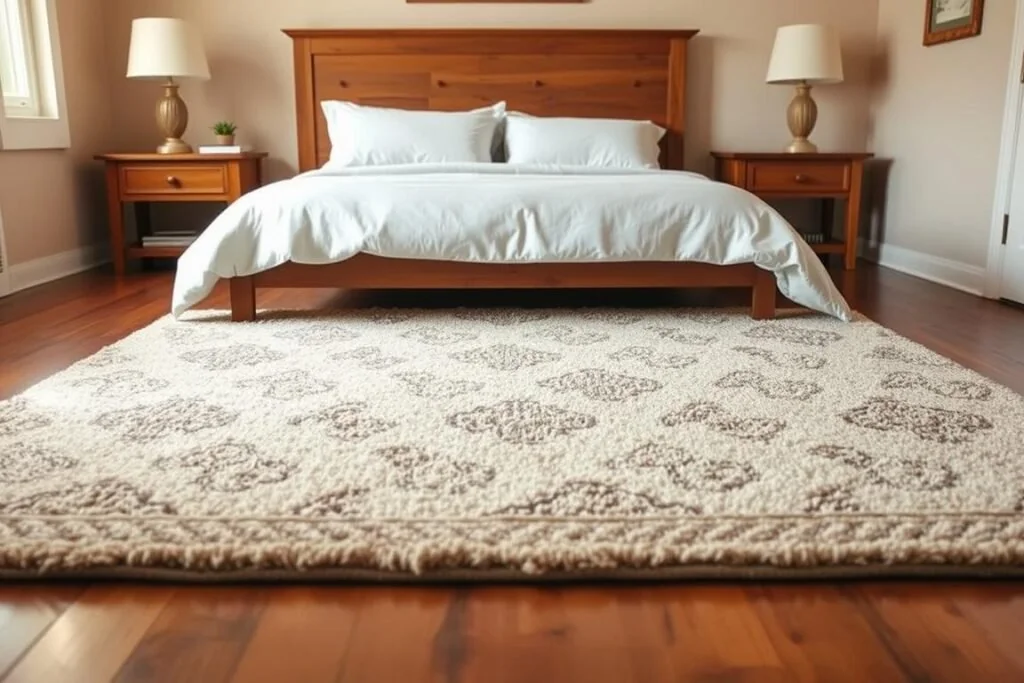
Awkward rooms and how to handle them
- Bed pushed into a corner: skip symmetry. Run the rug out from the two exposed sides instead of centering it, and let it slide under the bed rather than wrapping the wall side.
- Under-bed storage drawers: a thick pile plus a rug pad can stop drawers from opening. Choose low pile — under about half an inch — or keep the rug clear of the drawer side.
- Carpeted bedroom: a rug still works and still defines the bed. Layer a flat weave or low pile over the carpet and use a pad made for carpet-over-carpet so it doesn’t creep.
- Door and closet swings: a bifold or standard door clearing a thick rug by a quarter inch today will drag on it once the pad compresses. Open every door over the taped outline before you buy.
- Floor vents: covering one with a rug cuts airflow to the room. Shift the layout or drop to runners.
- Bench or chair at the foot: add its depth — usually 16 to 20 inches — to the length you need past the mattress, or the front legs will hang off the edge.
If you’re also rethinking what’s beside the bed, the nightstand sizing guide covers how much clearance to leave between the mattress and a bedside table.
Materials, pile and pads
Fiber matters less than most guides suggest, but there are real differences:
- Wool: springy, warm and naturally soil-resistant. It costs more and can shed for the first few months.
- Nylon: the toughest of the common synthetics and holds its color well, which suits a path that gets walked every day.
- Polypropylene (olefin): cheap, stain-resistant and easy to clean, though it flattens under heavy furniture faster than wool or nylon.
- Cotton and jute: casual and affordable. Cotton flat weaves are often machine washable in smaller sizes; jute is rough underfoot, so it’s better at the foot of the bed than beside it.
- Washable rugs: genuinely useful with pets or small kids. Check the size against your washer drum before you assume an 8×10 will fit — most won’t.
Two practical notes. First, a rug pad is not optional under a bedroom rug: it adds cushion, keeps the edges from curling and stops the rug sliding when you step out of bed. Health organizations that cover fall prevention, including Mayo Clinic, specifically recommend securing loose rugs with slip-resistant backing or tape — worth doing anywhere someone gets out of bed half-asleep. Second, rugs sold in the US have to meet federal surface-flammability requirements under 16 CFR Part 1631; small rugs that don’t pass can only be sold if they’re permanently labeled as flammable, so read the tag on bargain finds.

Tape it out before you buy
Fifteen minutes with painter’s tape beats any online visualizer.
- Mark the mattress footprint on the floor first — 60 by 80 inches — even if the bed is already in place.
- Tape the outline of your two best rug candidates, in the orientation you plan to use.
- Measure the gap from the tape to each wall and to the mattress edges. You’re looking for 18 to 24 inches past the bed and 12 to 18 inches to the walls.
- Open the bedroom door, closet doors and any under-bed drawers over the outline.
- Walk the route from the bed to the door and to the closet in bare feet. Then photograph the room from the doorway so you can compare options side by side.
- If you’re torn between two sizes, leave the tape down overnight and decide in the morning. Bigger usually wins.
For layout, style and colour decisions beyond sizing, our bedroom rug guide covers the rest of the room.
FAQ
Will a 5×7 rug work under a queen bed?
Not as the main rug. A 5×7 is narrower than the bed is long and barely wider than the mattress, so you get no usable side overhang. Use it at the foot of the bed or layered over a larger neutral base.
Is a 6×9 big enough for a queen?
Yes, in a small room, as long as you run the 9-foot side across the bed and slide it under the bottom two-thirds. You’ll get around 24 inches of rug on each side. It won’t reach the nightstands, which is fine.
Should the nightstands sit on the rug?
Either is correct. All-on looks more finished and needs an 8×10 or 9×12; nightstands off the rug saves money and suits two-thirds placement. What looks unfinished is a rug edge that runs under only the front legs of a nightstand.
8×10 or 9×12 for a queen?
Room size decides it. Under about 12×14, an 8×10 gives the better proportions; in a 13×15 or larger bedroom, a 9×12 keeps the rug from floating in the middle of the floor.
Can I layer rugs under a queen bed?
Yes. Put a large, plain low-pile rug down as the base and a smaller patterned one on top, usually across the foot of the bed or on one side. Keep total thickness low if you have under-bed drawers or a door that swings close to the floor.
Does the rug have to be centered on the bed?
Center it on the bed, not on the room — that’s the detail people get wrong. If the bed isn’t centered on its wall, a rug squared to the room will look crooked even though it’s perfectly straight.
Before you order
- Measure the frame, not just the mattress, if the frame is wider.
- Confirm the orientation you plan to use, not just the size.
- Add a rug pad cut about an inch smaller than the rug on all sides.
- Check the return policy — rug returns on big sizes can be expensive to ship back.
Updated September 2026.