

Sustainable bed frames are built from responsibly harvested or reclaimed wood, recycled metal, or fast-growing bamboo, finished with low-emission coatings, and put together so you can repair them instead of replacing them. The greenest frame is almost always the one that outlives three cheap ones, so joinery and hardware matter as much as the material label. Look for a real certification code, solid slats no more than about three inches apart, and bolts you can tighten with a wrench.
What actually makes a bed frame sustainable
Four things, in rough order of importance:
- Where the material came from. Certified or reclaimed wood, recycled steel, or bamboo instead of virgin timber of unknown origin.
- What’s holding it together. Panel products bonded with formaldehyde resins off-gas; solid wood joined with mechanical fasteners doesn’t have much to release.
- What’s on the surface. Water-based or hardwax-oil finishes release far less than conventional solvent-heavy lacquers.
- How long it survives. A frame you can take apart, move, tighten and refinish keeps working for decades. A frame with stripped cam locks and swollen fiberboard is landfill in five years.
Packaging and shipping distance count too, but they’re rounding errors next to a frame that has to be replaced twice.
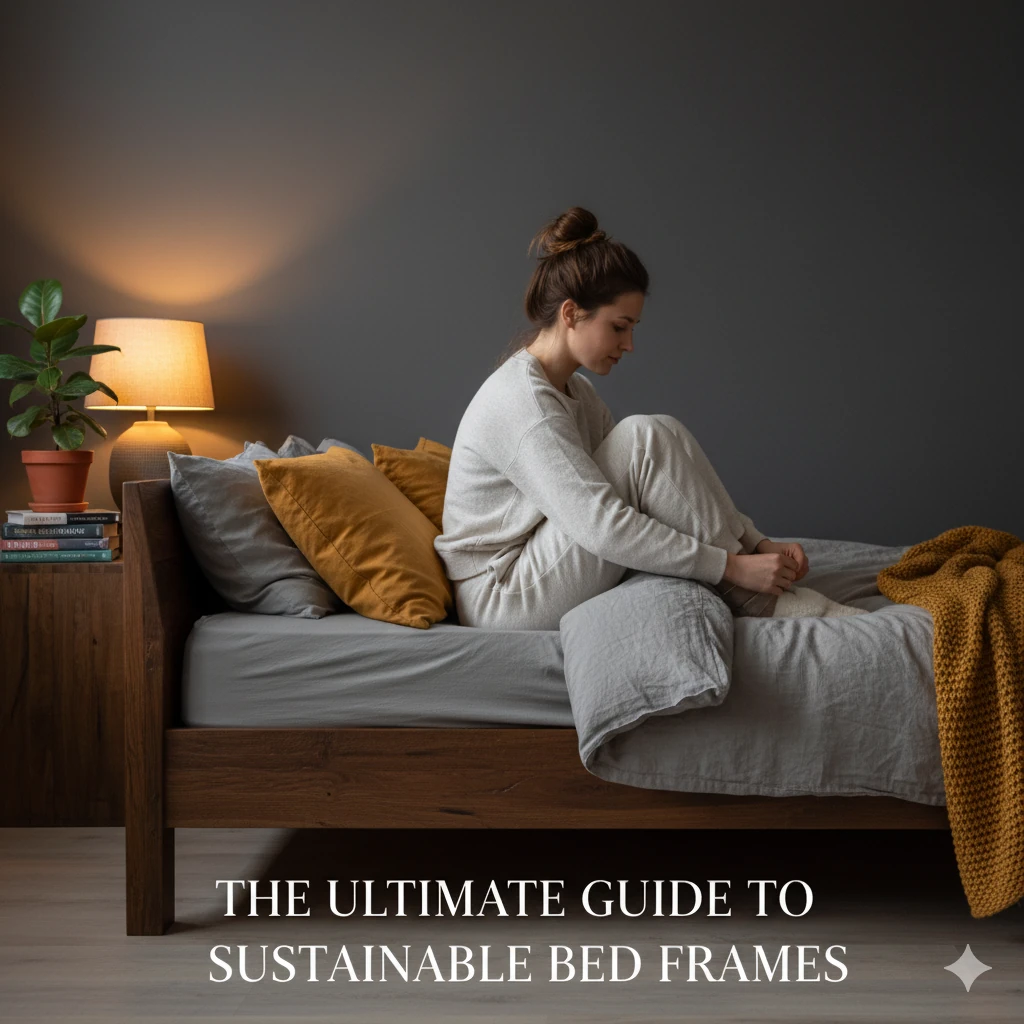
Materials compared: wood, bamboo, metal and the stuff to avoid
| Material | Why it works | Watch out for |
| Solid hardwood (oak, maple, ash, walnut) | Heavy, stiff, takes screws repeatedly, can be sanded and refinished many times | Price; unverified sourcing; “hardwood solids” that turn out to be thin rails with panel infill |
| Reclaimed wood | No new trees felled, dense old-growth timber, character you can’t fake | Old lead paint or wood preservatives on salvage from pre-1978 buildings; ask what was stripped and sealed |
| Bamboo (grass, not timber) | Regrows in a few years, strong laminated panels, light to move | Adhesive-heavy laminations; check the glue and finish, and whether it’s bamboo throughout or a veneer |
| Recycled or recyclable steel | Very long service life, no off-gassing, fully recyclable at end of life | Powder coating quality; thin tube gauge that flexes and squeaks; welds vs. bolted joints |
| Plywood (marine or Baltic-style, thick ply) | Dimensionally stable, strong for slats and panels, efficient use of a log | Resin type; ask for a low-emission spec, not just “eco plywood” |
| Particleboard and MDF | Cheap, flat, easy to ship | Swells permanently if it ever gets damp, fasteners strip, rarely worth repairing |
Engineered panels aren’t automatically toxic. Composite wood sold in the US has to meet federal formaldehyde limits under TSCA Title VI: EPA sets caps of 0.05 ppm for hardwood plywood, 0.09 ppm for particleboard and 0.11 ppm for MDF (0.13 ppm for thin MDF), the same limits California adopted. The durability argument against fiberboard is stronger than the chemistry one.
Certifications worth checking on sustainable bed frames
FSC labels aren’t all the same
The Forest Stewardship Council uses three on-product labels, and the difference matters when you’re comparing sustainable bed frames. FSC 100% means every fiber came from FSC-certified forests, FSC Recycled means 100% recycled fiber, and FSC Mix blends certified, recycled and “controlled” wood. A legitimate claim comes with a licence code that looks like FSC-C123456. If a listing just says “FSC wood” with no code, email and ask for it.
GREENGUARD Gold
This one is about what the finished piece emits into your bedroom air. The Gold tier applies stricter limits than standard GREENGUARD and is built around sensitive users like children and the elderly, which is why it shows up on nursery furniture. It’s a chamber test of the product, not a claim about forests, so it answers a different question than FSC does.
Certifications that don’t apply
CertiPUR-US and GOTS get quoted on bed frame pages constantly, and neither covers frames. CertiPUR-US is a foam program; GOTS is for textiles. If a frame page leans on those badges, it’s borrowing credibility from the mattress aisle.
The 10-minute pre-purchase check
Run through this before you click buy. It filters out most disappointments.
- Joinery. Mortise-and-tenon, dowelled, or bolted metal-to-metal beats staples and cam locks. Bed rails should attach with steel hardware (barrel nuts, hook plates or through-bolts), not particleboard dowels.
- Slat spacing and thickness. Plenty of foam, latex and hybrid warranties require gaps of roughly three inches or less. Slats under about half an inch thick bow; look for solid wood or thick plywood slats that are screwed or webbed in place, not loose.
- Centre support. Any queen or king frame needs a centre rail with at least one, usually two, legs to the floor. No centre leg on a king is a sagging mattress waiting to happen.
- Stated weight capacity. Look for a number that covers two sleepers plus the mattress. A latex or thick hybrid queen mattress alone can run well over 100 lb.
- Replacement parts. Can you buy a single slat, one bolt kit, one rail? Brands that sell spares expect the frame to last.
- Finish disclosure. “Natural finish” means nothing. You want water-based lacquer, hardwax oil, plant oil/wax, or bare wood.
- Real dimensions. Outside footprint, not mattress size. US mattresses run twin 38×75 in, full 54×75, queen 60×80, king 76×80, California king 72×84 — a frame usually adds 2 to 5 inches per side, more with a thick headboard.
- Under-bed clearance. Measure your storage bins before you fall for a low platform. Around 11 to 13 inches of clearance fits most rolling underbed boxes; 7 inches fits almost nothing.
- Assembly method. Flat-pack isn’t the enemy — flat-pack that can only be assembled once is. Frames designed to be taken apart repeatedly survive moves.
- Warranty length and what it covers. Frame structure for 10+ years is a signal. One year is a signal too.
Cost: what you actually pay over time
Most sustainable bed frames cost more on day one, especially solid hardwood and recycled steel. The maths only works out if you keep it, so the honest comparison is cost per year of use, not sticker price. A frame you keep for 20 years at a higher upfront price beats four flat-pack replacements plus four trips to the kerb.
Cheaper routes to the same outcome:
- Secondhand solid wood. Estate sales, restore shops and marketplace listings are full of hardwood frames. Check rails and hardware, then sand and oil.
- Unfinished furniture. Buying raw and applying your own hardwax oil skips factory coatings entirely and costs less.
- Platform instead of bed plus box spring. One purchase, less material, and most modern mattresses are designed for a slatted platform anyway.
- Repair first. A wobbly frame is usually loose bolts, a missing slat, or a stripped hole that a dowel and glue will fix in an afternoon.
If storage is driving the upgrade, compare designs before you commit — our roundup of king-size bed frames with storage covers drawer and lift-up layouts and the clearance each one needs.
Greenwashing red flags
- “Eco wood,” “sustainable materials,” or “responsibly sourced” with no certification code or species named.
- Bamboo or walnut described as a “finish” — that’s veneer over a core, and the core is what matters.
- Carbon claims with no scope or verifier attached.
- “Non-toxic” with no emissions testing named.
- A five-year frame sold as the planet-friendly option. Longevity is the whole argument for sustainable bed frames.
When the frame arrives
Even the low-emission finishes used on sustainable bed frames have a smell for the first few days. Unbox in a garage or spare room if you can, wipe surfaces with a damp cloth, and run a window open with cross ventilation for two or three days. Any smell that’s still strong after a couple of weeks is worth raising with the seller. The same airing-out approach applies to whatever you put on top of it — see how to reduce mattress off-gassing.
Then tighten every bolt after a week, and again after a month. Wood moves as it acclimatises, and most “this frame squeaks” complaints are loose hardware.
Building the rest of the bed around it
A frame is the part you’ll keep longest, so it’s a sensible starting point. After that, the two choices with the biggest effect on air quality and comfort are the mattress and the bedding. Organic cotton, linen and hemp sheets are the straightforward swaps — the trade-offs between them are covered in our guide to sustainable bedding materials, and there’s a wider list of swaps in sustainable sleep products for an eco-friendly bedroom.
Want specific frame styles rather than criteria? Our sustainable bed frames guide walks through eco-friendly picks by design.
FAQ
What’s the most sustainable bed frame material?
Reclaimed solid wood, because no new tree is cut and the timber is usually denser than what’s harvested today. Certified solid hardwood and recycled steel come next. Bamboo is renewable and fine, but check the adhesives in laminated panels.
Do sustainable bed frames off-gas?
Solid wood with an oil or water-based finish releases very little, and mostly in the first few days. Frames built from composite panels release more, though panels sold in the US have to meet federal formaldehyde limits. Ventilation for the first week handles most of it.
How long should a good frame last?
Solid wood and steel frames with bolted joints routinely stay in service for decades and can be repaired when something loosens. Fiberboard frames with cam-lock hardware usually don’t survive more than a move or two.
Is a platform bed better than a bed frame with a box spring?
For most modern foam, latex and hybrid mattresses, yes — less material, one purchase instead of two, and the slatted deck gives the airflow those mattresses want. Traditional innersprings are the exception and may still want a foundation. Our overview of mattress types explains which pairs with what.
Can I use my old mattress on a new slatted frame?
Usually, as long as slat gaps meet your mattress warranty (commonly three inches or less) and the frame has centre support in queen and king sizes. A sagging older mattress won’t be rescued by a new frame, though.
Is metal or wood greener?
Steel takes a lot of energy to make but is endlessly recyclable and effectively never wears out; certified or reclaimed wood stores carbon and is renewable. Either beats a frame you throw away in five years, which is the real comparison.
Updated September 2026.