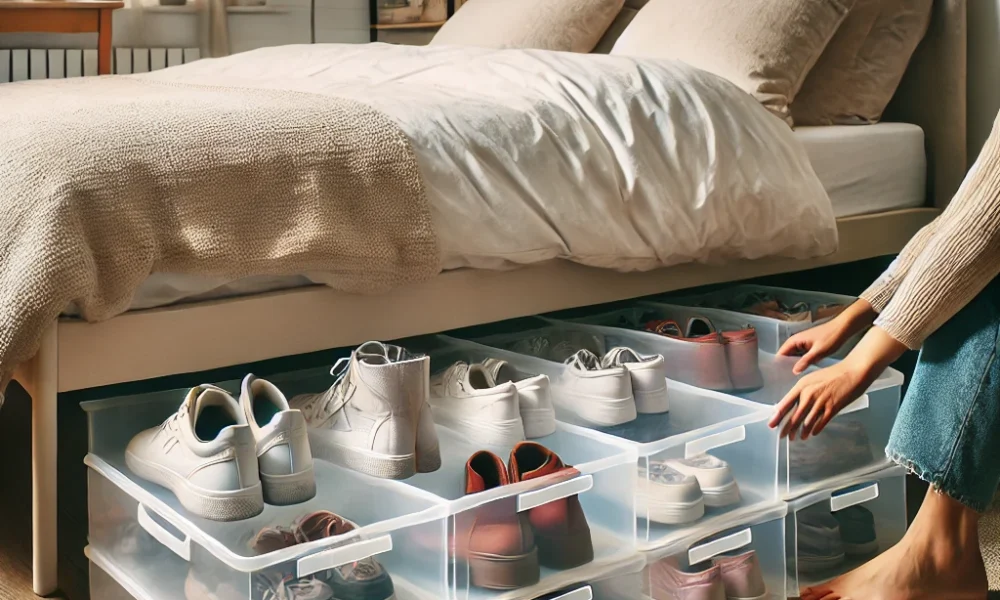
Good under bed shoe storage comes down to one number: the clearance between your floor and the lowest part of your bed frame. Pick a container about an inch shorter than that measurement, fill it with the shoes you wear this season, and keep daily pairs somewhere easier to reach. The rest — dividers, labels, odor control — is fine-tuning.
Measure three things before you buy a single bin
Most under bed shoe storage fails for the same reason: it was bought by eyeball. Grab a tape measure and write down these numbers.
- Clearance (height). Floor to the lowest point under the bed — usually the bottom edge of the side rail, but on some frames it’s a slat, a center support, or the box spring itself. Measure the lowest thing, not the prettiest.
- Depth (front to back). From the side rail inward to the center support leg or the far rail. On a queen, the usable strip on each side is often 15–18 inches before you hit the center bar.
- Width (side to side). The clear run between the corner legs. Two 33-inch bins need about 68 inches of unobstructed space, and plenty of frames don’t have it.
Then subtract a buffer. On hardwood or tile, leave at least 1 inch between the top of the bin and the frame. On carpet, leave 1.5 to 2 inches — the pile compresses under wheels and lifts the box higher than you think.
What fits in how much clearance
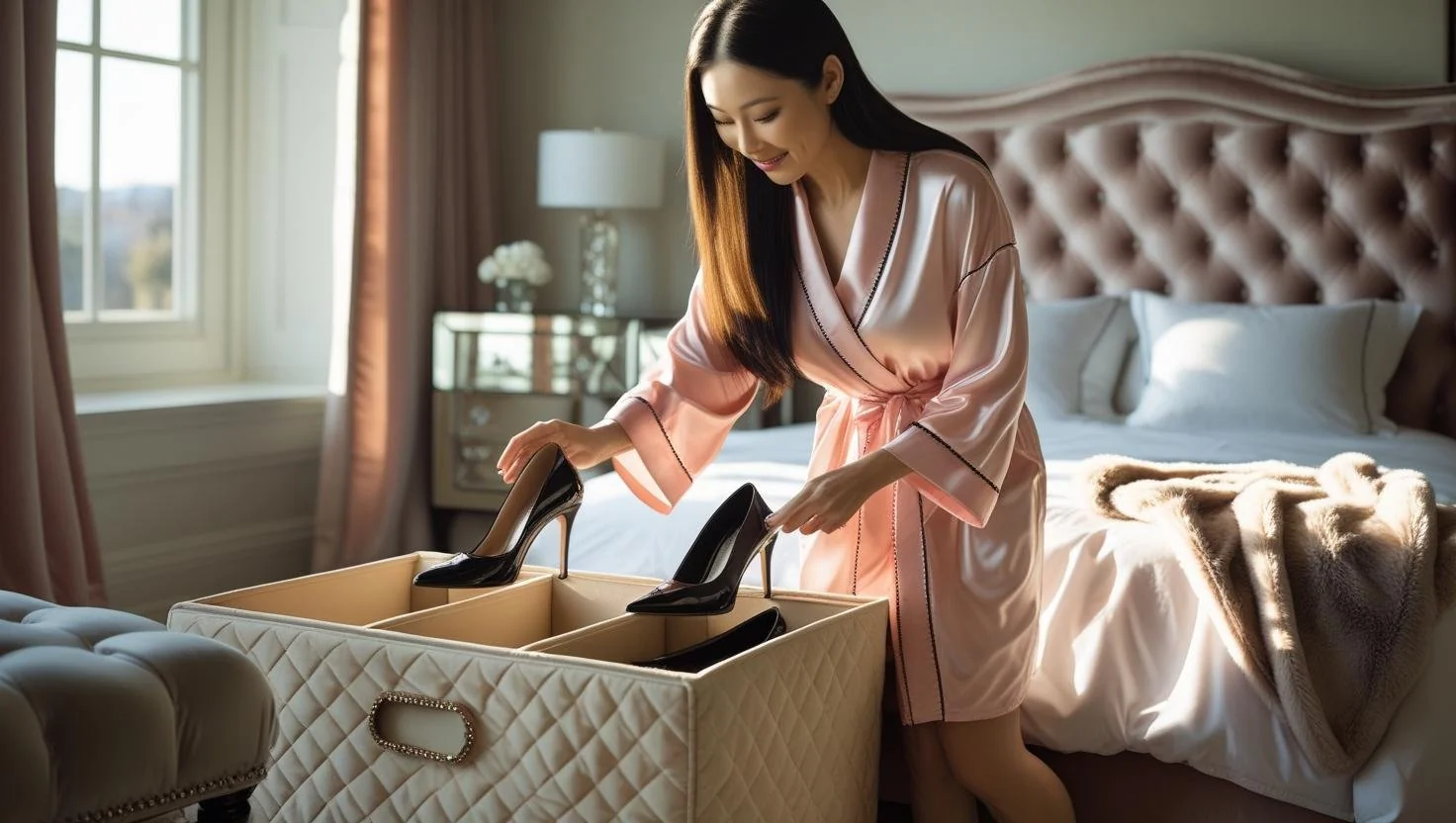
Shoes are taller than people expect. A men’s size 10 running shoe stands roughly 4.5 inches at the heel collar, a women’s flat around 3 inches, a 3-inch pump about 5 inches tip to heel when it sits upright, and a lace-up boot 7 inches or more.
- 3 to 4 inches: flat fabric trays and thin sliding drawers. Flats, sandals, slides, espadrilles.
- 5 to 6 inches: the sweet spot. Standard 6-inch bins swallow most sneakers, loafers, and low heels upright.
- 7 to 9 inches: rolling boxes on casters, taller heels, ankle boots, kids’ and adult shoes mixed in one box.
- 10 inches and up: two-tier organizers or wooden drawers. Tall boots still go on their sides.
Under bed shoe storage types, side by side
| Type |
Clearance needed |
Roughly holds |
Trade-off |
| Zippered fabric bag with clear top |
4–6 in |
6–12 pairs, slim styles |
Low cost and softest on carpet, but sags and offers no crush protection |
| Rigid plastic bin with lid |
6–8 in |
4–8 pairs |
Best dust and spill protection; you must pull the whole box out to dig |
| Rolling box on casters |
7–10 in |
6–10 pairs |
Easiest daily access; small hard wheels stall on thick carpet |
| Wooden or rattan drawer on wheels |
8–12 in |
6–9 pairs |
Looks good with no bed skirt; heavy and pricier |
| Open flat tray or sliding shelf |
3–5 in |
4–6 pairs |
Grab-and-go for daily shoes; collects dust fast |
| Riser plus a low shoe rack |
12 in+ |
8–16 pairs |
Great for tall frames; visible unless you add a skirt |
One rule worth repeating: whatever style of under bed shoe storage you choose, skip vacuum-compression bags for footwear. They crush toe boxes, flatten padding, and leave creases that never quite hang out.
How many pairs will really fit?
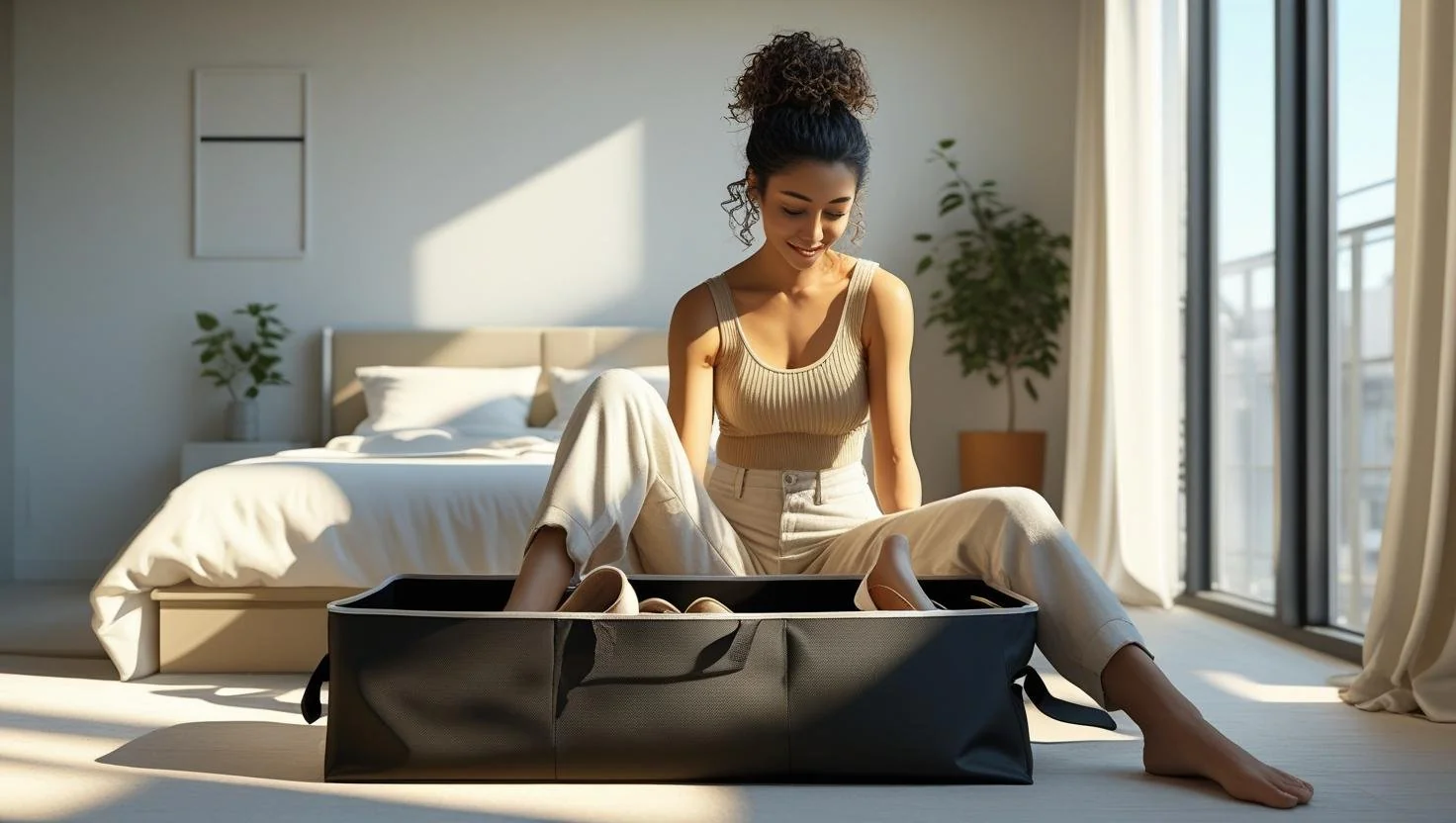
Do the arithmetic instead of trusting the box copy. An adult shoe is about 11–12 inches long and 3.5–4 inches wide. In a typical 33 × 16-inch bin, you get one row lengthwise and roughly eight shoe-widths across — four pairs of men’s shoes, or six to eight pairs of smaller women’s styles if you nest them heel-to-toe.
Two of those bins under a queen bed put 8–14 pairs out of sight. That’s most people’s off-season collection. If you’re trying to fit 30 pairs under there, the problem isn’t the container.
Play the space smart
- Nest shoes in opposite directions — toe next to heel — so the widest parts don’t collide. It gains you about one extra pair per bin.
- Lay tall boots flat with the shafts alternating, and slide a rolled magazine or boot shaper inside to stop creasing at the ankle.
- Keep one bin per category (work, sport, dressy) rather than one giant bin. Lighter boxes slide out with one hand.
- Use adjustable dividers or stiff cardboard so shoes don’t tip and tangle laces every time you pull the box.
- Tie a ribbon or fabric loop to lidless boxes if there’s no handle — much kinder to fingernails than gripping a plastic lip.
Prep shoes properly or you’ll regret it in spring
Anything headed into under bed shoe storage should be clean and bone dry. Damp shoes in a closed bin are how you end up with mildew spots on leather and a smell that survives two washes.
- Let worn shoes air out a full 24 hours before they go in. Sweat takes longer to leave a midsole than you’d guess.
- Brush grit off the outsoles and wipe the uppers. Trapped dirt holds moisture against the material.
- Pull out insoles on athletic shoes and let both parts dry separately.
- Stuff toe boxes with acid-free tissue or clean socks to hold shape — not newspaper, whose ink can transfer to pale linings.
- Add a silica gel pack or a cedar block per bin, and swap or dry out the silica each season.
Humidity and odor: the part most guides skip
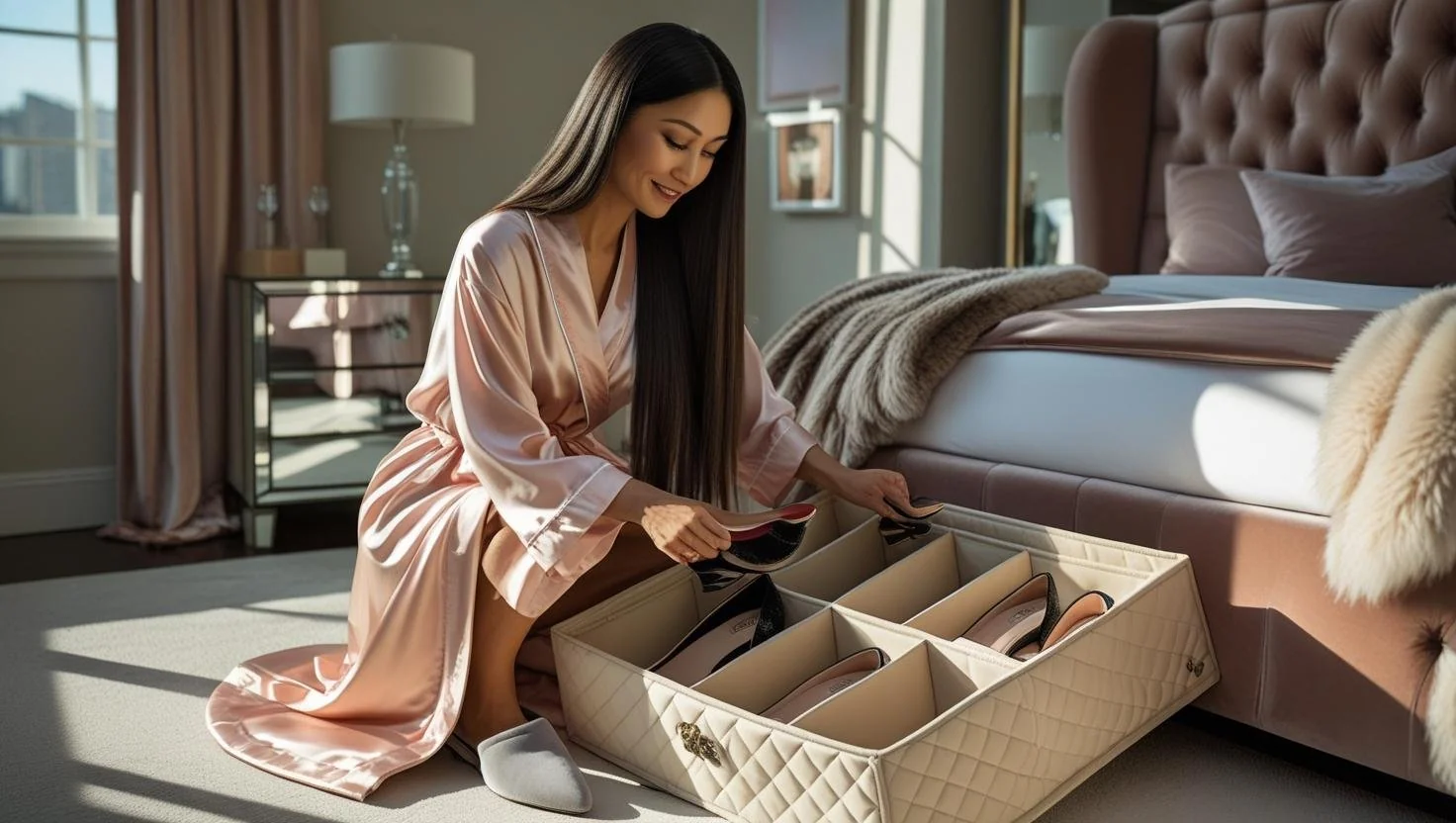
The air under a bed barely moves, so whatever humidity is in your room settles in and stays. The EPA advises keeping indoor relative humidity below 60 percent and ideally between 30 and 50 percent to discourage mold growth. A cheap hygrometer on the nightstand tells you where you stand.
If your room runs damp — basement bedroom, humid summer, no AC — use vented fabric bags rather than sealed plastic, or crack the lid on rigid bins so air can move. In a dry room, sealed bins are fine and keep dust off.
For smells, baking soda in a breathable pouch handles mild funk, and cedar handles both odor and moisture. Skip stuffing scented dryer sheets against leather for months at a stretch; airing the shoes out first fixes far more than masking does.
What shouldn’t go under the bed
Under bed shoe storage is a seasonal parking spot, not an everyday shoe rack. Daily pairs belong near the door or in a closet, because nobody kneels on the floor at 7:45 a.m. two days in a row.
A second reason to keep it tidy: pest control. University of Minnesota Extension notes plainly that storing things under the bed gives bed bugs more places to hide and makes an infestation harder to clear. Sealed, wipeable containers beat loose piles, and leaving a few inches of clear floor lets you vacuum and inspect.
Also think twice about storing anything under the bed if you’re sensitive to dust — that zone collects it, and open trays need wiping every couple of weeks.
Carpet, hardwood, and the sliding problem
Hard floors: almost anything glides, though bare plastic can scratch finished wood. Stick felt pads on the corners of rigid bins.
Carpet: small hard casters sink into the pile and fight you. Fabric bags with wide handles pull much more easily, or choose boxes with 2-inch-plus wheels. A thin plywood board or a cut-down rug pad laid smooth-side up under the bed also gives boxes a runway.
If your frame has a center support leg, you’ll be loading from both sides — plan bins for each side rather than one long box that only fits on paper.
No clearance at all? Change the bed, not the bins
Low platform beds and frames that sit flush to the floor leave nothing to work with. Two fixes: add risers (typical sets lift a frame 3 to 8 inches, and you should check the weight rating and the leg diameter before buying), or switch to a frame built for storage.
Drawer bases and lift-up designs give you enclosed, dust-free space that’s easier on your back — worth comparing if you’re already shopping. Our guide to under bed storage frames covers drawer layouts, and platform and storage beds walks through hydraulic lift styles. In a tight room, space-saving bed frames and these small bedroom storage solutions are the next places to look.
Keep the system from collapsing
Under bed shoe storage only stays useful if you touch it twice a year. Roughly March and October, pull every bin out and do a 15-minute swap. Boots and closed shoes go under the bed in spring; sandals go under in fall. Wipe the floor while the boxes are out, check the silica packs, and be honest about the pairs you skipped all season.
A one-in, one-out rule keeps the bins from creeping past full. And label the short end of each box, not the top — that’s the side you’ll actually see.
FAQ
How much clearance do I need for under bed shoe storage?
At least 4 inches for flat trays, 6–7 inches for standard bins holding sneakers upright, and 8 inches or more for rolling boxes and heels. Always leave an inch of wiggle room above the container, or two on carpet.
How many pairs fit in one under-bed box?
Four to six pairs of adult shoes in a standard 33 × 16-inch bin, or six to eight pairs of smaller, slimmer styles. Slim fabric bags with individual compartments can hold 12, but only for flats and low sneakers.
Will storing shoes under the bed ruin them?
Not if they go in clean, dry, and shaped. Damage comes from damp shoes in sealed containers, crushing heavy boxes on top of soft uppers, and vacuum bags flattening toe boxes.
Are fabric bags or plastic bins better?
Fabric breathes and slides well on carpet, which suits humid rooms and low clearance. Rigid plastic blocks dust and protects shape, which suits dry rooms and heavier boots. Many people use both.
How do I stop shoes from smelling in storage?
Air them 24 hours first, remove insoles to dry, add silica gel or cedar, and don’t seal the lid if your room runs humid. Washing insoles and letting them dry fully solves most lingering odor.
Updated September 2026.