The mirror hacks for small bedrooms that actually make a difference come down to three things: hang one big mirror instead of several little ones, put it where it catches daylight or a lamp, and make sure what it reflects is worth looking at. A 24-by-60-inch mirror on the wall across from your window does more for a cramped room than a dozen tiny round mirrors ever will. Everything below is about getting the size, placement, and hardware right.
Start here: the one placement rule that does the heavy lifting
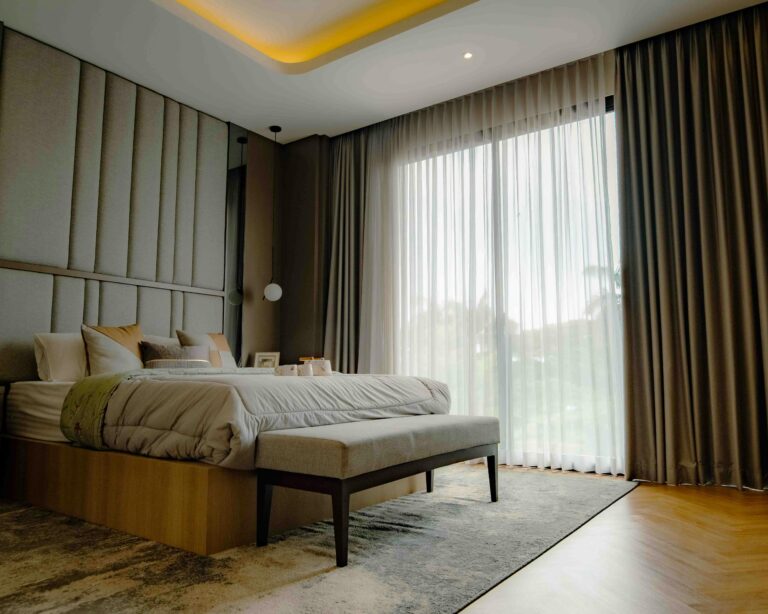
Stand at your window and note what’s directly opposite. That wall is prime mirror real estate: a mirror there pulls daylight back across the room and gives your eye a second “window.” If the bed or closet owns that wall, the wall at a right angle to the window is next best.
The other half of the rule: a mirror only ever shows you what’s in front of it. Point one at a laundry pile and you get twice the laundry. Point it at a plant, a lamp, a framed print, or an open doorway and the room reads deeper.
Surrounding surfaces matter too. A mirror is just the most extreme version of a light-reflecting wall, so it pays off most next to pale paint and a white ceiling, where the bounced light has somewhere to go. Against flat charcoal walls, the same mirror reads as a dark panel.
10 mirror hacks for small bedrooms, with the numbers you need
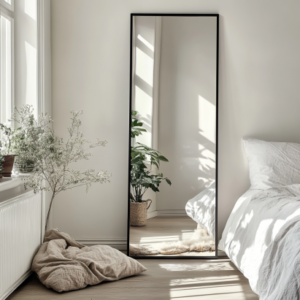
1. One full-length mirror, wall-mounted
Go big and go vertical. A mirror roughly 20-24 inches wide and 60-70 inches tall lets you see your whole outfit and stretches the wall visually. Mount it with the glass bottom about 12-18 inches off the floor so you’re not losing the reflection to baseboard.
Wall-mounting beats a leaner in a tight room, since a leaning mirror eats 14-18 inches of floor depth at its base. Under two feet of clear floor along that wall? Mount it.
2. Mirrored or mirror-fronted closet doors
Best space trade in the room: a full-length mirror for zero square footage. Bypass (sliding) and bifold closet doors both come with mirror panels, and you can glue a framed mirror to a flat slab door if the hinges are solid.
Check the glass spec before you buy. Federal rules for architectural glazing set safety requirements for the glazing used in doors and sliding glass doors, covering materials like tempered and laminated glass, so look for safety glass or a factory safety backing rather than a plain annealed mirror stuck on a moving door.
3. A mirror above the dresser, sized to the furniture
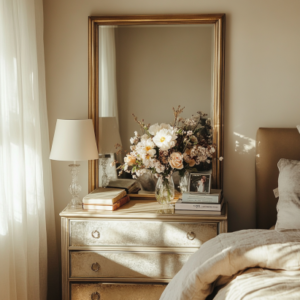
Size the mirror to about two-thirds to three-quarters the width of the dresser below it, so a 48-inch dresser wants roughly 32-36 inches of mirror. Leave 4-8 inches of bare wall between the dresser top and the frame, or the two pieces look stacked.
If you want the mirror to double as a getting-ready mirror, aim for the center of the glass at 57-60 inches off the floor, which is roughly standing eye level for most adults.
4. A horizontal mirror above the headboard
A wide, low mirror over the bed stretches the wall sideways and makes an 8-foot ceiling feel taller. Size it to two-thirds of the bed width (about 40 inches for a queen) and hang it 6-10 inches above the headboard.
Two cautions: anything over a bed needs studs or heavy-duty anchors, and some people hate catching their reflection from bed at 3 a.m. If that’s you, hang it on the wall behind your head instead of across from your feet.
5. Corner panels for an instant “extra room”
Two mirror panels on adjacent corner walls erase the corner line and read as a passage. Frameless panels in the 12-24 inch width range, run floor to ceiling, give the cleanest effect. Keep the seam tight; a visible gap kills the trick.
6. A mirror behind a lamp or sconce
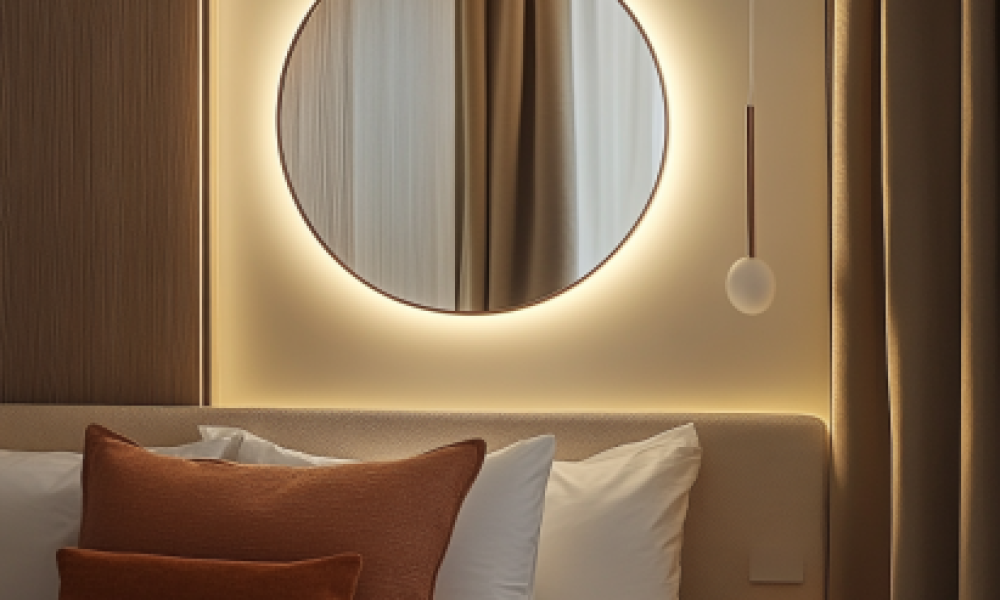
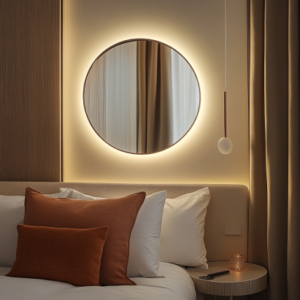
Set a small round mirror behind a sconce or bedside lamp and the light bounces forward instead of dying against the wall. It’s the cheapest of the mirror hacks for small bedrooms with one north-facing window. Use a warm bulb around 2700K so the reflected light stays cozy, not clinical.
7. Mirrored furniture, used in one spot only
A mirrored nightstand or a dresser with mirrored drawer fronts adds reflection without giving up wall space. One piece is plenty. Two or three and the room starts to look like a hotel lobby, plus every mirrored surface shows fingerprints and dust within a day. Antiqued or smoked mirror hides smudges better but reflects noticeably less light.
8. A tight mirror cluster, not a scattered gallery
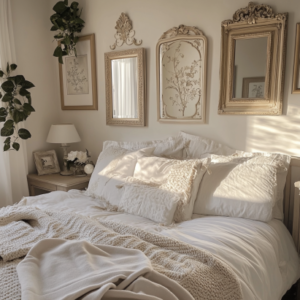
Groupings work in a small room only if you treat them as one shape. Pick three to five mirrors, keep the frames in one material family, and space them 2-3 inches apart so the cluster reads as a single rectangle. Trace each frame onto kraft paper and tape it up before you drill anything.
9. Mirrored sliding panels as a room divider
In a studio or shared room, a sliding screen with mirror on the bedroom-facing side buys privacy without blocking light. Ceiling-track systems need a joist to screw into, so locate joists before you commit. Acrylic panels weigh a fraction of glass, at the cost of a slightly wavy reflection.
10. A frame upgrade on a cheap mirror
A basic frameless mirror plus trim molding looks custom for the price of a few feet of wood. Miter the corners, glue the frame to the glass face with mirror-safe adhesive (silicone-based, not solvent-based, which can eat the backing), and paint or stain to match your bed. The same material logic applies here as with bed frame materials — matching the wood tone or metal finish across two pieces makes a small room feel deliberate instead of thrifted.
Hanging it safely: hardware, weight, and stud math
Mirror glass is heavier than people expect. Quarter-inch glass runs roughly 3.3 pounds per square foot, so a 24-by-60-inch mirror is about 33 pounds of glass before you add a frame. That is not a picture-hook job.
- Find studs. They’re usually 16 inches on center, sometimes 24 in newer builds. Screwing into framing is always stronger than any drywall anchor.
- If you must use drywall: snap-toggle or strap-toggle anchors handle real weight in half-inch drywall; plastic expansion plugs do not. Use two anchors minimum and treat the package rating as a best case, not a target.
- Use two points, not one. Two D-rings or a French cleat keep a heavy mirror level and spread the load.
- Anchor anything that leans. A tall leaning mirror can tip, and CPSC’s Anchor It! campaign makes the case for strapping tall items to the wall, which matters most if kids or pets share the space. Most leaning mirrors ship with a strap and screw; use it.
- Renting? Adhesive strips are fine for mirrors under a few pounds only. For anything bigger, lean it and strap it, or use a lightweight acrylic mirror.
Mirror sizing cheat sheet
| Spot |
Target size |
Mounting height |
| Full-length, wall-mounted |
20-24 in wide x 60-70 in tall |
Bottom 12-18 in off floor |
| Above a dresser |
2/3 to 3/4 of dresser width |
4-8 in above the dresser top |
| Above the headboard |
About 2/3 of bed width |
6-10 in above headboard |
| Behind a sconce or lamp |
12-20 in round |
Center at 60-66 in |
| Corner panels |
12-24 in wide, floor to ceiling |
Flush, tight seam at corner |
Mistakes that make a small room feel smaller
Too many mirrors. Reflections that bounce off each other create visual noise. In a room under about 100 square feet, one large mirror plus one small accent is the ceiling.
Reflecting the wrong thing. Stand where you usually stand — in the doorway, at the foot of the bed — and check the reflection before you drill. If it shows a radiator, a cable box, or the back of a door, move it.
Thin, wavy glass. Budget mirrors in 1/8-inch glass often have a slight funhouse ripple. Look at a straight line, like a door frame, in the reflection before buying; if it bends, so will you.
Peel-and-stick tiles in a grid. The seams read as seams, and adhesive tiles can pull paint (or drywall paper) off when you move out.
Mirrors in a genuinely dark corner. With no light to bounce, a mirror just becomes a dark gray rectangle. Give it something to reflect first.
Damp rooms. If your bedroom runs humid or shares a wall with a bathroom, copper-free mirrors resist the black edge spotting that appears as the silvering corrodes.
Keeping the effect once it’s up
Dusty glass looks gray and reflects less. Spray cleaner onto a microfiber cloth rather than the mirror itself, so liquid can’t wick behind the frame and attack the backing, then buff dry with a second cloth. Skip ammonia-heavy cleaners on antiqued or unsealed-edge mirrors.
Then keep the reflected zone tidy. The mirror is now showing that part of the room twice, so a hamper or a charging-cable tangle in frame undoes the work. Pairing mirrors with real storage helps — see these storage ideas for bedrooms with no closet and a few space-saving furniture picks that keep floors clear.
Common questions
Do mirrors really make a room look bigger?
They make a room look brighter and deeper, not physically bigger. The gain comes from bounced light and the depth of a reflected view, which is why most mirror hacks for small bedrooms live or die on placement rather than quantity.
Where should you not hang a mirror in a bedroom?
Avoid directly facing the bed if movement or your own reflection at night bothers you, avoid unsupported drywall above a bed or crib, and avoid any wall that mostly reflects clutter or a blank dark corner. Feng shui advice against mirrors facing the bed is a preference, not a rule — go by whether it disturbs your sleep.
What size mirror suits a small bedroom?
One mirror at least 24 inches wide, or 60 inches tall for a full-length, does more than several small ones. A mirror that covers roughly a quarter to a third of the wall it’s on hits the sweet spot.
Glass or acrylic?
Glass gives a truer reflection and feels more substantial. Acrylic is lighter, shatter-resistant, and easier to hang in a rental or a kid’s room, but it distorts slightly and scratches easily. Above a bed, that weight savings is a real safety advantage.
Want more on positioning and styling? These bedroom mirror placement tips go deeper on angles and light, and the mirror decorating ideas roundup covers frames and arrangements.
Updated September 2026.