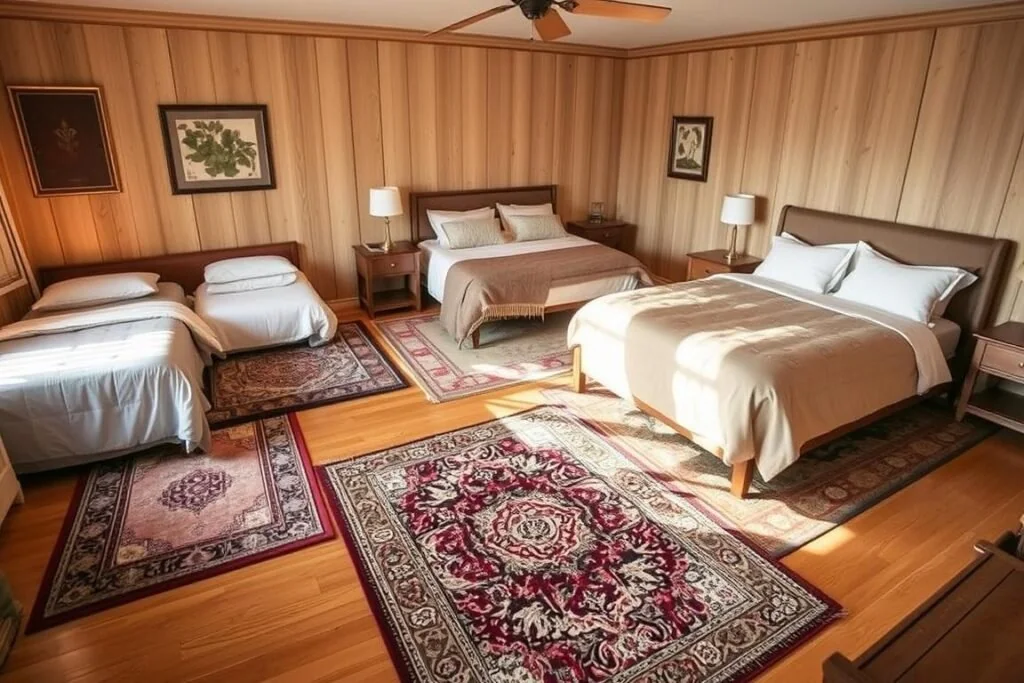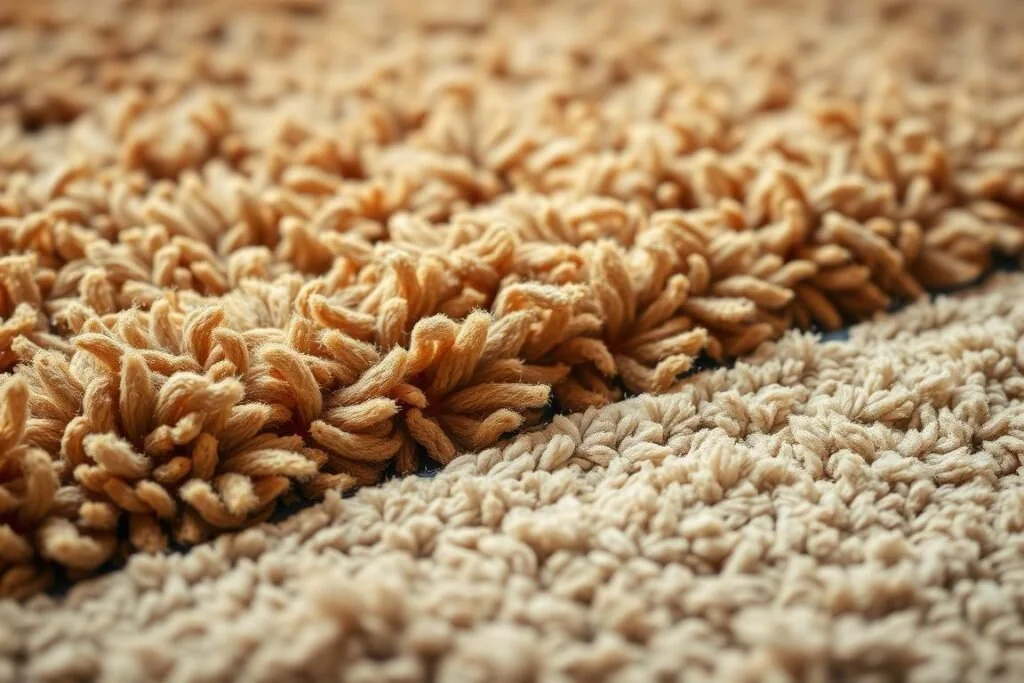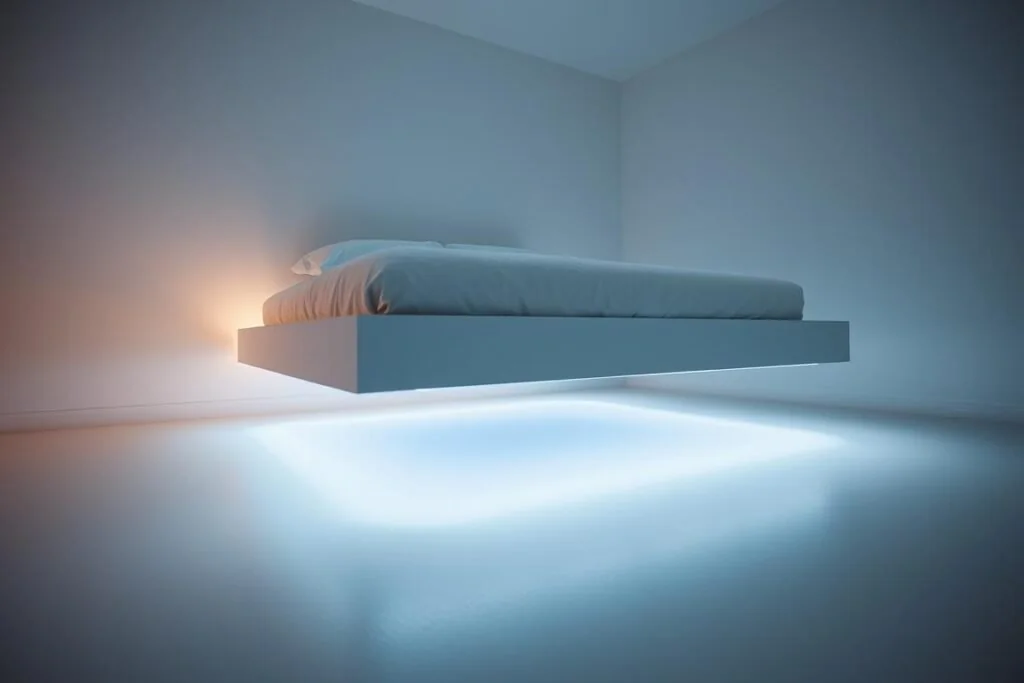
How to Layer Rugs in a Bedroom for a Designer Look

layering rugs in bedroom - layer rugs bedroom designer

Layering Rugs in Bedrooms for Warmth and Style

Layering Rugs in Bedroom can make your space look professionally styled in minutes. A smart stack of textiles adds tone, texture, and depth so your room feels cozy and curated without a full remodel. For bed-by-bed sizing basics, start with our Bedroom Rug Size Guide (pillar).

Key Takeaways

  • Use a larger base to frame the top rug and keep a visible border.
  • Pair natural flatweave with a plush accent to add texture and warmth.
  • Map sizes with painter’s tape so placement feels right before you buy.
  • Let furniture front legs rest on the base for a polished, designer effect.
  • Layering Rugs in Bedroom refreshes what you already own and boosts visual interest.
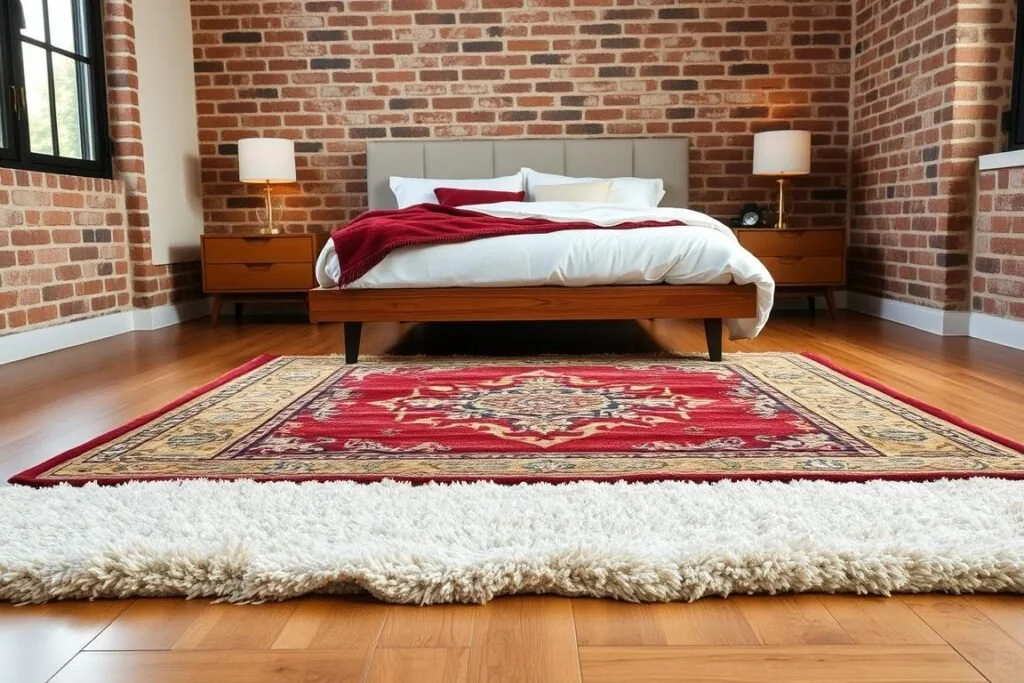

Layering rugs in a bedroom with a neutral flatweave base under a smaller patterned accent rug

Why Layer Rugs in a Bedroom Space

Pairing a large neutral with a smaller colorful piece anchors zones, adds depth, and brings warm texture without a full redesign. Comfort underfoot also supports a calming wind-down routine, which helps set the stage for better rest.

According to the CDC, most adults benefit from a consistent, comfortable sleep environment—layered rugs can reduce echo and add quiet softness.

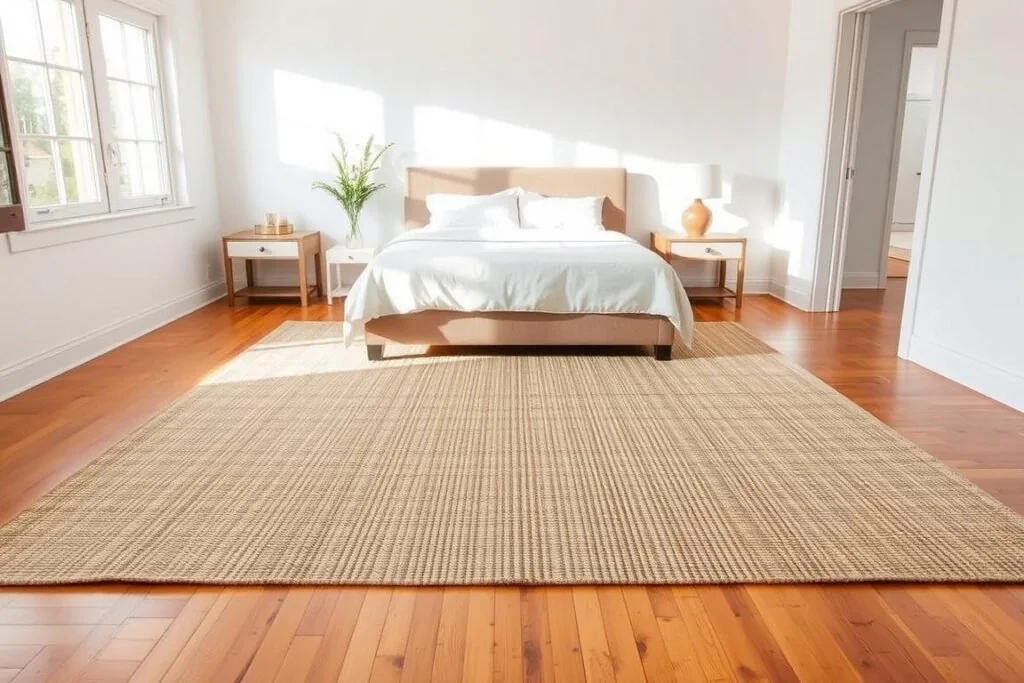
Above: a generous jute base lets the patterned top rug pop without overwhelming the room.

It’s budget-friendly: a smaller vintage or bold accent over a calm base gives a luxe look without paying for a massive area piece. You can hide wear on a favorite rug or make a too-small piece feel right-sized.

Pro tip: overlap slightly and let the bottom rug dominate; the contrast keeps the layout balanced and easy on the eye.

  • Use a dominant base with a character-rich accent to add color and interest.
  • Try a tactile mix so texture becomes part of the room’s story.
  • Rotate pieces seasonally to protect the base and refresh the space.
Benefit How it works Quick tip
Depth & warmth Neutral base + textured accent Keep base much larger than top
Budget boost Small statement over affordable area Choose vintage or washable accent
Flexibility Swap top piece seasonally Overlap slightly, not edge-to-edge

Build the Perfect Base: Size, Materials, and Color Foundations

Start with a clean canvas. A flat, durable base grounds the furniture so your accent rug can shine. Measure, mark with tape, and make sure the base reads clearly from all sides.

Get the size right

Measure your room and outline with painter’s tape before buying. An 8′×10′ often fits queen beds, but confirm against your tape map and furniture. For more sizing help, see our Bedroom Rug Size Guide.
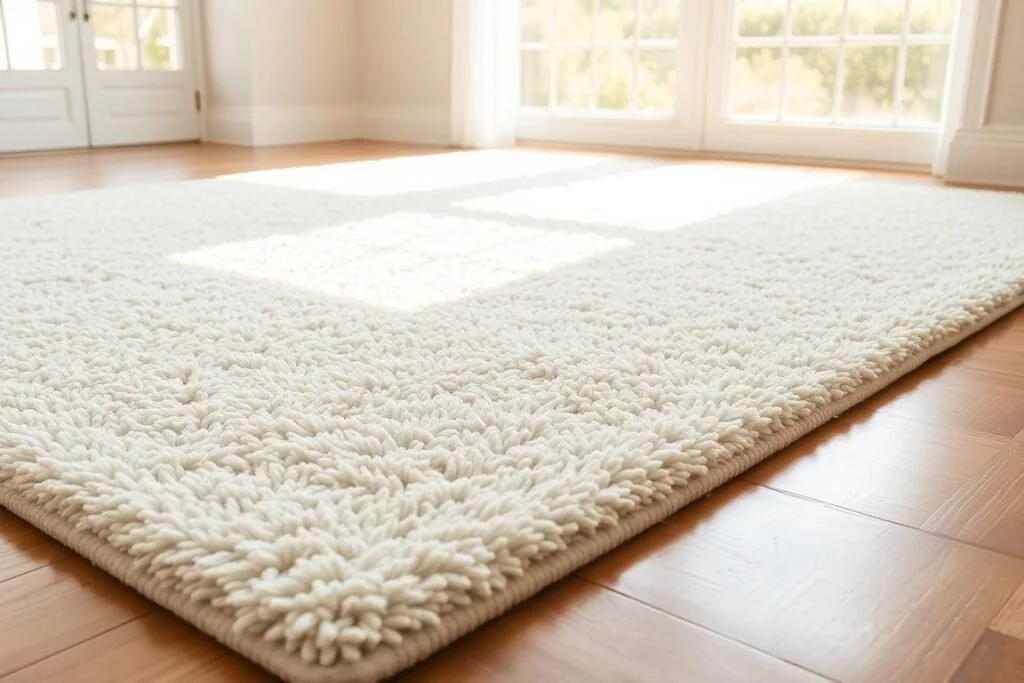
Layering Rugs in Bedroom works best when the base rug is sized first u featuring layer rugs bedroom designer

Mapping with tape shows how far the base should extend around your bed and nightstands.

Choose durable, neutral materials

Pick tightly woven jute or sisal for stability under furniture. A neutral base lets your patterned or colorful top rug stand out without visual clutter.

Shopping eco-conscious? Look for recognized textile and bedding certifications to reduce unwanted odors in the bedroom. See this overview of bedding and materials certifications and this consumer-friendly non-toxic buying guide for context.

  • Place front bed legs and nightstands on the base for a stable, tailored look.
  • If unsure, size up—the extra border looks custom.
  • Slide furniture and recheck clearances before committing.
Tip Why it matters Quick action
Measure first Avoid returns and wrong rug size Use painter’s tape to map footprint
Choose jute/sisal Durable, neutral base with texture Pick flatweave for furniture stability
Hold furniture on base Creates a cohesive, designer feel Place front legs on the rug

Layering Rugs in Bedroom: Step-by-Step for a Cohesive, Safe Layout

Place the biggest rug first, then test a smaller accent for the most flattering overlap. Work in small moves and check sightlines from the doorway and bed.
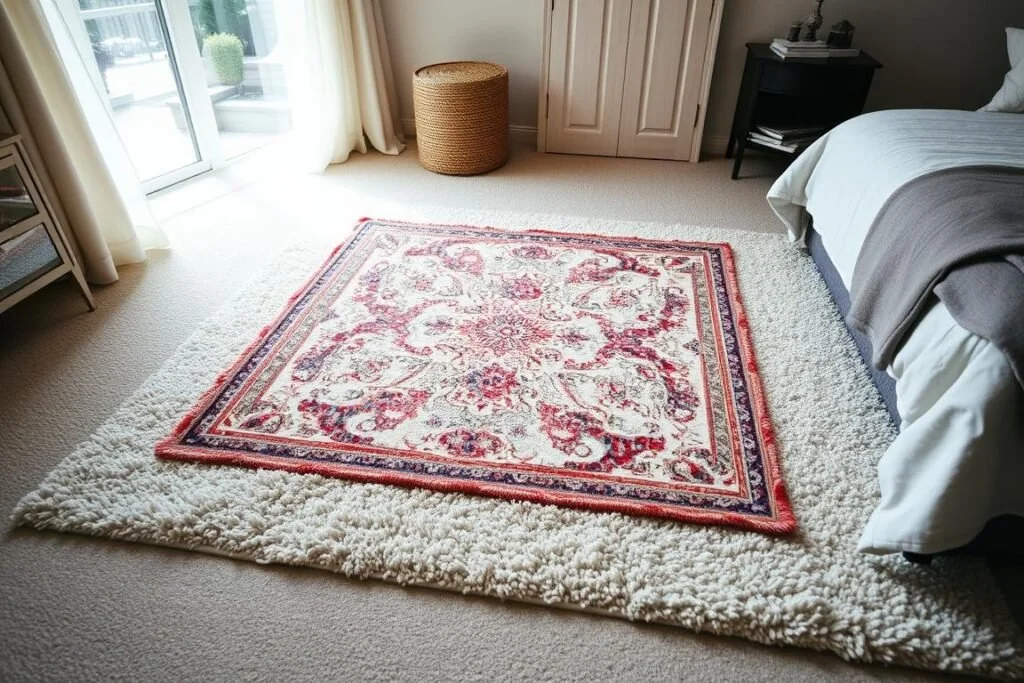
Layering Rugs in Bedroom shown step-by-step with a base rug and top ru featuring layer rugs bedroom designer

A visible border all around the top rug keeps the composition crisp and intentional.

Placement options

Center the base under the bed so the front legs sit on it. Add a top rug under the lower third of the bed, place a small accent at the foot, or run wide side runners for symmetry.

Pairing pattern and texture

Pair a calm, flatweave base rug with a patterned or high-pile top rug to add depth and color. The contrast reads curated without clutter. For low-maintenance care, consider washable low-pile accents.

Proportions that work

Keep the base much larger so a clear border shows all around. Aim for modest overlap—avoid edge-to-edge alignment so the layout feels balanced.

Safety first

Use a quality rug pad under the base and a thin grip under the top rug to reduce slips. Avoid stacking very thick piles, and walk your paths to test stability. See our quick guide to pads in the Bedroom Rug Size Guide.

  • Place base first, then add the top rug.
  • Show a consistent border around the accent piece.
  • Rotate the top rug regularly to refresh the look with minimal lifting.
Step Action Result
Set base Place largest rug under bed; add pad Anchors the space and prevents slip
Add top Center or offset smaller rug Creates contrast and visual interest
Secure Use a thin grip under the top Safe, stable walkways

For an illustrated step-through, see this helpful how-to from The Spruce.

Designer-Approved Combos, Room Scenarios, and What Works Best

Use a tried-and-true pairing when you want instant polish. A generous neutral base with a bolder smaller top works in most bedrooms.

Common size pairings: an 8′×10′ base with a 5′×8′ or 6′×9′ top. If furniture is visually heavy, go with the larger top so the accent still reads intentional. Mark both sizes with painter’s tape and walk the space before you buy.

Want a quick visual demo? Architectural Digest often showcases layered looks that mirror these size rules.

  • 8′×10′ base + 5′×8′ or 6′×9′ top for balanced proportion.
  • Size the top up if the accent feels too delicate.
  • Use a neutral jute or flatweave base so the top’s pattern pops.
Combo Best use Quick tip
8′×10′ base + 5′×8′ top Bedroom anchor Place front furniture legs on the base
8′×10′ base + 6′×9′ top Heavier furniture Let top corners peek past the table or bench
Runner over base Foot-of-bed or narrow spaces Layered look without extra area purchase

Want fit-checks by bed size? Don’t miss our quick explainer: Best Rug Sizes Under a Queen Bed, plus layout notes in the How to Choose a Bedroom Rug guide. For style inspiration, browse real-home examples on Apartment Therapy.

FAQ

Can you layer rugs over carpet in a bedroom?

Yes. Use a low-pile or flatweave base rug over carpet to stabilize the surface, then add a lighter accent on top. A thin pad or grip helps prevent shifting.

What size top rug works on an 8′×10′ base?

A 5′×8′ keeps a generous border; a 6′×9′ feels bolder with heavier furniture. Tape both to see which reads best in your room.

How do you keep layered rugs from slipping?

Use a quality rug pad under the base and a low-profile grip under the top rug. Avoid stacking thick piles in walkways.

Do layered rugs make a small bedroom look smaller?

No, if the base is large enough. A clear border around the top rug actually clarifies the layout and can make the room feel more intentional.

Conclusion

Wrap up the look by setting a generous foundation and letting one smaller piece define the mood. Anchor the plan with a clear base so the top rug shows a visible border, mix one texture with one pattern or color, and secure both layers with pads for safety. With these checks, Layering Rugs in Bedroom becomes a simple designer move that protects pieces, improves traffic flow, and elevates your space. For more cozy bedroom wins, explore Cozy Bed Quarters.

Other reading we found popular

How to Place a Rug Under a Bed: Sizes, Reveals and the Layout Math

how to place a rug under a bed - place rug under bed

How to place a rug under a bed comes down to three layouts: the whole bed plus both nightstands sitting on the rug, the lower two-thirds of the bed on the rug, or two runners flanking the bed. Center the rug on the bed, not on the room, and aim for roughly 18–24 inches (46–61 cm) of rug showing along each side of the mattress so both feet land on something soft. In a typical 10 x 12 ft bedroom that usually means an 8 x 10 under a queen and a 9 x 12 under a king.

Everything below is the arithmetic behind those numbers: what fits, what to measure first, and where the usual advice falls apart.

How to place a rug under a bed: the three layouts and who each one suits

Pick the layout before you pick the rug. It decides the size, and the size decides the price.

1. Full coverage (bed, nightstands, bench all on the rug)

The rug starts a few inches off the headboard wall, runs past the foot of the bed and swallows the nightstands. Hotel look, warmest underfoot, hides scuffed floorboards.

Who it suits: rooms of about 12 x 14 ft (3.7 x 4.3 m) or larger, hard floors, cold climates, anyone who hates stepping onto bare wood in January.

Who should skip it: anyone on a budget. Going from 8 x 10 to 9 x 12 adds 28 sq ft of rug, and 10 x 14 adds 60 sq ft over the 8 x 10 — the cost curve is steep.

2. The two-thirds layout (the one most rooms should use)

Slide the rug under the bed so its top edge sits just past the nightstands — commonly 20–30 inches (51–76 cm) down from the headboard wall. About two-thirds of the bed sits on the rug, and the rest of the rug spreads out at the foot.

You get soft landings on both sides and at the foot, and you don’t pay for rug nobody sees. A 6 x 9 turned sideways under a queen is the classic version: the 9 ft (108 in / 274 cm) dimension runs across the bed, leaving about 24 inches (61 cm) of rug beyond each side of a 60-inch mattress.

Who it suits: most bedrooms between about 10 x 10 and 12 x 14 ft. If you only learn one way of how to place a rug under a bed, learn this one.

Who should skip it: anyone with a very low frame. Under 3 inches (7.6 cm) of clearance and sliding a padded rug underneath means lifting the frame, not shoving.

3. Two runners (or one runner plus a foot rug)

Two runners of about 2.5 x 8 ft (30 x 96 in / 76 x 244 cm) flank the bed, with an optional third across the foot. Nothing goes under the bed.

Who it suits: narrow rooms, beds against a side wall, rentals, and anyone opening under-bed drawers daily. It’s the cheapest warm floor beside a bed, and a small cotton runner goes in the washing machine.

Who should skip it: households where someone has balance problems. Three separate rug edges beside a bed mean three more things to catch a toe on at 3 a.m.

Rug size by bed size, with the exact reveal in inches and cm

Standard U.S. mattress sizes are Twin 38 x 75 in, Twin XL 38 x 80, Full 54 x 75, Queen 60 x 80, King 76 x 80 and California King 72 x 84. The reveal figures below are measured from the mattress edge on a centered rug. Most bed frames add about 2–4 inches (5–10 cm) per side, and upholstered frames can add 4–6 inches (10–15 cm), so subtract that from the reveal.

Bed Mattress (in / cm) Tight but workable Best all-round Rug showing each side (best all-round)
Twin 38 x 75 / 97 x 191 3 x 5 beside the bed 5 x 8 (60 x 96 in / 152 x 244 cm) 11 in / 28 cm
Full 54 x 75 / 137 x 191 5 x 8 turned sideways 6 x 9 sideways (108 in / 274 cm across) 27 in / 69 cm
Queen 60 x 80 / 152 x 203 6 x 9 sideways 8 x 10 (96 x 120 in / 244 x 305 cm) 18 in / 46 cm
King 76 x 80 / 193 x 203 8 x 10 9 x 12 (108 x 144 in / 274 x 366 cm) 16 in / 41 cm
California King 72 x 84 / 183 x 213 8 x 10 9 x 12 or 10 x 14 (120 x 168 in / 305 x 427 cm) 18 in / 46 cm (9 x 12), 24 in / 61 cm (10 x 14)

Do the reveal math yourself in ten seconds

Side reveal = (rug width − bed frame width) ÷ 2. A king frame 80 inches wide on a 9 x 12: (108 − 80) ÷ 2 = 14 inches (36 cm) per side. Enough for one foot; 18 inches is enough for both feet and a dropped phone.

Foot reveal = rug length − (bed frame length − how far down the rug starts). A queen frame 85 inches long with an 8 x 10 starting 24 inches off the headboard wall: 120 − (85 − 24) = 59 inches (150 cm) of rug past the foot. That’s a lot, and it’s why an 8 x 10 in a 12 ft deep room ends up as full coverage whether you planned it or not.

If you’re deciding between two specific sizes, we broke the queen and king cases down further in rug size for a queen bed and the right rug size for a king bed.

Diagram showing how to place a rug under a bed with 18 to 24 inches of rug showing on each side

How much floor should show around the edges?

Most advice on how to place a rug under a bed quotes a bare border of 10–20 inches (25–51 cm) between the rug edge and the baseboards, closer to 18 in larger rooms. Be honest about what that is: a design convention, not a tested standard. What matters functionally is walkway width.

Designers generally call for at least 24 inches (61 cm) of clear floor on each side of a bed, 30–36 inches (76–91 cm) for a queen, and 36 inches or more for a king or Cal King, with main traffic paths around 36 inches. Your rug sits inside that walkway — but the walkway has to exist first. Measure it with the bed where it actually lives.

Two hard minimums: leave at least 6 inches (15 cm) of bare floor at any wall, because a rug that dies into a baseboard reads like failed wall-to-wall carpet, and never let a rug edge land in a doorway threshold.

What to measure before you buy (do all nine)

  1. Bed frame footprint, not the mattress — outside width and length, including feet that splay.
  2. Room, wall to wall, at floor level. Baseboards eat an inch a side.
  3. Door swing. Tape the arc of the bedroom and closet doors.
  4. Door undercut. Interior doors commonly clear the floor by about 5/8–3/4 inch (16–19 mm). A 1/2-inch pile on a 1/4-inch pad is already 3/4 inch. Measure your own gap with a ruler before you buy anything plush.
  5. Floor vents and floor outlets. Covering a supply vent is a heating problem, not just an aesthetic one.
  6. Under-bed clearance, if you’re sliding a rug under a loaded frame.
  7. Drawer and dresser swing at the rug edge.
  8. Delivery path. Rugs ship rolled, and the tube is usually about as long as the rug’s short side — so a 9 x 12 arrives as a roll around 9 ft (2.7 m) long. Measure your tightest stairwell turn and doorway width. A 9-ft tube does not pivot on a landing that’s 3 ft square.
  9. Lift help. Big dense wool rugs are a two-person job. Check the shipping weight on the spec page rather than guessing; it varies hugely between a flatweave and a hand-knotted pile of the same size.

Then tape the outline. Painter’s tape on the floor for 24 hours teaches you more about how to place a rug under a bed than any guide will. Walk it barefoot in the dark.

Nightstands, benches and dressers: on the rug or off?

The rule people repeat is “front two legs on the rug.” That’s a living-room rule; in a bedroom it applies to benches and chairs, not the bed.

  • Nightstands: either all the way on or completely off. Half-on creates a rug edge under a lamp cord and a wobbling drawer, and it’s the single most common thing that makes a bedroom look accidental.
  • Bench at the foot: all four legs on, or the rug ends before it. A bench straddling a rug edge rocks.
  • Dresser against a wall: keep it off the rug entirely. Heavy dressers crush pile permanently, and a dresser half on a rug tilts forward slightly, which matters if you have anti-tip hardware or small children.
  • Beds with storage drawers: keep the rug off the drawer side, or use runners. Drawers that open over a pile rug scrape and eventually stick.

Materials: what each one is actually like to live with

Feel first, then care. A bedroom rug gets bare feet twice a day and little else, which is a gentler life than a hallway rug has. Feel should outrank toughness here.

Fiber Underfoot Holds up to Watch out for Best for
Wool Warm, springy, the best barefoot feel Crushing, years of use; naturally resilient Sheds for months when new; moths; higher cost Bedrooms with hard floors and a real budget
Polypropylene (olefin) Soft but slightly slick Stains and spills; cleans easily Crushes flat under furniture and doesn’t bounce back Kids’ rooms, rentals, pets, tight budgets
Nylon Plush, close to wool in higher grades Heavy traffic; good resilience Fades in direct sun; costs more than olefin Shared or high-use bedrooms
Jute / sisal Coarse and scratchy barefoot Dry wear; good texture as a base layer Water stains; sisal is bad near humidity The bottom layer in a layered setup, not the top
Cotton flatweave Thin, cool, no cushion Washing — the main reason to pick it Slides badly without a pad; wrinkles Small runners beside the bed, allergy households
Viscose / “art silk” Very soft, high sheen Very little Permanent water marks from one dropped glass Low-traffic accents only; avoid beside a bed

On indoor air: if off-gassing worries you, the Carpet and Rug Institute runs third-party emissions testing for carpet and cushion. Its Green Label Plus program tests for VOC emissions and is recognized in the EPA’s federal purchasing recommendations — one of the few labels here with a published protocol behind it.

Rug placement compared for twin, queen and king beds showing full coverage and two-thirds layouts

Rug pads, pile height and the door problem

A pad isn’t optional. It stops creep, adds cushion, keeps grit from grinding into the floor, and it’s the difference between a rug that lies flat and one you straighten weekly.

  • On hardwood, tile or vinyl: felt-and-rubber, 1/4 inch (6 mm) for comfort, 1/8 inch (3 mm) if door clearance is tight. Natural rubber grips best; cheap PVC mesh can mark finished floors over time.
  • Over carpet: use a pad rated carpet-on-carpet. Regular pads let the top rug ripple and walk. Keep the top rug low-pile over plush carpet; two thick layers is how you get a rolling edge.
  • Total stack height: pile plus pad, compared to your door gap. Over roughly 3/4 inch and you’re trimming a door.
  • Trim the pad about 1 inch (2.5 cm) smaller than the rug on all sides so it never peeks out.

Safety: the part most rug guides skip

Loose rugs are a recognized trip hazard. A CDC-authored analysis of U.S. emergency department data on rug- and carpet-related falls in adults 65 and over found most of these injuries happened at home, the bathroom was the most common room, and falls often occurred at the transition between rug and bare floor. The study is on the National Library of Medicine site.

Two caveats: that data covers older adults treated in emergency departments and doesn’t isolate bedroom rugs. Don’t read it as “rugs are dangerous” — read it as a reason to be deliberate about edges.

Practical version: gripping pad under every rug, thin or bound edges rather than thick rolled ones, rug edge kept out of the path between bed and bathroom door, and a light you can reach without standing up (several picks in our bedside lighting round-up are motion-activated for this reason). If someone uses a cane or walker, runners are the wrong call — one large rug with no interior edges is safer.

Small bedrooms, over-carpet, and other awkward cases

Room under 10 x 10 ft: one rug, as large as you can manage, beats three small ones — fewer edges makes a small room read bigger. More on that in choosing a rug for a small bedroom.

Bed against a side wall: forget symmetry. Run the rug out from the open side and let it disappear under the bed.

Over wall-to-wall carpet: fine, and often how renters get a floor color they chose. Low-pile rug, carpet-to-carpet pad, check the edges monthly for curl.

Round beds: a round rug about 2 ft (61 cm) wider than the bed all round. Half-coverage under a round bed looks intentional; under a rectangular bed it rarely does.

Layering: a patterned wool rug over a larger jute base, showing 6–12 inches (15–30 cm) of jute. Use a pad between the layers or the top rug travels.

On cost: prices move too fast and vary too much by fiber and construction for a number here to mean anything. What drives price is fiber, construction and square footage — and square footage is the one you control, by choosing the two-thirds layout over full coverage.

Wool, jute and flatweave rug samples with a felt rug pad for a bedroom floor

Five mistakes that make a good rug look wrong

  • Centering on the room instead of the bed. If the bed isn’t centered on its wall, a room-centered rug looks crooked forever.
  • Buying one size down to save money. A too-small rug is the most common error in how to place a rug under a bed, and styling won’t fix it. Size up.
  • Measuring to the comforter edge. A queen comforter hangs well past a 60-inch mattress. Measure to the frame.
  • Skipping the pad. Creeping, curling, flattening — usually the missing pad, not the rug.
  • Ignoring the door until delivery day. Check the undercut before you order, not after unrolling 80 sq ft of wool in a hallway.

Get those five right and the rest is taste. For style, pile and pattern, our bedroom rug guide covers what this page doesn’t.

FAQ

Should the rug go under the nightstands?

All the way under or fully clear — not half. Under gives the widest soft landing and the hotel look but needs a bigger rug; clear saves money and keeps cords reachable. Half-on is the one version of how to place a rug under a bed that always looks accidental.

What size rug do I need for a queen bed?

An 8 x 10 (96 x 120 in / 244 x 305 cm) is the safe answer: about 18 inches (46 cm) beyond each side of a 60-inch mattress when centered. A 6 x 9 turned sideways suits tighter rooms, giving about 24 inches (61 cm) per side with less rug under the bed.

Which direction should the rug run?

Long dimension in line with the bed’s length for full coverage; across the bed’s width for a two-thirds layout. Either way, keep the rug edges parallel to the walls — two degrees off reads as sloppy from the doorway.

Can I put an area rug over carpet in a bedroom?

Yes, with a carpet-to-carpet pad. Pick a low-pile top rug, especially over plush carpet, and check the corners for curling every few weeks. Bound or flatweave edges lie flatter over carpet than thick rolled edges do.

Do I need a rug at all if my bedroom is already carpeted?

Functionally, no. People add one for color, to define the bed area in a large room, or to protect rental carpet. If none of those apply, skip it and avoid the extra edges.

How do I stop the rug sliding out from under the bed?

The bed’s weight holds the section beneath it; the loose end moves. A felt-and-rubber pad trimmed 1 inch smaller than the rug fixes most of it, and rug tape on one stubborn corner handles the rest without gumming up the whole floor.

Updated September 2026.

15 Cool LED Lighting Ideas for an Aesthetic Bedroom

led lighting bedroom ideas - cool led lighting aesthetic

LED Bedroom Lighting Ideas for Modern Homes

Updated 2025

Want fast results? led lighting bedroom ideas can transform your space overnight without a remodel. This guide shows you how to layer light, save energy, and turn your room into a calm retreat. For a deeper design framework, explore our bedroom lighting ideas guide.

You’ll see how strips and smart bulbs work together for ambient glow, task control, and playful accents. Motion-activated under-bed strips add safe path light, while a backlit headboard and illuminated wall art give soft halos that elevate any decor.

With tunable color and the right lumen targets, these led lighting bedroom ideas deliver a polished, practical setup that fits your style and routine.

Key Takeaways

  • Layer ambient, task, and accent sources for balance.
  • Use smart controls and tunable warmth to match your day.
  • Under-bed motion strips add safety and a floating look.
  • Cove and backlighting create high-end, diffused glow.
  • Set the right lumens by zone to keep led lighting bedroom ideas intentional.

Plan Your Layers: Ambient, Task, Accent

Map the room so every fixture has a job. Use ceiling strips or a flush fixture for ambient fill, bedside lamps for tasks, and a few accents that add depth along shelves or baseboards.

Strips are ideal for coves and furniture edges. Smart bulbs and addressable RGB strips create scenes you can automate. For deeper dives, see our cluster guides on bedroom lighting ideas, bedside lighting ideas, and smart lighting for bedroom.

led lighting bedroom ideas for beginners

Start with one high-impact zone—under-bed glow or a simple headboard halo—then expand as you learn what you like.

Under-Bed LED Strips for a Floating Effect

These led lighting bedroom ideas make the bed appear to float and guide late-night steps without glare. Mount the strip along the inner frame so it washes the floor and hides the hardware.

Choose warm white for hotel-calm or RGB for mood scenes you can control by app or voice. Motion sensors switch on as your feet hit the floor and off when you return to bed.

Example of led lighting bedroom ideas with under-bed strip glow - cool led lighting aesthetic

Tip: Use diffuser channels to soften dots and protect the tape; hide power blocks neatly under the bed.

Smart Bulbs: Brightness & Color for Every Mood

Swap standard bulbs for LEDs you can dim, tune, and automate. Many offer 1800K–6500K white plus millions of colors, and Matter support for easy control with Apple Home, Alexa, or Google Home.

Use 2700–3000K to wind down and 3500–4100K for focused tasks. Create scenes for mornings, reading, and sleep; schedule gentle brightening at wake-up and dimming before bed.

Backlit Headboard & Wall Art Halos

A soft halo behind the headboard becomes your room’s focal point and keeps light indirect. The same approach behind artwork adds gallery depth and doubles as a low-glare night light.

led lighting bedroom ideas with a backlit headboard halo - cool led lighting aesthetic

Warm white feels cozy; cool white reads crisp and modern. Tunable white lets you read in neutral light then wind down warmer. Use diffuser channels for a smooth, uniform glow.

Vanity & Closet Lighting That Works

Even, shadow-free light speeds up grooming and keeps colors true. Frame mirrors with a continuous strip for face-even light, or backlight with frosted diffusers for a soft halo that minimizes glare.

In closets, motion-activated strips turn on with the door and off when you close it—great for quick mornings and low energy use. Pick 2700–3500K near skin for natural tones.

According to the CDC, consistent, dimmer evening light supports wind-down before bed. If you’re choosing safer components, consult bedding certification references while you plan your setup.

Fairy curtain lights as part of led lighting bedroom ideas - cool led lighting aesthetic

Bonus idea: A soft curtain of fairy lights behind sheer drapes adds twinkle without tools—perfect for renters.

Controls, Color Temperature & Safety Tips

Balance color, brightness, and control so each scene fits the moment. Use dimmable drivers and bulbs to protect sleep rhythms and avoid glare at night.

  • Color: 2700–3000K for restful evenings; 3500–4100K for focus.
  • Lumens: Plan ~1,500–3,000 total for ambient; 400–800 per task bulb; 200–400 for accents.
  • Power: Match voltage and wattage; size power supplies with 10–20% headroom; avoid long daisy chains.
  • Install: Clean surfaces, test placement with painter’s tape, and use aluminum channels with diffusers.
  • Learn more: Watch a quick cove-lighting walkthrough.

Automation makes these systems even more powerful. Set wake-up routines that brighten gradually like sunrise, or evening schedules that fade lights slowly as bedtime nears. Many smart platforms also track energy use, showing you monthly savings compared to old bulbs. Over time, efficient led lighting bedroom ideas can cut your electric bill while keeping your room comfortable and safe.

FAQ

How many lumens do I need for a bedroom?

Plan 1,500–3,000 lumens for ambient light, then add 400–800 lumens per task area and 200–400 for accents. Adjust for room size, wall color, and ceiling height.

Are LED strips safe to leave on overnight?

Quality LEDs run cool and are efficient. Use UL-listed strips, matched drivers, and diffuser channels for heat management. Keep fabric and soft goods away from the tape.

What color temperature is best before bed?

Warmer tones around 2700–3000K help you relax; cooler tones feel energizing. Program evening scenes to warm and dim an hour before sleep.

Conclusion

Start with one high-impact upgrade, then build layers that suit your routine. With these led lighting bedroom ideas, you’ll get flexible control, long life, and energy savings—from warm whites to playful color scenes.

Keep installs tidy with channels, diffusers, and clean cable paths. Aim lumens by zone, pick warm tones for cozy moments, and add one fun accent to make the space yours. For more inspiration across the home, visit Cozy Bed Quarters.

Related reading from Cozy Bed Quarters

Other reading we found popular