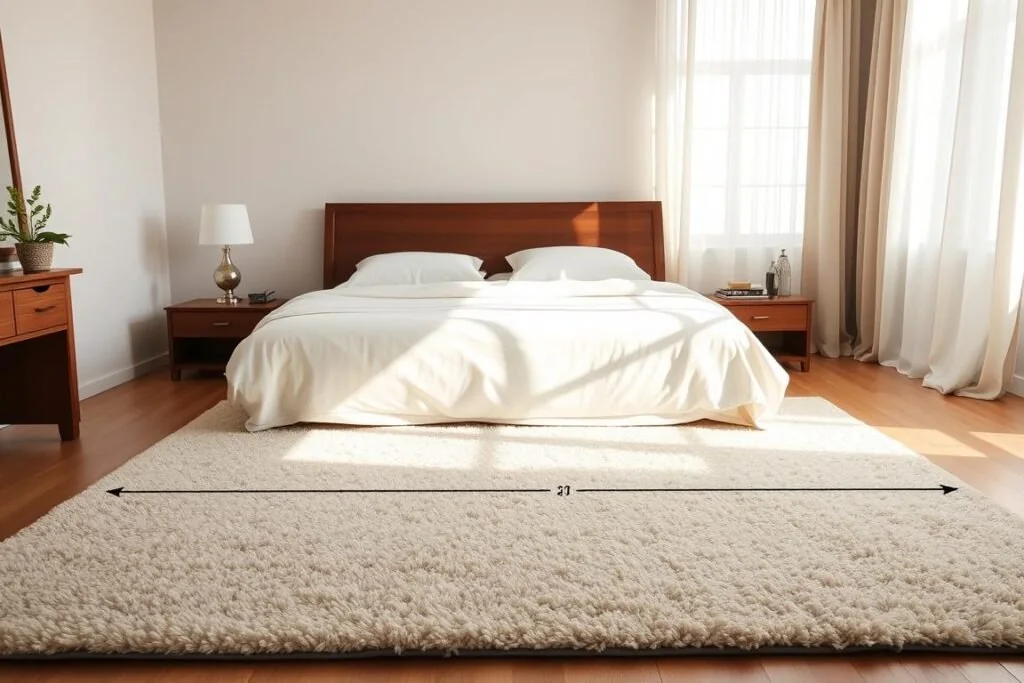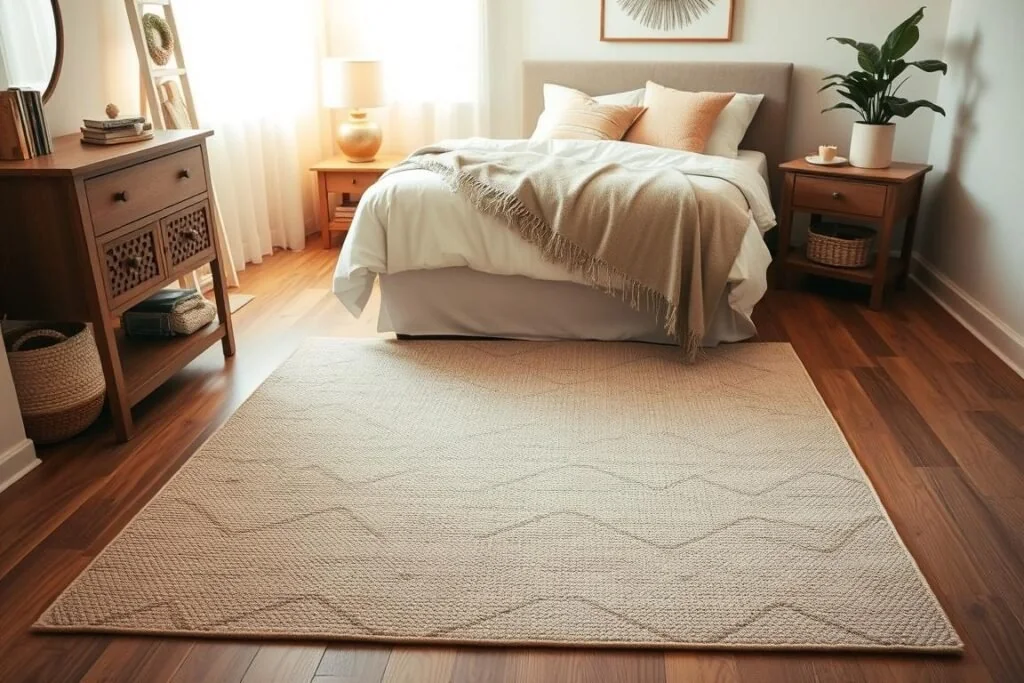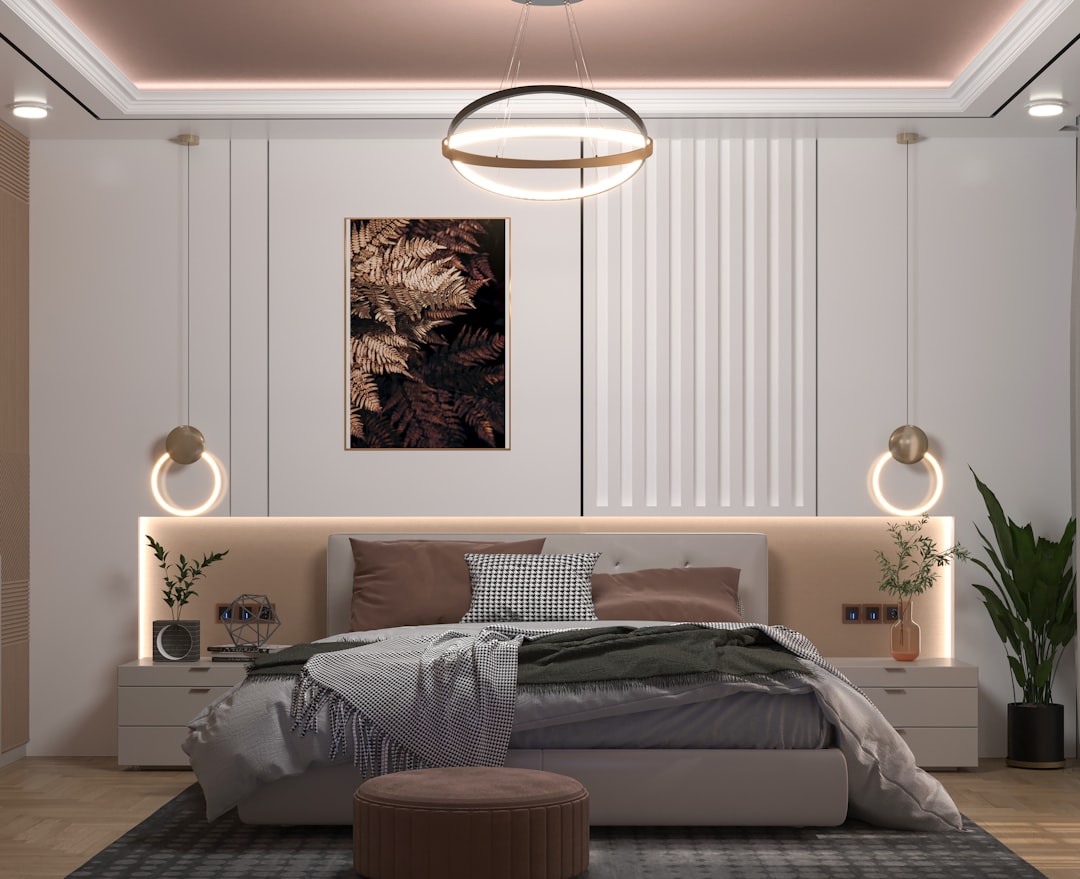

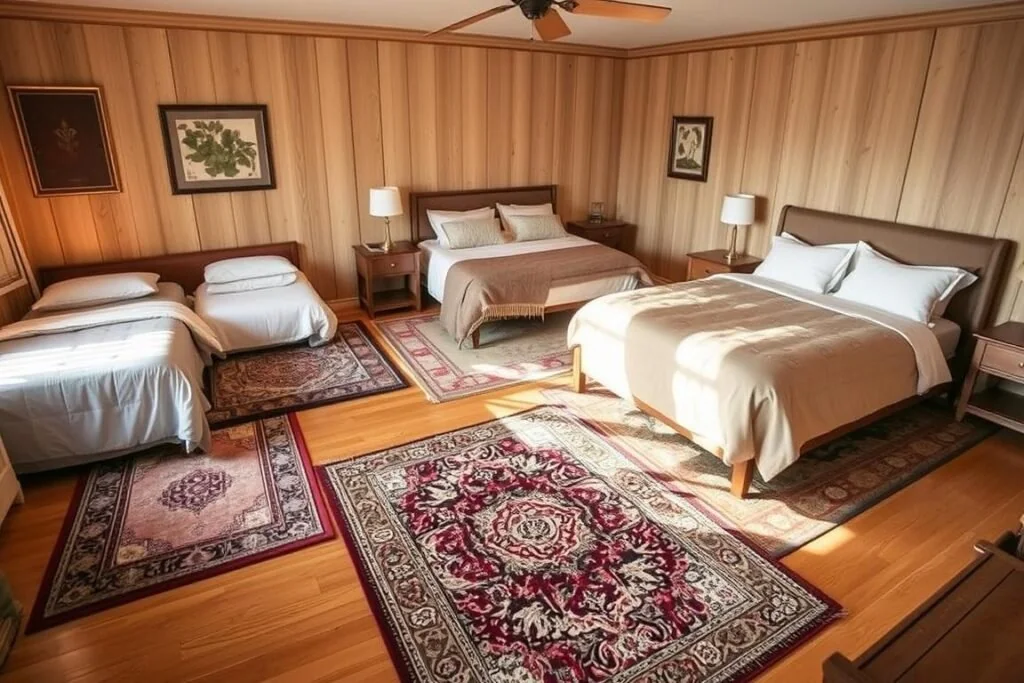
How to place a rug under a bed comes down to three layouts: the whole bed plus both nightstands sitting on the rug, the lower two-thirds of the bed on the rug, or two runners flanking the bed. Center the rug on the bed, not on the room, and aim for roughly 18–24 inches (46–61 cm) of rug showing along each side of the mattress so both feet land on something soft. In a typical 10 x 12 ft bedroom that usually means an 8 x 10 under a queen and a 9 x 12 under a king.
Everything below is the arithmetic behind those numbers: what fits, what to measure first, and where the usual advice falls apart.
How to place a rug under a bed: the three layouts and who each one suits
Pick the layout before you pick the rug. It decides the size, and the size decides the price.
1. Full coverage (bed, nightstands, bench all on the rug)
The rug starts a few inches off the headboard wall, runs past the foot of the bed and swallows the nightstands. Hotel look, warmest underfoot, hides scuffed floorboards.
Who it suits: rooms of about 12 x 14 ft (3.7 x 4.3 m) or larger, hard floors, cold climates, anyone who hates stepping onto bare wood in January.
Who should skip it: anyone on a budget. Going from 8 x 10 to 9 x 12 adds 28 sq ft of rug, and 10 x 14 adds 60 sq ft over the 8 x 10 — the cost curve is steep.
2. The two-thirds layout (the one most rooms should use)
Slide the rug under the bed so its top edge sits just past the nightstands — commonly 20–30 inches (51–76 cm) down from the headboard wall. About two-thirds of the bed sits on the rug, and the rest of the rug spreads out at the foot.
You get soft landings on both sides and at the foot, and you don’t pay for rug nobody sees. A 6 x 9 turned sideways under a queen is the classic version: the 9 ft (108 in / 274 cm) dimension runs across the bed, leaving about 24 inches (61 cm) of rug beyond each side of a 60-inch mattress.
Who it suits: most bedrooms between about 10 x 10 and 12 x 14 ft. If you only learn one way of how to place a rug under a bed, learn this one.
Who should skip it: anyone with a very low frame. Under 3 inches (7.6 cm) of clearance and sliding a padded rug underneath means lifting the frame, not shoving.
3. Two runners (or one runner plus a foot rug)
Two runners of about 2.5 x 8 ft (30 x 96 in / 76 x 244 cm) flank the bed, with an optional third across the foot. Nothing goes under the bed.
Who it suits: narrow rooms, beds against a side wall, rentals, and anyone opening under-bed drawers daily. It’s the cheapest warm floor beside a bed, and a small cotton runner goes in the washing machine.
Who should skip it: households where someone has balance problems. Three separate rug edges beside a bed mean three more things to catch a toe on at 3 a.m.
Rug size by bed size, with the exact reveal in inches and cm
Standard U.S. mattress sizes are Twin 38 x 75 in, Twin XL 38 x 80, Full 54 x 75, Queen 60 x 80, King 76 x 80 and California King 72 x 84. The reveal figures below are measured from the mattress edge on a centered rug. Most bed frames add about 2–4 inches (5–10 cm) per side, and upholstered frames can add 4–6 inches (10–15 cm), so subtract that from the reveal.
| Bed | Mattress (in / cm) | Tight but workable | Best all-round | Rug showing each side (best all-round) |
|---|---|---|---|---|
| Twin | 38 x 75 / 97 x 191 | 3 x 5 beside the bed | 5 x 8 (60 x 96 in / 152 x 244 cm) | 11 in / 28 cm |
| Full | 54 x 75 / 137 x 191 | 5 x 8 turned sideways | 6 x 9 sideways (108 in / 274 cm across) | 27 in / 69 cm |
| Queen | 60 x 80 / 152 x 203 | 6 x 9 sideways | 8 x 10 (96 x 120 in / 244 x 305 cm) | 18 in / 46 cm |
| King | 76 x 80 / 193 x 203 | 8 x 10 | 9 x 12 (108 x 144 in / 274 x 366 cm) | 16 in / 41 cm |
| California King | 72 x 84 / 183 x 213 | 8 x 10 | 9 x 12 or 10 x 14 (120 x 168 in / 305 x 427 cm) | 18 in / 46 cm (9 x 12), 24 in / 61 cm (10 x 14) |
Do the reveal math yourself in ten seconds
Side reveal = (rug width − bed frame width) ÷ 2. A king frame 80 inches wide on a 9 x 12: (108 − 80) ÷ 2 = 14 inches (36 cm) per side. Enough for one foot; 18 inches is enough for both feet and a dropped phone.
Foot reveal = rug length − (bed frame length − how far down the rug starts). A queen frame 85 inches long with an 8 x 10 starting 24 inches off the headboard wall: 120 − (85 − 24) = 59 inches (150 cm) of rug past the foot. That’s a lot, and it’s why an 8 x 10 in a 12 ft deep room ends up as full coverage whether you planned it or not.
If you’re deciding between two specific sizes, we broke the queen and king cases down further in rug size for a queen bed and the right rug size for a king bed.
How much floor should show around the edges?
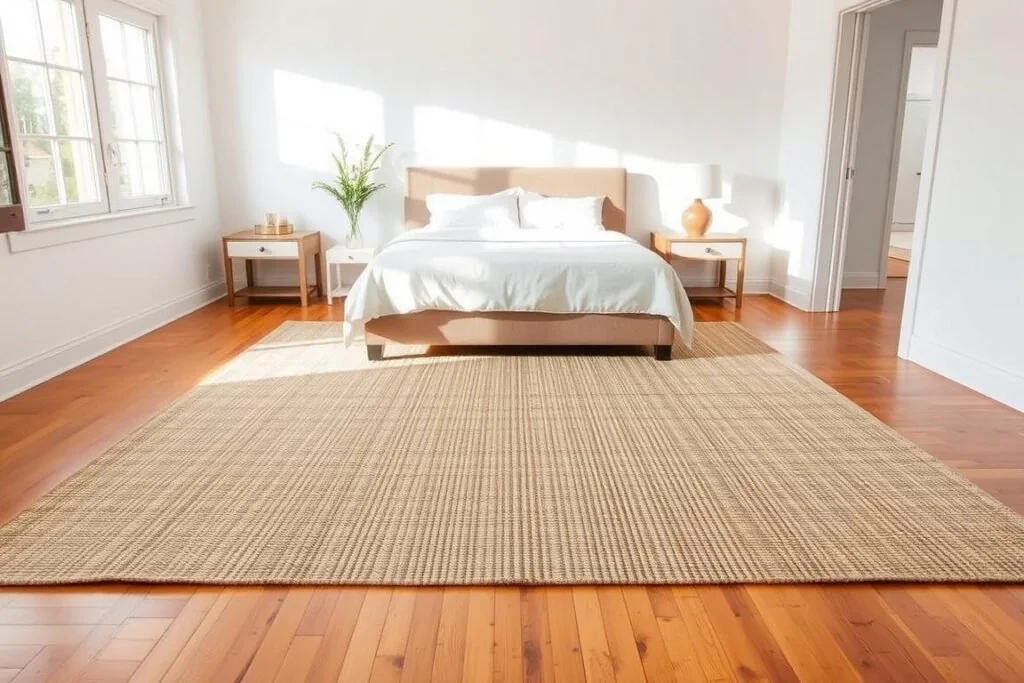
Most advice on how to place a rug under a bed quotes a bare border of 10–20 inches (25–51 cm) between the rug edge and the baseboards, closer to 18 in larger rooms. Be honest about what that is: a design convention, not a tested standard. What matters functionally is walkway width.
Designers generally call for at least 24 inches (61 cm) of clear floor on each side of a bed, 30–36 inches (76–91 cm) for a queen, and 36 inches or more for a king or Cal King, with main traffic paths around 36 inches. Your rug sits inside that walkway — but the walkway has to exist first. Measure it with the bed where it actually lives.
Two hard minimums: leave at least 6 inches (15 cm) of bare floor at any wall, because a rug that dies into a baseboard reads like failed wall-to-wall carpet, and never let a rug edge land in a doorway threshold.
What to measure before you buy (do all nine)
- Bed frame footprint, not the mattress — outside width and length, including feet that splay.
- Room, wall to wall, at floor level. Baseboards eat an inch a side.
- Door swing. Tape the arc of the bedroom and closet doors.
- Door undercut. Interior doors commonly clear the floor by about 5/8–3/4 inch (16–19 mm). A 1/2-inch pile on a 1/4-inch pad is already 3/4 inch. Measure your own gap with a ruler before you buy anything plush.
- Floor vents and floor outlets. Covering a supply vent is a heating problem, not just an aesthetic one.
- Under-bed clearance, if you’re sliding a rug under a loaded frame.
- Drawer and dresser swing at the rug edge.
- Delivery path. Rugs ship rolled, and the tube is usually about as long as the rug’s short side — so a 9 x 12 arrives as a roll around 9 ft (2.7 m) long. Measure your tightest stairwell turn and doorway width. A 9-ft tube does not pivot on a landing that’s 3 ft square.
- Lift help. Big dense wool rugs are a two-person job. Check the shipping weight on the spec page rather than guessing; it varies hugely between a flatweave and a hand-knotted pile of the same size.
Then tape the outline. Painter’s tape on the floor for 24 hours teaches you more about how to place a rug under a bed than any guide will. Walk it barefoot in the dark.
Nightstands, benches and dressers: on the rug or off?
The rule people repeat is “front two legs on the rug.” That’s a living-room rule; in a bedroom it applies to benches and chairs, not the bed.
- Nightstands: either all the way on or completely off. Half-on creates a rug edge under a lamp cord and a wobbling drawer, and it’s the single most common thing that makes a bedroom look accidental.
- Bench at the foot: all four legs on, or the rug ends before it. A bench straddling a rug edge rocks.
- Dresser against a wall: keep it off the rug entirely. Heavy dressers crush pile permanently, and a dresser half on a rug tilts forward slightly, which matters if you have anti-tip hardware or small children.
- Beds with storage drawers: keep the rug off the drawer side, or use runners. Drawers that open over a pile rug scrape and eventually stick.
Materials: what each one is actually like to live with
Feel first, then care. A bedroom rug gets bare feet twice a day and little else, which is a gentler life than a hallway rug has. Feel should outrank toughness here.
| Fiber | Underfoot | Holds up to | Watch out for | Best for |
|---|---|---|---|---|
| Wool | Warm, springy, the best barefoot feel | Crushing, years of use; naturally resilient | Sheds for months when new; moths; higher cost | Bedrooms with hard floors and a real budget |
| Polypropylene (olefin) | Soft but slightly slick | Stains and spills; cleans easily | Crushes flat under furniture and doesn’t bounce back | Kids’ rooms, rentals, pets, tight budgets |
| Nylon | Plush, close to wool in higher grades | Heavy traffic; good resilience | Fades in direct sun; costs more than olefin | Shared or high-use bedrooms |
| Jute / sisal | Coarse and scratchy barefoot | Dry wear; good texture as a base layer | Water stains; sisal is bad near humidity | The bottom layer in a layered setup, not the top |
| Cotton flatweave | Thin, cool, no cushion | Washing — the main reason to pick it | Slides badly without a pad; wrinkles | Small runners beside the bed, allergy households |
| Viscose / “art silk” | Very soft, high sheen | Very little | Permanent water marks from one dropped glass | Low-traffic accents only; avoid beside a bed |
On indoor air: if off-gassing worries you, the Carpet and Rug Institute runs third-party emissions testing for carpet and cushion. Its Green Label Plus program tests for VOC emissions and is recognized in the EPA’s federal purchasing recommendations — one of the few labels here with a published protocol behind it.
Rug pads, pile height and the door problem
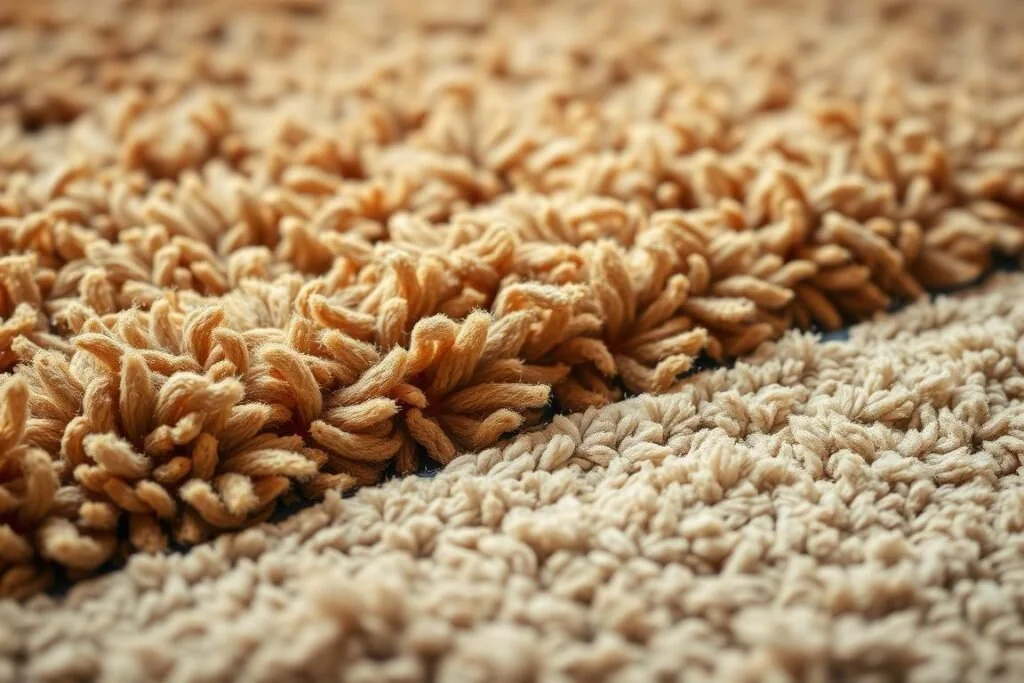
A pad isn’t optional. It stops creep, adds cushion, keeps grit from grinding into the floor, and it’s the difference between a rug that lies flat and one you straighten weekly.
- On hardwood, tile or vinyl: felt-and-rubber, 1/4 inch (6 mm) for comfort, 1/8 inch (3 mm) if door clearance is tight. Natural rubber grips best; cheap PVC mesh can mark finished floors over time.
- Over carpet: use a pad rated carpet-on-carpet. Regular pads let the top rug ripple and walk. Keep the top rug low-pile over plush carpet; two thick layers is how you get a rolling edge.
- Total stack height: pile plus pad, compared to your door gap. Over roughly 3/4 inch and you’re trimming a door.
- Trim the pad about 1 inch (2.5 cm) smaller than the rug on all sides so it never peeks out.
Safety: the part most rug guides skip
Loose rugs are a recognized trip hazard. A CDC-authored analysis of U.S. emergency department data on rug- and carpet-related falls in adults 65 and over found most of these injuries happened at home, the bathroom was the most common room, and falls often occurred at the transition between rug and bare floor. The study is on the National Library of Medicine site.
Two caveats: that data covers older adults treated in emergency departments and doesn’t isolate bedroom rugs. Don’t read it as “rugs are dangerous” — read it as a reason to be deliberate about edges.
Practical version: gripping pad under every rug, thin or bound edges rather than thick rolled ones, rug edge kept out of the path between bed and bathroom door, and a light you can reach without standing up (several picks in our bedside lighting round-up are motion-activated for this reason). If someone uses a cane or walker, runners are the wrong call — one large rug with no interior edges is safer.
Small bedrooms, over-carpet, and other awkward cases
Room under 10 x 10 ft: one rug, as large as you can manage, beats three small ones — fewer edges makes a small room read bigger. More on that in choosing a rug for a small bedroom.
Bed against a side wall: forget symmetry. Run the rug out from the open side and let it disappear under the bed.
Over wall-to-wall carpet: fine, and often how renters get a floor color they chose. Low-pile rug, carpet-to-carpet pad, check the edges monthly for curl.
Round beds: a round rug about 2 ft (61 cm) wider than the bed all round. Half-coverage under a round bed looks intentional; under a rectangular bed it rarely does.
Layering: a patterned wool rug over a larger jute base, showing 6–12 inches (15–30 cm) of jute. Use a pad between the layers or the top rug travels.
On cost: prices move too fast and vary too much by fiber and construction for a number here to mean anything. What drives price is fiber, construction and square footage — and square footage is the one you control, by choosing the two-thirds layout over full coverage.
Five mistakes that make a good rug look wrong
- Centering on the room instead of the bed. If the bed isn’t centered on its wall, a room-centered rug looks crooked forever.
- Buying one size down to save money. A too-small rug is the most common error in how to place a rug under a bed, and styling won’t fix it. Size up.
- Measuring to the comforter edge. A queen comforter hangs well past a 60-inch mattress. Measure to the frame.
- Skipping the pad. Creeping, curling, flattening — usually the missing pad, not the rug.
- Ignoring the door until delivery day. Check the undercut before you order, not after unrolling 80 sq ft of wool in a hallway.
Get those five right and the rest is taste. For style, pile and pattern, our bedroom rug guide covers what this page doesn’t.
FAQ
Should the rug go under the nightstands?
All the way under or fully clear — not half. Under gives the widest soft landing and the hotel look but needs a bigger rug; clear saves money and keeps cords reachable. Half-on is the one version of how to place a rug under a bed that always looks accidental.
What size rug do I need for a queen bed?
An 8 x 10 (96 x 120 in / 244 x 305 cm) is the safe answer: about 18 inches (46 cm) beyond each side of a 60-inch mattress when centered. A 6 x 9 turned sideways suits tighter rooms, giving about 24 inches (61 cm) per side with less rug under the bed.
Which direction should the rug run?
Long dimension in line with the bed’s length for full coverage; across the bed’s width for a two-thirds layout. Either way, keep the rug edges parallel to the walls — two degrees off reads as sloppy from the doorway.
Can I put an area rug over carpet in a bedroom?
Yes, with a carpet-to-carpet pad. Pick a low-pile top rug, especially over plush carpet, and check the corners for curling every few weeks. Bound or flatweave edges lie flatter over carpet than thick rolled edges do.
Do I need a rug at all if my bedroom is already carpeted?
Functionally, no. People add one for color, to define the bed area in a large room, or to protect rental carpet. If none of those apply, skip it and avoid the extra edges.
How do I stop the rug sliding out from under the bed?
The bed’s weight holds the section beneath it; the loose end moves. A felt-and-rubber pad trimmed 1 inch smaller than the rug fixes most of it, and rug tape on one stubborn corner handles the rest without gumming up the whole floor.
Updated September 2026.