Choosing a Rug for a Small Bedroom: Rules to Follow (and Break)

rug for small bedroom - rug small bedroom

Choosing the Right Rug for Small Bedroom Spaces

Rug for Small Bedroom decisions get easy when you plan around the bed. A right-size piece anchors the layout, smooths traffic, and adds cozy underfoot comfort without crowding precious floor.

Use this friendly guide to pick the best size, shape, and material. You’ll learn simple reveals that make a tiny room feel larger, when to slide a rug under the bed, and how light colors or small patterns widen the view. For sleep-health context, adults need at least seven hours a night; a soft landing can make mornings gentler (CDC – Sleep Resources).

A calm, balanced layout starts with consistent floor reveal around the bed.

Key Takeaways

  • Plan placement around the bed to anchor the room fast.
  • Reveal 12–18 inches of floor on all sides for balance.
  • Rug for Small Bedroom rule of thumb: when unsure, size up.
  • Use runners to add visual length and keep walkways clear.
  • Match pile and materials to your cleaning habits and budget.

Start with sizing: simple rules that make small rooms feel bigger

Measure first, then decide. Leave about 12–18 inches of visible floor on the long and short sides of your bed. This reveal calms the eye and prevents a cramped look.

Mini-scenario: you have a full bed tight to one wall. A 6×9 centered from the free wall creates even reveal, while a 5×7 can float at the foot if doors need clearance.
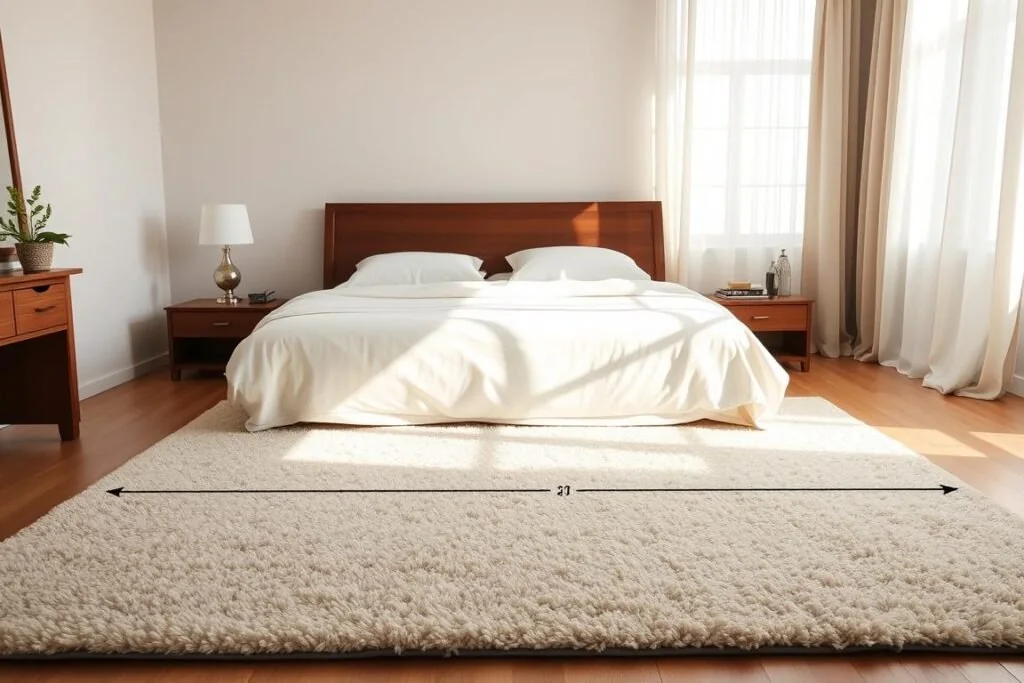
Rug for Small Bedroom sizing diagram showing 12–18 inch floor reveal - rug small bedroom

Check door swings and drawers at the side so edges never block openings.

  • 5×7: Accent at the foot or peeking at sides for full/queen in tight rooms.
  • 6×9: Neat center under a full or queen with modest reveal.
  • 8×10: Two-thirds under most queen/king for generous coverage.
  • 9×12: All four legs on when the room still shows perimeter floor.

Want the full decision tree? See our pillar guide: Bedroom Rug Size & Placement Guide.

Smart placement ideas for a Rug for Small Bedroom

Use layout to stretch your square footage. Slide partway under the bed for a layered look, or use narrow pieces at the sides to keep the center aisle open.

Mini-scenario: small queen room with two doors. An 8×10 starts near the nightstand line so the headboard stays on floor, not textile. Doors clear cleanly and you keep soft landings.
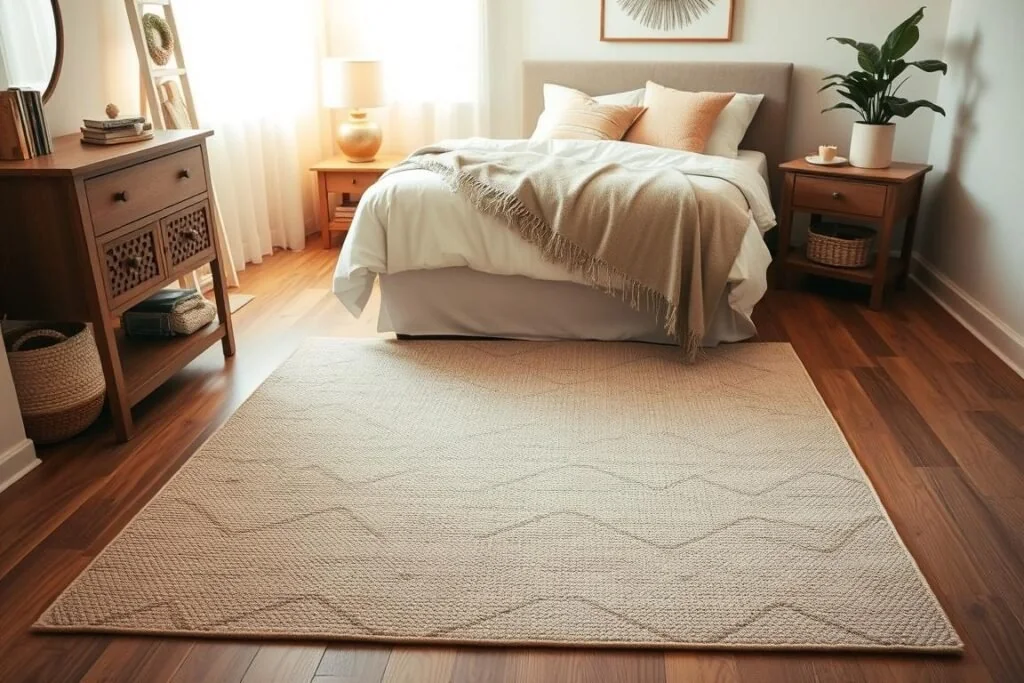
Rug for Small Bedroom using side runners to keep the center aisle clear - rug small bedroom

Two-thirds under the bed: Slide 8×10 so the rug begins near the nightstands. All four legs on: Choose 9×12 if you still see floor around the edges. For tight rooms, matching side runners give warmth without a giant footprint.

Choose materials and pile that match your lifestyle

Pick comfort you’ll enjoy every morning, then match care to your routine. Bedrooms are low traffic, so plush feels great, while flatweaves keep doors moving freely.

Mini-scenario: light-sleeper household with pets. A low-pile, washable rug plus a thin pad helps cleaning while keeping the door glide smooth.

For safer buying, look for recognized labels when choosing bedding and textiles. Learn what common labels mean here: Bedding & Mattress Certifications. If you prefer low-tox home goods, this roundup can help you compare materials and finishes: Non-Toxic Mattress Guide.

  • Plush or shag: Cozy under bare feet; pair with a thin pad to prevent slipping.
  • Flatweave: Door-friendly and easy to vacuum in tight rooms.
  • Wool: Warm, resilient, and naturally soil-resistant.
  • Synthetics (polyester/PP): Stain-resistant and often washable.
  • Jute/sisal: Earthy texture that layers well at the sides of the bed.

Prefer video? Try this short how-to: How to choose the right bedroom rug.

Color, pattern, and shape: easy ways to “stretch” a tiny room

Light, low-contrast rugs bounce light and make the footprint read wider. Small patterns hide lint without visual busyness.

Mini-scenario: narrow room with a queen bed. A pale, small-scale pattern plus a runner along the long wall pulls the eye forward for more “length.” A round rug can soften sharp corners near a dresser.

  • Light neutrals: Open the space; great under mid-tone bedding.
  • Small pattern: Hides daily dust but stays calm.
  • Runner along the long axis: Adds visual length and flow.
  • Round accent: Softens corners and offsets boxy layouts.

Choosing a Rug for a Small Bedroom: Rules to Follow (and Break) - rug small bedroom

Keep edges aligned with furniture lines so the layout feels intentional, not random.

Budget and care: practical wins that still feel polished

Set the budget by size first. It keeps choices focused and prevents overbuying. Washable constructions offer stress-free care in kid- or pet-friendly rooms.

Mini-scenario: you want plush comfort on a budget. Start with an 8×10 synthetic blend and add a quality pad for cushion—often cheaper than stepping up to a pricier dense pile.

  • Use a pad for grip and comfort (thin under doors, cushier in open spaces). See our picks: Best Rug Pads for Bedrooms.
  • Spot clean weekly; rotate seasonally for even wear. Learn more: How to Clean an Area Rug.
  • Map walkways before you buy to avoid curled edges in high-traffic lanes. Layout ideas: Small Bedroom Layout Ideas.

FAQ

What size rug works for a small bedroom with a queen bed?

An 8×10 usually covers two-thirds under the bed with nightstands off the rug. If the room allows a floor perimeter, a 9×12 puts all four legs on for a seamless look.

Should I put the rug under the bed or beside it?

Both work. Two-thirds under is great for coverage without crowding. Side runners give warm landings and keep the center aisle open in very tight rooms.

What material is best if I have allergies?

Low-pile wool or tightly woven synthetics are easy to vacuum. Pair with regular cleaning and a thin pad. Check labels and care notes before buying.

Do I need a rug pad in a small room?

Yes. A pad adds grip and comfort, and it helps rugs lie flat. Choose a thinner pad if doors skim the floor.

Conclusion

Rug for Small Bedroom choices come down to scale, placement, and care. Measure your bed, aim for a 12–18 inch reveal, and choose 8×10 for two-thirds under a queen or 9×12 to place all legs on the textile. Match pile to daily habits, use runners to guide sightlines, and keep tones light to “open” the space. For deeper sizing charts and room layouts, start with our pillar: Bedroom Rug Size & Placement Guide. Thanks for reading Cozy Bed Quarters—sleep cozier, live better.


Other reading we found popular

Bed Risers for Storage: How to Pick, Fit and Load Them Safely

Bed risers for storage lifting a bed frame to fit bins underneath

Bed risers for storage lift each leg of your bed 2 to 8 inches, turning the dead zone under the frame into space for bins, luggage, and off-season bedding. Most sets are stackable plastic or solid wood with a recessed cup that grips the leg or caster, and a good set fits your leg shape, holds the combined weight of frame plus mattress plus sleepers, and still leaves your mattress at a height you can sit on comfortably. The measurement that decides everything isn’t the riser height — it’s the clearance under the side rail, because that’s the opening your bins actually pass through.

What bed risers for storage actually add

A riser lifts the leg. Your storage opening, though, is measured from the floor to the lowest point of the frame — usually the bottom edge of the side rail, sometimes a center support leg or a low slat. On a lot of metal frames the rail hangs 2 to 3 inches below the top of the leg, so a 5-inch riser doesn’t give you 5 inches of usable slot. It gives you 5 inches added to whatever slot you already had.

Fabric storage bag sliding into the gap created by bed risers for storage

Here’s roughly what different lifts get you:

Riser height Typical result What fits underneath
2–3 in Mild lift, bed still looks normal Low-profile bins (about 6 in tall), shoes, flat vacuum bags
5 in Noticeably taller; bed skirts start to fall short Standard underbed bins, rolling carts, carry-on luggage
8 in (usually 3 + 5 stacked) High bed; you may slide off the edge rather than step down Tall totes, duffels, storage drawers, a folded stroller

Keep the mattress top in mind too. For most adults, a mattress top around 22 to 25 inches lets you sit on the edge with your feet flat and knees about level with your hips. If you’re already at 25 inches and you add 8, you’re climbing into bed — fine for a young renter, rough for anyone with knee, hip, or balance trouble.

Take these three measurements first

  1. Floor to the bottom of the side rail. Tape measure at the middle of the long side, not at the corner. This is your real storage opening.
  2. The leg or caster footprint. Measure the width of a square leg and the diameter of a round post or wheel. Most molded risers take legs up to about 3 inches round or 2 1/4 inches square, with a cup roughly 1 inch deep. Chunky farmhouse posts and wide plinth feet often won’t seat.
  3. The bin you plan to buy. Underbed boxes commonly run 6 inches tall, and rolling ones sit a bit taller with the casters. Add an inch of wiggle room, or you’ll be shoving lids off every time you pull one out.

Also check ceiling-adjacent stuff: a bolted-on headboard has fixed bolt slots, and lifting the frame 5 inches can leave the headboard sitting low against the mattress. Slotted headboard brackets usually have a couple of inches of play. If yours doesn’t, the headboard legs need risers too.

Matching riser type to your bed

Stackable plastic risers

The cheap, common ones. They’re light, they stack (3 + 5 to reach 8), and many have a foam or rubber pad in the cup that grips a caster. Downsides: the plastic can splay under a heavy platform bed with a big mattress, and they slide on hard floors if the base has no rubber. Good pick for dorm frames, twin beds, and light metal frames.

Solid wood blocks

Heavier, steadier, and easier to live with under a king. Look for a routed recess at least 3/4 inch deep. A flat wood block with no recess is a slipping hazard — legs walk off it over months of getting in and out. Add felt pads underneath on hardwood.

Steel or adjustable clamp risers

These bolt or clamp to the leg instead of just cupping it, which is the safest setup for frames with odd leg shapes or for anyone who moves around a lot in bed. They’re the priciest option and usually the ugliest, but they don’t skate.

Risers with outlets or USB ports

Handy, and fine when the unit carries a recognized safety certification mark (UL, ETL, or similar) printed on the housing. Don’t plug a space heater or an air conditioner into one, and don’t run a power strip into another power strip under the bed where you can’t see it.

Weight limits: read the number twice

Listings love big numbers. “Supports up to 5,000 lbs” is often the figure for a set of four under ideal, perfectly centered load — not what one riser holds at an angle when you flop down on the corner. Add up your real load: a queen mattress runs roughly 100 to 160 pounds, a foundation or box spring another 50 to 70, the frame 30 to 80, plus two adults, plus whatever you stash underneath. That’s easily 600 pounds on four contact points.

Three habits that prevent the wobble-then-crack sequence:

  • Use a riser under every load-bearing point, including the center support leg that most queen and king frames have. Lifting only the corners leaves the middle hanging and puts the whole load on four legs it wasn’t designed for.
  • Re-check the bolts. Frame hardware loosens when you lift and set down. Snug every bolt the day after, then again in a month.
  • Do a shove test. Push each corner sideways with your hip. Any rock or slide means the leg isn’t seated, the floor isn’t level, or the riser is too small for the leg.

Installing them without hurting yourself or the frame

  1. Strip the bed and pull the mattress off. That single step removes most of the weight and most of the risk. Lean it against a wall, not on your foot.
  2. Clear the floor all the way around, and set the risers where each leg will land before you lift anything.
  3. Work one corner at a time with a helper. Lift just enough to slide the riser under — an inch or two. Tilting the whole bed up on two legs is how frames bend.
  4. Seat each leg fully in the cup, then lower slowly and feel for the leg dropping in.
  5. Do the center leg last; many are threaded and adjust up or down, so you may be able to spin it out instead of adding a riser.
  6. Put the mattress back, sit hard on each corner, and re-check.

Renting or in student housing? Check the rules before you buy. Policies vary a lot — the University of Colorado Boulder’s housing guide, for instance, permits bed risers up to 6 inches and notes that many residence hall beds already adjust to different heights, while other schools ban risers outright.

What to store under there — and what to skip

Good candidates: off-season clothing, spare sheets and blankets, empty suitcases (nest the small one inside the big one), wrapping paper, shoes in clear boxes, sports gear. Rolling bins on the sides you can reach; long, awkward stuff pushed toward the wall side.

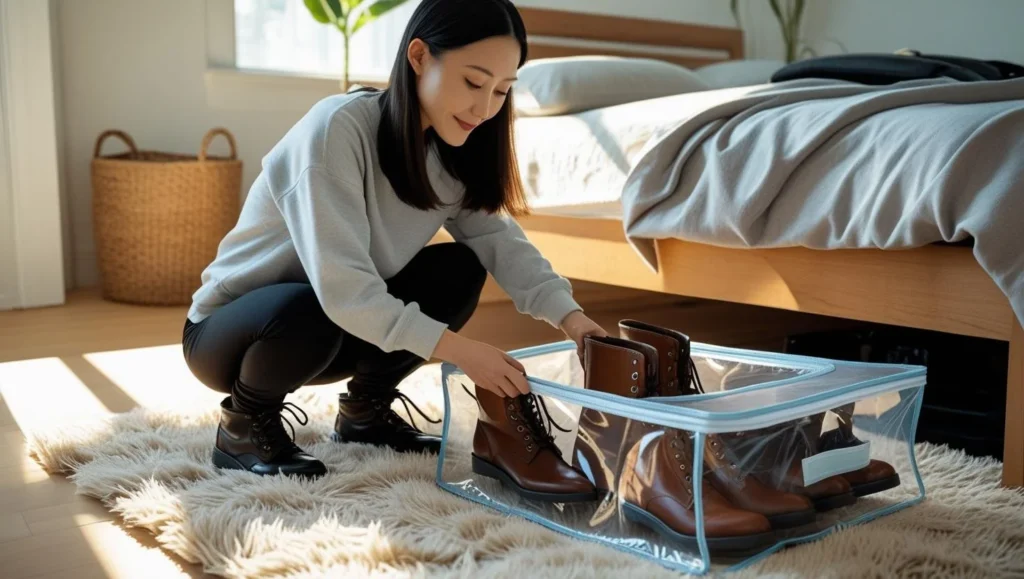
Clear zippered storage box holding boots being tucked beneath a low bed frame

Leave out anything that hates heat or humidity, and anything you’d hate to lose: important documents, photos, candles, anything in cardboard if you’re in a basement bedroom. Skip bulk food, too, unless it’s sealed in hard plastic — crumbs under a bed are an open invitation to pantry moths and mice.

A few space tricks that genuinely pay off:

  • Vacuum bags for lofty items only. Duvets, puffer coats, and pillows compress well. Don’t crush memory foam pillows or down you plan to use soon; they need time to recover loft.
  • Uniform bin sizes. Three of one size beats six random tubs — they slide evenly and you can see the row at a glance.
  • Label the short end, the side facing out. Labels on the lid are useless once the bin is under a bed.
  • Leave a lane. Keep 6 inches of empty floor at the front so you can pull a bin without moving two others.

Dust, allergens, and airflow

A raised bed is easier to vacuum under — as long as you can still get the nozzle in there. If you pack the whole footprint solid, you’ve built a dust trap you’ll never clean. Lidded bins beat open baskets for this reason, and a quick vacuum pass under the bed every few weeks keeps things reasonable.

It matters more if anyone in the house has allergies or asthma. The American Lung Association advises keeping indoor humidity below 50 percent and cutting down on the fabric surfaces where mites settle, so sealed containers make more sense than loose piles of blankets right under where you sleep.

Bed risers for storage vs. a frame built for it

Risers are the fast, cheap fix: a set costs less than dinner out, installs in 20 minutes, and comes back off when you move. What you give up is looks and convenience. You’ll see the risers, you’ll see the bins unless you add a longer bed skirt (standard skirts drop about 15 inches; after a 5-inch lift you need 18 to 21), and you’re still crawling on the floor to reach things.

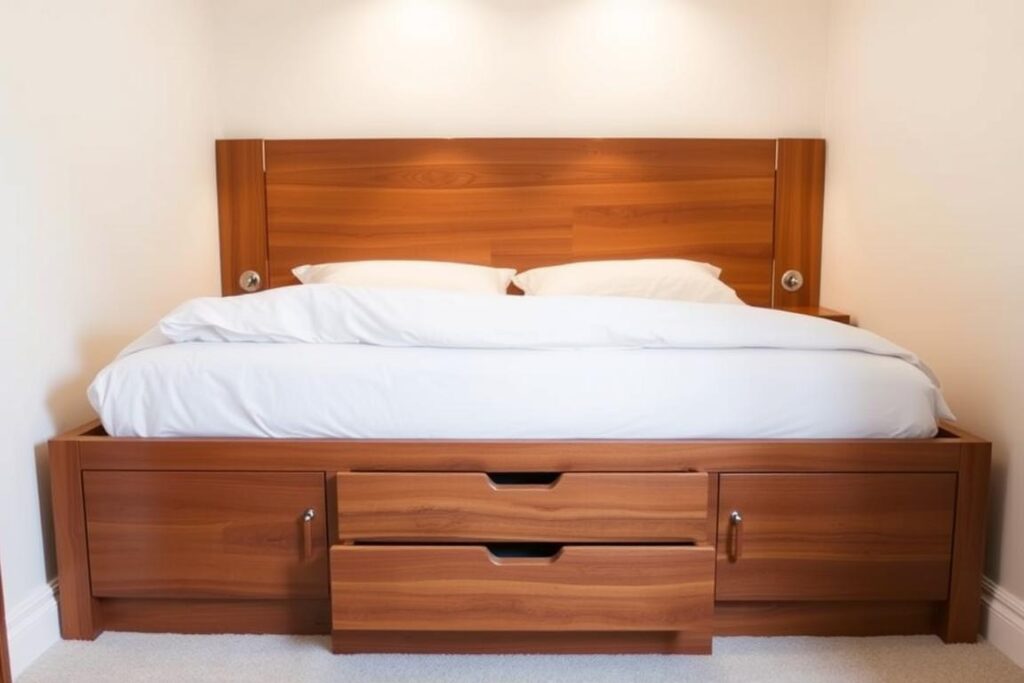
Wooden platform bed with built-in drawers set into the base instead of risers

If you’re buying a bed anyway, drawers built into the base are a better long-term answer. Compare the options in our guide to platform and storage beds, and see how built-in drawer frames handle the same problem in under-bed storage frames. For a kid’s or guest room, a twin bed with storage underneath usually beats risers because the drawers glide instead of dragging on carpet. Working with a larger room, a king frame with storage gives you far more capacity than any riser setup.

Common questions

Are bed risers safe?

They are when the legs seat fully in the cup, every support point is raised, and you stay under the rated load. The failure cases are predictable: a leg perched on an oversized cup, a plastic riser under a heavy king, or a riser sitting on plush carpet that lets it tip. Check the corners for rocking every few months.

Will risers work on a platform bed?

Sometimes. Platform beds with four distinct legs work fine. Solid panel, sled, or plinth bases have no leg to cup, and lifting those on blocks is asking for a slide. Beds with a floating base or a wide center rail need risers under the center supports too.

Can I use bed risers on carpet?

Yes, but pick a wide, flat base rather than a narrow foot, and expect the riser to sink a bit into thick pile. Re-level after a couple of weeks. On hardwood or vinyl, add felt pads to protect the finish.

What about a bed with caster wheels?

Most risers have a cup sized for casters, which is actually a nice bonus — the bed stops rolling. Alternatively, unscrew the casters and use the bare post in a deeper cup for a lower, steadier result.

Do risers make the bed noisier?

They can. Adding height to a wobbly frame amplifies existing creaks. Tighten the hardware, add a nylon washer at any metal-on-metal joint, and make sure all four risers touch the floor before blaming the risers themselves.

How high is too high?

Once you can’t sit on the edge with your feet flat on the floor, you’ve gone past useful for daily life. Reserve 8-inch stacks for guest rooms, dorms, and anyone young and nimble. Also want the room to feel bigger, not just hold more? Pair the extra clearance with the tricks in our post on hidden storage beds.

Updated September 2026.