Velvet sofas for small living rooms work best when they stay under about 72 inches wide, under 36 inches deep, and sit up off the floor on visible legs so you can see carpet underneath. Performance velvet — a tightly woven polyester or poly blend — handles kids, pets, and spilled coffee far better than cotton, viscose, or silk versions. Everything below is the measuring, fabric, and care detail that decides whether the sofa feels cozy or feels like it swallowed your room.
Sizing Velvet Sofas for Small Living Rooms
Three numbers matter more than the style name on the tag: overall width, overall depth, and how much floor you can still walk on afterward.
- Width: loveseats run roughly 52–64 inches. “Apartment” sofas land around 68–78 inches. A standard three-seater is 84–90 inches and usually too much for a room under 12 feet wide. Leave at least 3 inches of air at each end so the piece doesn’t look wedged in.
- Depth: 32–36 inches overall is the sweet spot. Deep-seat lounge sofas hit 40 inches or more, and that extra 6 inches comes straight out of your walkway.
- Seat depth: 21–23 inches suits most people sitting upright. Anything past 25 inches needs a pile of pillows behind you, which then adds visual bulk.
- Back height: under 33 inches keeps sightlines open across the room. Tall-back velvet sofas read like a wall.
- Leg lift: 4–7 inches of visible leg makes a sofa look lighter and lets a vacuum head slide under.
- Seat height: 17–19 inches off the floor feels normal to stand up from. Those low 15-inch mid-century frames look great and get old fast if anyone in the house has cranky knees.
Clearances to protect
Keep your main walking path at 30–36 inches. Between the sofa front and a coffee table, 14–18 inches lets you slide past without turning sideways and still reach your mug. If the sofa faces a TV, don’t let the table crowd the front edge — you’ll feel it every single day.
Before you buy anything, tape the footprint on your floor with painter’s tape and live with it for two days. Walk the path to the kitchen. Open the closet door. It’s free, and it catches mistakes a measuring tape hides.
Will it fit through the door?
This is the part people skip. Measure the doorway width and height, the narrowest hallway point, any stair turn, and the elevator if you have one.
Then measure the sofa’s diagonal depth: from the top back corner, run a straight line down to the front bottom of the arm or seat. That diagonal is what has to clear your door opening, not the listed depth. A standard 30-inch interior door handles most sofas with a diagonal depth of 30 inches or less. If yours is tight, look for models with unscrewable legs, knock-down frames that assemble in the room, or two-piece loveseats.
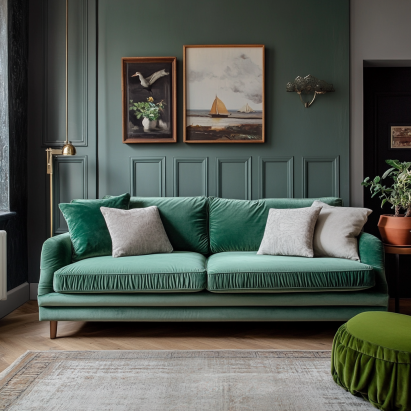
Exposed legs and a low back keep a compact velvet sofa from visually filling the room.
Shapes that eat the least floor space
Track or square arms beat rolled arms in a tight room. A rolled or scroll arm can add 6–8 inches per side of width you can’t sit on — that’s over a foot of your sofa doing nothing.
Armless or low-arm settees squeeze the most seating into the least width, though they’re less comfortable for napping.
Small chaise sectionals can work if the chaise tucks along a wall instead of jutting into the room. Reversible-chaise models let you switch sides later, which is worth a lot if you move often.
Sleeper velvet sofas need a reality check: measure the open length, not the closed one. Most pull out 6–7 feet from the wall, which means your coffee table has to go somewhere on guest nights. If your space is genuinely tiny, a sofa-to-trundle-bed setup often hides a guest bed with less nightly fuss than a heavy pull-out mechanism.
Not all velvet is the same fabric
“Velvet” describes a weave with a cut pile, not a fiber. What that pile is made of decides how the sofa ages.
| Type |
Feel and look |
Living with it |
| Performance polyester velvet |
Short, dense pile with a soft sheen |
The practical pick. Usually cleanable with water-based products, resists water rings, holds color in sunlight better than natural fibers |
| Cotton velvet |
Matte, deep color, expensive-looking |
Crushes and shows sit marks; develops a lived-in patina some people love and others hate |
| Viscose, rayon, or silk blends |
The glossiest, most dramatic shine |
Water spots easily and often carries a solvent-only care code — a rough match for kids or drinks on the sofa |
| Crushed velvet |
Deliberately rumpled texture |
Hides pressure marks and pet prints better than any flat pile |
One thing to expect no matter what you buy: shading. Run your hand across a flat velvet and the pile lies in a new direction, which reads as a lighter or darker patch. That’s normal behavior for a cut pile, not a defect, and a quick brush resets it.
If a maker lists an abrasion rating — Wyzenbeek double rubs or Martindale cycles — higher is better for a sofa that gets daily use. Fabrics sold as heavy-duty residential typically list five-figure double-rub numbers.
Always order swatches. Velvet changes character dramatically between daylight and lamplight, and a navy that looks rich in the showroom can go flat-black in a north-facing room. Tape the swatch to the wall and check it morning and night.
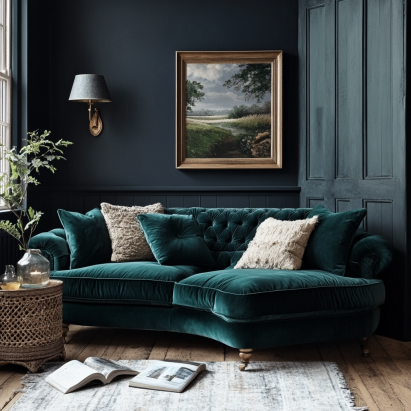
Under-seat storage earns its keep when the room has no closet to spare.
Colors that keep a small room feeling open
Dark jewel tones aren’t the enemy people assume they are. Emerald, navy, and rust read as one solid block of color, which is calmer than a busy pattern and makes the sofa feel like architecture rather than clutter. They also hide crumbs.
Light neutrals — oatmeal, dove gray, mushroom, taupe — let the sofa recede into a pale wall so your eye keeps traveling. The trade-off is visible soil, especially on arm fronts and the seat edge where hands land.
A trick worth stealing: pick a sofa color close in value (lightness) to your wall color. Low contrast makes furniture blur into the background, and the room feels bigger. High contrast does the opposite, which is great if you want the sofa to be the star.
Velvet’s real superpower in a small space is light. The pile catches and throws it, so a sofa near a window adds glow instead of a dead matte rectangle. Play that up with reflective surfaces — the same logic behind these mirror tricks for small rooms works in a living room.
Keeping velvet looking good
Find the care code on the tag before you touch any cleaner. The University of Illinois Extension spells out what each letter allows: W means water-based cleaners, S means solvents only, S-W allows either, and X means vacuuming or light brushing only. Using water on an S-code velvet is how you end up with a permanent ring.
The weekly routine takes five minutes:
- Vacuum with a soft brush attachment on low suction, following the pile direction. Loose grit is what actually wears a pile down.
- Rotate and flip loose cushions so wear spreads evenly instead of concentrating in one seat.
- Brush the pile back with a soft garment or velvet brush to erase sit marks.
For spills, blot immediately with a clean white cloth — press, lift, repeat, never rub, because rubbing drives the mess into the pile and mats it. Pretest any cleaner on a hidden panel, like the back corner or under a cushion.
Crushed spots on polyester velvet usually lift with a light pass of steam held a few inches away, followed by brushing while it’s warm. Skip steam entirely on viscose or silk blends.
Two more habits: keep the sofa out of a direct sun beam (all fabric fades, velvet obviously), and if one end gets more light than the other, spin the piece occasionally.
Pets? Cut-pile velvet handles claws better than bouclé or any loop weave, because there are no loops to snag and pull. Hair sits on top of a tight pile rather than burrowing in, and a rubber pet-hair brush clears it in one sweep.
What to check before you hand over your money
- Frame: kiln-dried hardwood beats particleboard or plastic. Lift one front corner a few inches — if the other front leg stays on the floor, the frame is twisting, and that frame will loosen.
- Joinery: corner blocks that are glued and screwed, not staples doing the structural work.
- Suspension: sinuous S-springs or eight-way hand-tied are both fine. Plain elastic webbing sags soonest.
- Cushions: high-density foam wrapped in fiber or down holds its shape; loose fiber-fill alone flattens within a year or two.
- Safety label: upholstered furniture sold in the US must carry a permanent label reading “Complies with U.S. CPSC requirements for upholstered furniture flammability”. No label is a red flag on an import.
- Delivery: confirm curbside versus in-room before you buy, especially for a walk-up. Also check the return window and who eats the return shipping on a 90-pound sofa.
If your living room doubles as a bedroom or office, sofa choice is only half the puzzle — these space-saving furniture ideas for small rooms cover the storage pieces that go around it.
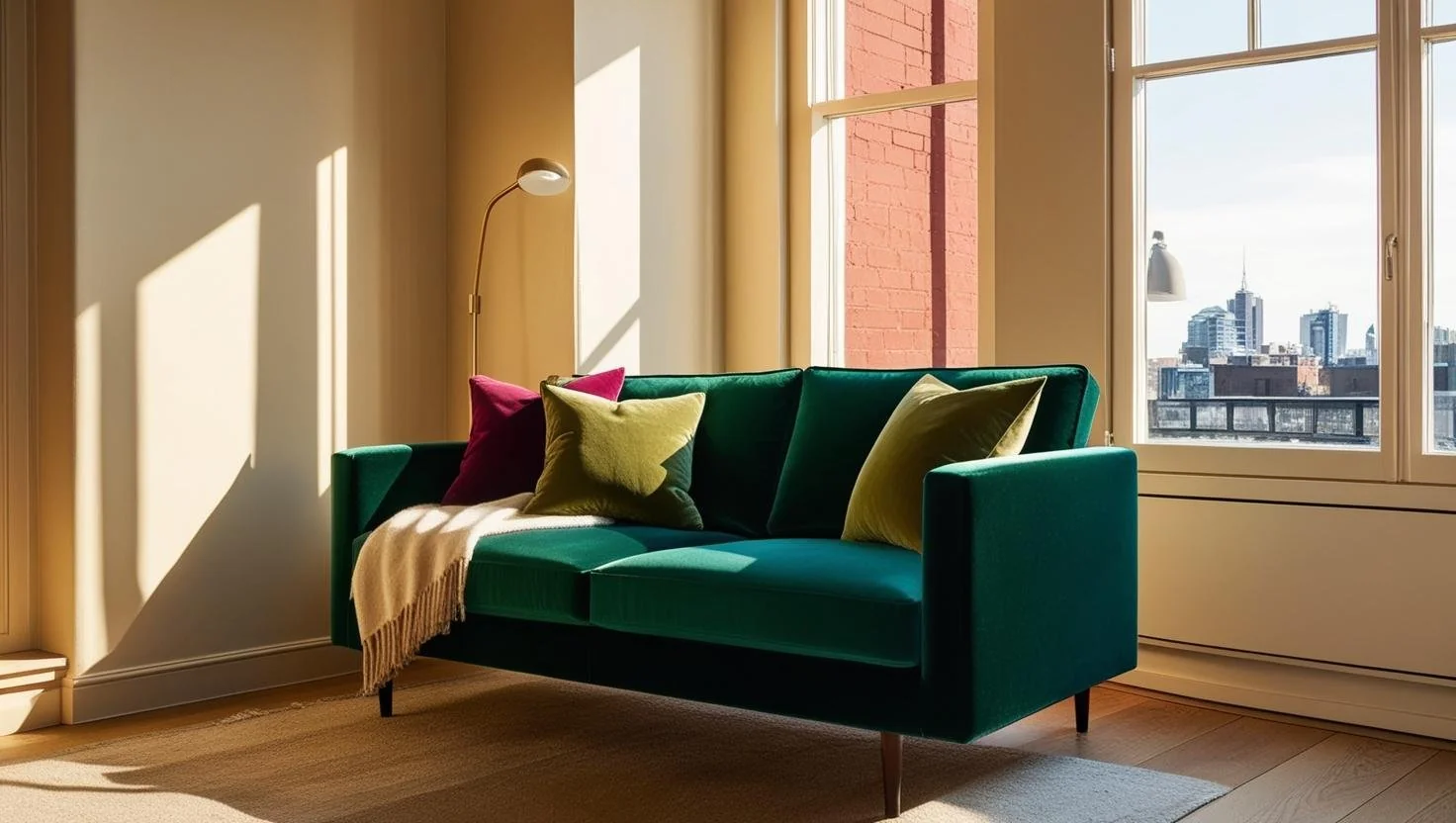
A low coffee table about 16 inches from the sofa front keeps the walkway usable.
Velvet vs. linen vs. bouclé
- Velvet: soft, light-reflective, rich color. Shows pile marks. Performance versions clean easily; natural-fiber versions don’t.
- Linen: breathable and casual, cooler to sit on in summer. Wrinkles, stretches at the seat, and absorbs spills fast unless it’s treated.
- Bouclé: cozy and texture-forward, but the looped surface is the one cats target, and dropped crumbs hide in it.
In a small room, velvet has one quiet advantage: the sheen gives a single-color sofa depth, so you don’t need a busy pattern to make it interesting — and busy patterns are exactly what makes small rooms feel cluttered.
FAQ
What size sofa fits a 10 x 12 living room?
Aim for 60–72 inches wide and no more than 35 inches deep, on legs. That leaves room for a 30-inch walkway plus a small side table.
Are velvet sofas practical with kids?
Performance polyester velvet, yes. It’s tightly woven, usually carries a W or S-W care code, and wipes up quickly if you blot fast. Cotton and viscose velvets are a harder ask with small kids.
Why does my velvet sofa look like it has water marks?
Usually it’s shading — the pile lying in different directions after someone sat down. Brush it in one direction and it evens out. Genuine water marks on viscose velvet, though, are often permanent, which is why that fiber gets a solvent-only code.
Does velvet make a small room feel smaller?
Not if the frame is compact and raised. What shrinks a room is bulk and blocked sightlines: deep seats, tall backs, skirted bases, and rolled arms. Fabric texture isn’t the problem.
Do velvet sofas fade?
Any fabric in a sun beam fades. Solution-dyed polyester velvets hold up best; silk and cotton fade fastest. Sheer curtains or rotating the sofa twice a year buys you years.
Can I use a steam cleaner on velvet?
Light steam held a few inches from the surface can revive flattened polyester pile. Don’t saturate it, and don’t steam viscose, silk, or anything labeled X.
Updated September 2026.