A king canopy bed is a king-size frame with four tall posts joined by beams overhead, built so you can hang fabric, leave it bare, or drape it only at the corners. It holds a standard king mattress — 76 inches wide by 80 inches long — and most frames add a couple of inches beyond that on each side, so plan for a footprint closer to 80 by 84 inches. Give it a room roughly 12 by 12 feet or larger and a ceiling of at least 8 feet, and it reads as a grand focal point instead of a crowded one.
What a king canopy bed actually is
The structure is simple: four posts, a rectangular frame across the top, and a king mattress in the middle. That top frame is the whole difference between a canopy bed and a plain four-poster, which has the posts but no connecting canopy rails. If you’re weighing the two, we break the distinction down in our guide to canopy beds vs four-poster beds.
The design isn’t decorative nostalgia — it started as insulation. Private bedrooms barely existed in medieval and early modern Europe, so curtains around a bed created warmth and a screen from the rest of a shared room. Harvard Magazine’s look at early American bed furnishings notes that curtains softened winter drafts and gave sleepers some shelter from the household around them. Heated houses made that unnecessary; the shape stuck because it looks magnificent.

Will a king canopy bed fit your room?
This is where most people get burned. A canopy frame eats floor space and vertical space at the same time, and the vertical part is easy to forget until the box arrives.
Start with the floor. Designers generally want about 30 inches of walking clearance around a bed, with 36 inches feeling genuinely comfortable — the reference library Dimensions.com lists those same minimums for king bedroom layouts. Do the arithmetic and a 76-inch-wide mattress with 30 inches on each side needs about 11 and a half feet of wall-to-wall width, which is why 12 by 12 feet gets quoted as the practical floor for a king.
| Measurement |
What to plan for |
| Standard king mattress |
76″ wide x 80″ long |
| Typical frame footprint |
Add roughly 2–4″ per side; confirm with the listing |
| Walking clearance |
30″ minimum, 36″ comfortable |
| Workable room size |
About 12′ x 12′ and up |
| Ceiling |
8′ or more is the easy zone |
Now the height. Canopy frames vary enormously — some low-profile models sit barely above a headboard, others tower — so treat the listed overall height as a hard number and measure your ceiling before ordering. For context, the International Residential Code sets 7 feet as the minimum ceiling height for habitable rooms, so older or converted spaces can be tighter than you assume. If you have 8-foot ceilings, look for a slimmer frame and skip a heavy fabric top, which visually drops the ceiling another few inches.
One more check people skip: the mattress and foundation stack. A thick mattress plus a box spring can push the sleeping surface high enough that the canopy feels low over your face. If you want the full breakdown of king measurements and layout math, see our king size bed dimensions guide.
Styles worth knowing
Four broad looks cover most of what’s sold, and the one you pick changes how heavy the bed feels in the room.
- Traditional. Turned or carved posts, warm wood tones, full drapery. Big presence, best in a big room with tall ceilings.
- Modern and minimalist. Thin black or brass metal rails, no curtains, open at the top. It sketches the outline of a canopy without the mass — the safest choice for smaller or lower rooms.
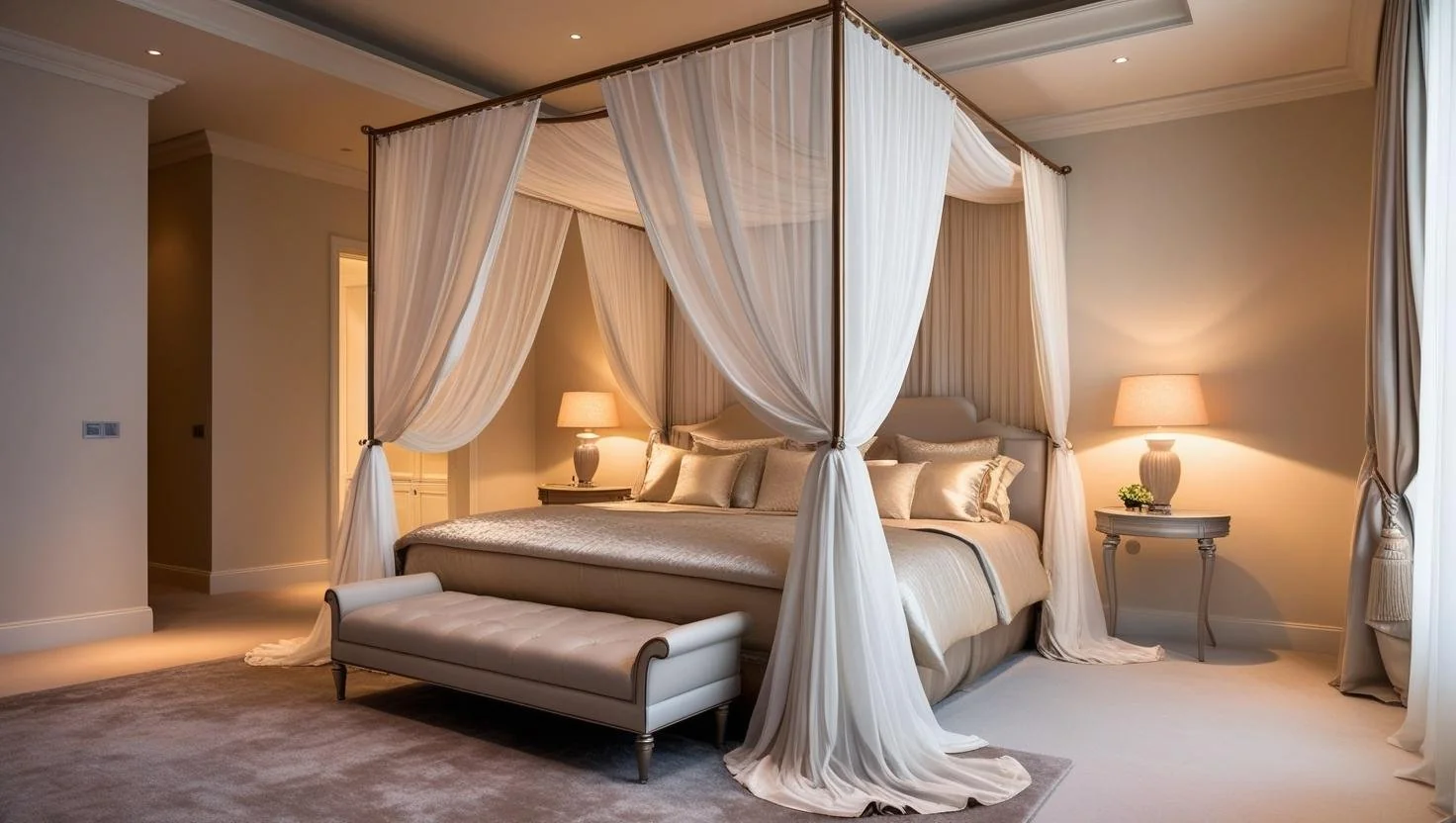
- Romantic. Soft fabrics, pale palettes, sheer panels at the corners, lamplight instead of overheads.
- Rustic. Squared-off beams, reclaimed or matte-finished wood, earthy linens. Heavier than modern, less formal than traditional.
Picking the frame material
A canopy frame carries more leverage than a normal bed — tall posts plus a top rail means small weaknesses at the joints show up as wobble. Material choice matters more here than it does on a platform bed.
- Solid wood. Heavy, stable, and easy to live with long-term. Look at how the side rails attach; bolted metal-to-wood connections hold up better than dowels alone.
- Metal. Usually powder-coated steel or iron. Slim profile, strong, and the visual lightness helps in tighter rooms. Cheap thin tubing can rattle, so check the gauge if the listing states it.
- Upholstered. Padded headboard and posts, softer look, more work to keep clean. Best where you sit up in bed to read.
- Mixed. Wood posts with metal rails, or a metal frame with a wood headboard — stability plus a bit of contrast.
Our comparison of wood vs metal vs upholstered frames goes deeper on durability trade-offs, and if you’re still shortlisting, start with canopy bed frames sized for a king mattress.
Styling it without smothering the room
The frame does the heavy lifting. Everything else is volume control.
Drapery
Sheer voile, cotton gauze, and washed linen keep the silhouette but let light through. Velvet, heavy linen, or blackout panels give you real privacy and darkness, and they make the bed feel considerably bigger — a good trick in a large room, a bad one in a small one. Corner panels only, left open, are the easy middle ground. Muslin or voile is simple to hem yourself if you want custom lengths on a budget.
Bedding
Mix textures rather than colors: a crisp cotton sheet, a linen duvet, one chunky throw at the foot. Keep the palette near the drape color so the bed doesn’t split into two competing zones. Euro shams stack well against a tall canopy headboard — here’s how to size and style Euro shams.
Lighting
Overhead fixtures fight with a canopy, and a chandelier directly above one needs real ceiling height to avoid looking cramped. Wall sconces flanking the headboard, small lamps on the nightstands, or a soft string light run along the top rail work better in most rooms.
The rug underneath
A canopy frame draws the eye up, and a too-small rug drags it back down. You generally want the rug to extend past the sides and foot of the bed, not float in the middle — our bedroom rug guide covers the placement options.
Living with one day to day
Two honest downsides: fabric collects dust, and tall frames loosen over time.
Dust is the bigger one if anyone in the house has allergies. Bed curtains are textile surfaces right next to your face all night, and they collect the same household dust as any drape. Standard allergy advice from the Mayo Clinic is to wash bedding weekly in hot water — at least 130 F — and to dust with a damp cloth rather than a dry one so particles don’t go airborne. Choose machine-washable canopy fabric and put it on a regular rotation, or skip the curtains entirely and leave the frame open.
For the frame itself, retighten the bolts at the posts and rails every few months. Assembly is usually straightforward but awkward alone — the top rails go on last, overhead, and a second person saves a lot of swearing. Clear a path before the boxes arrive; king canopy parts are long.
The cocooning effect is real but it’s comfort, not climate control, and a closed canopy can trap warmth. Most sleep guidance points to a cool room — the Sleep Foundation cites a common recommendation of roughly 65 to 68 F. If you sleep hot, lightweight breathable drapes or an open frame will serve you better than velvet.
Choosing the mattress
Any standard king mattress fits. What you choose depends on how you sleep, not on the canopy — although a very tall frame flatters a thicker mattress, and a low frame can look odd under a 14-inch hybrid. Check whether the frame ships with slats or requires a foundation, since that changes your total height by several inches. If you’re still deciding on feel, compare memory foam vs spring construction before you commit.
FAQ
Do canopy beds make a room look smaller?
Heavy ones can. The frame draws the eye upward, which helps, but full-length dark curtains add visual bulk. Open metal frames and sheer fabric keep the room feeling larger.
Can I use a king canopy bed with 8-foot ceilings?
Usually yes, if you pick a low-profile or slim frame and check the stated overall height against your ceiling. Leave clearance for a ceiling fan or light fixture if one sits nearby.
What fabric works best for canopy curtains?
Voile, cotton gauze, and linen for airiness and easy washing. Velvet or lined blackout panels if you want darkness and warmth — just expect more maintenance.
Are king canopy beds hard to assemble?
Not complicated, but bulky. Most ship flat-packed with hardware and instructions; the overhead rails are the tricky step, so plan on two people.
Is a king canopy bed worth it in a smaller bedroom?
Only with a slim open frame and enough ceiling height. In a room under about 12 by 12 feet, a king already fills the floor — adding posts often makes movement uncomfortable.
Can I add a canopy to a bed I already own?
Ceiling-mounted rails or a hanging bed crown give you the draped effect without a new frame. It’s a reasonable trial run before spending on the real thing — and if you want the softer version of the look, our romantic canopy bed ideas show what’s possible with fabric alone.
Updated September 2026.