Canopy Bed vs Four-Poster Bed: The Short Answer
In everyday furniture shopping, a canopy bed has four tall corner posts joined by horizontal rails overhead, so you can hang curtains, netting or lights from the frame. A four-poster bed has the same four tall posts but no connecting rails at the top, so it reads as open and architectural rather than enclosed. Historically the two overlap almost completely — the original four-poster was defined by the canopy frame it carried — which is why the labels are used loosely today.
Key Differences at a Glance
| Feature |
Canopy bed |
Four-poster bed |
| Frame |
Four posts plus overhead rails (a “tester” frame) |
Four posts only, usually topped with finials |
| Visual effect |
Enclosed, cocooning, room-within-a-room |
Open, airy, vertical lines only |
| Drapes and netting |
Designed for them |
Possible only with added rails or a ceiling track |
| Ceiling height needed |
More — the top rail is the tallest point |
Less, and low-post versions are available |
| Upkeep |
Fabric washing plus dusting of top rails |
Dusting posts only |
| Typical cost |
Usually the higher of the two at a given quality level (more material and hardware) |
Usually less for a comparable frame |
What Is a Canopy Bed?
A canopy bed is a posted bed whose posts are connected by a rectangular frame overhead. That frame is the whole point: it holds sheer linen panels, blackout curtains, mosquito netting, fairy lights or a fabric ceiling, turning the bed into a defined sleep zone. In a king size, the effect is substantial — the frame outlines roughly seven feet of bed length at eye level and above.
Variations worth knowing:
- Full tester: rails on all four sides, the classic canopy silhouette.
- Half-tester: a canopy over the head end only, supported from the headboard or back wall — a lighter option in rooms that a full canopy would swamp.
- Minimalist “outline” canopy: slim metal rails, usually left undraped, used purely as a graphic frame.
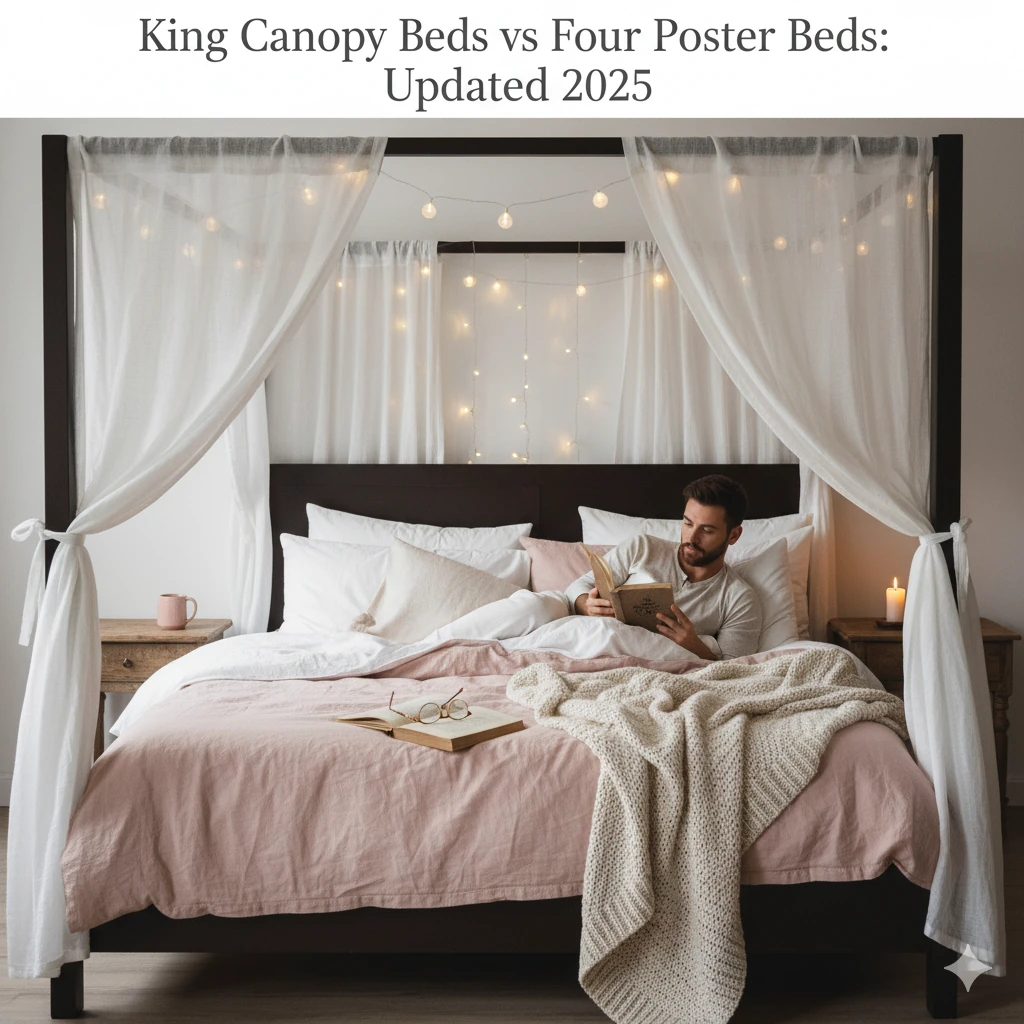
A classic king canopy bed creates instant drama and intimacy.
What Is a Four-Poster Bed?
A four-poster bed has four vertical posts, one at each corner, rising well above the mattress and finished with turned tops, finials or bed knobs. Nothing bridges the posts, so sightlines stay open and the bed feels tall without feeling closed in. Post height varies a lot: “low-post” designs stop not far above the headboard, while tall-post versions can approach ceiling height.
A Note on Terminology
Strictly speaking, the distinction is fuzzier than product listings suggest. In furniture history, a four-poster (or tester bed) is described as a bed with four columns supporting a tester — the upper panel or frame that carried the curtains — as set out in the reference description of the four-poster bed. Modern retailers split the family into “canopy” (rails present) and “four-poster” (rails absent), and that is the split most shoppers mean. When you are comparing two specific beds, ignore the label and look at whether there is a frame overhead.
Why Were Four-Poster Beds Invented?
The posts existed to carry curtains, and the curtains solved real problems. Early bedchambers were draughty and rarely private — households often slept several to a room, servants included — so enclosing the bed in fabric held warmth in and kept prying eyes, dust and insects out. Surviving examples are ornate and frequently made of oak, with many dating from the 16th century and earlier.
The best-known survivor shows how far the style could be pushed: the Great Bed of Ware, an enormous carved oak four-poster made around 1590–1600 and now in the Victoria and Albert Museum, became famous enough to be name-dropped in Elizabethan drama. Once central heating, glazed windows and private bedrooms became normal, the curtains stopped being necessary and the frame survived as decoration. For a fuller timeline, see our four-poster bed history guide.
Will It Fit? Ceiling Height and King-Size Measurements
This is where most canopy-versus-poster decisions are actually settled.
Ceiling height. Residential codes set a floor, not a comfortable target: the International Residential Code requires habitable rooms to have a ceiling height of not less than 7 feet, and 8 feet is the common standard in newer homes. Many king canopy frames stand somewhere between 6 and 8 feet tall, so measure your ceiling, subtract the frame height from the spec sheet, and check that what is left still looks like breathing room — not a squeeze. If the gap is under about 12 inches, a four-poster, a low-post bed or a half-tester will sit far better in the room.
Mattress footprint. A standard US king mattress measures 76 inches wide by 80 inches long. Posted frames add to that on every side, because the posts sit outside the rails, so the real floor footprint of a king canopy or four-poster is usually a few inches wider and longer than the mattress. Add walking clearance of roughly 24–30 inches on the sides you use, plus space for a door or wardrobe to swing. Our king size mattress dimensions guide has the full size chart if you are still deciding between king and California king.
Access. Long posts and canopy rails are awkward pieces. Check stair turns, doorway widths and, if the bed will be under a ceiling fan or pendant light, the clearance above the top rail before you buy.
Materials and Finishes
- Solid hardwood (oak, ash, maple, walnut, mahogany): the traditional choice for four-posters. Heavy, stable, refinishable, and the most convincing at tall post heights.
- Metal (powder-coated steel, iron, brass-finished tube): the usual pick for slim modern canopies, because thin rails can still be rigid. Visually the lightest option in a small room.
- Upholstered: softens the frame and hides bulk; fabric posts and headboards need vacuuming and are harder to spot-clean.
- Mixed: wood posts with metal rails, or a metal frame with an upholstered headboard, is common in hybrid designs.
If you are torn, our comparison of wood vs metal vs upholstered bed frames covers durability and noise trade-offs in more detail, and the best canopy bed frames for a king mattress roundup shows how the same silhouette reads in different materials.

Pros and Cons
Canopy Beds
Pros
- Curtains let you control light, draughts and sightlines — useful in studios, shared rooms and bright east-facing bedrooms.
- Netting is a practical option where insects are an issue.
- Seasonal fabric changes refresh the whole room without buying new furniture.
- The strongest focal point you can put in a large bedroom.
Cons
- Needs generous ceiling height to avoid looking cramped.
- Fabric means laundering, dusting of top rails and more allergen-collecting surface.
- More parts to assemble, usually with overhead work and a second pair of hands.
- Can visually shrink a small room, especially in dark finishes.
Four-Poster Beds
Pros
- Height and presence without enclosing the space.
- Simpler assembly and less upkeep — no fabric to manage.
- Works under standard 8-foot ceilings, and low-post versions fit lower ones.
- Generally the cheaper of the two at a similar build quality.
Cons
- No draping, so no light control or privacy benefit.
- Tall posts still restrict where you can hang art or place a fan.
- Less dramatic in a very large room, where the bed can look under-scaled.
What Actually Drives the Price
We do not publish price ranges we have not tested, and posted beds span everything from flat-pack metal to bench-made hardwood, so any single figure would mislead. What we can say plainly: for two beds of the same material and build standard, the canopy version tends to cost more, because it uses more material and more hardware. The bigger cost drivers are solid wood versus veneered composite, the quality of the corner brackets and centre support, and whether the frame includes a slat system rated for a king mattress. Our king bed frame buying guide walks through those checks.
Also budget for the extras a canopy invites: curtain panels wide enough for a king frame, rings or clips, and possibly a rug large enough to sit under the posts.
Styling by Room Size
- Small bedrooms: choose slim metal in a light or matte-black finish, skip heavy drapes or use sheers only, and keep bedding and walls in a close tonal range. A low-post four-poster or half-tester keeps the vertical interest without the enclosure.
- Average bedrooms (8-foot ceilings): a four-poster is the safer fit. If you want a canopy, look for frames with thin rails and leave them undraped or dress only the head end.
- Large rooms and high ceilings: this is where a full canopy earns its keep. Floor-length panels, a rug that extends well past the posts, and scaled-up nightstands keep the proportions right. Metallic frames read as glamour rather than bulk — see our gold canopy bed styling ideas.
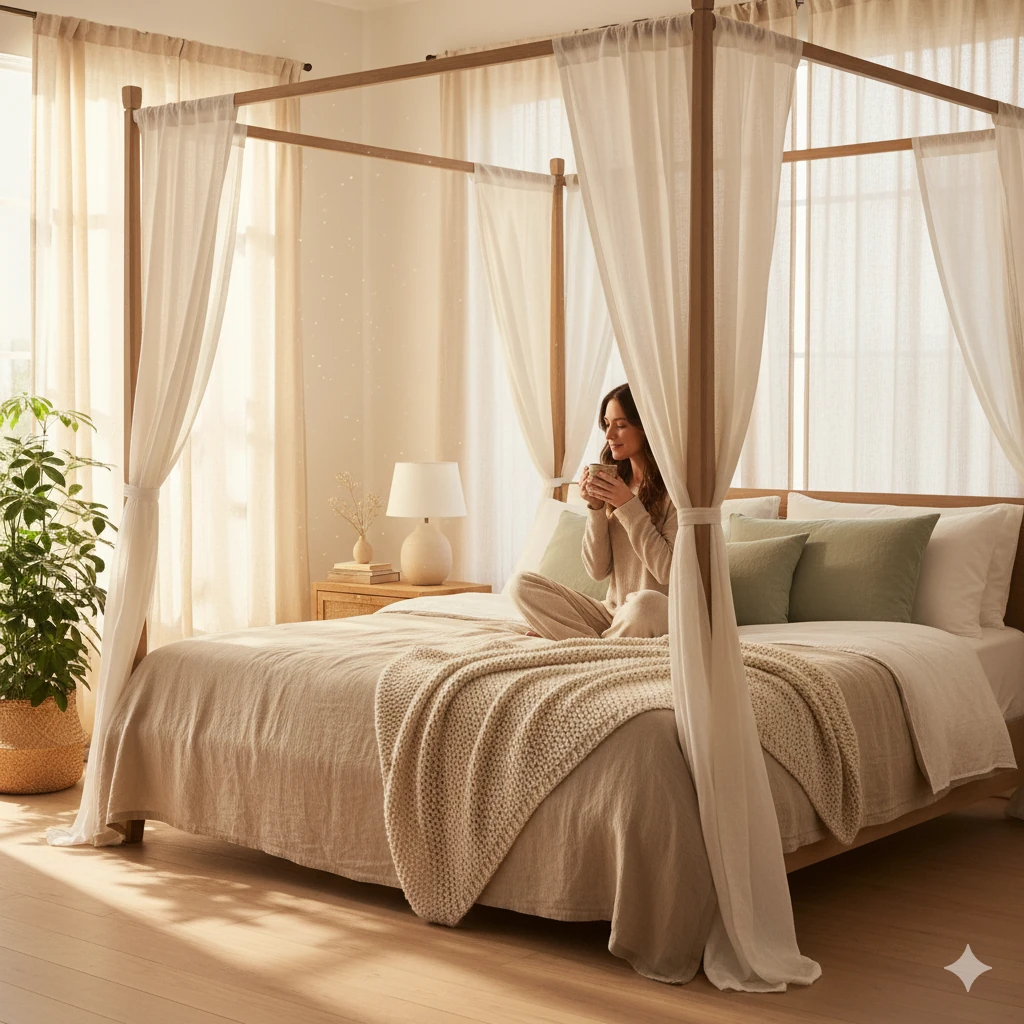
A side-by-side look at canopy and poster styles.
Living With Drapes: Airflow, Cleaning and Allergies
Enclosing a bed in fabric has two honest downsides: airflow and dust. Breathable weaves such as linen and plain-weave cotton move more air than lined velvet, so if you sleep warm, keep heavy panels for the head and foot and leave the long sides open — or hang nothing at all and treat the frame as sculpture.
Dust matters more than most style articles admit. Allergy guidance is explicit that dust mites collect in curtains and other fabrics that are not washed regularly in hot water, and the Asthma and Allergy Foundation of America recommends getting rid of fabrics you cannot easily launder in a bedroom where someone has a dust-mite allergy. Practical translation for canopy owners:
- Buy machine-washable panels and check the recommended wash temperature before you commit.
- Dust the top rails on a schedule — they are out of sight and collect quickly.
- Wash or vacuum panels seasonally; more often in a household with allergies or pets.
- Re-tighten post and rail fasteners once or twice a year, since tall frames amplify any wobble.
On the sleep side, the case for either bed is aesthetic, not medical. What does have evidence behind it is total sleep time: the CDC advises adults to get at least 7 hours a night, and a large share of US adults fall short. A canopy’s curtains can help indirectly by cutting early-morning light; the frame itself does nothing for your mattress or support.
Which Should You Choose?
Choose a canopy bed if you have ceiling height to spare, want light and privacy control, like changing fabrics with the seasons, and don’t mind the laundry.
Choose a four-poster bed if you have a standard-height ceiling, want height and heritage character with minimal upkeep, or need the room to stay visually open.
Consider a hybrid or half-tester if you want the canopy outline without the enclosure — slim crossbars, a partial frame, or a canopy over the head end only.

A hybrid canopy-poster bed merges drama and elegance.
FAQ
Is a four-poster bed the same as a canopy bed?
Not in current usage. Both have four tall posts; only the canopy has rails joining them overhead. In furniture history the terms overlap, because the original four-poster carried a tester frame for curtains.
Can a four-poster bed be turned into a canopy bed?
Sometimes. Some manufacturers sell matching canopy rails or kits for their posted frames, and a ceiling-mounted track or corona is an alternative. Don’t improvise rails or hang heavy fabric on posts that were not designed for the load — check the maker’s guidance on attachment points and weight first.
What ceiling height do I need for a canopy bed?
There is no official rule. Work from the frame’s stated height and aim for a clear, comfortable gap above the top rail; under 8 feet, favour slim rails, a low-post four-poster or a half-tester.
Do canopy beds make a room feel smaller?
They can, especially in dark finishes with full-length drapes in a compact room. Slim frames, light fabrics and a tonal colour scheme reduce the effect.
Do canopy beds trap heat?
Closed heavy curtains will restrict airflow around the bed. Breathable linen or cotton and leaving the long sides open keep things comfortable; that’s a fabric choice, not a flaw in the frame.
Which is easier to assemble?
A four-poster, generally — no overhead rails to line up. King canopy frames usually need two people for the top assembly.
Do canopy beds need special bedding?
No. Standard king bedding fits a king canopy or four-poster. Curtain panels, netting and a canopy topper are separate purchases.
Are four-poster beds still in style?
Yes, and both silhouettes are widely produced in modern, minimalist versions alongside traditional ones — the reason the style survived heating and glazed windows is that the frame looks good.
Updated September 2026.