The best mattress for couples who toss and turn is usually a pocketed-coil hybrid with a thick foam or latex comfort layer, in the medium to medium-firm range (about 5.5 to 7 out of 10). If the restless partner is the main problem and neither of you runs hot, a dense all-foam bed swallows movement even better. And if you disagree about firmness by more than a point or two, stop shopping for one mattress and look at a split king instead.
Why you feel every flip and roll
Motion travels through the support core, not the cushy top. Old-style innersprings use coils tied together on a single wire grid, so a knee moving on one side tugs the whole sheet of springs. Pocketed coils are each sleeved in fabric and compress on their own, which cuts the ripple way down. Foam and latex absorb energy instead of passing it along.
Noise is the other half of the story, and people forget it. A squeaky frame, a loose center support, or a 12-year-old innerspring will wake you even on a mattress that isolates motion perfectly. Before you blame the bed, shake the frame with the mattress off and listen.
Sharing a bed isn’t the enemy, either. Lab research using overnight polysomnography on couples has found that bed-sharing is linked with more REM sleep and more synchronized sleep stages than sleeping alone. The setup is what you can fix.

Best mattress for couples who toss and turn: foam, hybrid, or latex
Each material trades something away. Pick based on which problem keeps you up more often — being jostled, or waking up sweaty and stuck.
| What matters |
Memory foam |
Pocketed-coil hybrid |
Latex |
| Motion isolation |
Best in class |
Very good with pocketed coils |
Good, but bouncier |
| Heat |
Traps the most; gel and open-cell help |
Coil layer moves air |
Naturally breathable, especially perforated Talalay |
| Edge support |
Usually the weak spot |
Strongest, with foam encasement or firmer perimeter coils |
Decent |
| Ease of changing position |
Slow, sinking feel |
Springy and easy |
Quick rebound |
| Typical lifespan |
About 6–10 years |
About 7–10 years |
Often 10–15 years |
| Best for |
A partner who flips constantly; light sleepers |
Hot sleepers, heavier couples, combo sleepers |
People who hate the sinking feel and want longevity |
Memory foam
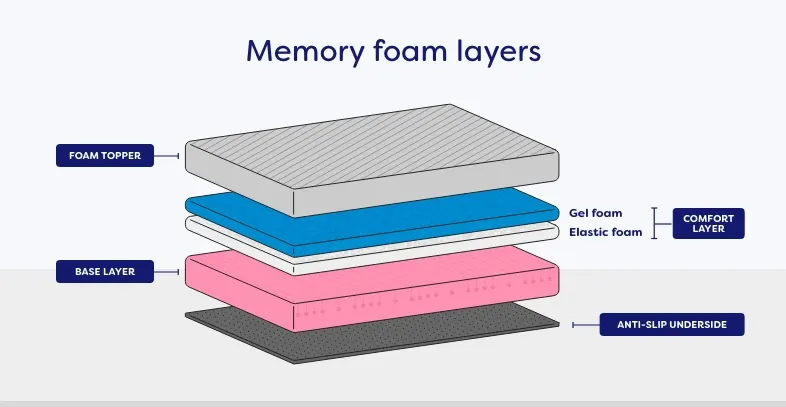
Foam absorbs movement instead of transferring it, which is why it still wins motion tests. The catch is that deep contouring makes rolling over feel like work, and if one of you is already restless, a slow-response foam can make you flop around more, not less. Look for a faster-responding foam or a thinner memory foam layer over a firmer base.
Heat is the other trade. Gel beads, open-cell structures, copper and graphite all help a little, but a solid slab of foam will never breathe like a coil layer. Our memory foam vs. hybrid breakdown goes deeper if you’re torn between the two.
Pocketed-coil hybrid
This is the safest pick for most couples. You get foam or latex on top for pressure relief and individually wrapped coils underneath for airflow, edge support, and enough bounce that changing position doesn’t wake you up doing it.
Check the spec sheet for three things: coils that are wrapped (the listing will say “individually wrapped” or “pocketed”), a foam-encased perimeter or firmer edge coils, and zoning — firmer coils under the hips, softer at the shoulders. Zoning is what keeps a heavier partner from sinking into a hammock that rolls you both toward the middle.
Latex
Natural latex lasts the longest and sleeps the coolest of the three, but it’s springy by nature, so motion isolation lands a notch below foam. It’s a great fit when one of you has joint pain and hates feeling stuck, and it’s worth the look if you want a bed you won’t shop for again in seven years.

The five specs to check before you buy
1. Firmness — and how far apart you are
Most couples land fine on medium to medium-firm. Side sleepers want 5–6.5 with a 3- to 4-inch comfort layer so shoulders and hips can sink. Back sleepers do best around 6–7. Stomach sleepers need 7 or firmer, or their hips drop and their lower back pays for it. If you two are within about a point of each other, split the difference. More than that, a split setup or a topper on one side is the honest answer. Our guide to matching firmness to sleep position has the full rundown.
2. Foam density
Density is the number that predicts sagging, and sagging is what turns two sleepers into one lump in the middle. For memory foam, 3 lb/ft³ or higher holds up; under that, expect body impressions within a couple of years. For polyfoam base layers, 1.8 lb/ft³ is the usual floor. Many brands bury these numbers in a specs tab — if a company won’t publish them at all, that tells you something.
3. Edge support
Weak edges shrink the bed. When you can’t sleep within six inches of the perimeter without feeling like you’re sliding off, a queen effectively becomes a full. Sit on the side and see whether it collapses or holds. Foam encasement or reinforced perimeter coils is what you want on the spec sheet.
4. Cooling that’s actually structural
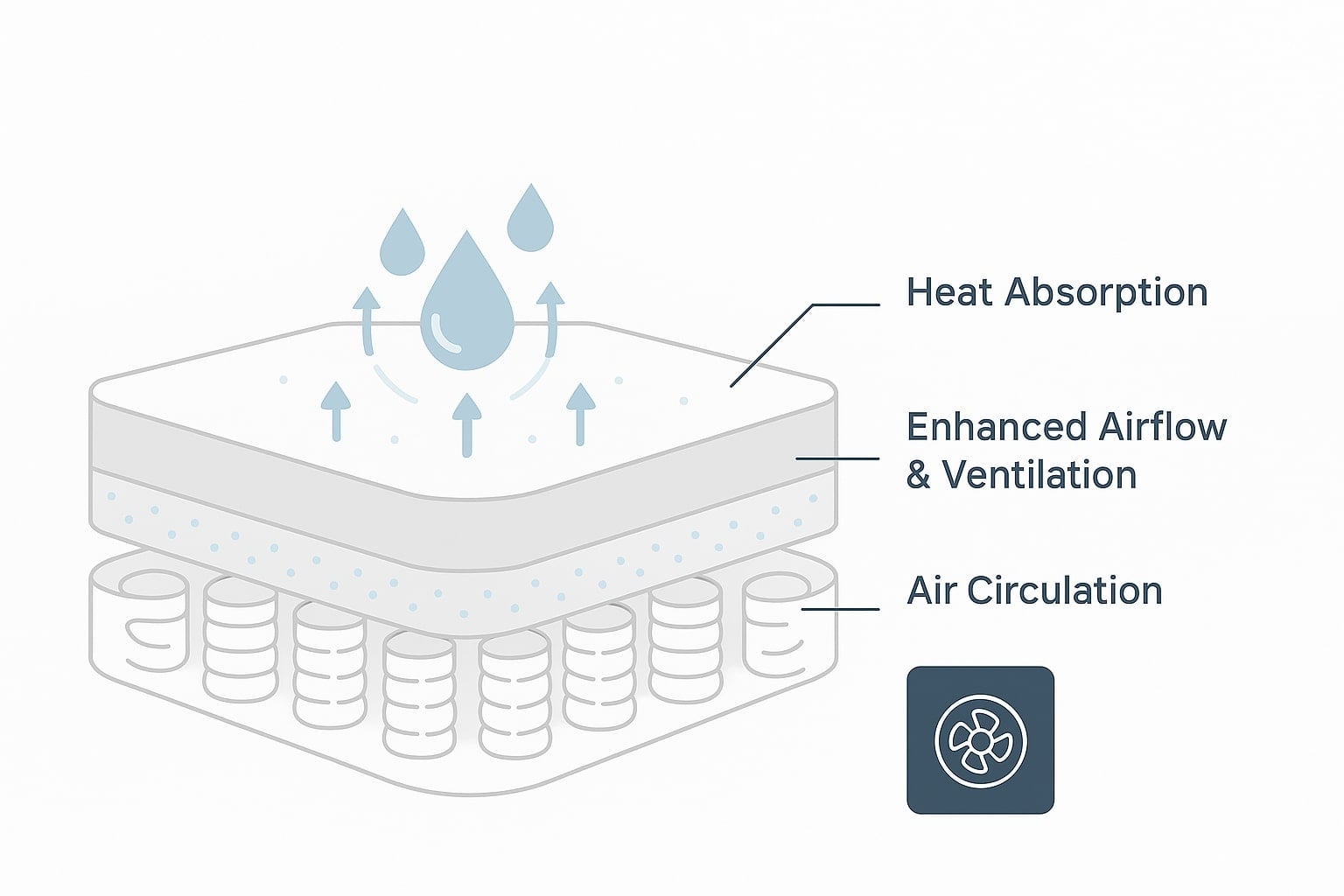
Phase-change covers feel cold for about 20 minutes and then they’re just a cover. Real cooling comes from a coil layer that moves air, a breathable knit or Tencel cover, and foam that isn’t a dense sealed slab. Set the room to help, too — federal health guidance on healthy sleep habits calls for keeping the bedroom cool, dark, and quiet.
5. The trial and the warranty
Take nothing shorter than a 100-night trial, and read the return terms: some require you to keep it 30 nights before you can send it back, some charge a pickup fee, and some only offer store credit. Foam beds need two to four weeks to break in and your body needs about that long to stop noticing the change, so a quick verdict in week one isn’t a verdict.
How to test motion transfer without a lab
- The glass test, done right. Set a half-full glass of water near the middle of the bed, then have your partner sit down and roll over a foot away. A little wobble is normal. Water sloshing over the rim means the energy is traveling.
- Lie still and close your eyes. This is the one that counts. Have your partner get in and out of bed twice on their side. You’re checking whether you feel the mattress lift and drop, not just wiggle.
- Test the edge. Sit on the side like you’re putting on socks, then lie near the perimeter for a minute. A good edge compresses a few inches and stops.
- Bring your actual pillows to a showroom, and lie in your real sleeping position for at least 10 minutes per bed. Two minutes on your back tells you nothing.
- Check noise. Shift your weight fast and listen. Coil squeak gets worse with age, never better.
Sometimes the answer is more square footage
A queen is 60 by 80 inches, which gives each person 30 inches of width — narrower than a standard crib mattress is long, and less than most people realize. A king is 76 by 80, so each of you gets 38 inches. That extra eight inches per person does more for a restless couple than most cooling gimmicks.
- Queen (60″ x 80″) — workable if neither of you sprawls and no pets are involved.
- King (76″ x 80″) — the default upgrade. Measure your room: leave at least 24 inches of walking space on each side.
- California king (72″ x 84″) — four inches narrower, four inches longer. Choose it for height, not for space between you.
- Split king (two 38″ x 80″ twin XL) — two separate mattresses under one set of sheets. Each partner picks their own firmness, and motion transfer between sides drops to essentially zero.
Split king also opens up independent adjustable bases, so one of you can read at an incline while the other sleeps flat, and raising the head a few degrees can quiet down snoring. We covered the real trade-offs in whether adjustable beds are worth it for couples — the main ones being cost, weight, and a gap you’ll want a bridge pad for.

Cheaper fixes to try first
If your mattress is under about five years old and still flat, try these before spending real money:
- Two separate duvets. Scandinavian-style, one comforter each. This kills cover-stealing overnight and costs less than a pillow.
- Tighten the frame. Center support legs loosen. So do bolts. Ten minutes with a wrench solves a lot of “the mattress is noisy” complaints.
- Add a 2- to 3-inch topper on one side only. On a king, a twin XL topper lets one partner soften their half without touching the other.
- Check your pillows. Neck pain makes people flip all night. Side sleepers usually need 4–6 inches of loft; back sleepers 3–5; stomach sleepers as flat as possible.
- Move the bed away from the wall if a headboard is knocking. Felt pads on the legs help on hard floors.
When tossing isn’t a mattress problem
No bed fixes restless legs syndrome, untreated sleep apnea, chronic pain, or a nightcap at 10 p.m. If one of you kicks rhythmically for long stretches, gasps or snores loudly, or wakes unrefreshed no matter what the bed is, that’s worth a conversation with a doctor rather than another mattress order. Alcohol and late caffeine both fragment the back half of the night, and a warm room does the same.
Common questions
Does a topper reduce motion transfer?
Some. A 3-inch memory foam topper will soften the jolt of a partner rolling over, but it can’t fix a bouncy connected-coil base underneath. If the mattress itself is sagging, a topper just follows the dip.
Memory foam or hybrid if my partner never stops moving?
Foam, if you can live with the heat and the sinking feel. Hybrid, if either of you sleeps hot, weighs more than about 230 pounds, or hates feeling stuck. A hybrid with a 3-inch foam comfort layer gets you most of the motion control without the swampy part.
How firm should it be if one partner is much heavier?
Go one step firmer than the lighter partner would pick alone, and prioritize zoned coils and high-density foam. Heavier sleepers compress comfort layers further, so a soft bed that suits a 130-pound side sleeper often bottoms out for a 240-pound one. A split setup ends the argument entirely.
How long before I know it’s working?
Give it 30 nights. Track how many times you actually wake up in week one versus week four — write it down, because memory is terrible at this. If you’re still being jolted awake at the end of the trial window, return it while you still can. If you’re building a shortlist on a budget, our roundup of boxed mattresses worth buying is a sensible starting point.

Updated September 2026.