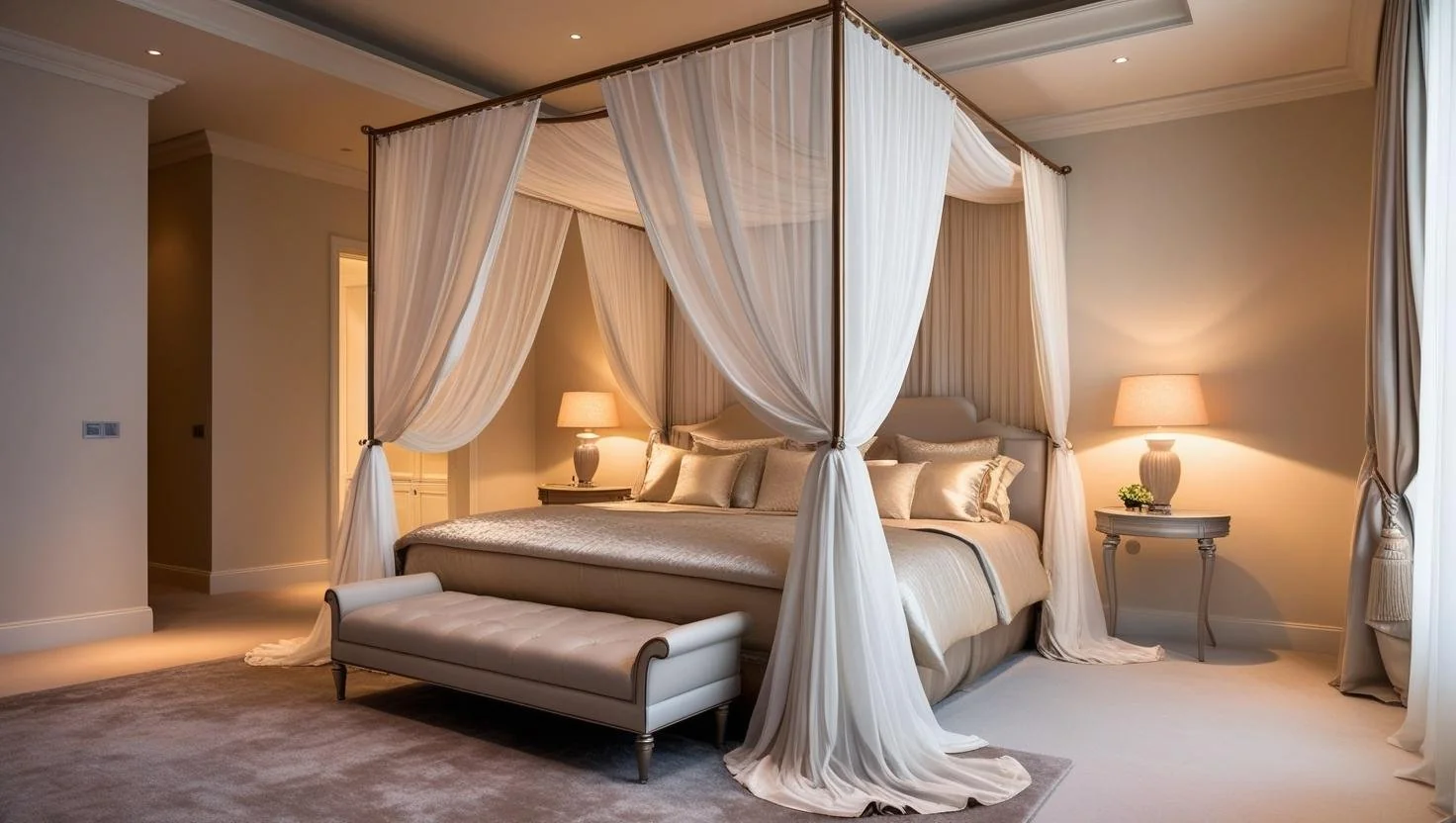
Canopy Bed Frames: Styles, Sizes and How to Choose

Best Canopy Bed Frames for a King Size Mattress - Featured Image

Canopy bed frames are four-post beds with rails connecting the tops of the posts, so you can leave the frame bare for a graphic, architectural look or hang fabric for privacy and softness. The right one comes down to three things: enough ceiling clearance above the top rails, a frame that doesn’t wobble once curtains are added, and a material you’re happy to live with and dust. Measure your room and ceiling before you fall in love with a style.

Below you’ll find the styles worth knowing, what actually matters in the build, and how to dress a canopy without making the room feel closed in.
Light wood canopy bed frames with white bedding in a bright modern bedroom

What to Look For in Canopy Bed Frames

Start with height. A canopy frame is tall — often close to seven feet at the top rail — so find the manufacturer’s listed overall height and subtract it from your ceiling. If you’re left with only an inch or two, the bed will read as crammed against the ceiling, and you’ll have nowhere to hang drapery rings. A hand’s width of clearance is the bare minimum; six inches or more looks better.

Then think footprint. A canopy doesn’t take up much more floor space than a standard frame, but the posts sit at the outer corners, so add a few inches to the mattress dimensions and check your walkways. Our king size bed dimensions guide has the exact measurements, and the bedroom layout guide covers clearance around nightstands and doors.

What to check What good looks like Why it matters
Ceiling clearance At least 6 inches above the top rails Keeps the frame from visually crowding the room and leaves space for curtain hardware
Material Solid hardwood, powder-coated steel, or a sturdy upholstered box frame Drives weight capacity, maintenance and how the bed ages
Joinery and brackets Metal-to-metal connections, corner brackets, bolts rather than cam locks Canopies sway more than low frames, especially once fabric is hung
Slats and support Closely spaced slats plus a centre rail and legs on queen and larger Protects the mattress and stops sagging in the middle
Finish Water-based or low-emission finishes; certified composite panels Less off-gassing in a room you breathe in for eight hours a night
Assembly Labelled parts, pre-drilled holes, hex or Torx hardware Upper rails are awkward; clear instructions and a second pair of hands save an evening

Slim four-post canopy bed frame with neutral linens in a calm bedroom

Canopy Bed Styles, From Four-Poster to Minimalist

Classic four-poster

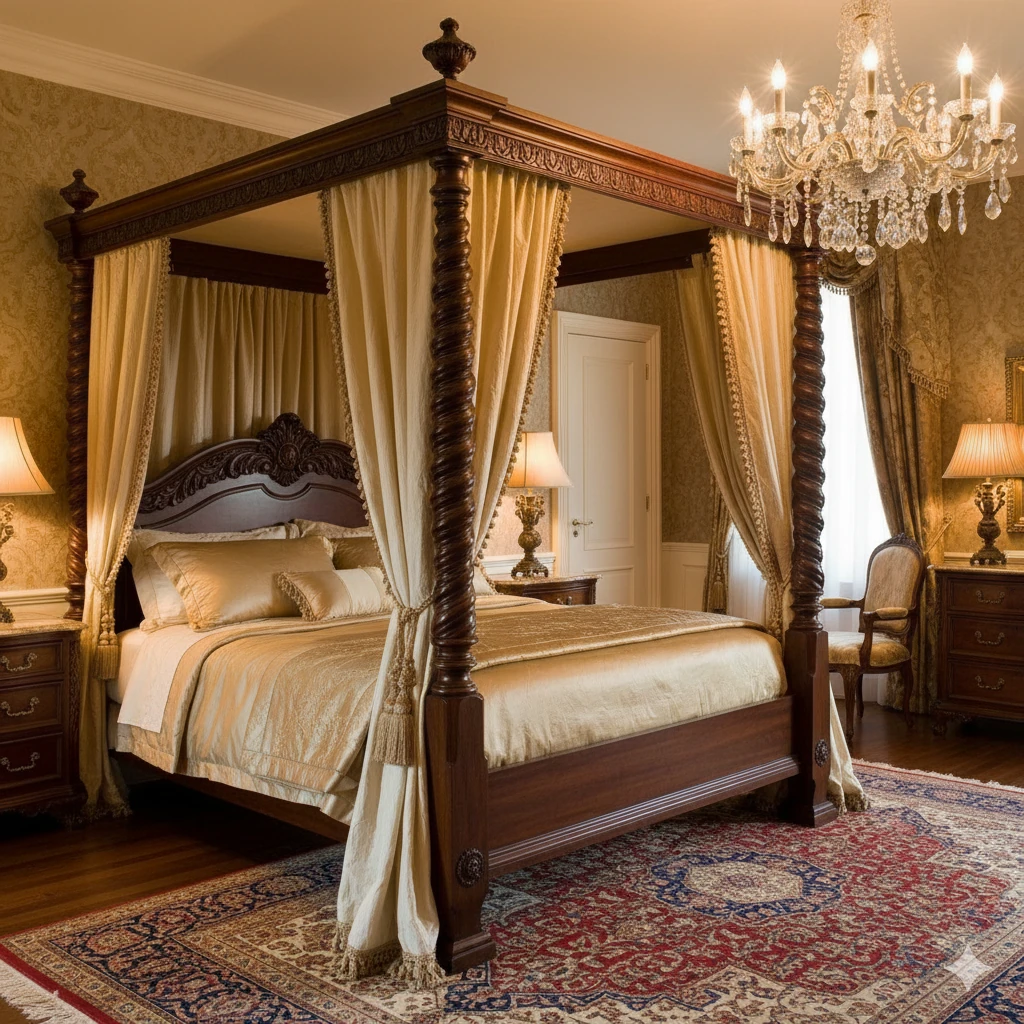
Four tall posts, four connecting rails, and a symmetry that anchors a room. Carved or turned wood suits traditional and farmhouse rooms; a squared-off profile in walnut or oak leans transitional. If you’re weighing the two silhouettes against each other, we break it down in canopy bed vs four-poster bed.

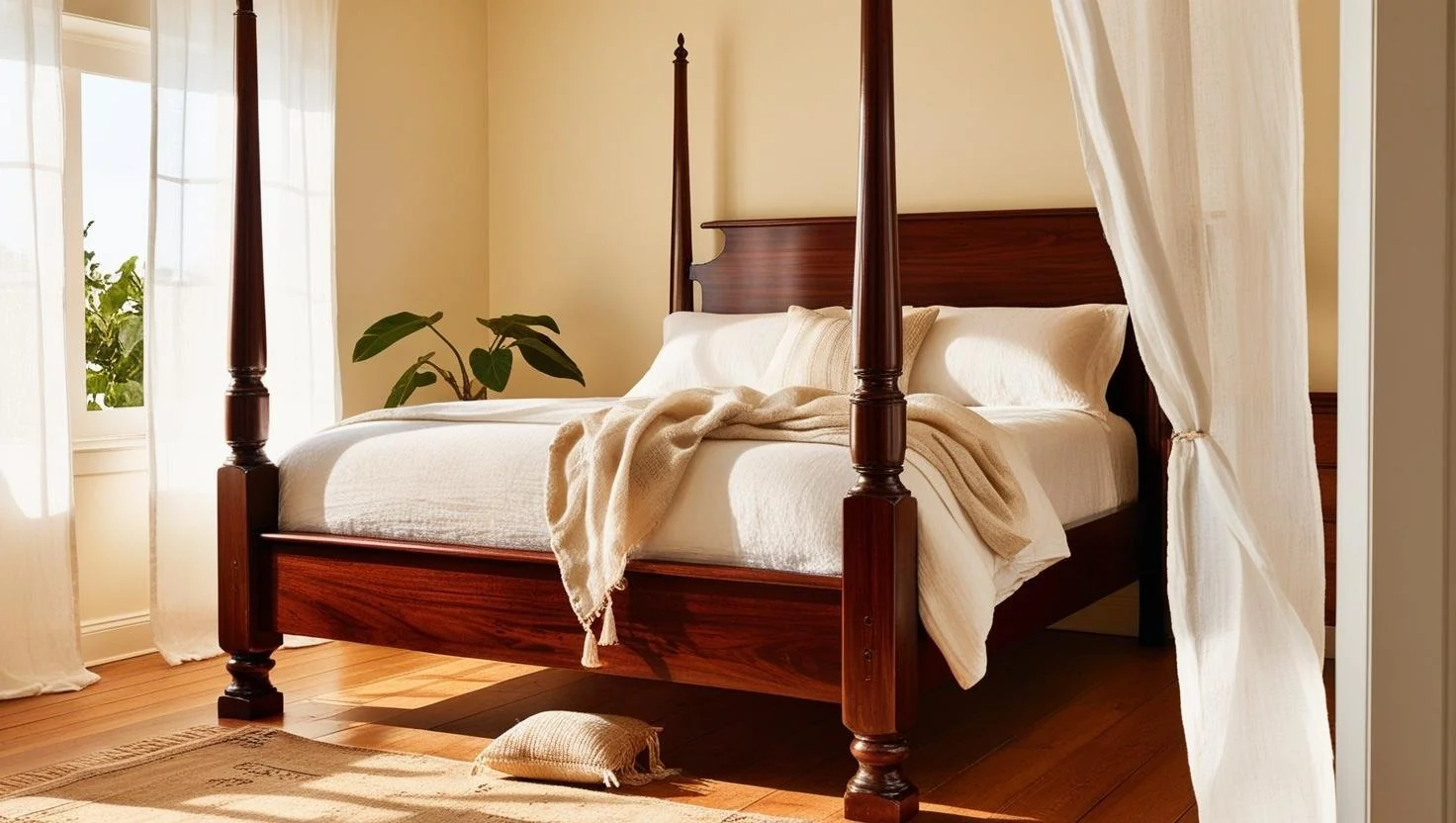
Traditional wooden four-poster canopy bed with tall turned posts and layered bedding

Half-tester and suspended canopies

Instead of four posts, a half-tester hangs a partial canopy over the head of the bed from the wall or ceiling. It’s an old idea — the Metropolitan Museum of Art describes an 18th-century French lit à la duchesse whose canopy is suspended from the ceiling rather than supported on posts. In a modern bedroom that translates to a ceiling-mounted rod and two fabric panels: drama at the headboard, no bulk at the foot of the bed. Good option for narrow rooms.

Crown and domed canopies

The curvy, theatrical cousin. The Getty’s collection includes a French lit à la polonaise from about 1775–1780, where curved iron arcs meet in a small crown above the bed. Today you can get the effect with a ceiling-mounted corona and two long panels, without committing to a gilded antique.

Modern minimalist

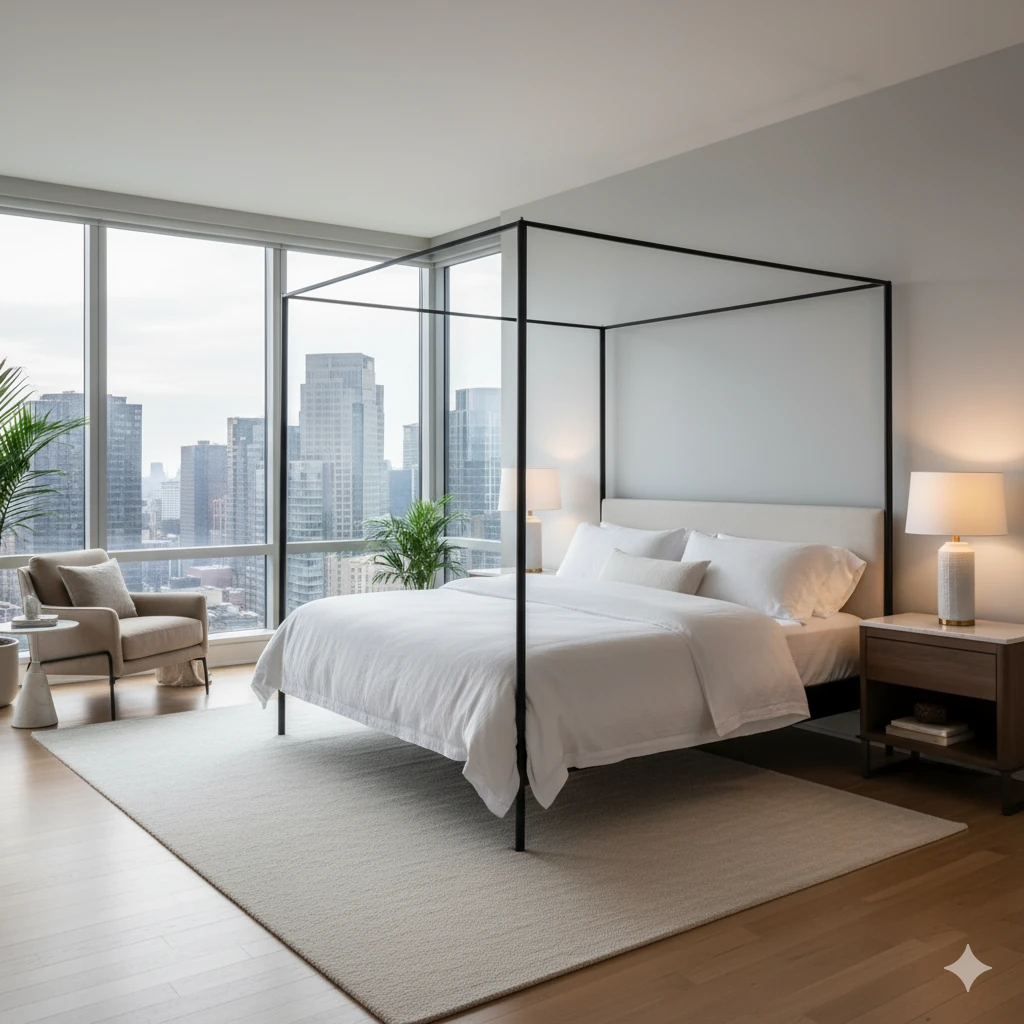
Slim metal or wood posts, matte black or bone-white, nothing carved, nothing draped. This is the most forgiving style in a small or low-ceilinged room because the frame draws your eye upward without adding visual weight.

Upholstered canopy

A padded headboard makes reading in bed genuinely comfortable, and fabric posts soften a room full of hard surfaces. The trade-off is cleaning — upholstery holds dust and is harder to spot-clean than a wiped-down wood post.

Industrial and mixed-material

Steel posts with wood rails, or a blackened metal frame with a reclaimed-look headboard. Works well in rooms with exposed brick, big windows or high ceilings, where a delicate frame would disappear.

Rustic, bohemian and convertible

Distressed finishes and rounded posts suit farmhouse rooms; lightweight frames are the natural home for gauzy panels, macramé and rattan. Some frames are convertible — the top rails unbolt so you can run the bed as a plain four-poster and add the canopy back later. If you like changing your mind, that’s worth looking for.
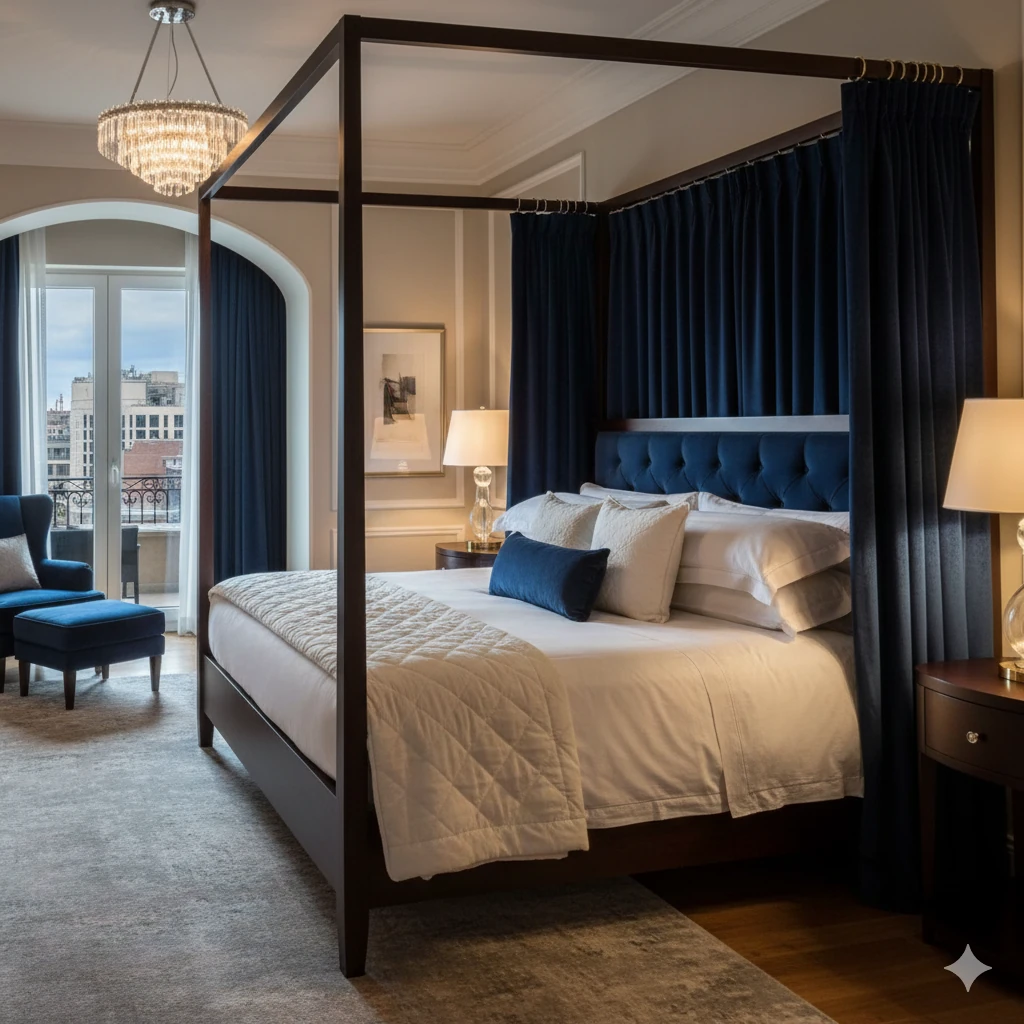
Dark walnut canopy bed frame styled with crisp white bedding

Wood, Metal or Upholstered?

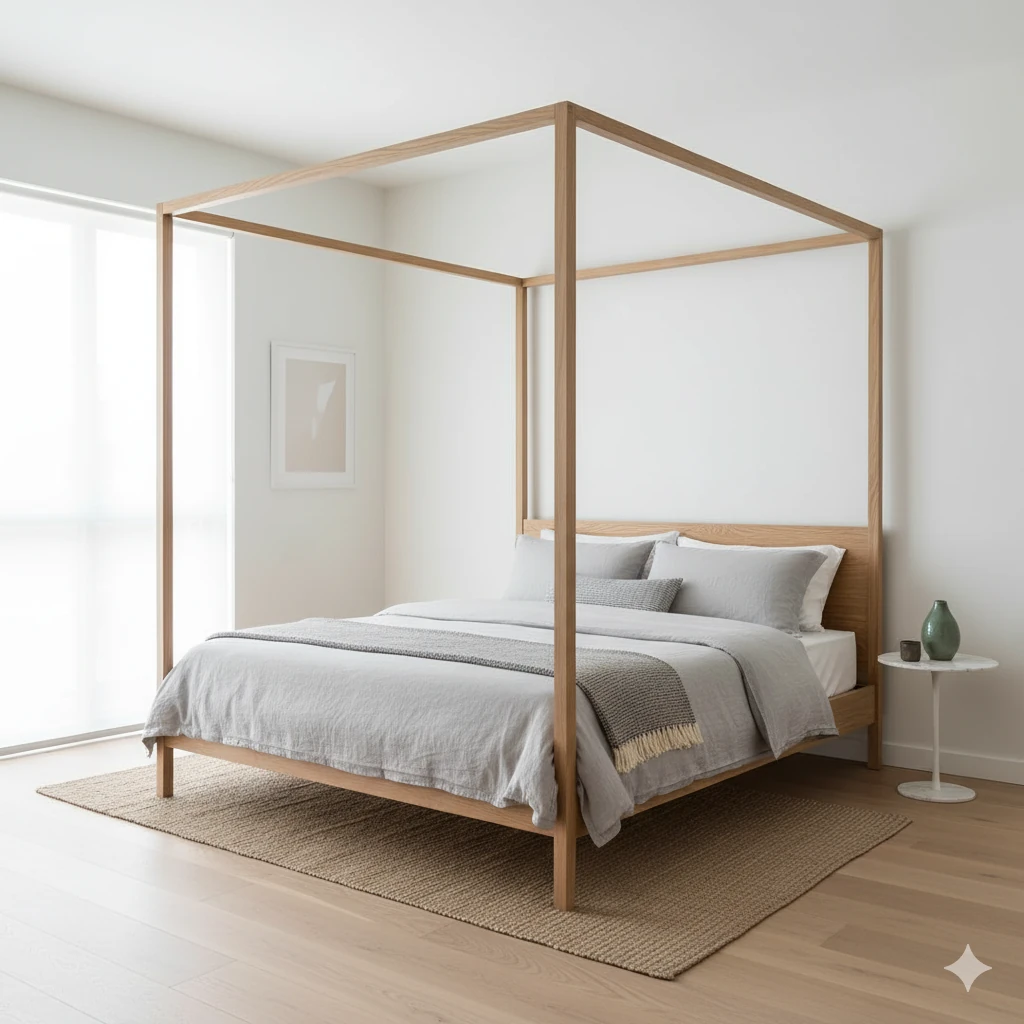
Wood gives you warmth, weight and repairability — you can sand and refinish a solid frame years later. Metal is the low-fuss pick: slim posts, powder-coated finishes that resist scuffs, and usually the easiest to move. Upholstered frames are the most comfortable to lean against and the fussiest to keep clean. None of the three is objectively best; it’s a question of how the room is used and how much maintenance you’ll actually do. Our wood vs metal vs upholstered comparison goes deeper on durability and noise.
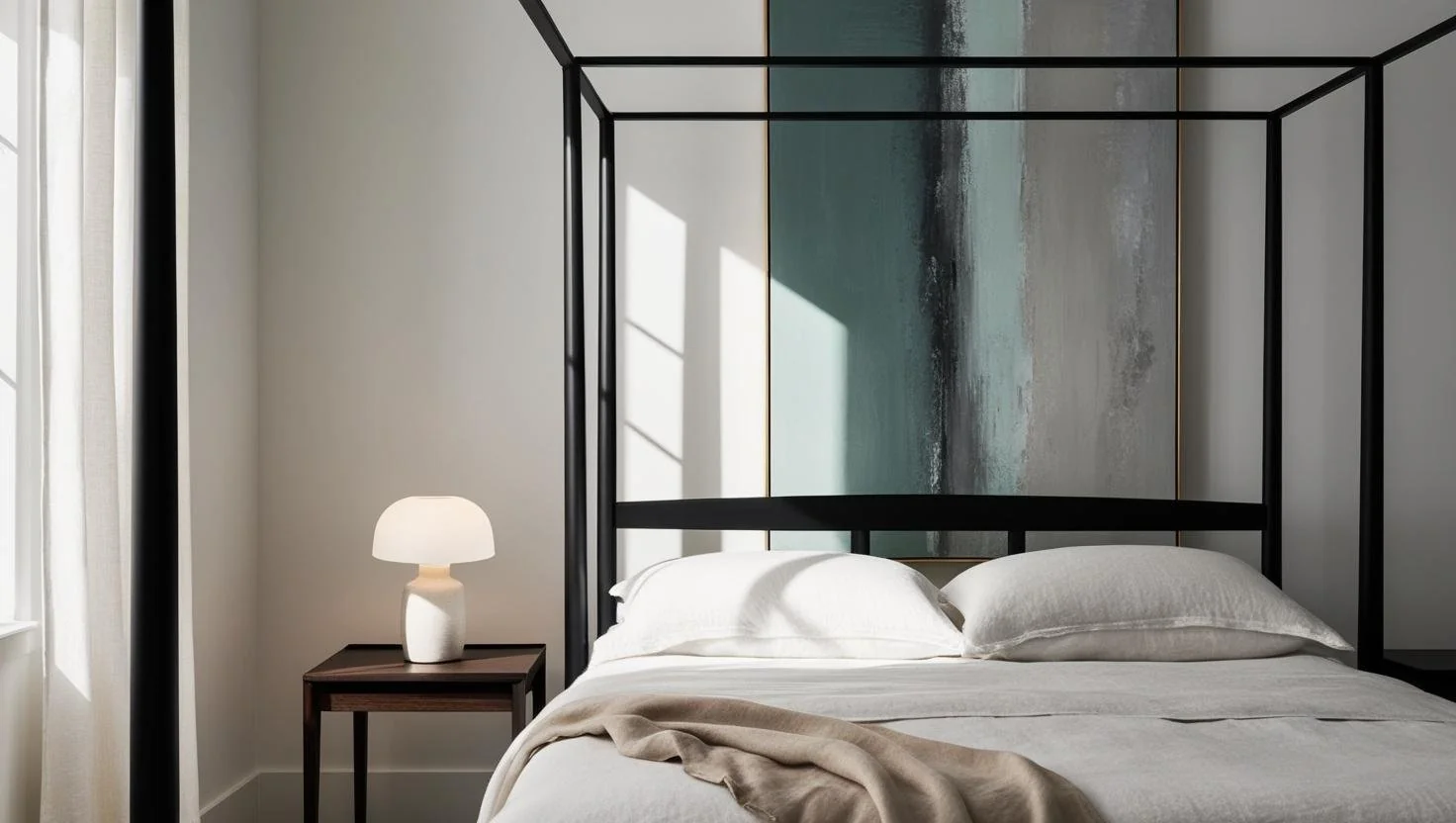
Minimalist black metal canopy bed frame with slim posts in a neutral bedroom

Matte black metal canopy bed frame seen from the foot of the bed

Stability: The Part People Skip

A canopy is a tall, rectangular structure with a lot of leverage at the top. Anything that adds load or movement up there — curtains, string lights, a cat with ambitions — shows up as sway. Look for bolted metal-to-metal joints at the post tops rather than pegs or plastic connectors, check that the frame ships with corner brackets, and re-tighten every bolt a few weeks after assembly once the wood has settled. If the room is carpeted, felt pads or thin coasters under the posts keep the frame from rocking in soft pile.

Under the mattress, spacing matters too: most foam and hybrid mattresses need closely spaced slats or a solid platform plus centre support, and manufacturers often set a maximum slat gap in the warranty. Check your mattress paperwork before you buy the frame, not after.

Certifications Worth Knowing

Marketing words like “non-toxic” and “eco” mean nothing on their own. Independent labels are more useful:

One honest caveat: certifications tell you about sourcing and emissions. They don’t promise a frame will last longer, and there’s no reliable public testing that ranks canopy frames by lifespan. Joinery quality and solid material tell you more about durability than any label does.
Canopy bed frame in certified wood with natural linen bedding and plants

Light wood canopy bed frame in a sunlit room with woven textures

Draping, Lighting and Styling

Fabric is what turns a frame into a room within a room, and it’s the cheapest way to change the whole mood later.

  1. Sheers filter daylight and keep the bed feeling open. Linen and cotton voile hang better than stiff synthetics.
  2. Heavier panels — velvet, lined cotton — block more light and make the bed feel enclosed. They also absorb a little sound, though don’t expect a noticeable difference in how quiet the room is.
  3. Clip rings on a slim rod let you take panels down for washing in a couple of minutes. Fabric tied permanently to the rails never gets cleaned.
  4. Lighting works best low and warm: a string of small LEDs along the top rail, or wall sconces either side. Anything heavy should hang from a ceiling joist, not from the frame.
  5. Bedding does the rest. Mix a crisp weave with something textured — a waffle throw, a knit blanket — so the bed reads layered rather than flat.

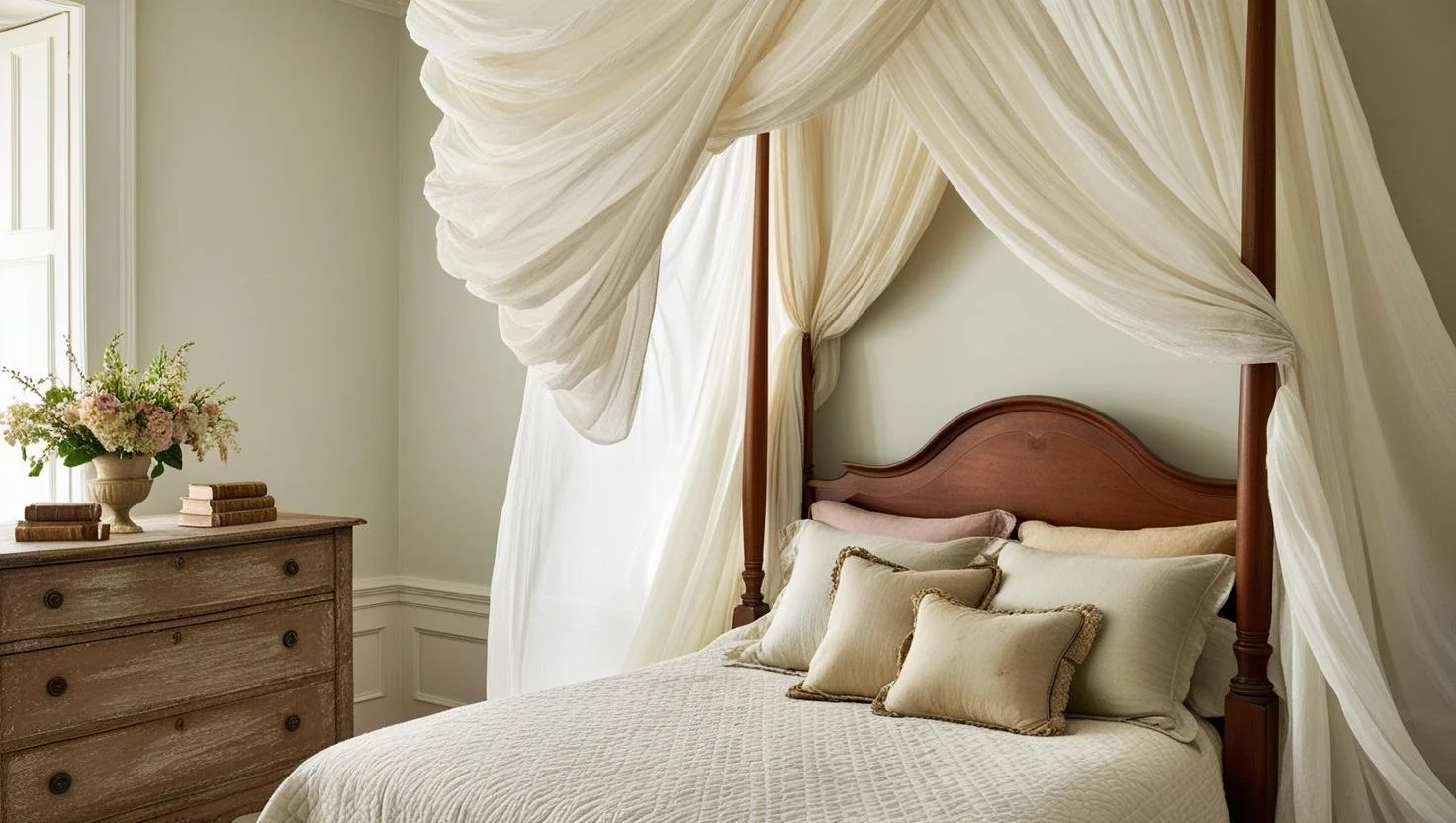
Canopy bed frame dressed with floor-length drapery and layered bedding

Sheer white curtains hanging from a canopy bed frame beside a sunny window

Canopy Beds in Small or Low-Ceilinged Rooms

A canopy can work in a small room, but the frame has to stay visually light. Choose slim posts in a colour close to your walls, skip the side panels and hang fabric only at the head of the bed, and keep the bedding palette tight so the eye isn’t stopped at every layer. Keeping the space under the bed clear helps too — if you need storage down there, a storage bed frame may serve you better than a canopy. And if the bed is the last big decision left, our king size canopy bed guide covers scale in bigger rooms.

Airy bedroom with a canopy bed frame, light drapery and layered neutral linens

Canopy bed frame decorated with warm string lights and sheer curtains at night

Keeping It Clean

Dust settles on top rails faster than anywhere else in the room, so run a microfibre cloth or an extendable duster along them when you change the sheets. Wash cotton and linen panels on a cool cycle and rehang them slightly damp to drop the creases; send velvet and silk to a dry cleaner. Wipe wood posts with a barely damp cloth and dry them straight away, and vacuum upholstered posts and headboards with a brush attachment.

FAQ

What ceiling height do I need for a canopy bed?

Eight feet is comfortable for most frames. Compare the frame’s listed overall height to your ceiling and aim for at least six inches of clearance — more if you want curtain hardware above the rails.

Are canopy beds hard to put together?

The base goes together like any bed frame; the upper rails are the awkward part because you’re lifting long pieces overhead and lining up bolt holes. Plan for two people and an hour or two.

Can I use any mattress with a canopy frame?

Yes, as long as the sizes match and the slat spacing suits your mattress type. Foam and hybrid mattresses generally want closely spaced slats or a solid platform with centre support.

Do canopy beds make a room feel smaller?

An undraped frame usually makes a room feel taller, not smaller, because it leads your eye upward. Heavy, dark, floor-length curtains on all four sides are what shrink a space.

Can I fake a canopy without buying a new bed?

You can. Ceiling-mounted tracks or a corona above the headboard give you the draped effect over the bed you already own. Fix the hardware into joists, not just drywall.

Are canopy beds still in style?

They keep reappearing in current interiors, usually in slimmer, less ornate forms than the antique versions. Style trends move, though, and nobody can promise where they’ll be in five years — the practical case for a canopy is privacy, focal point and the ability to restyle with fabric.

Updated September 2026.

Four Poster Bed History: How a Draft Shield Became a Status Symbol

he Great Bed of Ware, a historic four-poster bed displayed in a museum.

Four poster bed history begins with cold rooms and zero privacy: by the 1400s, joiners were building beds with four corner posts so curtains could hang from the frame itself instead of dangling from the ceiling. Those hangings trapped body heat, blocked drafts and dust, and screened the sleeper from the servants and relatives who often shared the chamber. The posts survived long after chimneys and central heating made them unnecessary, because by then they had become a way to show off.

Four poster bed history at a glance

Before about 1400 Curtains and a flat canopy (the tester) hang from ceiling ropes or a wall bracket. The bedstead underneath is a simple frame.
1400s Posts rise from the bed itself and carry the tester. The four-poster as we know it takes shape in wealthy European households.
1500s Massive joined oak beds with carved headboards, bulbous posts and inlay. Hangings often cost more than the woodwork.
1600s State beds go tall and fully upholstered. Posts disappear under silk, velvet and fringe.
1700s Mahogany, slim reeded or fluted posts, and plain American pencil-post beds. Lighter, cleaner lines.
1800s Iron and brass bedsteads spread, half-testers get popular, and hygiene reformers attack heavy hangings as dust traps.
1900s Central heating and fitted bedrooms push curtains out. The style fades to country houses and hotels.
Now Skinny wood or powder-coated steel frames, usually with no fabric at all. The posts are there to draw the eye.

The tester came first, the posts came second

Medieval inventories describe a “bed” as the textiles, not the woodwork. The valuable part was the set of curtains, the tester overhead, the dorsar hung behind the head, and the coverlet. Early canopies were suspended from the ceiling joists or cantilevered off the wall, which meant they could be taken down and moved with the household.

The switch to posts is the hinge point in four poster bed history, and it solved a practical problem. A frame that carried its own canopy could be set anywhere in the room, hold heavier fabric, and be assembled and knocked down with pegs and bolts. Once carpenters started making the posts decorative, the arms race was on.

Carved oak bed with heavy drapes illustrating early four poster bed history

The Tudor showpiece years

Sixteenth-century oak beds are the ones people picture: melon-shaped posts, arcaded headboards, inlaid panels in light and dark wood. The most famous survivor is the Great Bed of Ware, an oak four-poster carved, inlaid and originally painted, made in England around 1590–1600 and now in the Victoria and Albert Museum collection. It measures about 3.26 metres (10 feet 8 inches) across, near enough twice the width of a modern king mattress, and it sleeps four couples if you believe the old stories.

It was almost certainly a marketing stunt for a Hertfordshire inn, and it worked: Shakespeare name-checked it in Twelfth Night, and playwrights kept the joke running for a century.

Beds were also serious property. Shakespeare’s 1616 will left his wife the “second best bed,” a line scholars still argue over, and the fact that a bed merited a clause at all tells you where it sat in the household inventory.

Why the curtains mattered

  • Heat. An unheated stone or timber chamber loses warmth fast. Closed wool or serge hangings turn the bed into a small insulated room.
  • Privacy. Beds sat in rooms people walked through, and servants often slept on a truckle bed underneath.
  • Dust and soot. Open fires, rush lights and thatched or beamed ceilings dropped debris. The tester caught it.
  • Status. Silk damask cost a fortune. Everyone who entered the chamber could price it at a glance.

The Victorian backlash

By the mid-1800s, cheap rolled-iron and brass bedsteads were being sold as the sanitary alternative to carved wood, on the argument that metal gave bedbugs nowhere to hide and could be scrubbed. Sanitary writers of the period pushed the same line about hangings: heavy curtains held dust and stale air, so half-testers and bare frames gained ground. That shift, plus better heating, is the reason four poster bed history has a gap in it: the full tester bed nearly disappeared from ordinary bedrooms by 1920.

What the modern four-poster kept, and what it dropped

The modern chapter of four poster bed history keeps the silhouette and throws out almost everything else. Posts are thinner, often 2 to 3 inches square instead of a carved 6-inch column. Frames come in oak, ash, walnut, rubberwood and tubular or square-section steel. Most ship with a flat top rail on all four sides and no fabric.

The old warmth argument is mostly gone, but the light argument holds up. Darkness is one of the main signals your body clock reads, and the National Institute of General Medical Sciences notes that light and dark have the biggest influence on circadian rhythms. Lined curtains on a four-poster give you a pocket of dark inside a room you can’t fully black out, which is genuinely useful in a studio, a bright city flat, or a summer bedroom with thin blinds.

If you’re weighing a canopy against an open frame, our canopy bed vs four-poster comparison lays out the structural differences in detail.

Slim modern four-poster bed frame with clean square posts and no canopy fabric

How to tell an old four-poster from a reproduction

Plenty of “antique” four-posters are Victorian or early 20th-century frames assembled from older panelling, or straight reproductions. Things worth checking before you pay antique money:

  • Saw marks. Straight, irregular pit-saw marks suggest hand sawing. Regular arcs mean a circular saw, so the timber was cut no earlier than the 1830s.
  • Shrinkage. Turned posts and pegs on genuinely old wood dry out across the grain and go slightly oval. Perfectly round sections are a flag.
  • Pegs and bolts. Hand-cut pegs usually stand slightly proud. Original bed bolts are often hand-threaded and mismatched, with a bolt cover on the outer rail.
  • Patina mismatch. Compare the colour inside the joints with the outside faces. A “marriage” of parts from different beds shows up here first.
  • Carving depth. Machine carving is uniform and shallow; hand carving wanders and undercuts.
  • Mattress size. Many pre-1900 frames were built for a mattress narrower and shorter than today’s standards. Measure the inside of the rails before you plan any bedding.

None of this is proof on its own. Two or three matching signs, plus a dealer who will put the date in writing on the receipt, is what you want.

Will one fit your room? Measure these five things

  1. Ceiling height. Modern posts usually run 70 to 90 inches tall. On a standard 96-inch ceiling, aim for at least 8 to 12 inches of air above the top rail so the bed doesn’t look jammed in.
  2. Walkway clearance. Leave 24 inches minimum on any side you use, and 30 inches if you want to make the bed comfortably. Posts eat into that space visually more than a headboard does.
  3. Mattress and rail size. A queen mattress is 60 by 80 inches and a king is 76 by 80. Check the frame’s external footprint too; posts and rails can add 3 to 6 inches on each side.
  4. Delivery route. Ask whether the posts split into two sections with a threaded dowel. A one-piece 84-inch post will not turn a tight stair landing.
  5. Light fittings. Pendant lights, ceiling fans and sloped ceilings decide the whole thing. Tape the post height on the wall and live with it for a day.

Small rooms are not automatically out. A pale, slim-posted frame with no top rail reads lighter than a bulky upholstered headboard, because you can see the wall through it. Dark, heavy posts in a small room do the opposite.

Four-poster bed dressed with light linen curtains tied back at the posts

Dressing it without going full Tudor

Fabric is where this style goes wrong fastest. A few rules that keep it wearable:

  • Sheer linen or cotton voile at the head corners only. You get the softness without the cave.
  • If you want real blackout, line just the two curtains facing the window and leave the rest sheer.
  • For gathered curtains, allow about twice the rail length in fabric width so they hang in folds rather than flat panels.
  • Wash hangings on a schedule. They collect dust exactly as the Victorians complained.

For style-by-style options and canopy hardware, see our guide to choosing a four-poster canopy bed. If you’re drawn to the period look, the longer read on four-poster beds through history goes deeper on the decorative eras.

Keeping an old frame sound

Bed bolts loosen. Check and snug them every six months, and every time you move the bed; a wobbling four-poster is almost always four loose bolts, not a broken joint. Keep indoor humidity somewhere around 40 to 50 percent if you can, since swinging humidity is what splits old rails and pops inlay.

Use paste wax on waxed antique wood, not silicone spray polish, and never oil a shellacked surface. Felt pads under the posts stop them chewing floorboards and let you slide the bed out to clean.

Traditional wooden four-poster bed with turned posts and a flat tester frame

Frequently asked questions

When was the four-poster bed invented?

Four poster bed history has no single inventor or date. Curtained beds with ceiling-hung canopies existed well before 1400; beds with four corner posts carrying their own tester became common in wealthy European homes during the 1400s and were standard for the well-off by the 1500s.

Why do antique four-poster beds look so short?

Partly because of how they were used. People slept propped on bolsters and pillows rather than flat, and the piled bedding and high side rails make the sleeping area look shorter than it is. Average adult heights were modestly lower than today, but the “everyone was tiny” explanation is overstated. Measure the rails rather than guessing.

Do four-poster beds need curtains?

No. Most modern frames are sold bare and work fine as pure architecture. Add fabric only if you want the darkness, the warmth or the enclosed feeling.

Are four-poster beds bad for small bedrooms?

Not if you keep the posts slim, the finish light and the top rails open. What kills a small room is a heavy canopy plus full-length curtains, which cuts the floor plan into a box.

Is a four-poster bed a sustainable choice?

It can be. A solid hardwood frame with bolted joints is repairable and often outlives several mattresses, which is the whole argument for buying well once. Our guide to sustainable bed frames covers certifications, glues and finishes to look for.

What happened to bed curtains?

Chimneys, then stoves, then central heating removed the reason for them, and 19th-century hygiene campaigns finished the job by branding them dust traps. The ritual side of the bedroom shifted too, as our piece on bedding rituals through history explains.

Updated September 2026.