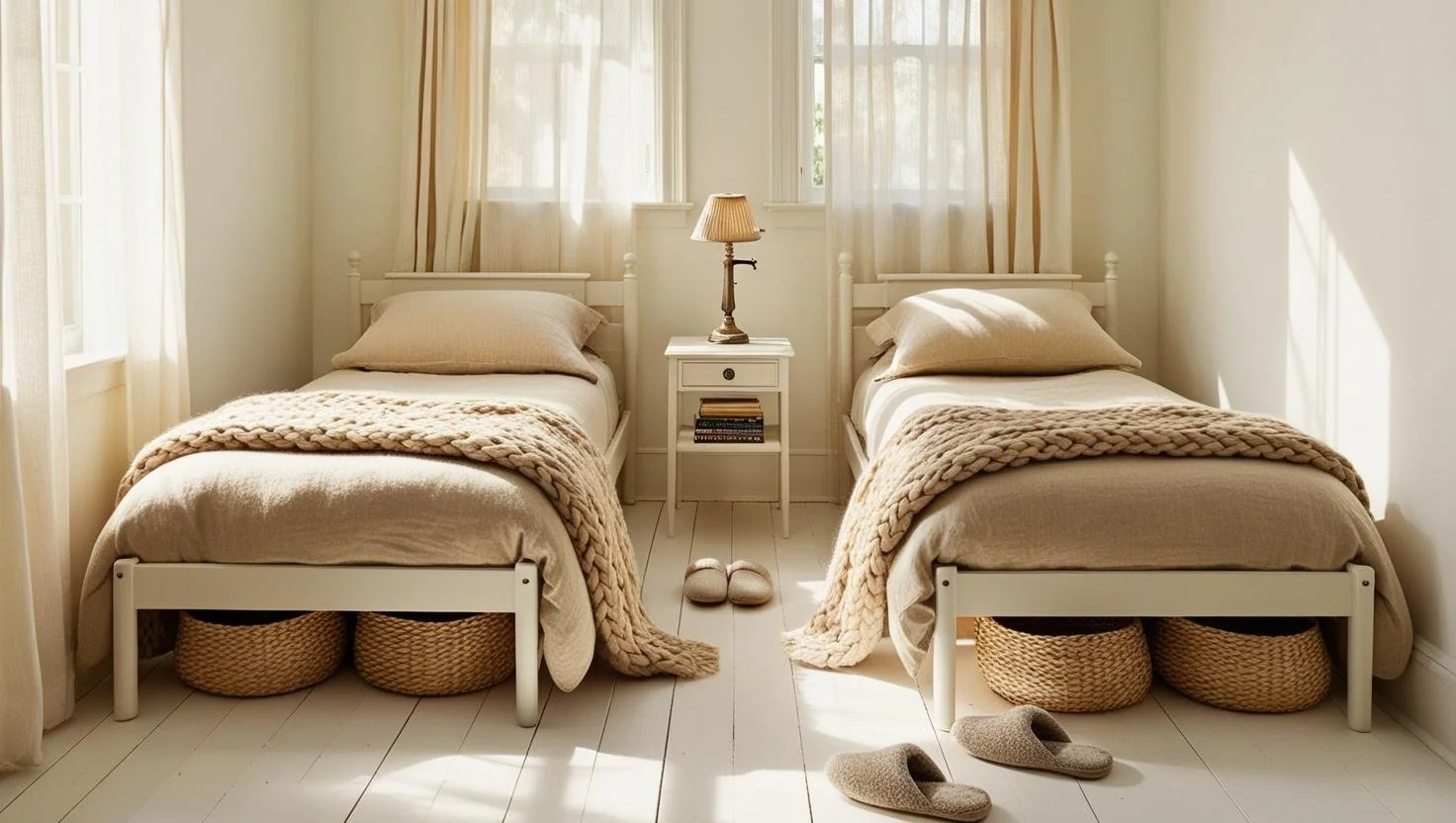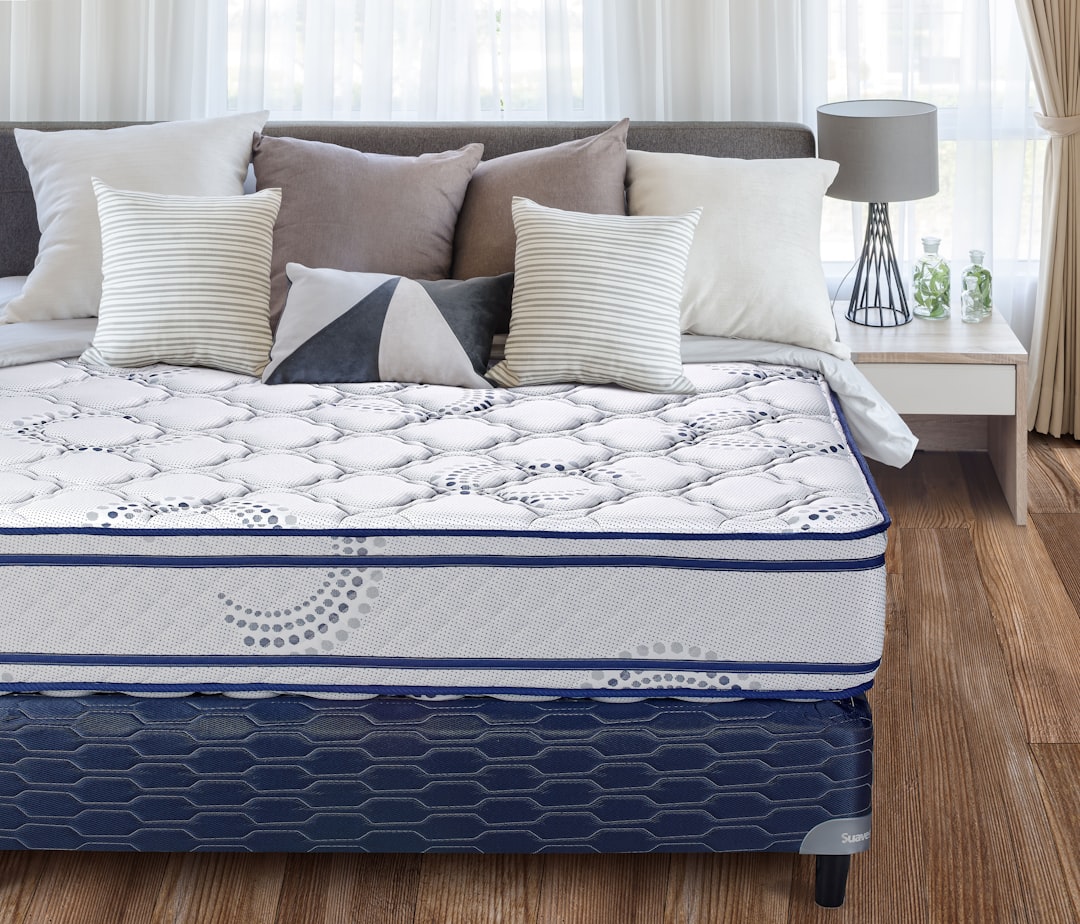
Under Bed Storage Frames That Maximize Bedroom Space

Beds with Built-In Storage


Beds With Built-In Storage for Organized Living

If your bedroom feels cluttered or you’re looking to make the most of every square foot, Beds with Built-In Storage offer the perfect solution. These smart designs integrate drawers, shelves, or hidden compartments directly into the bed frame, combining comfort with practicality. For more ideas, explore Hidden Storage Beds: Smart Space Savers.

Serene modern bedroom featuring Beds with Built-In Storage to maximize floor space and organization

Key Takeaways

  • Beds with Built-In Storage help maximize bedroom space while maintaining a stylish design.
  • Popular choices include platform beds, ottoman beds, captain’s beds, and Murphy beds.
  • These designs are ideal for small apartments, guest rooms, or multipurpose spaces.
  • Choosing the right storage bed depends on accessibility, storage needs, and room layout.

Why Choose Beds with Built-In Storage?

Bedrooms often double as storage areas, leaving closets overstuffed and under-bed bins in disarray. That’s where Beds with Built-In Storage stand out. By integrating storage into the frame itself, they eliminate clutter and free up valuable floor space. Whether in a city apartment or a compact guest room, these beds make organization effortless. For further ideas, check out Better Homes & Gardens’ bedroom storage solutions.

Types of Beds with Built-In Storage

There are multiple types of Beds with Built-In Storage, each offering a different balance of convenience, accessibility, and storage capacity. From sleek drawers to hidden lift-up compartments, the right choice depends on your space and lifestyle. For guidance, see How to Choose the Right Platform Bed with Storage.

Type of Storage Bed Best For Storage Capacity Key Advantage
Platform Beds with Drawers Minimalist bedrooms, daily essentials Moderate Accessible drawers without visible clutter
Ottoman Beds Small spaces, bulky seasonal storage High Gas-lift design reveals full under-bed space
Captain’s Beds Kids’ rooms, multipurpose layouts Moderate Mix of drawers and shelving
Murphy Beds with Storage Studios, guest rooms, tiny homes Moderate to High Saves floor space while adding hidden compartments

Each of these Beds with Built-In Storage caters to different needs. The best option depends on how much space you need and how you prefer to access it.

Platform Beds with Drawers

Answer first: choose platform beds if you want simple, everyday storage that blends into a minimalist design. Platform beds integrate two to four drawers into the frame, ideal for linens, shoes, or clothing. They’re especially useful in rooms with enough clearance for drawer access. Explore IKEA’s storage bed collection for affordable options.

Buyer’s tip: Opt for full-extension drawers to reach the back easily; felt-lined bottoms protect delicates. If your rug is thick, confirm the drawer height clears the pile.

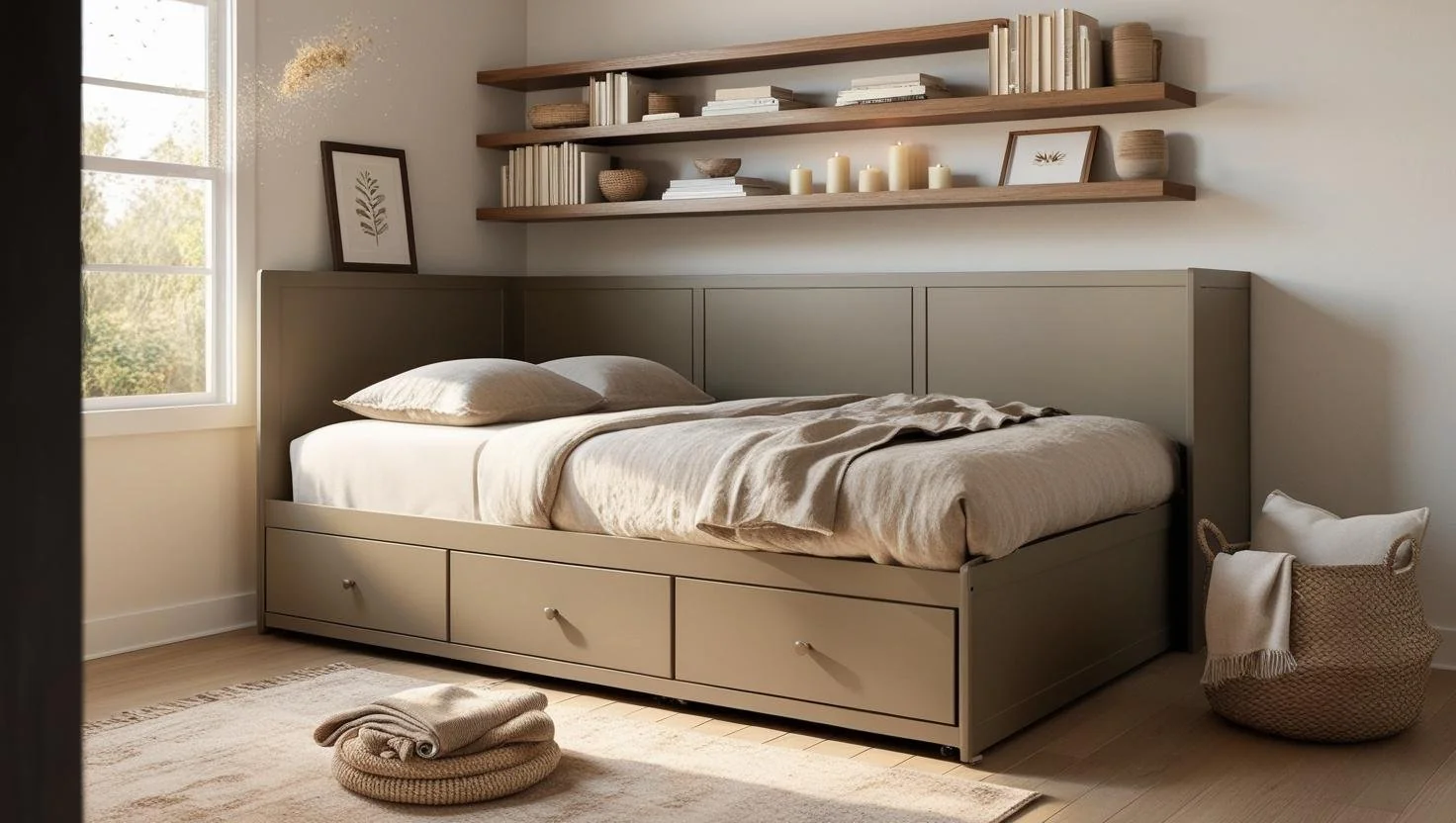
Wood platform storage bed with drawers keeping a small bedroom organized and clutter-free

Ottoman Beds

Answer first: pick an ottoman base when you need maximum capacity in the same footprint as a standard bed. The mattress lifts on gas struts to reveal a single large compartment—ideal for winter duvets and gear. For complementary ideas, read Under-Bed Drawers for Small Bedroom Storage.

Buyer’s tip: Side-lift models are easier to open in tight rooms. Always match the gas-lift rating to your mattress weight, and add bins or cubes so the big cavity doesn’t become a jumble.
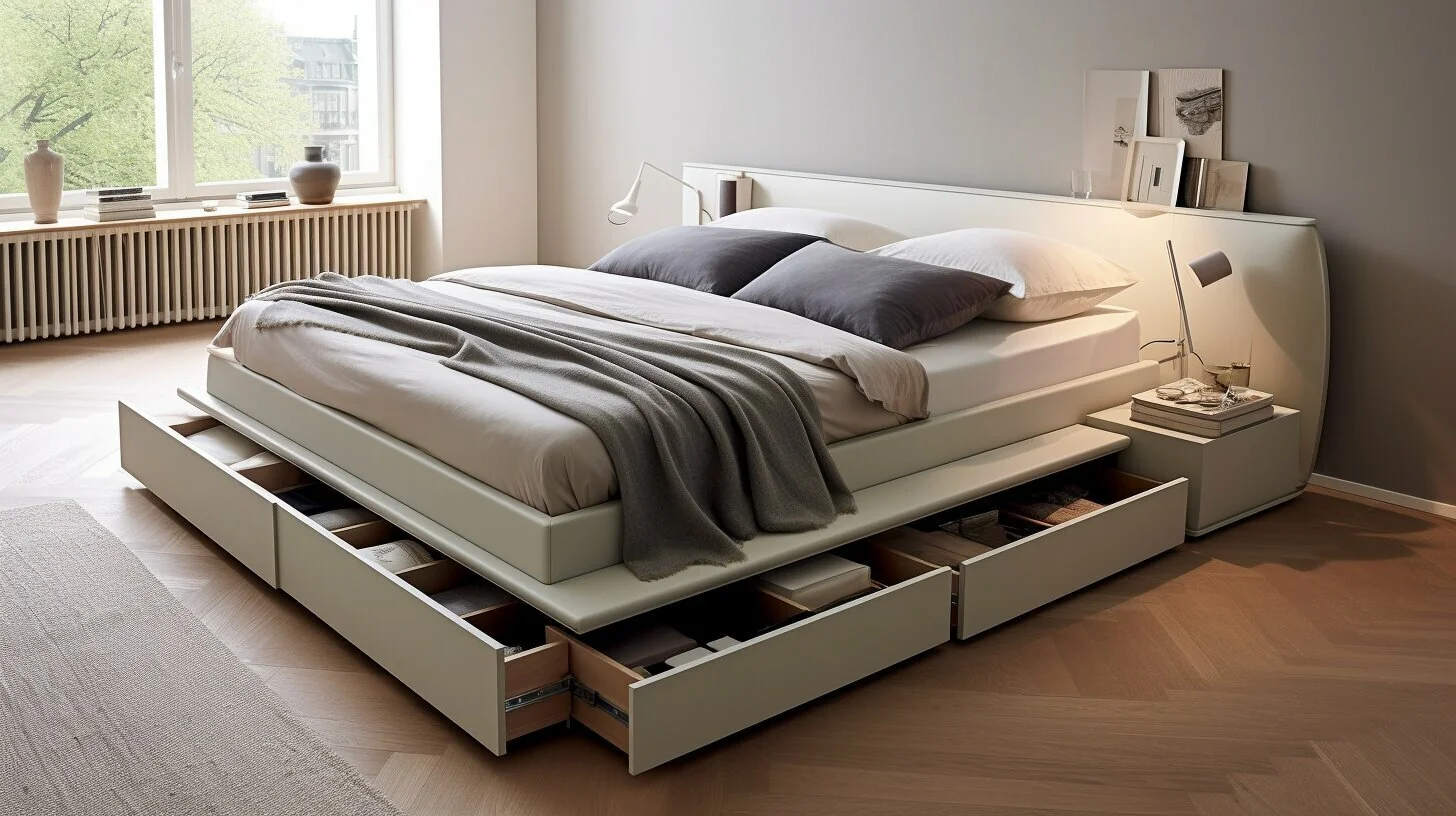
Space-saving ottoman bed raised to show under-bed compartment for seasonal storage

Captain’s Beds

Answer first: choose a captain’s bed for kid-friendly organization and multi-zone storage. These ship-inspired frames combine side drawers with headboard shelves, corralling toys, clothes, and books without extra furniture. See this Sleep Foundation guide to the best storage beds for inspiration.

Buyer’s tip: Prioritize soft-close drawers to protect little fingers, and look for adjustable shelving in the headboard to handle everything from picture books to baskets.
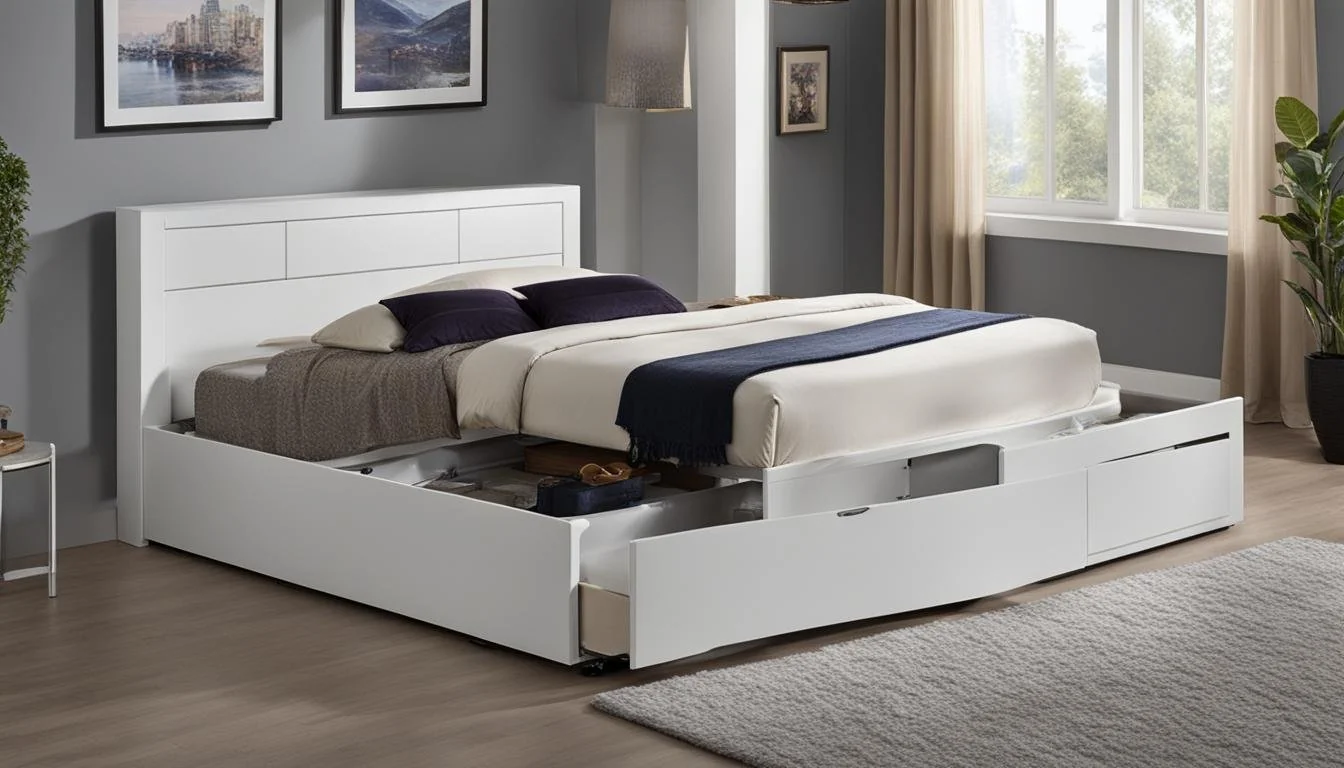
Captain’s storage bed with drawers and headboard shelves organizing a busy kids’ room

Murphy Beds with Storage

Answer first: select a Murphy bed when you need daytime floor space plus cabinetry for linens and gear. Wall-mounted designs fold away and often include side closets, cubbies, or hidden compartments. Explore more ideas in Space-Saving Bed Frame Solutions.

Buyer’s tip: Verify ceiling height, wall studs, and swing clearance before purchase. Many systems need professional installation; plan for lead times and anchoring hardware.

Murphy bed with side storage cabinets folded into a compact studio for flexible floor space

How to Choose the Right Storage Bed

Answer first: match access (drawers vs. lift) to how often you’ll use items, then confirm clearance and mattress compatibility. A quick checklist below narrows the field.

  • Measure movement: Map drawer swing, lift height, and door clearances; tape the footprint to test flow.
  • Match mattress weight: Dense foam/hybrids are heavy—verify gas-lift ratings or choose drawers instead. See Innovative Bed Frames with Storage Options.
  • Plan ventilation: Use breathable bags, cedar inserts, and avoid storing damp textiles.
  • Hardware quality: Full-extension slides, soft-close action, and reinforced corners extend lifespan.
  • Assembly needs: Murphy systems and heavy ottomans may need pros; check delivery path and stairwells.
  • Warranty & returns: Longer warranties signal durability; review weight limits and trial windows.
Style Access Best Use Capacity Room Fit
Platform Drawers Side pull-out drawers Daily linens, clothing Moderate Needs 24–36″ side clearance
Ottoman Lift Top lift on gas struts Bulky/seasonal items High Great for tight rooms; plan top clearance
Captain’s Bed Drawers + headboard shelves Kids’ rooms, multi-use Moderate Compact footprint replaces extra furniture
Murphy + Cabinets Folds into wall unit Studios/guest rooms Moderate–High Requires wall anchoring and ceiling clearance

FAQ

Are beds with built-in storage worth it?
Yes, they maximize space, reduce clutter, and add convenience, especially in smaller bedrooms.
Which storage bed offers the most capacity?
Ottoman beds typically provide the most storage, as they use the full under-bed space.
Can storage beds support heavy mattresses?
Many can, but always check manufacturer specifications. Reinforced frames and gas-lift systems work best with dense foam or hybrid mattresses.
Do storage beds require special care?
Keep drawer tracks clean, inspect gas-lift hardware annually, and avoid overloading compartments to preserve performance.

Final Thoughts

A thoughtfully chosen Bed with Built-In Storage transforms your bedroom into an organized, clutter-free retreat. From platform drawers to wall-mounted Murphy beds, these designs enhance both function and comfort. For even more inspiration, explore the full range of ideas at Cozy Bed Quarters.

Related Reading from Cozy Bed Quarters

Other Reading We Found Popular


More Expert Insights

Before discovering under-bed storage bags, my bedroom floor felt like a dumping ground. I unearthed forgotten treasures like a concert ticket from 2010, entire dust colonies, and, of course, the infamous odd sock graveyard. These discoveries were my wake-up call to start organizing smartly with proper storage solutions.

For expert recommendations, explore Real Simple’s under-bed storage solutions or browse Better Homes & Gardens’ best picks. You can also find budget-friendly yet stylish options at IKEA.

Organization starts with categorizing items—seasonal clothing, spare bedding, and those “just in case” items. For bulky items, vacuum-sealed bags work wonders, reducing volume significantly. Rolling clothes instead of folding makes packing more efficient and even satisfying, like completing a perfect game of Tetris.

To maximize space, I place rarely used items toward the back and stack bags in an even layer. I even created a quick “storage map” to remember where everything is—no more pulling out three bags just to find a scarf!

Every season, I rotate my under-bed storage bags to keep my wardrobe fresh and relevant. I follow a one-in-one-out rule to prevent unnecessary buildup and toss a dryer sheet inside each bag to maintain a pleasant scent. Regular checks ensure bags stay in good condition, protecting my belongings from damage.

Besides saving space, under-bed storage bags protect items from dust, moisture, and pests. No more finding sweaters with moth holes or bedding that smells musty. According to The Spruce, vacuum-sealed bags also help reduce allergens by keeping dust mites at bay.

For real-world user insights, see discussions on Reddit’s organization tips or trusted reviews on Consumer Reports.

From overstuffing bags (and sitting on them to zip them shut!) to crushing fragile ornaments, I’ve made all the rookie mistakes. Labeling fragile items and not overpacking has helped me refine my storage strategy.

Under-Bed Storage Bags are more than just convenient—they transform cluttered bedrooms into functional, tidy spaces. With a little effort, you can reclaim your under-bed area and make it work smarter for you.

Under-bed storage is more than just a place to stash random items. When used strategically, it frees up valuable closet and drawer space, reduces clutter, and creates a serene, minimalist atmosphere in your bedroom. By organizing this hidden zone, you can store seasonal clothes, linens, keepsakes, and occasional gear without sacrificing accessibility.

The golden rule of under-bed storage is simplicity. Start by sorting your belongings into key categories such as seasonal clothing, bedding, shoes, memorabilia, and occasional gear. Avoid placing daily-use items under the bed to prevent constant digging. For example, winter coats and comforters are perfect for storage during summer months, while flip-flops and summer hats can be stored in winter.
For more insights on bedding care, visit the Bedding Guide from Jabbour Linens.

The right storage tools can make all the difference. Use clear containers to instantly see what’s inside. Vacuum-seal bags are ideal for compressing bulky bedding. Rolling storage bins offer smooth accessibility, especially for heavier items. Lastly, dust-proof covers protect items from dirt and allergens.

Label each bin or container with both its contents and storage date. This prevents confusion and keeps your under-bed storage system organized. A quick glance at the labels means no more wasting time rummaging for that extra sheet or holiday decoration.

Even with limited clearance, you can optimize vertical space. Stackable containers and multi-compartment organizers work like a charm, creating layers of storage that function like a game of Tetris—every inch counts!

Place frequently used items near the front for quick access, while less-used items like holiday decorations or camping gear can be pushed to the back. This approach keeps your storage system functional and hassle-free.

Sketching a simple map of your under-bed layout might sound excessive, but it’s a huge time-saver. Tape this map inside your closet door, marking exactly where each category lives—no more searching in the dark abyss!

A clutter-free under-bed space requires periodic maintenance. Every 3–6 months, rotate seasonal items, remove things you no longer need, and ensure everything is stored properly. This keeps the space efficient and prevents buildup.

An organized under-bed storage system gives you more space in your bedroom, improves accessibility to your items, and maintains a tidy, clutter-free environment that promotes relaxation and better sleep. For deeper insights into bedding essentials, see the Sleep Foundation’s guide on bed shams or explore Crane & Canopy’s explanation of shams.

Organizing your under-bed storage is a simple yet powerful way to reclaim hidden space. By decluttering, using smart tools, and maintaining the system, you’ll enjoy a more functional and serene bedroom. Start small today, and soon you’ll wonder how you ever lived without this storage hack!

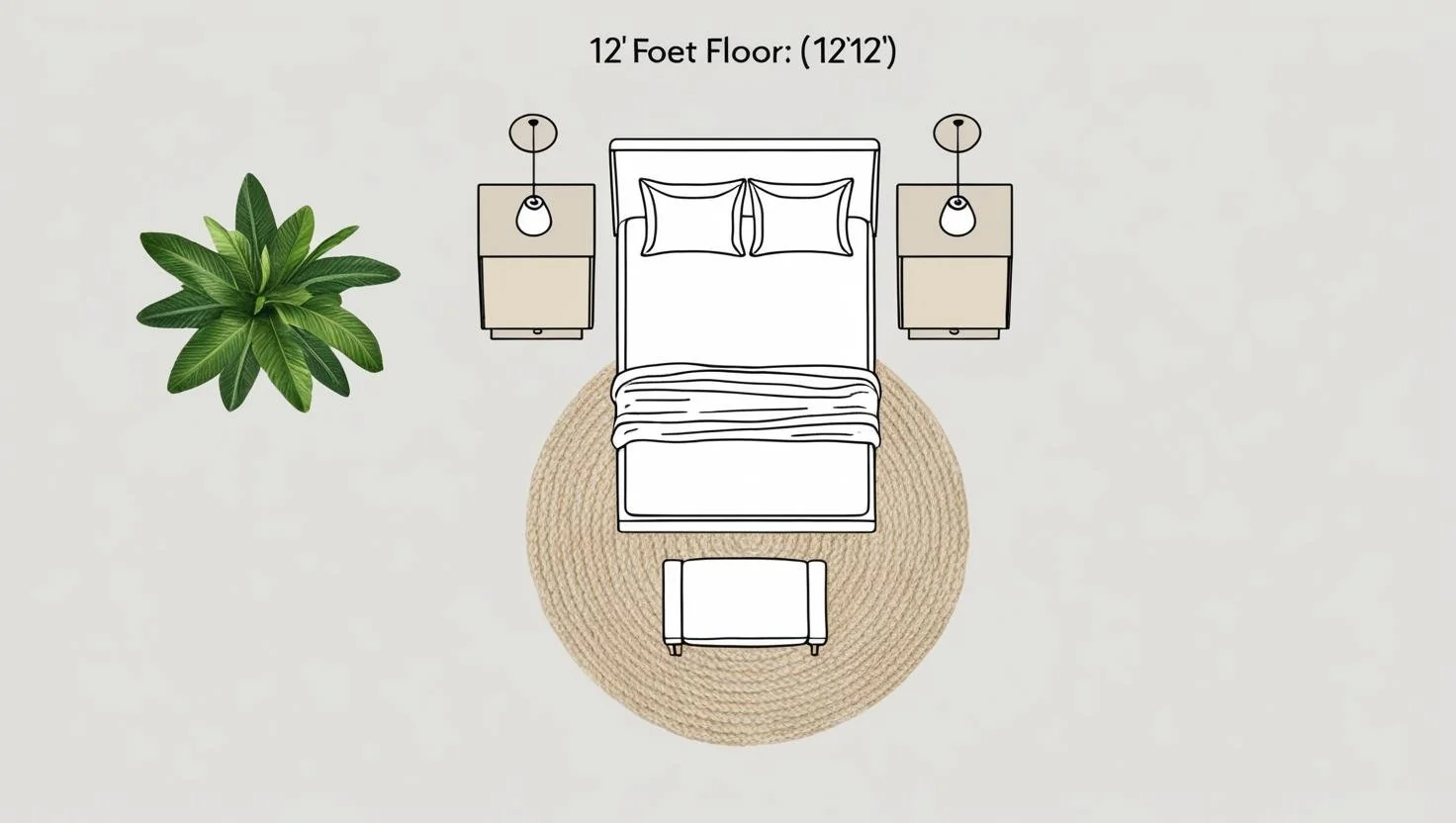
Bed Frame Dimensions Guide: Find the Perfect Fit for Your Room

Modern bedroom with a queen-size bed frame and optimal bed frame dimensions.

Standard Bed Frame Dimensions and Size Guidelines

Choosing the right bed frame dimensions is crucial for comfort, functionality, and enhancing your bedroom’s aesthetics. Whether you’re outfitting a cozy guest room or a spacious master suite, understanding bed frame sizes ensures a harmonious and restful environment.

Key Takeaways

  • Optimal comfort: Prevents cramped sleeping spaces and ensures restful nights.
  • Efficient use of space: Essential for maximizing room functionality, especially in smaller areas.
  • Enhanced room aesthetics: A well-proportioned bed frame complements your bedroom design.
  • Better planning: Choosing the right bed frame dimensions avoids costly mistakes in room setup.

Why Bed Frame Dimensions Matter

A bed frame does more than support your mattress; it defines the room’s layout and flow. Selecting the appropriate size ensures:

  • Comfortable movement: Avoids stubbed toes and cramped pathways.
  • Balanced design: Harmonizes with other furniture pieces and room proportions.
  • Functional space: Allows for additional furnishings like nightstands and dressers.

Nothing disrupts relaxation like navigating around an oversized bed. A correctly sized frame makes your room feel open and inviting, enhancing your overall comfort.

Visual reference of bed frame dimensions in modern bedroom

Understanding Bed Frame Dimensions

While mattress sizes are standardized, bed frame dimensions can vary based on design and style. Here’s a comprehensive guide:

Mattress Size Mattress Dimensions (inches) Typical Bed Frame Dimensions (inches)
Twin 38″ x 75″ 40″–43″ x 77″–80″
Twin XL 38″ x 80″ 40″–43″ x 82″–85″
Full 54″ x 75″ 56″–59″ x 77″–80″
Queen 60″ x 80″ 62″–65″ x 82″–85″
King 76″ x 80″ 78″–81″ x 82″–85″
California King 72″ x 84″ 74″–77″ x 86″–89″

Note: Bed frames often add 2–5 inches to mattress dimensions due to design elements like headboards or footboards.

Bed frame size comparison with mattress dimensions

Choosing the Right Bed Frame for Your Room

Room Size Recommendations

Room Size (sq. ft.) Recommended Bed Size
Up to 100 Twin or Twin XL
100–200 Full or Queen
200+ King or California King

Considerations:

  • Walking space: Aim for at least 2 feet of clearance around the bed.
  • Ceiling height: Important for canopy or four-poster beds.
  • Additional furniture: Account for nightstands, dressers, and seating.

Planning a bedroom makeover? Combining smart frame sizing with layout strategies can transform your space. Explore how ancient wisdom meets modern design in our post on Feng Shui principles for bedroom layout.

Types of Bed Frames and Their Impact on Dimensions

Platform Beds

Sleek and modern, platform beds sit low to the ground and often match mattress dimensions closely, making them ideal for smaller rooms.

Sleigh Beds

With their curved headboards and footboards, sleigh beds add elegance but require more space due to their design.

Canopy Beds

Featuring posts at each corner, canopy beds make a statement but need rooms with higher ceilings and ample space.

Storage Beds

Equipped with drawers or compartments, storage beds are functional but add bulk, requiring more room for accessibility.

Common Misconceptions About Bed Frame Sizes

Myth: All bed frames are the same size as their corresponding mattresses.

Reality: While mattress sizes are standardized, bed frame dimensions can vary based on design, material, and additional features. Always check the specific measurements before purchasing.

It’s easy to assume that buying a “queen frame” means it’ll fit your queen mattress perfectly. But differences in construction—like thick upholstery, built-in storage, or decorative headboards—can change the footprint significantly.

Full bed frame dimensions with storage drawers

Final Thoughts

Selecting the right bed frame dimensions is a blend of understanding your space, needs, and style preferences. By considering room size, frame type, and additional features, you can ensure a comfortable and aesthetically pleasing bedroom setup.

For more insights on optimizing your bedroom space, check out our Ultimate Guide to Bedroom Layouts and Top 10 Space-Saving Furniture Ideas.

FAQ

What is the standard height of a bed frame?
Most bed frames are between 8 to 18 inches tall. Combined with the height of your mattress, your total bed height can be between 16 to 30 inches tall. Ideally, your bed should be just tall enough so when you’re sitting at the edge of it, your feet are flat on the floor. This is for ease of use, particularly for individuals with limited mobility and the elderly. Source
Do bed frames come in standard sizes?
Yes, bed frames are typically designed to match standard mattress sizes: Twin, Twin XL, Full, Queen, King, and California King. However, the actual dimensions of bed frames can vary slightly based on design and style. Source
Can I use a queen mattress on a full-size bed frame?
No, a queen mattress (60″ x 80″) is larger than a full-size bed frame (typically 56″–59″ x 77″–80″). Using a mismatched frame can lead to inadequate support and potential damage to the mattress.
How much space should I leave around my bed?
It’s recommended to have at least 2 feet of clearance on all sides of the bed to allow for easy movement and access to other furniture.
Are there bed frames larger than a California King?
Yes, there are oversized bed frames like the Alaskan King (108″ x 108″), Wyoming King (84″ x 84″), and Texas King (80″ x 98″). These are less common and require spacious rooms. Source

Related Reading from Cozy Bed Quarters

Other Reading We Found Popular


Canopy Bed Frames: Styles, Sizes and How to Choose

Best Canopy Bed Frames for a King Size Mattress - Featured Image

Canopy bed frames are four-post beds with rails connecting the tops of the posts, so you can leave the frame bare for a graphic, architectural look or hang fabric for privacy and softness. The right one comes down to three things: enough ceiling clearance above the top rails, a frame that doesn’t wobble once curtains are added, and a material you’re happy to live with and dust. Measure your room and ceiling before you fall in love with a style.

Below you’ll find the styles worth knowing, what actually matters in the build, and how to dress a canopy without making the room feel closed in.

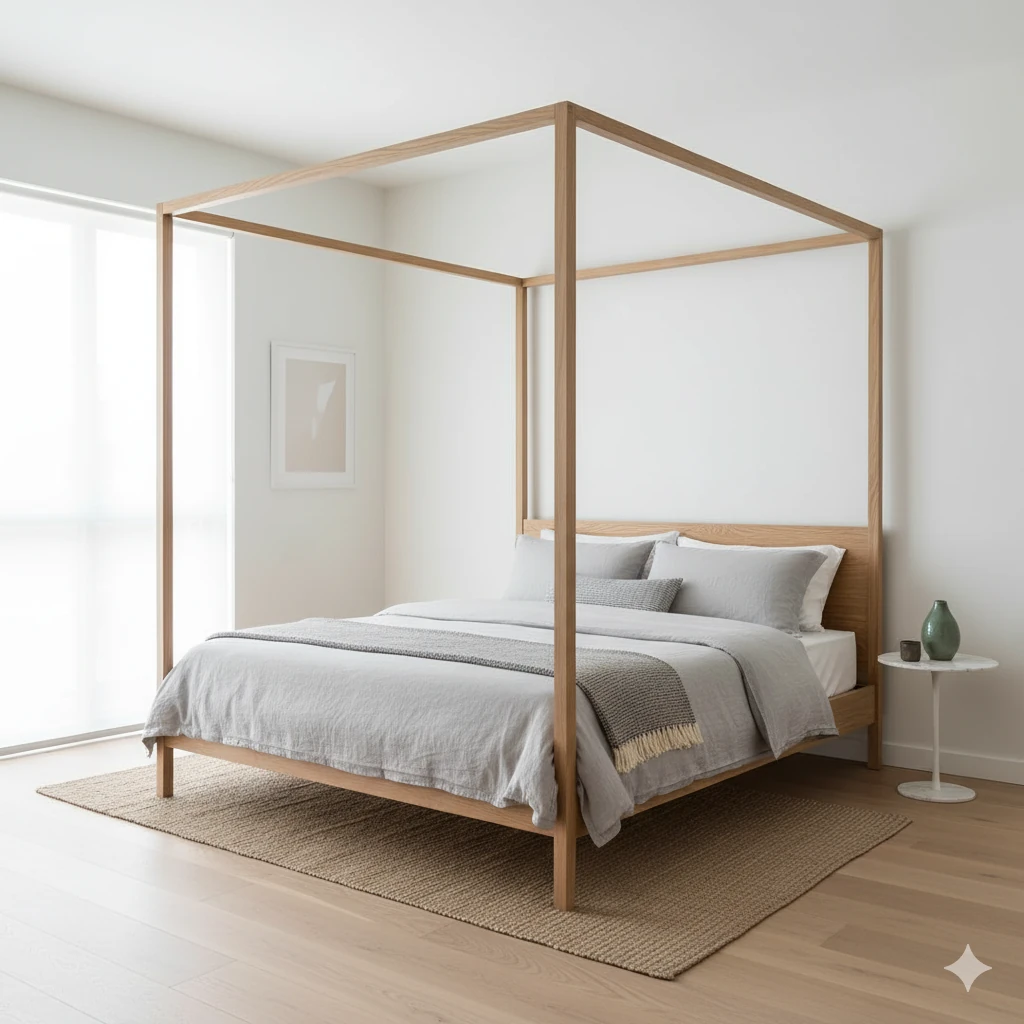
Light wood canopy bed frames with white bedding in a bright modern bedroom

What to Look For in Canopy Bed Frames

Start with height. A canopy frame is tall — often close to seven feet at the top rail — so find the manufacturer’s listed overall height and subtract it from your ceiling. If you’re left with only an inch or two, the bed will read as crammed against the ceiling, and you’ll have nowhere to hang drapery rings. A hand’s width of clearance is the bare minimum; six inches or more looks better.

Then think footprint. A canopy doesn’t take up much more floor space than a standard frame, but the posts sit at the outer corners, so add a few inches to the mattress dimensions and check your walkways. Our king size bed dimensions guide has the exact measurements, and the bedroom layout guide covers clearance around nightstands and doors.

What to check What good looks like Why it matters
Ceiling clearance At least 6 inches above the top rails Keeps the frame from visually crowding the room and leaves space for curtain hardware
Material Solid hardwood, powder-coated steel, or a sturdy upholstered box frame Drives weight capacity, maintenance and how the bed ages
Joinery and brackets Metal-to-metal connections, corner brackets, bolts rather than cam locks Canopies sway more than low frames, especially once fabric is hung
Slats and support Closely spaced slats plus a centre rail and legs on queen and larger Protects the mattress and stops sagging in the middle
Finish Water-based or low-emission finishes; certified composite panels Less off-gassing in a room you breathe in for eight hours a night
Assembly Labelled parts, pre-drilled holes, hex or Torx hardware Upper rails are awkward; clear instructions and a second pair of hands save an evening

Slim four-post canopy bed frame with neutral linens in a calm bedroom

Canopy Bed Styles, From Four-Poster to Minimalist

Classic four-poster

Four tall posts, four connecting rails, and a symmetry that anchors a room. Carved or turned wood suits traditional and farmhouse rooms; a squared-off profile in walnut or oak leans transitional. If you’re weighing the two silhouettes against each other, we break it down in canopy bed vs four-poster bed.

Traditional wooden four-poster canopy bed with tall turned posts and layered bedding

Half-tester and suspended canopies

Instead of four posts, a half-tester hangs a partial canopy over the head of the bed from the wall or ceiling. It’s an old idea — the Metropolitan Museum of Art describes an 18th-century French lit à la duchesse whose canopy is suspended from the ceiling rather than supported on posts. In a modern bedroom that translates to a ceiling-mounted rod and two fabric panels: drama at the headboard, no bulk at the foot of the bed. Good option for narrow rooms.

Crown and domed canopies

The curvy, theatrical cousin. The Getty’s collection includes a French lit à la polonaise from about 1775–1780, where curved iron arcs meet in a small crown above the bed. Today you can get the effect with a ceiling-mounted corona and two long panels, without committing to a gilded antique.

Modern minimalist

Slim metal or wood posts, matte black or bone-white, nothing carved, nothing draped. This is the most forgiving style in a small or low-ceilinged room because the frame draws your eye upward without adding visual weight.

Upholstered canopy

A padded headboard makes reading in bed genuinely comfortable, and fabric posts soften a room full of hard surfaces. The trade-off is cleaning — upholstery holds dust and is harder to spot-clean than a wiped-down wood post.

Industrial and mixed-material

Steel posts with wood rails, or a blackened metal frame with a reclaimed-look headboard. Works well in rooms with exposed brick, big windows or high ceilings, where a delicate frame would disappear.

Rustic, bohemian and convertible

Distressed finishes and rounded posts suit farmhouse rooms; lightweight frames are the natural home for gauzy panels, macramé and rattan. Some frames are convertible — the top rails unbolt so you can run the bed as a plain four-poster and add the canopy back later. If you like changing your mind, that’s worth looking for.

Dark walnut canopy bed frame styled with crisp white bedding

Wood, Metal or Upholstered?

Wood gives you warmth, weight and repairability — you can sand and refinish a solid frame years later. Metal is the low-fuss pick: slim posts, powder-coated finishes that resist scuffs, and usually the easiest to move. Upholstered frames are the most comfortable to lean against and the fussiest to keep clean. None of the three is objectively best; it’s a question of how the room is used and how much maintenance you’ll actually do. Our wood vs metal vs upholstered comparison goes deeper on durability and noise.

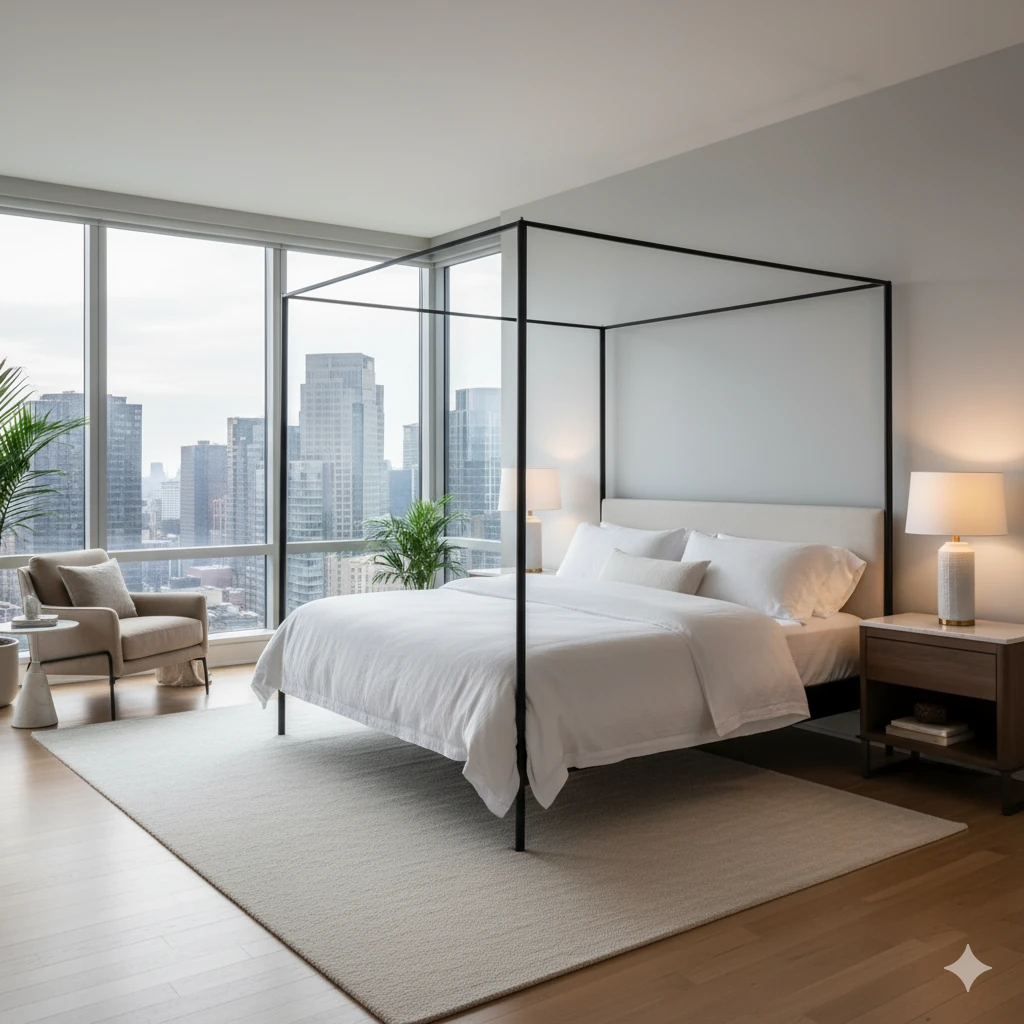
Minimalist black metal canopy bed frame with slim posts in a neutral bedroom

Matte black metal canopy bed frame seen from the foot of the bed

Stability: The Part People Skip

A canopy is a tall, rectangular structure with a lot of leverage at the top. Anything that adds load or movement up there — curtains, string lights, a cat with ambitions — shows up as sway. Look for bolted metal-to-metal joints at the post tops rather than pegs or plastic connectors, check that the frame ships with corner brackets, and re-tighten every bolt a few weeks after assembly once the wood has settled. If the room is carpeted, felt pads or thin coasters under the posts keep the frame from rocking in soft pile.

Under the mattress, spacing matters too: most foam and hybrid mattresses need closely spaced slats or a solid platform plus centre support, and manufacturers often set a maximum slat gap in the warranty. Check your mattress paperwork before you buy the frame, not after.

Certifications Worth Knowing

Marketing words like “non-toxic” and “eco” mean nothing on their own. Independent labels are more useful:

One honest caveat: certifications tell you about sourcing and emissions. They don’t promise a frame will last longer, and there’s no reliable public testing that ranks canopy frames by lifespan. Joinery quality and solid material tell you more about durability than any label does.

Canopy bed frame in certified wood with natural linen bedding and plants

Light wood canopy bed frame in a sunlit room with woven textures

Draping, Lighting and Styling

Fabric is what turns a frame into a room within a room, and it’s the cheapest way to change the whole mood later.

  1. Sheers filter daylight and keep the bed feeling open. Linen and cotton voile hang better than stiff synthetics.
  2. Heavier panels — velvet, lined cotton — block more light and make the bed feel enclosed. They also absorb a little sound, though don’t expect a noticeable difference in how quiet the room is.
  3. Clip rings on a slim rod let you take panels down for washing in a couple of minutes. Fabric tied permanently to the rails never gets cleaned.
  4. Lighting works best low and warm: a string of small LEDs along the top rail, or wall sconces either side. Anything heavy should hang from a ceiling joist, not from the frame.
  5. Bedding does the rest. Mix a crisp weave with something textured — a waffle throw, a knit blanket — so the bed reads layered rather than flat.

Canopy bed frame dressed with floor-length drapery and layered bedding

Sheer white curtains hanging from a canopy bed frame beside a sunny window

Canopy Beds in Small or Low-Ceilinged Rooms

A canopy can work in a small room, but the frame has to stay visually light. Choose slim posts in a colour close to your walls, skip the side panels and hang fabric only at the head of the bed, and keep the bedding palette tight so the eye isn’t stopped at every layer. Keeping the space under the bed clear helps too — if you need storage down there, a storage bed frame may serve you better than a canopy. And if the bed is the last big decision left, our king size canopy bed guide covers scale in bigger rooms.

Airy bedroom with a canopy bed frame, light drapery and layered neutral linens

Canopy bed frame decorated with warm string lights and sheer curtains at night

Keeping It Clean

Dust settles on top rails faster than anywhere else in the room, so run a microfibre cloth or an extendable duster along them when you change the sheets. Wash cotton and linen panels on a cool cycle and rehang them slightly damp to drop the creases; send velvet and silk to a dry cleaner. Wipe wood posts with a barely damp cloth and dry them straight away, and vacuum upholstered posts and headboards with a brush attachment.

FAQ

What ceiling height do I need for a canopy bed?

Eight feet is comfortable for most frames. Compare the frame’s listed overall height to your ceiling and aim for at least six inches of clearance — more if you want curtain hardware above the rails.

Are canopy beds hard to put together?

The base goes together like any bed frame; the upper rails are the awkward part because you’re lifting long pieces overhead and lining up bolt holes. Plan for two people and an hour or two.

Can I use any mattress with a canopy frame?

Yes, as long as the sizes match and the slat spacing suits your mattress type. Foam and hybrid mattresses generally want closely spaced slats or a solid platform with centre support.

Do canopy beds make a room feel smaller?

An undraped frame usually makes a room feel taller, not smaller, because it leads your eye upward. Heavy, dark, floor-length curtains on all four sides are what shrink a space.

Can I fake a canopy without buying a new bed?

You can. Ceiling-mounted tracks or a corona above the headboard give you the draped effect over the bed you already own. Fix the hardware into joists, not just drywall.

Are canopy beds still in style?

They keep reappearing in current interiors, usually in slimmer, less ornate forms than the antique versions. Style trends move, though, and nobody can promise where they’ll be in five years — the practical case for a canopy is privacy, focal point and the ability to restyle with fabric.

Updated September 2026.