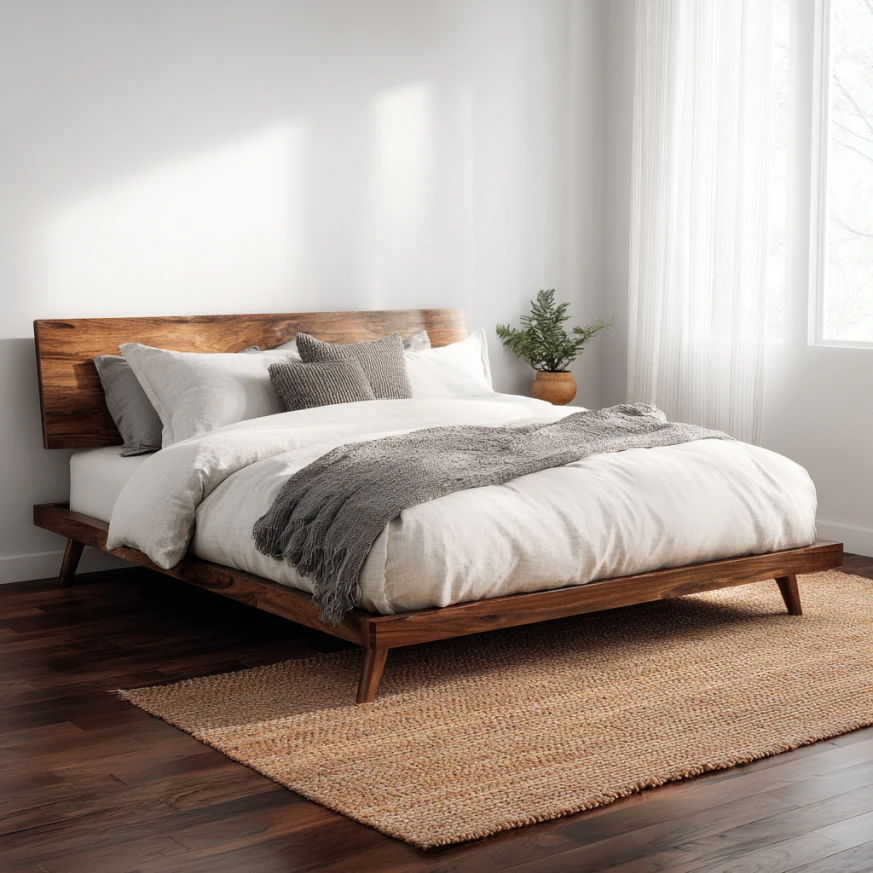
Toddler Bed Mattress and Crib-to-Bed Transition Guide

Best Toddler Bed Mattress

Most toddler beds use a standard crib mattress: the federal toddler-bed rule defines a toddler bed as one sized for a full-size crib mattress measuring at least 51 5/8″ long by 27 1/4″ wide (usually sold rounded to 52″ x 28″), with mattress thickness capped at 6 inches. Pick a firm, flat mattress that fits the frame with no gaps, keep the sleep surface low, and add a guardrail if your child can roll out. Time the switch by your child’s size and climbing ability rather than a birthday — safety groups point to the crib rail sitting below the chest, or a height of about 35 inches, as the cue.

Quick answers before you shop

  • Size: Crib/toddler mattresses share one regulated size, so a crib mattress normally moves straight into a toddler frame.
  • Fit: No gaps between mattress, frame and guardrail. Measure the frame’s inside dimensions before ordering.
  • Feel: Firm and flat, not plush. Firmness for young children is a safety feature, not a comfort preference.
  • Timing: Move out of the crib when climbing starts or the rail is below chest height; there is no “correct” age.
  • Room: Once your child can get out of bed alone, the whole room needs to be as safe as the crib was.
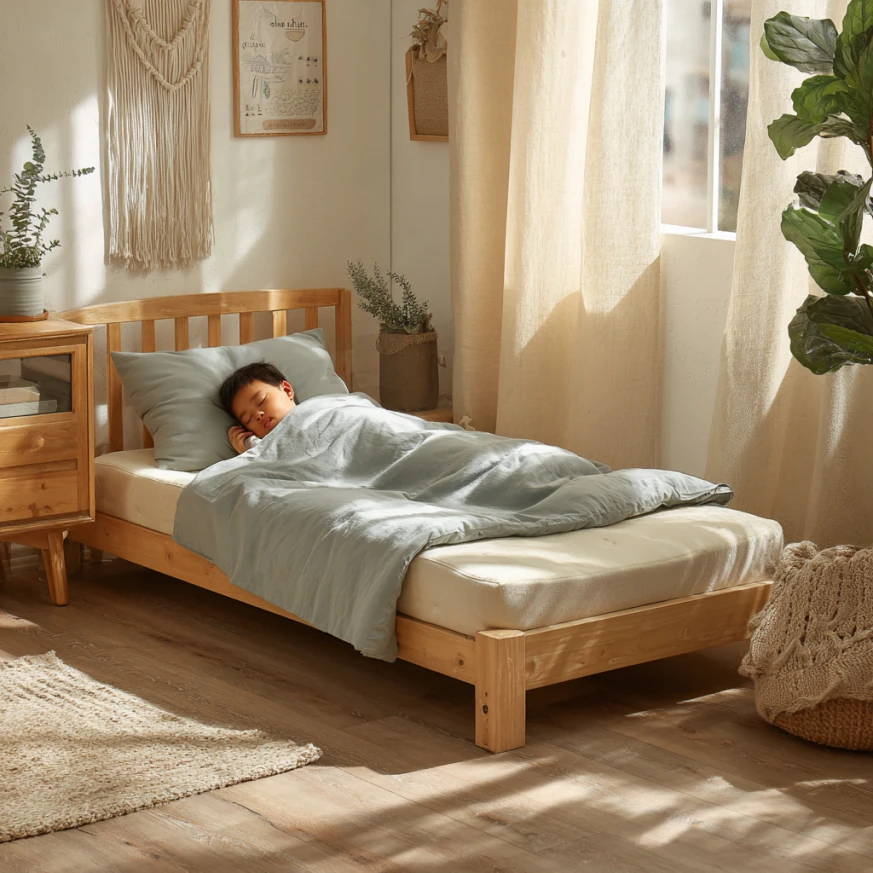
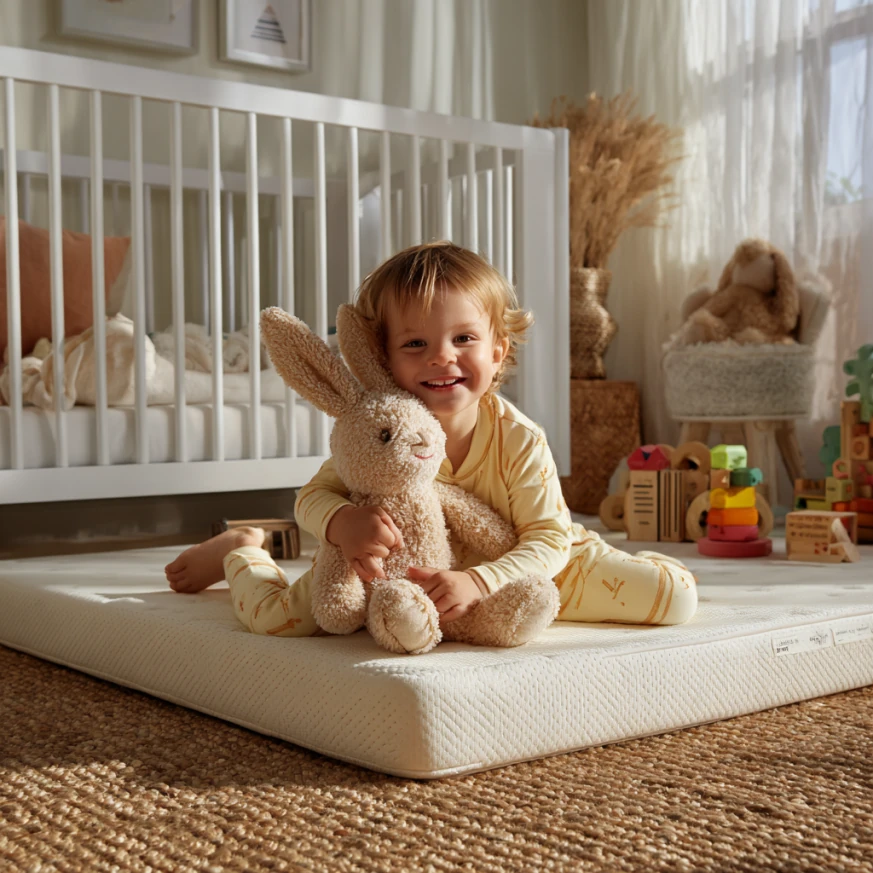
A smiling child stretches on a firm and breathable toddler bed mattress that demonstrates a snug, safe fit—clearly showing the exact focus keyword toddler bed mattress.

When to move from the crib to a bed

Readiness is physical first. Nationwide Children’s Hospital summarises the American Academy of Pediatrics’ position that a child should move out of the crib once the crib railing sits lower than their chest, because that is the point at which climbing — and falling — becomes easy. The Consumer Product Safety Commission’s crib standard also requires assembly instructions to warn parents to move a child taller than 35 inches into a youth or regular bed.

Other signs hospitals list include a child pulling up and over the rail, or hooking a leg over the top rail even before a full escape. Interest in a “big kid” bed and the ability to follow simple two-step instructions make the change easier socially, but they are not safety triggers on their own.

If the first attempt goes badly — hours of roaming, early wakings, a distressed child — it is fine to pause, return to the crib for a few weeks (as long as the crib is still safe for their height) and try again. One change at a time also helps: if a sibling is arriving or daycare is starting, give the bed switch its own quiet fortnight.

The Toddler Bed Transition Handbook overview image

Mattress size and fit: the part that matters most

CPSC regulates crib mattresses under 16 CFR part 1241, which incorporates the ASTM F2933 standard. The agency’s own crib mattress FAQ explains that the rule covers mattress dimensions, thickness, exposed coils, labelling, and specifically the hazards of entrapment from a poor mattress fit and suffocation on an overly soft mattress. Those are the two risks your purchase decision should address.

The matching toddler-bed rule (16 CFR part 1217) incorporates ASTM F1821 and defines a toddler bed around that same full-size crib mattress footprint — CPSC lists the standard on its toddler beds page, and the mandatory version was updated to the 2026 revision of ASTM F1821 this year. In practice that means a compliant toddler frame and a compliant crib mattress should fit each other.

Practical checks:

  • Measure the frame inside the rails before buying; frames sold abroad or second-hand may not match US sizing.
  • Press the mattress into each corner. Hospitals advise fitting guardrails tight against the mattress and frame so there are no gaps at all. The familiar “no more than two fingers” test is a useful rule of thumb, not a regulated measurement — if you can see or feel a gap, the fit is wrong.
  • Check thickness against the 6-inch limit for crib mattresses, and keep the guardrail height well above the sleep surface.
  • Reusing the crib mattress? Look for sagging, body impressions, torn seams or broken coils. Those are replacement signals rather than break-in quirks — our guide on how often to replace a mattress covers what wear actually looks like.

Firmness and support

For this age group, firm wins. AAP’s safe-sleep guidance for the first year calls for a firm, flat, non-inclined surface with no soft bedding, and the crib mattress standard exists partly because overly soft mattresses have been linked to suffocation deaths. Toddlers are past the highest-risk window, but a firm surface still gives better support and a more stable platform for climbing in and out.

Because brand firmness labels are not standardised, test by hand: press the centre and the perimeter and look for quick rebound and little sink. If you want context for how manufacturers use those labels, see our mattress firmness scale explained.
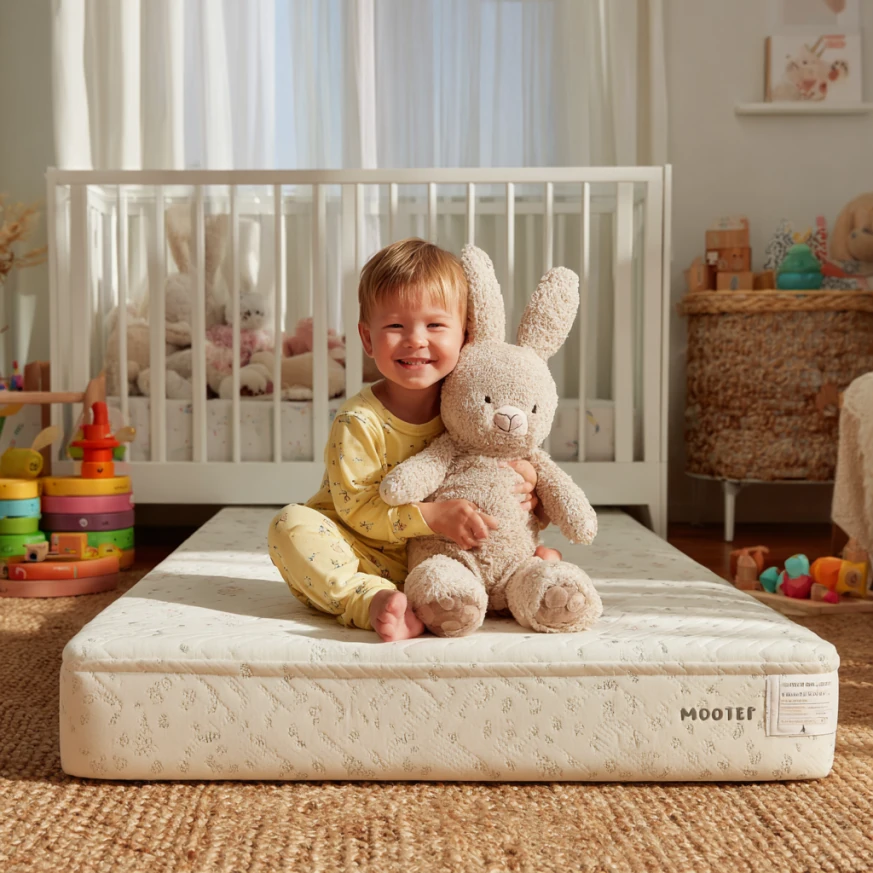
This image shows a non-toxic, firm, and breathable toddler bed mattress in a bright nursery—clearly illustrating the exact focus keyword toddler bed mattress.

Mattress types compared

Type Strengths Watch for
Innerspring Firm feel, open interior for airflow, widely available Thin comfort layers that compress; weak edges; exposed coil damage over time
Foam Light, easy to lift for sheet changes and clean-ups Can sleep warm; low-density foam softens quickly, which works against a firm surface
Hybrid Coil support with a cushioned top layer Heavier; extra layers can push total thickness past the 6-inch crib limit
Latex Resilient, resists body impressions, naturally breathable Higher price; check whether it is natural or blended
Dual-sided (infant/toddler) One firmer infant side, one slightly softer toddler side Make sure the correct side faces up after every deep clean

Breathability is a genuine comfort factor if your child runs warm: ventilated cores, open-cell foams and latex move air better than dense foam blocks, and a removable washable cover helps. Treat “cooling” marketing claims cautiously — independent evidence for toddler-specific cooling performance is thin.

Materials, certifications and new-mattress smell

Labels such as CertiPUR-US, GREENGUARD Gold and OEKO-TEX are voluntary third-party programmes, not government safety requirements. They can be a reasonable tiebreaker between two otherwise similar mattresses, but they do not replace the basics of fit, firmness and compliance with the federal crib mattress rule. Be sceptical of vague words like “non-toxic” or “natural” with no certificate behind them.

If a new mattress arrives with an odour, unwrap it in a well-ventilated room and let it air before the first night. Our guide on reducing mattress off-gassing walks through simple steps that work without special products.

Toddler frame, floor bed, or straight to a twin?

All three can work. A toddler frame keeps the sleep surface low and reuses the crib mattress. A floor mattress is the lowest option of all, provided the room is fully childproofed. Going straight to a twin or full saves buying twice — check our standard bed size chart and full size bed dimensions guide for room fit before committing.

A few safety points that apply whichever route you take:

  • Guardrails: fit them tight to the mattress and frame with no gaps. CPSC’s mandatory standard for portable bed rails covers rails intended for children typically aged 2 to 5 on an adult bed, and requires that they not create a dangerous gap with the mattress. CPSC has issued warnings as recently as 2026 about non-compliant rails sold online, so buy from sellers you can verify and check recall notices.
  • Bunk beds: children’s hospitals advise against upper bunks or other raised beds for children under about age 6.
  • Placement: not under a window, and away from cords and climbable furniture.
  • Travel: a folding cot gives a familiar surface away from home; see our notes on folding cots with mattresses.

Make the room as safe as the crib was

Freedom to climb out changes the safety question from “the bed” to “the room”. Anchor dressers and bookcases to the wall: under the STURDY Act, CPSC adopted ASTM F2057-23 as a mandatory stability standard for clothing storage units in 2023, and its Anchor It campaign explains how to secure furniture properly. Then cover outlets, shorten or secure blind cords, add window stops, and clear the floor path between the bed and the door. A soft rug beside the bed is a sensible cushion for early tumbles, and a baby gate at the doorway keeps night-time wandering contained rather than roaming the house.
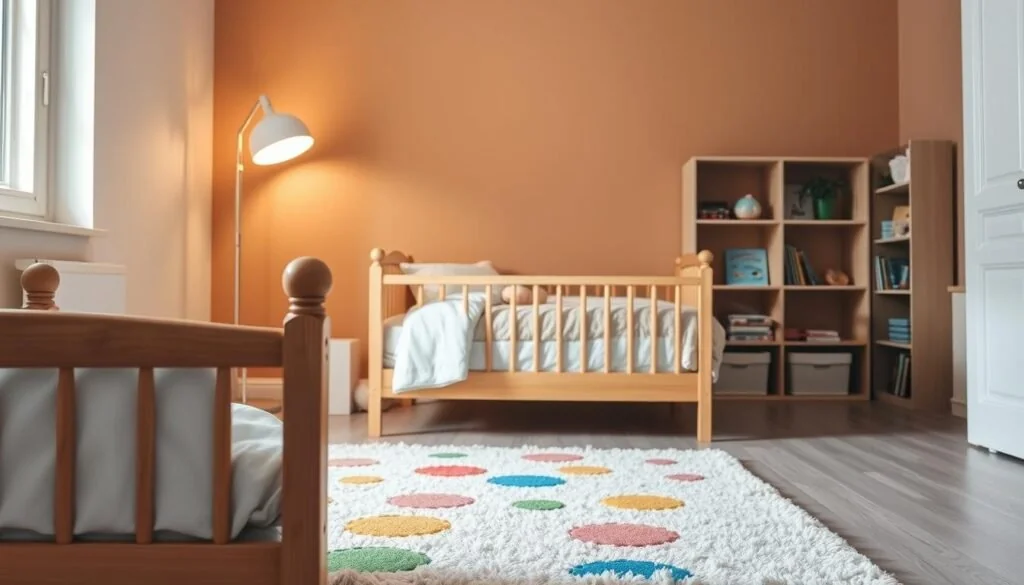
Room setup from The Toddler Bed Transition Handbook

Bedding: keep it minimal

AAP’s infant guidance is to keep the sleep space bare — no pillows, loose blankets, bumpers, soft toys or weighted blankets in the first year. Past the first birthday the picture relaxes, but children’s hospitals still advise no pillow before age 2, then a small, firm one. A fitted sheet that grips the corners, one lightweight blanket or a wearable sleep sack, and a single comfort object are enough. For weighted blankets at any toddler age, authoritative guidance is limited; ask your pediatrician rather than following marketing claims.

A waterproof, zippered mattress protector is the one accessory worth buying without hesitation. It handles potty-training accidents and illness, keeps the mattress itself out of the wash, and launders quickly.

A minimalist bedroom displays a breathable foam toddler bed mattress with a waterproof protector—clearly using the exact focus keyword toddler bed mattress.

A calm two-week plan

  1. Days 1–3: Talk about the new bed in positive, matter-of-fact terms. Childproof and anchor everything while your child is out of the room.
  2. Days 4–6: Offer two small choices — sheet pattern, which book comes first, where the lovey sits. Ownership lowers resistance.
  3. Days 7–9: Assemble the bed, check mattress fit and guardrail gaps, and rehearse “lie down, cozy up, rest” in daylight.
  4. Days 10–14: First nights. Same routine, same words, same order. If your child gets up, walk them back with minimal conversation, no snacks and no screens.

Expect some testing. A morning-light clock gives non-readers a clear signal for when getting up is allowed, and a simple sticker chart can reinforce staying in bed. Keep total sleep in view too: the American Academy of Sleep Medicine recommends 11–14 hours per 24 hours for children aged 1–2 and 10–13 hours for ages 3–5, including naps. If bedtime resistance is really an over- or under-tired nap schedule, fix the schedule first.

Everyday care

Vacuum the surface during sheet changes, deal with spills immediately rather than letting them soak in, and wash the protector per its label. Rotate the mattress head-to-foot every few months to spread wear, and air it out with the bedding stripped when you get the chance. Replace it when you find sagging, permanent impressions, broken coils or damaged seams.
A protector-clad toddler bed mattress airs out near a window, emphasizing freshness and safety—again using the exact focus keyword toddler bed mattress.

FAQ

What size mattress fits a toddler bed?

A full-size crib mattress. The federal toddler-bed standard is built around a minimum of 51 5/8″ x 27 1/4″, commonly sold as 52″ x 28″, with thickness no more than 6 inches. Always measure your specific frame.

Can I reuse our crib mattress?

Usually yes, and it is the simplest option — as long as it is still firm and flat, with no sagging, impressions, tears or exposed coils.

How firm should it be?

Firm enough that your child does not sink in, with quick rebound when you press the centre and edges. Plush “adult” comfort is the wrong target here.

Is foam safe for toddlers?

Foam mattresses that meet the federal crib mattress rule are widely used. Choose a dense, firm build that keeps its shape, air it out before first use, and pair it with a washable protector.

Do we need a guardrail?

If your child rolls or the surface is higher than a low toddler frame, yes. Fit it so there is no gap between the rail and the mattress, and check that any portable rail meets the current CPSC standard.

What if my toddler keeps getting out of bed?

Respond the same brief way every time: guide them back, repeat one short phrase, no negotiation. Consistency usually does more than any gadget, and a return to the crib for a short reset is a legitimate option if nights become unsafe.

Updated September 2026.

Trundle Bed Mattress Guide: Sizes, Thickness and What Actually Fits

Trundle Bed Mattress

A trundle bed mattress is just a twin (or twin XL) mattress thin enough to slide under the main bed, which in practice means 6 to 8 inches thick and often less. Measure the clearance from your trundle platform up to the underside of the main bed frame before you shop, then subtract an inch for wiggle room. A 6-inch foam or thin hybrid hits the sweet spot: comfortable enough for real sleep, light enough that a kid can roll the drawer out alone.

Measure first: the numbers that decide everything

Most trundle bed mattress regrets start the same way. The mattress is too tall, the drawer won’t close, and now you own a twin mattress with nowhere to live. Grab a tape measure and write down four numbers.

  • Interior clearance: from the trundle’s sleeping deck to the underside of the main bed’s slats or rails. This is your hard ceiling.
  • Deck length and width: most trundles are built for a standard twin at 38 by 75 inches. Some newer frames take twin XL at 38 by 80 inches.
  • Floor clearance: from the bottom of the main bed frame to the floor, including the rug. A 3/4-inch plush rug can stop a trundle cold.
  • Pull-out space: you need roughly 7 feet of open floor beside the bed once the trundle is out and made up.

Rule of thumb: buy a mattress at least 1 inch shorter than your interior clearance. Foam mattresses puff slightly at the seams, sheets add bulk, and a mattress protector adds another quarter inch. If clearance measures 8 inches, shop 6 or 7.

Standard twin vs. twin XL vs. full

Size Dimensions Where it shows up
Twin 38 x 75 in The default for daybeds and captain’s beds with trundles
Twin XL 38 x 80 in Taller teens and adults; check the deck length before buying
Full 54 x 75 in Full-over-full bunks and some daybed trundles

Sizes vary by a half inch or so between makers, so trust your tape measure over the spec sheet.

Low-profile trundle bed mattress sliding under a daybed frame in a small room

Pop-up trundles change the math

Two very different frames get called trundles, and they need different mattresses.

Roll-out (drawer) trundles stay on the floor. The mattress sits low, maybe 10 to 14 inches off the ground once it’s out. Thickness is limited only by the closed compartment.

Pop-up trundles lift on a scissor mechanism so the second mattress rises level with the main bed, turning two twins into a king-ish sleeping surface. Here, thickness has to match: if your main mattress is 10 inches and your trundle mattress is 6, you get a 4-inch step between the two. Check the manufacturer’s stated lift height, then pick a trundle mattress that closes the gap to within an inch or two. Some pop-up frames top out at a 6-inch mattress because of the folded mechanism height.

Pop-up frames also have weight limits that cover both the mattress and the sleeper. A dense hybrid can eat 40 to 50 pounds of that budget before anyone lies down, so read the limit rather than guessing.

Which trundle bed mattress type actually works

Memory foam and poly foam

The most common choice, and usually the right one. Foam comes in 5, 6, and 8-inch profiles, weighs roughly 25 to 35 pounds in a twin, and ships compressed so you can wrestle it down a hallway. Downsides: cheap foam sleeps warm, and low-density base foam softens into a dip within a couple of years under a nightly adult sleeper. For occasional guests, that hardly matters.

Thin hybrids

An 8-inch hybrid packs a short coil unit under an inch or two of foam. You get more airflow, more edge support, and an easier time getting off the bed, which older guests notice. The trade-offs are weight and thickness. Many trundles simply can’t close over 8 inches, and a hybrid twin can be a lot for a 9-year-old to haul out.

Innerspring

Budget 6-inch innersprings are light and bouncy, and they’re everywhere in the bunk and trundle aisle. They’re fine for kids and sleepovers. They also tend to feel thin at the edges and get noisy as they age.

Latex

Durable, naturally springy, and it resists sagging better than cheap foam. It’s also the heaviest option per inch and the priciest, which is a hard sell for a bed used ten nights a year. If someone sleeps on the trundle most nights, it earns its keep. Want the fuller comparison? See our rundown of the main mattress types.

Type Typical thickness Twin weight Best for
Foam 5-8 in 25-35 lb Kids, sleepovers, tight clearance
Hybrid 8 in 40-55 lb Adult guests, regular use
Innerspring 6 in 25-40 lb Lowest budget, light sleepers
Latex 6-8 in 45-60 lb Nightly sleepers, allergy-prone homes

Firmness, and whether adults can actually sleep on it

Medium-firm handles the widest mix of bodies, and it’s the safer pick for a bed that different people use. Thin mattresses give you less room for error: on a 6-inch mattress, a side sleeper’s hip can press close to the deck, so a slightly firmer feel with a supportive base layer beats a plush one that bottoms out.

Adults sleep fine on a trundle bed mattress if you get two things right. Pick 8 inches when clearance allows, and put something solid under it. A 1-inch topper can help, but count it against your clearance before you buy. If your guest has neck or shoulder trouble, the pillow usually matters more than the extra inch of mattress.

What’s under the mattress

Most trundles use a solid plywood or metal deck, some use slats. Foam needs slat gaps under about 3 inches or it sags between them. Solid decks are stable but trap moisture, since there’s no airflow from below and the whole thing lives in a closed box. That’s worth caring about: the EPA recommends keeping indoor relative humidity between 30 and 50 percent to limit dust mites and mold, and a sealed trundle compartment in a damp room runs higher than the rest of the house.

Bedding that doesn’t slide off a 6-inch mattress

Standard twin fitted sheets are cut for 12 to 14-inch pockets. On a 6-inch mattress you end up with a bunched mess under the sleeper. Fixes, in order of how well they work:

  1. Buy sheets labeled low-profile, slim, or for bunk and trundle beds.
  2. Use sheet suspenders or elastic straps under the corners.
  3. Zippered bedding that attaches to the mattress, which also makes the bed easier for kids to remake.

Skip thick mattress pads. A thin, quilted, washable protector keeps spills out without stealing clearance, and it’s the single best thing you can do for a mattress that sits unused for months.

Trundle bed made up with low-profile fitted sheets and a thin mattress protector

Buying checklist

  • Clearance minus 1 inch. Non-negotiable.
  • Weight. If a child pulls the trundle bed mattress out, stay under about 35 pounds.
  • Certifications. Mattresses sold in the US must meet the federal open-flame standard; the Consumer Product Safety Commission requires a general certificate of conformity for general-use mattresses. Foam certifications like CertiPUR-US cover content and emissions, which matters in a small closed room.
  • Expansion time. Boxed mattresses need 24 to 72 hours to reach full height. Unbox on the floor, not in the trundle, and air it out before the compartment closes.
  • Return window. Check that it covers a mattress you’ve opened, since you may not sleep on it for weeks.

Keeping it usable between guests

  • Air the trundle bed mattress out. Roll the drawer open and leave it for a few hours every month or two. Closed storage plus body moisture from the last visitor is how mattresses get musty.
  • Rotate head to foot every three to six months if it’s in nightly use.
  • Vacuum the surface with an upholstery tool, and spot clean with a barely damp cloth. Soaked foam takes days to dry.
  • Store spare bedding somewhere else. Cramming a comforter in beside the mattress compresses the foam and blocks the drawer.
  • Check the casters. A wheel that won’t roll is usually a carpet fiber jam, not a broken wheel.

Frequently asked questions

What size mattress fits a trundle bed?

Almost always a standard twin, 38 by 75 inches, in a 6 to 8-inch profile. Twin XL and full trundle bed mattress sizes exist too, so measure the deck rather than assuming.

Can I use a regular twin mattress in a trundle?

Only if it’s thin enough. A typical 10 to 12-inch twin won’t let the drawer close. The length and width are the same; height is the problem.

Does a trundle need a box spring?

No. The trundle deck is the support. Adding a foundation eats the clearance you need.

How long does a trundle mattress last?

Longer than a main bed, purely because it gets used less. A guest-only foam mattress can stay comfortable for years; nightly use on a cheap 6-inch foam shows body impressions much sooner. Replace it when you can feel the deck through the middle.

Is a trundle safe for a young child?

The trundle itself sits low to the floor, which makes it one of the gentler options for a kid moving out of a crib. Our toddler mattress and crib-to-bed guide covers fit gaps and firmness for little sleepers. Keep the drawer fully closed or fully open, never halfway, so no one trips.

Still deciding on the frame?

If you haven’t bought the bed yet, the frame drives the mattress choice, not the other way around. Compare styles in our trundle bed overview, see how a sofa can double as one in our sofa to trundle bed ideas, or read about hosting occasional visitors in trundle beds for occasional guests.

Pull-out trundle bed mattress made up for a guest in a cozy bedroom

Updated September 2026.

Queen Mattress Bed Frame: Top Styles & Buying Guide (2025)

queen mattress bed frame

Choosing a Queen Mattress and Bed Frame Together

Looking for the perfect queen mattress bed frame? This warm, practical guide walks you through sizes, materials, features, style choices, and setup so you can confidently pick a frame that fits your room, sleep needs, and budget.

Key Takeaways: Queen Mattress Bed Frame

  • Measure first: A queen mattress is typically 60″ x 80″; most frames add 2–5 inches to width and length.
  • Match support to mattress: Slats suit most foam and hybrid beds; use a foundation only if your warranty requires it.
  • Pick materials with intent: Wood brings warmth, metal maximizes durability, and upholstered frames add softness and sound-dampening.
  • Plan features: A queen mattress bed frame with drawers or lift-up storage is ideal for smaller rooms.
  • Style smart: Choose finishes and heights that complement your décor and make daily life easier.

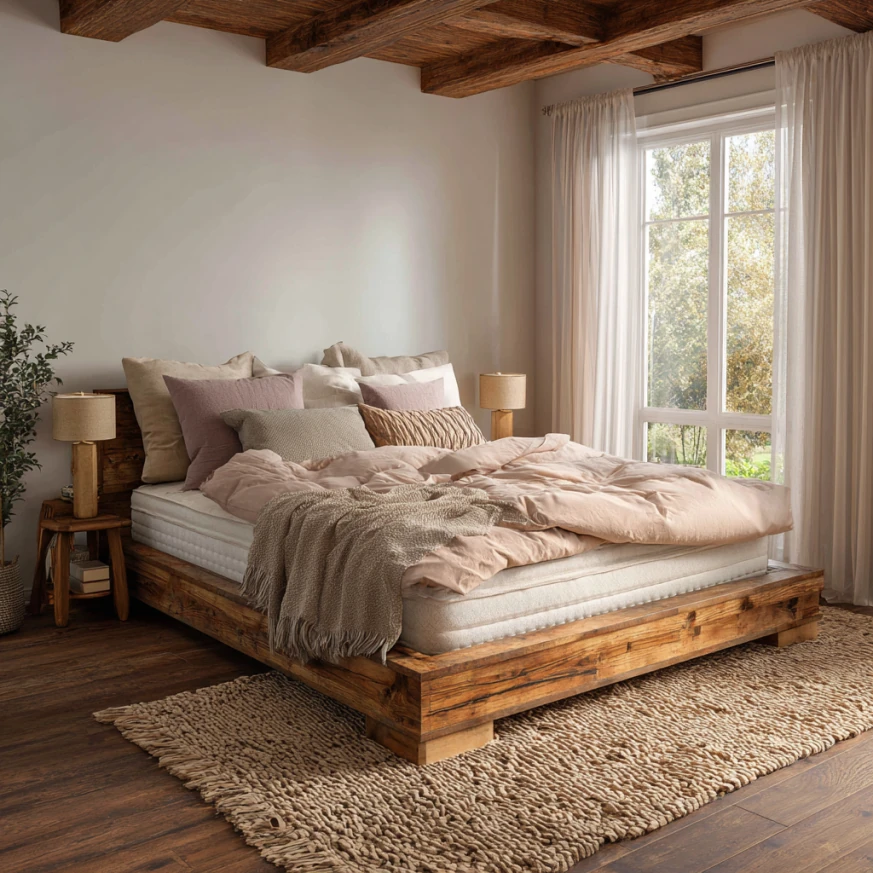
This bright, modern bedroom shows a queen mattress bed frame styled with neutral bedding and proves how a queen mattress bed frame fits comfortably in most rooms.

Why Choose a Queen Size?

Answer first: A queen gives couples comfortable sleeping space while still fitting most primary and guest bedrooms. The footprint balances comfort, cost, and room flow better than many larger options.

For most homes, a queen strikes the sweet spot between the snug footprint of a full and the sprawl of a king. You gain enough width for two sleepers without overwhelming mid-sized rooms. To confirm exact mattress dimensions, see the Sleep Foundation’s guide (Queen Size Bed Dimensions). If you’re optimizing for tight hallways, studios, or small guest rooms, compare full vs. queen sizing here (Full vs. Queen Comparison).

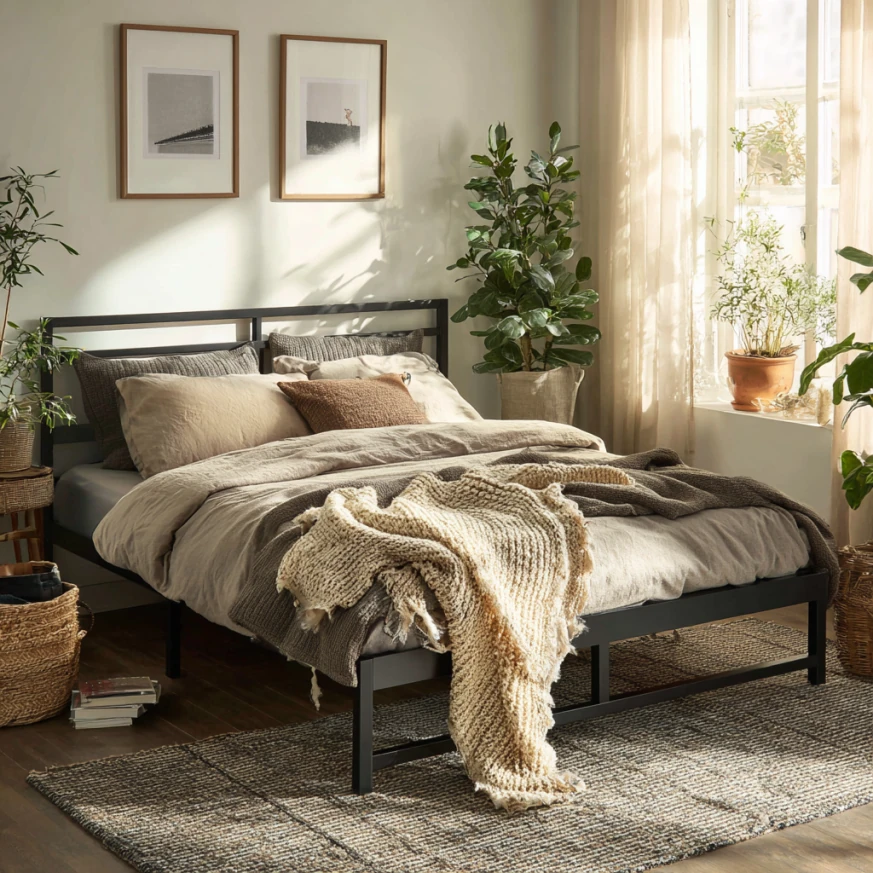
This minimal bedroom shows a queen mattress bed frame with a supportive foam mattress, demonstrating how a queen mattress bed frame offers spacious comfort without crowding the room.

Measure & Space Plan (So It Actually Fits)

Answer first: Measure the room, doorways, and path to the bedroom; then add 2–5 inches beyond 60″ x 80″ to account for the frame itself.

Start with your room: leave at least 24–30 inches of walkway space on each accessible side. Frames typically add bulk beyond the mattress perimeter—platform rails, headboards, and footboards can extend total length and width to about 62–65″ x 82–85″ for many queens (What Size Is a Queen Bed Frame?). If you’re working with alcoves or low ceilings, consider low-profile designs for a lighter visual footprint.

Need a fit-focused breakdown? Try our internal Queen Bed Frame Fit Guide and Queen Bed Frame Length Explained for measurements, clearances, and layout tips.

This image shows a bedroom floor plan and a queen mattress bed frame placed with ample walkways, illustrating how a queen mattress bed frame should be measured for an accurate fit.

Choose the Right Support for Your Mattress

Answer first: Most foam and hybrid mattresses work best on slats or a solid platform; some spring models may need a box spring or foundation—always check your warranty.

Slatted designs allow airflow and stable support for many foam and hybrid beds. Solid platforms deliver a firmer feel and sleek look. Box springs are less common with modern foam—but some brands require a specific foundation to protect your warranty; see Sleep Foundation’s explainer (Do You Need a Box Spring?).

Need help pairing? Our guide on How to Choose a Sturdy Bed Frame outlines weight limits, center supports, and slat spacing so your queen mattress bed frame feels rock solid.

This close-up shows strong wooden slats inside a queen mattress bed frame, clearly demonstrating how a queen mattress bed frame supports foam and hybrid mattresses.

Materials & Build: Wood, Metal, or Upholstered?

Answer first: Wood brings warmth and longevity, metal maximizes durability and value, and upholstered frames offer softness, sound dampening, and a cozy, designer look.

Wood: Timeless, repairable, and often quieter with the right joinery. Consider hardwoods for strength and a classic finish. Start with our Bed Frame Materials Guide or weigh options in Metal vs. Wood Bed Frame.

Metal: Great value and slim profiles. Look for center legs and cross-bracing to curb flex and squeaks. If creaks are a concern, see Noise-Free Bed Frames and Stop a Metal Bed Frame from Squeaking.

Upholstered: Soft edges, added comfort, and a polished hotel feel. Fabric choices can complement eco-conscious sheets, sustainable bedding, and other organic bedding if you’re styling for a greener bedroom.

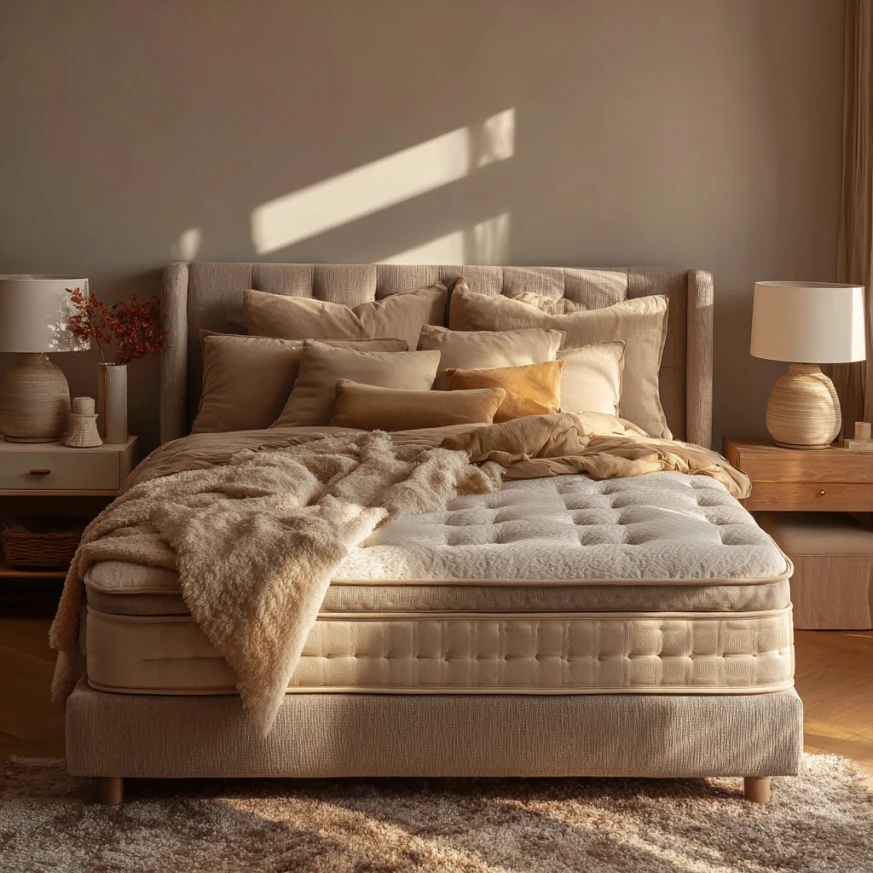
This styled shot shows a wooden queen mattress bed frame beside an upholstered option, helping you compare how a queen mattress bed frame looks in different materials.

Frame Types & Features (Pick What You’ll Actually Use)

Answer first: Platform frames are low-maintenance; storage frames organize tight rooms; adjustable bases elevate comfort for reading and recovery.

Platform: Simple, sturdy, and box-spring-free. Learn more in Platform Beds: Benefits & Styles.

Storage: Drawers or lift-up platforms add cubic feet of space—lifesaver for apartments and shared closets.

Adjustable: Split-adjustable setups pair well with a queen mattress bed frame that houses or conceals the base. See our Adjustable Bed Frames primer.

This storage design shows drawers under a queen mattress bed frame, illustrating how a queen mattress bed frame can add organization without taking more floor space.

Style & Decor: Make It Yours

Answer first: Choose a frame height and finish that fits your palette and makes daily life easier—sitting, reading, and changing sheets should all feel effortless.

Match frame finishes to your room tones for harmony, or contrast for drama. Upholstered frames soften acoustics and add texture; wood frames can tie together nightstands and dressers. For palette ideas that complement a queen mattress bed frame, browse Better Homes & Gardens’ bedroom color schemes (30 Brilliant Bedroom Color Schemes) or soothing picks (Soothing Bedroom Paint Colors). For frame inspiration, Parachute Home’s guide has timeless options (Bed Frame Ideas).

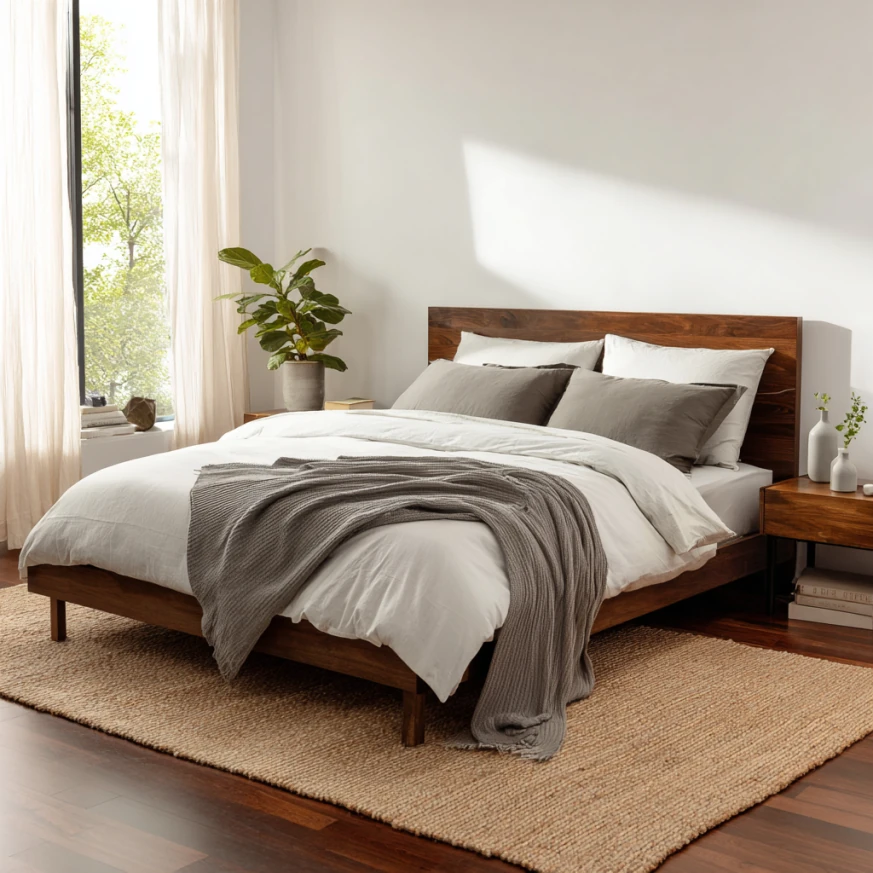
This serene palette shows neutral tones styled around a queen mattress bed frame, demonstrating how a queen mattress bed frame can anchor your color scheme.

Budgeting & Quality Checks

Answer first: Decide your must-have features first, then choose the highest-quality build you can afford—center support, sturdy slats, and reliable joinery are worth it.

Prioritize structural details: solid wood rails or heavy-gauge metal, center support legs, slat spacing (often 2–3 inches for many foam warranties), and durable upholstery. If you’re choosing between materials, our comparison Comparing Bed Frames by Material highlights value, longevity, and maintenance needs for your queen mattress bed frame.

This detail shot shows strong center supports inside a queen mattress bed frame, underscoring why a queen mattress bed frame should include sturdy slats and center legs.

Eco-Minded Choices

Answer first: If sustainability matters, look for FSC-certified wood, low-VOC finishes, and textiles that pair well with organic bedding, sustainable bedding, and eco-conscious sheets.

Solid wood frames with certified sources and safe finishes reduce indoor emissions and can last decades. Upholstered frames with removable covers help you refresh the look without replacing the entire queen mattress bed frame. Pair with breathable, natural bedding to complete an eco-friendly sleep setup.

This cozy setting pairs natural linens with a queen mattress bed frame, reinforcing how a queen mattress bed frame complements organic bedding and eco-conscious sheets.

Quick Buying Checklist

Answer first: Use this checklist to move from “overwhelmed” to “ordered.” It covers size, support, materials, features, and style in a few clear steps.

  1. Room & path measurements: Confirm clearances, doorways, and hallways.
  2. Support type: Slats vs. platform vs. box spring per your mattress warranty.
  3. Material fit: Wood, metal, or upholstered for your lifestyle and décor.
  4. Features: Storage drawers, adjustable compatibility, or extra headboard height.
  5. Quality checks: Center support, slat spacing, joinery or weld quality.
  6. Style: Height, finish, and headboard shape that complements the room.
  7. Budget: Invest where it matters for a long-lasting queen mattress bed frame.

This shopping scene shows swatches and measurements beside a queen mattress bed frame, modeling how to confidently choose a queen mattress bed frame you’ll love.

FAQ

What size is a queen mattress and frame?
A queen mattress is typically 60″ x 80″. Many frames add about 2–5 inches in both directions depending on the design.
Do I need a box spring with a queen mattress bed frame?
Not always. Many foam and hybrid beds prefer slats or a platform. Check your mattress warranty for required support.
Which material is best for a queen mattress bed frame?
Wood offers warmth and longevity, metal maximizes value and strength, and upholstered frames add comfort and a designer finish.
Will a queen fit in a small room?
Usually, yes—if you plan for walkways of at least 24–30 inches and choose a compact frame without bulky footboards.
How long should a good frame last?
With proper care and sturdy construction, many frames can last a decade or more.

This maintenance photo shows hardware being tightened on a queen mattress bed frame, demonstrating how a queen mattress bed frame lasts longer with simple upkeep.

Final Thoughts: Choosing Your Queen Mattress Bed Frame

The right queen mattress bed frame blends fit, support, materials, and style into a setup that makes sleep feel effortless. Measure carefully, match support to your mattress, and pick the features you’ll use every day. If you want more help, our editors at Cozy Bed Quarters curate frame ideas, support tips, and room-friendly layouts to guide your decision.


From Cozy Bed Quarters