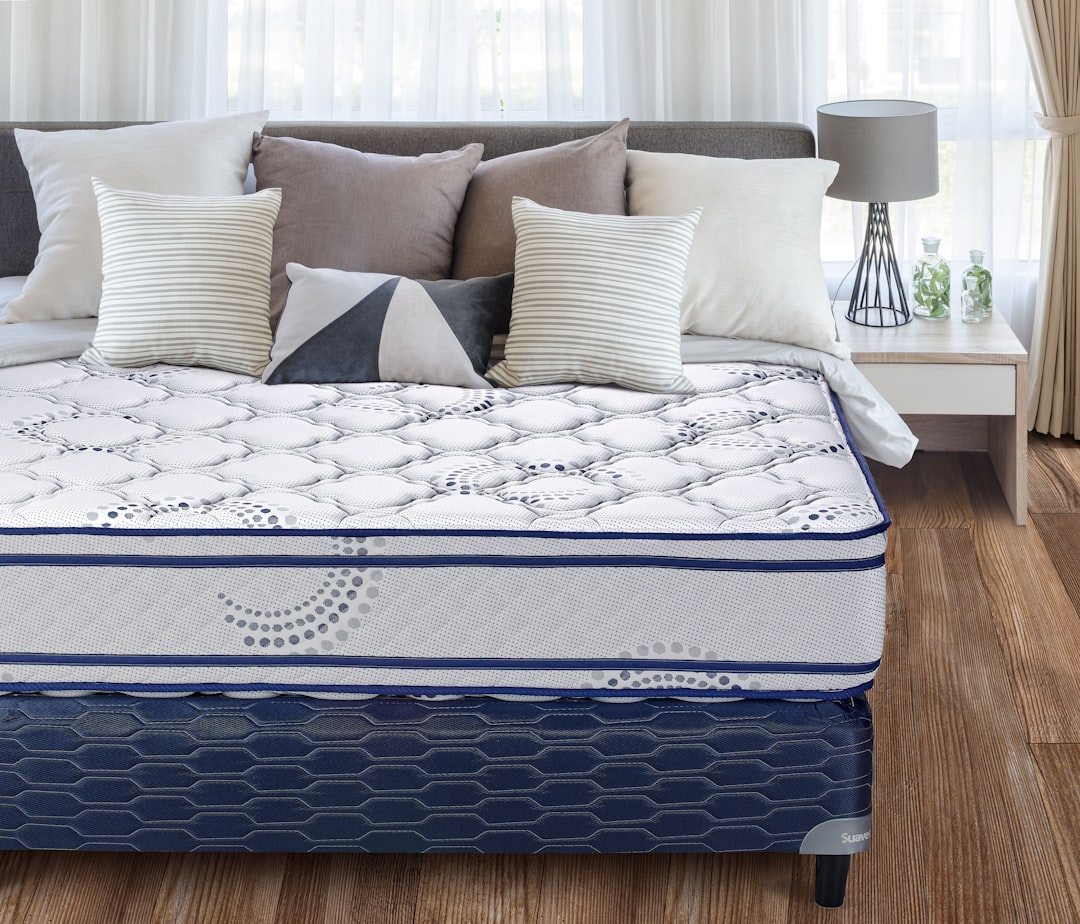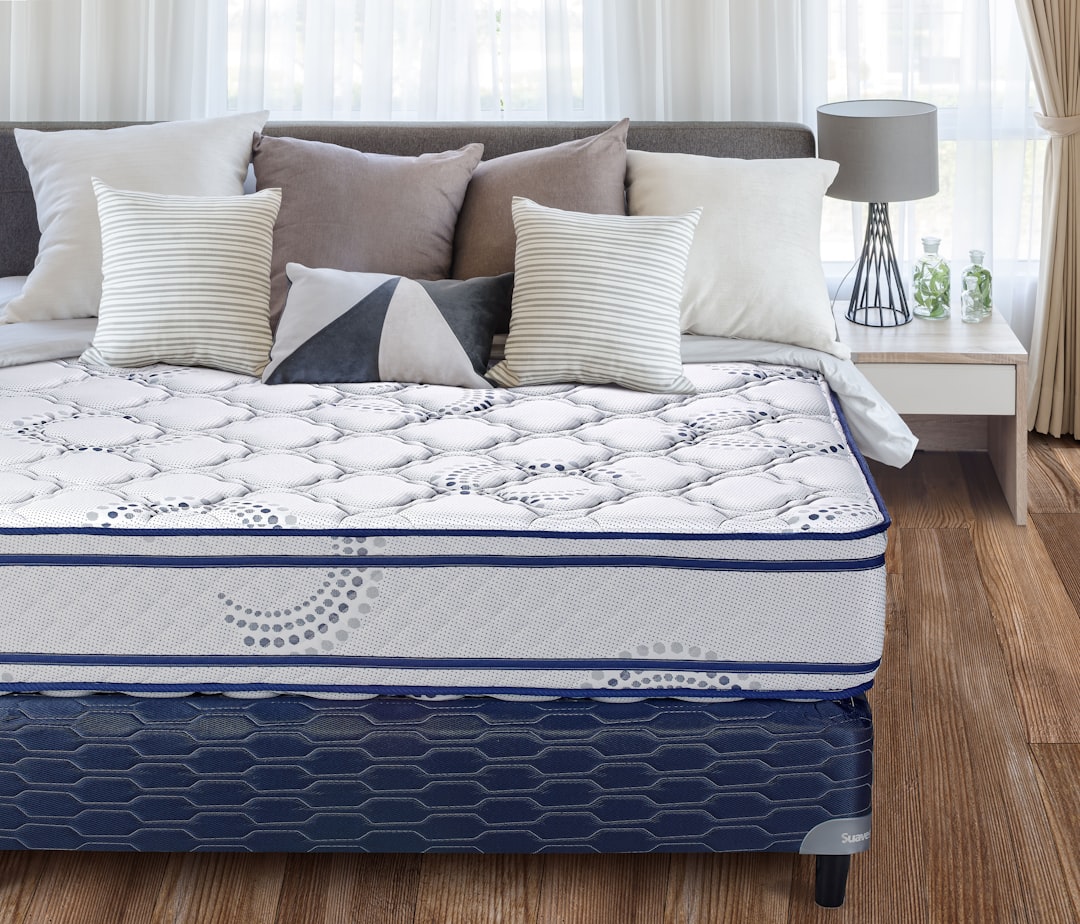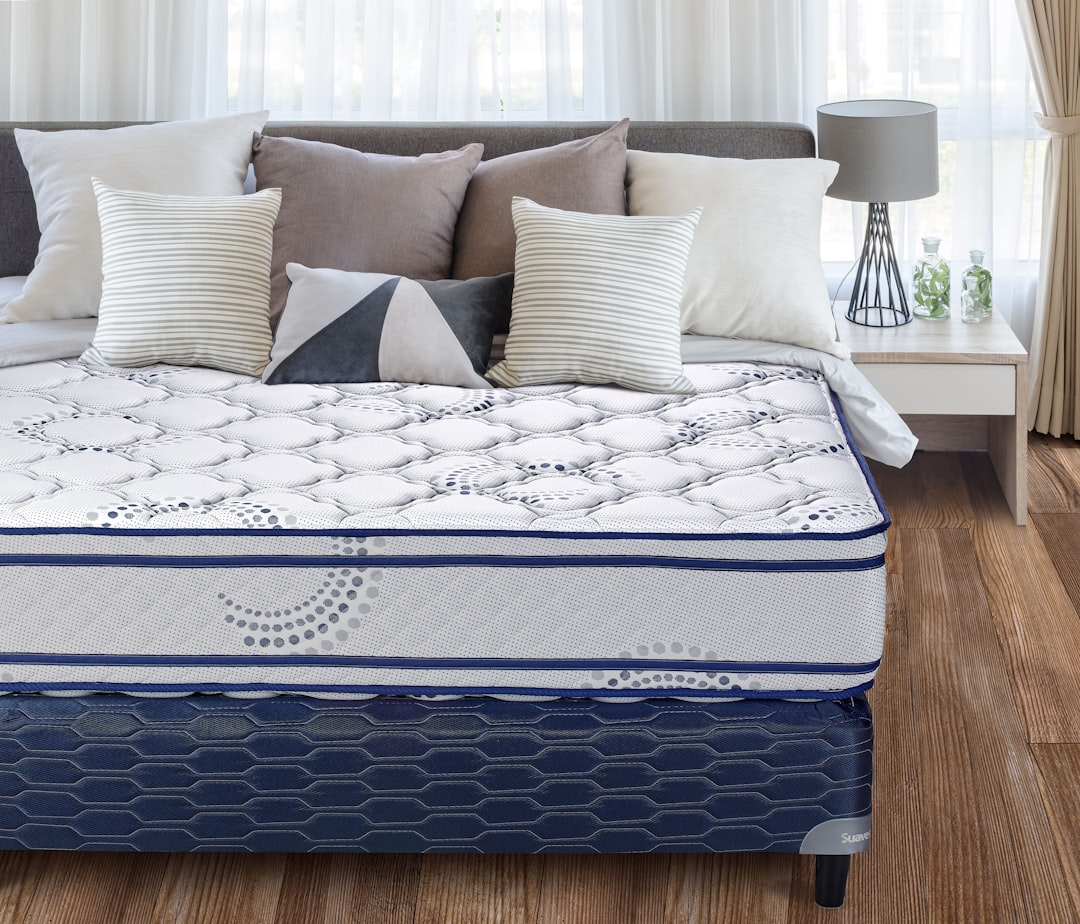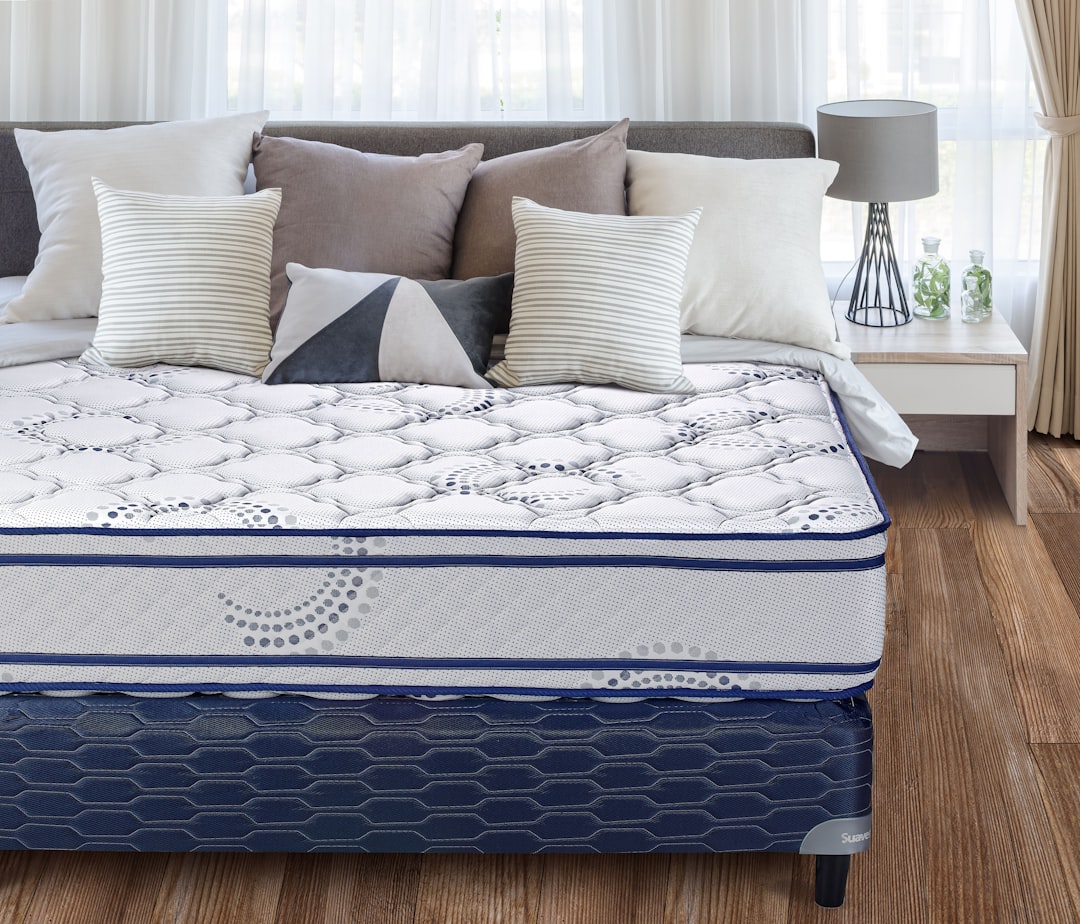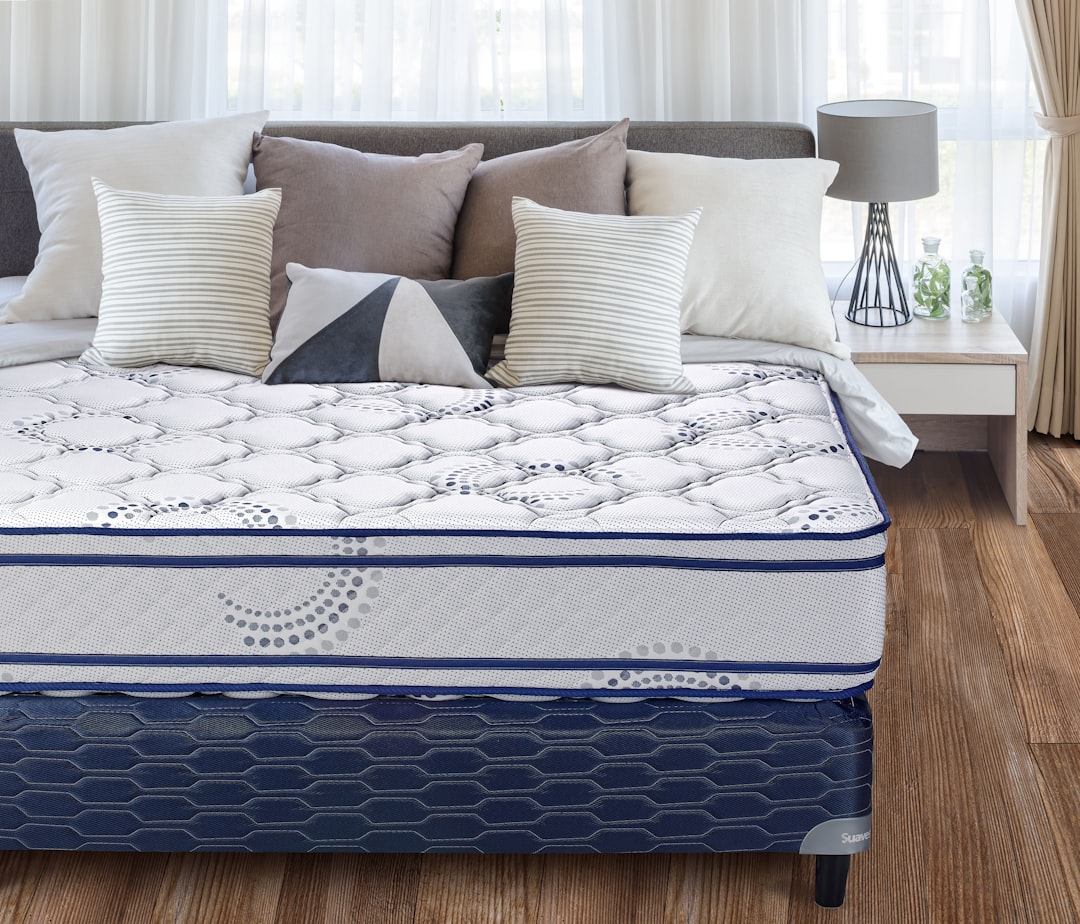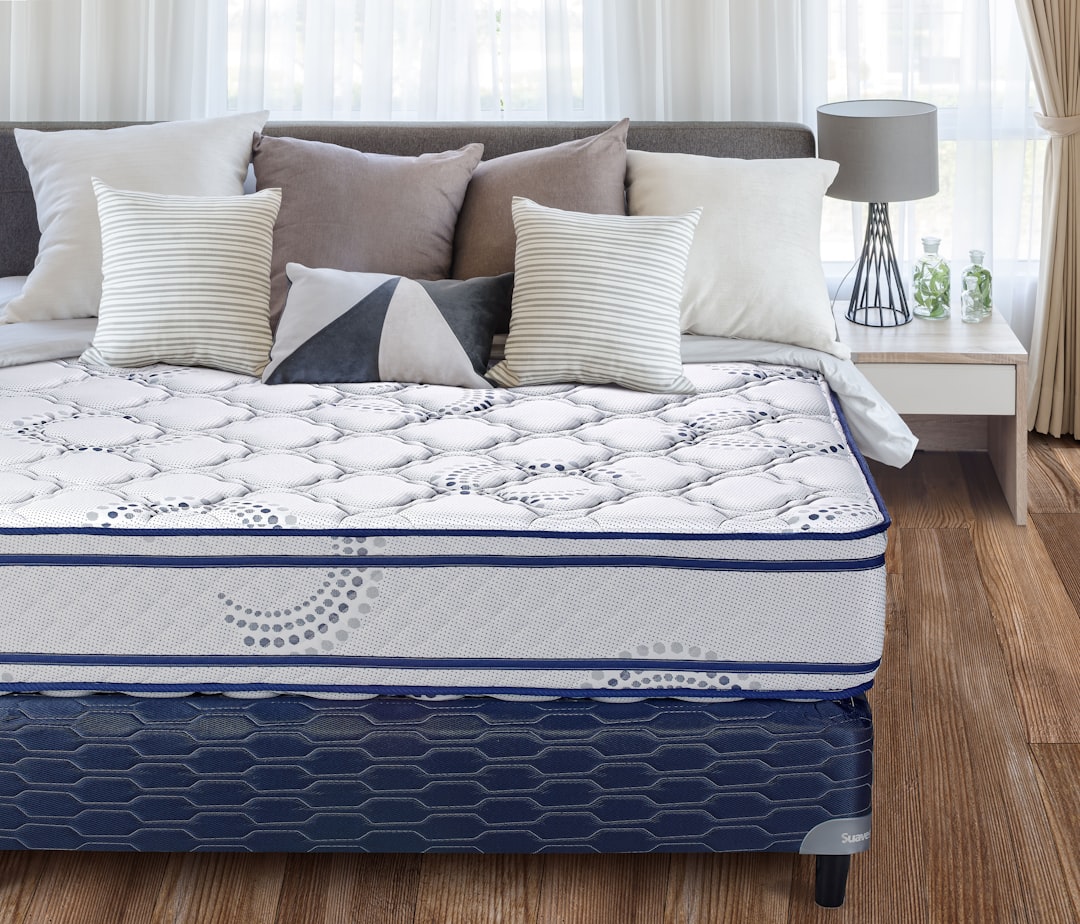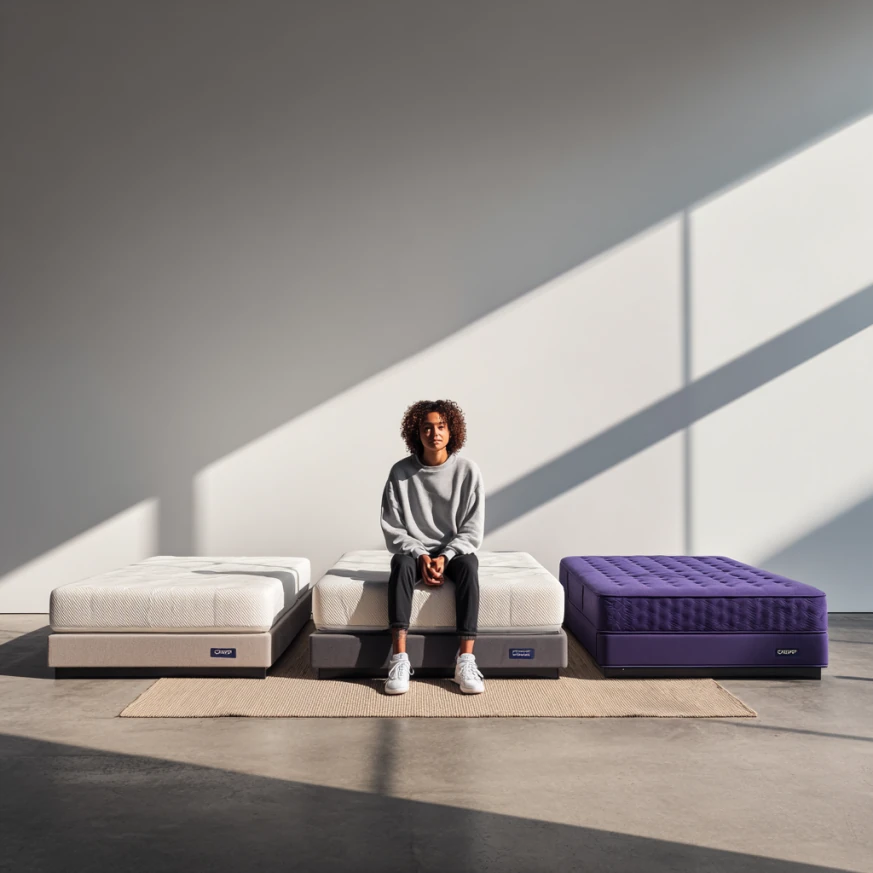
Best Mattress for Side Sleepers: A Guide to Pressure Relief

The best mattress for side sleepers with shoulder and hip pressure rel featuring mattress side sleepers

Choosing a Mattress for Side Sleepers

If shoulder or hip pain keeps you up, this guide to the best mattress for side sleepers shows exactly how to get deep pressure relief, better spinal alignment, and cooler sleep—without guesswork. You’ll learn which materials work, how to test a mattress in minutes, and how to keep your bed performing like new.

Key Takeaways

  • The best mattress for side sleepers pairs plush surface contouring with stable support beneath to protect shoulders and hips.
  • Memory foam and plush hybrids typically deliver the most pressure relief; latex adds bounce and durability.
  • Target a medium to medium-soft feel (with zoning if possible) for alignment and comfort.
  • Prioritize breathable foams, coils, and covers for temperature control.
  • Use in-store or at-home tests to verify relief, then maintain the mattress to extend its life.

Why Side Sleepers Need Specialized Support

Answer first: Side sleeping concentrates weight at the shoulder and hip, so you need plush contouring on top with steadier support underneath to keep your spine neutral.

When you sleep on your side, your shoulders and hips become high-pressure zones. A mattress that’s too firm compresses these areas and can pinch nerves, while one that’s too soft lets your midsection sink and strain your lower back. The sweet spot is plush contouring at the surface with steadier support below so your spine stays neutral from neck to tailbone.

If you often wake up with sore shoulders, choosing a mattress for shoulder pain can make a major difference in keeping pressure off your joints.

What that feels like: your shoulder should sink just enough to keep your neck level on the pillow, your hip should be cradled without tilting your pelvis, and your waist should be gently supported to avoid side-bend sagging.
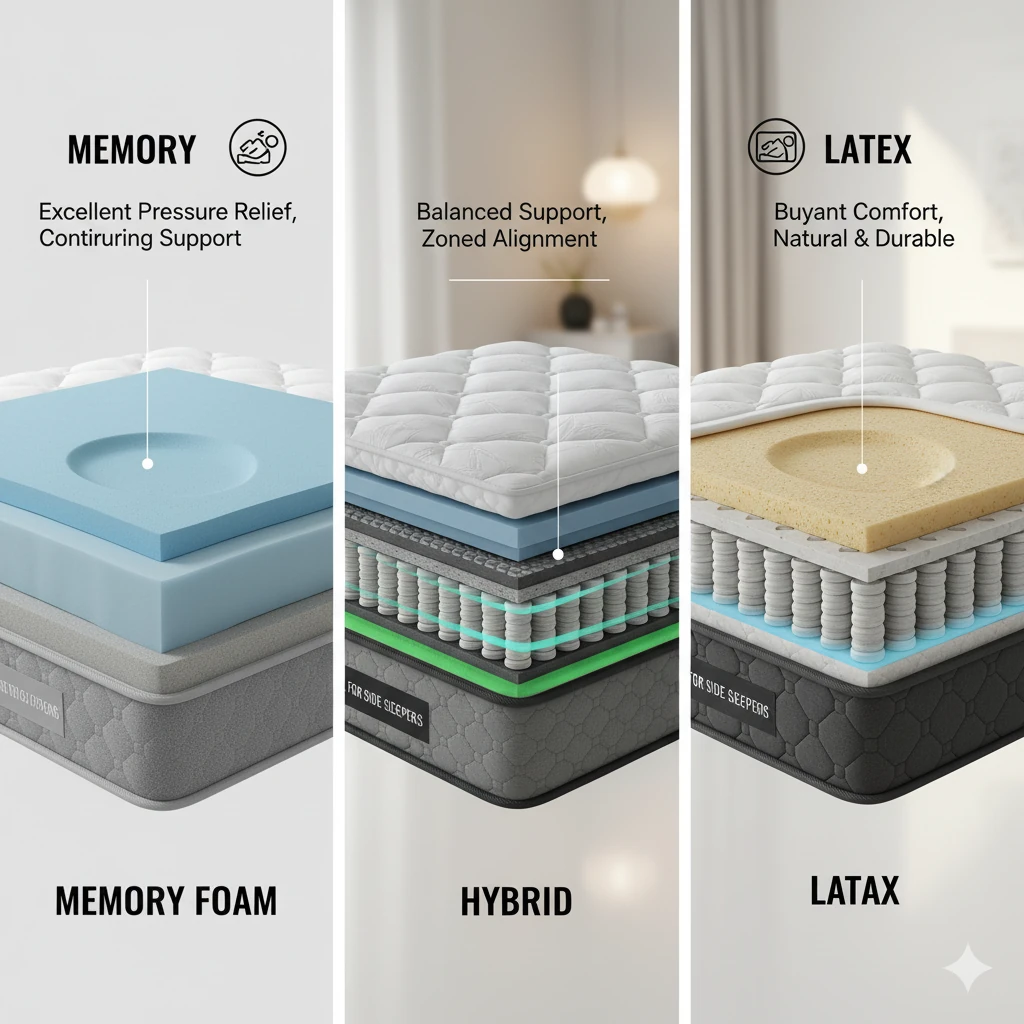
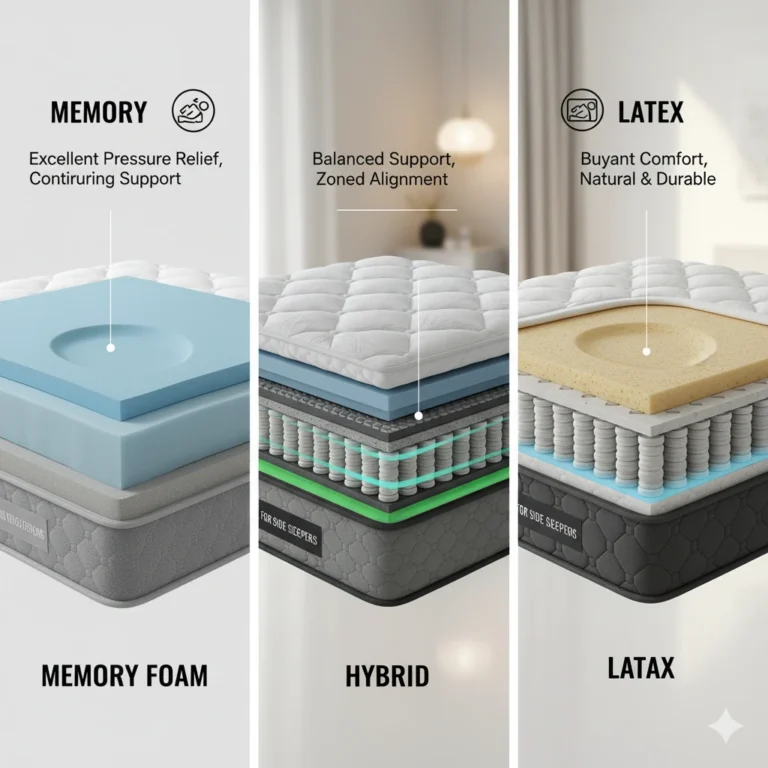
Cutaway of the best mattress for side sleepers comparing memory foam,  featuring mattress side sleepers

Best Mattress Types for Side Sleepers (Memory Foam, Hybrid, Latex)

Answer first: Memory foam offers the deepest contouring, hybrids blend relief with bounce and airflow, and latex provides responsive cushioning with standout durability.

Memory Foam

Foam’s slow-hug feel conforms closely to curves, reducing peak pressure at the shoulder and hip. Look for comfort foams in the 3–4 lb/ft³ range for plush relief, with denser transition foam beneath to prevent bottoming out. If you also sleep warm, consider open-cell foams or phase-change covers for better airflow.

Hybrid

A hybrid pairs foam comfort layers with a pocketed coil core. For side sleepers, this combo can be ideal: deep contouring on top with springy, zoned coils that keep your lumbar from sinking. Choose coils with edge reinforcement if you sit on the side of the bed frequently, and aim for a medium or medium-soft feel.

Latex

Latex has a buoyant, responsive cradle—great if you want pressure relief without the “stuck-in-foam” sensation. Talalay latex tends to feel plusher, while Dunlop feels denser and more supportive. Latex is naturally breathable and durable, making it a solid long-term investment.

Not sure which direction to go? This comparison of materials can help you decide between a plush foam hug and a bouncier, breathable feel found in coil-assisted designs—see our guide to hybrid mattress benefits for practical pros and cons.

Key Features: Pressure Relief, Zoned Support, Cooling

Answer first: Aim for 2–4 inches of plush comfort material, targeted zoning for shoulders and lumbar, and breathable construction to manage heat.

The best mattress for side sleepers with breathable covers and airflow-friendly coils, perforated latex, or ventilated foam channels will keep you more comfortable through the night. Moisture-wicking covers also help reduce clammy wake-ups. Learn more about temperature control in this Sleep Foundation guide on sleep temperature regulation.

Look for a pressure relief mattress that balances softness and structure, helping your body relax into alignment.
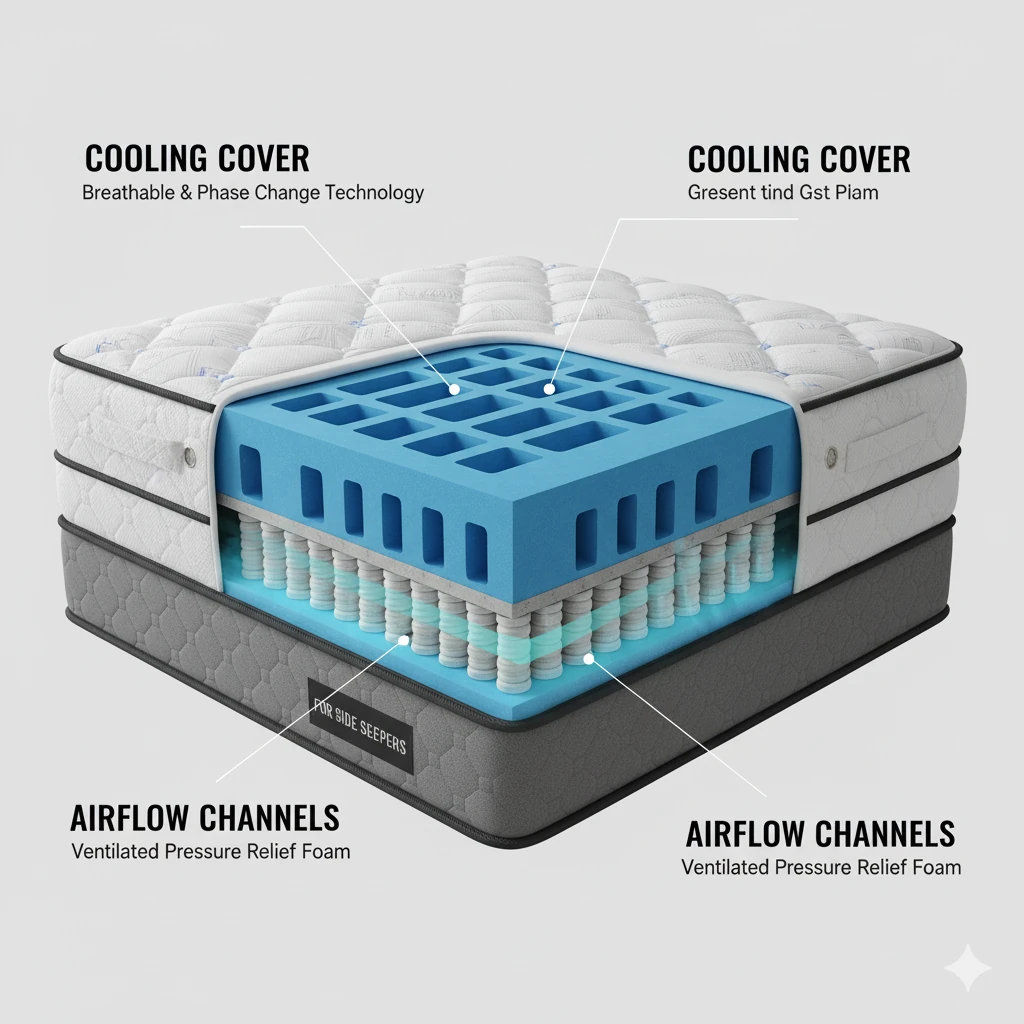
Cooling features in the best mattress for side sleepers, showing breat featuring mattress side sleepers

Top Picks by Budget and Body Type

Answer first: When comparing options, the best mattress for side sleepers should feel medium to medium-soft across budgets; lighter bodies benefit from plusher tops, while heavier bodies need thicker comfort layers and sturdier cores.

A slightly soft mattress for side sleepers allows natural shoulder and hip cushioning without losing support.

Budget-Friendly (Under $800–$1,000 for Queen)

Look for medium to medium-soft memory foam models with at least two comfort layers and a dense base foam. Prioritize reputable warranties and real trial periods to test pressure relief at home.

Mid-Range ($1,000–$1,700)

Plush hybrids shine here: zoned pocketed coils for alignment, plus gel-infused or open-cell foam for pressure relief. If you’re under 150 lbs, a slightly softer top helps you sink enough at the shoulder; 150–230 lbs. often prefer classic medium; above 230 lbs. may need a medium-firm with thicker comfort layers.

Premium ($1,700+)

Consider latex hybrids or advanced foams with targeted zoning and breathable covers. These options often last longer and keep support consistent across years of use. If you want something that still feels brand new five years from now, a latex hybrid could be your forever mattress.

If you experience both side sleeping and back issues, our strategies in the back pain mattress guide (king-size focus) can help you choose a feel that balances contouring with lumbar stability.
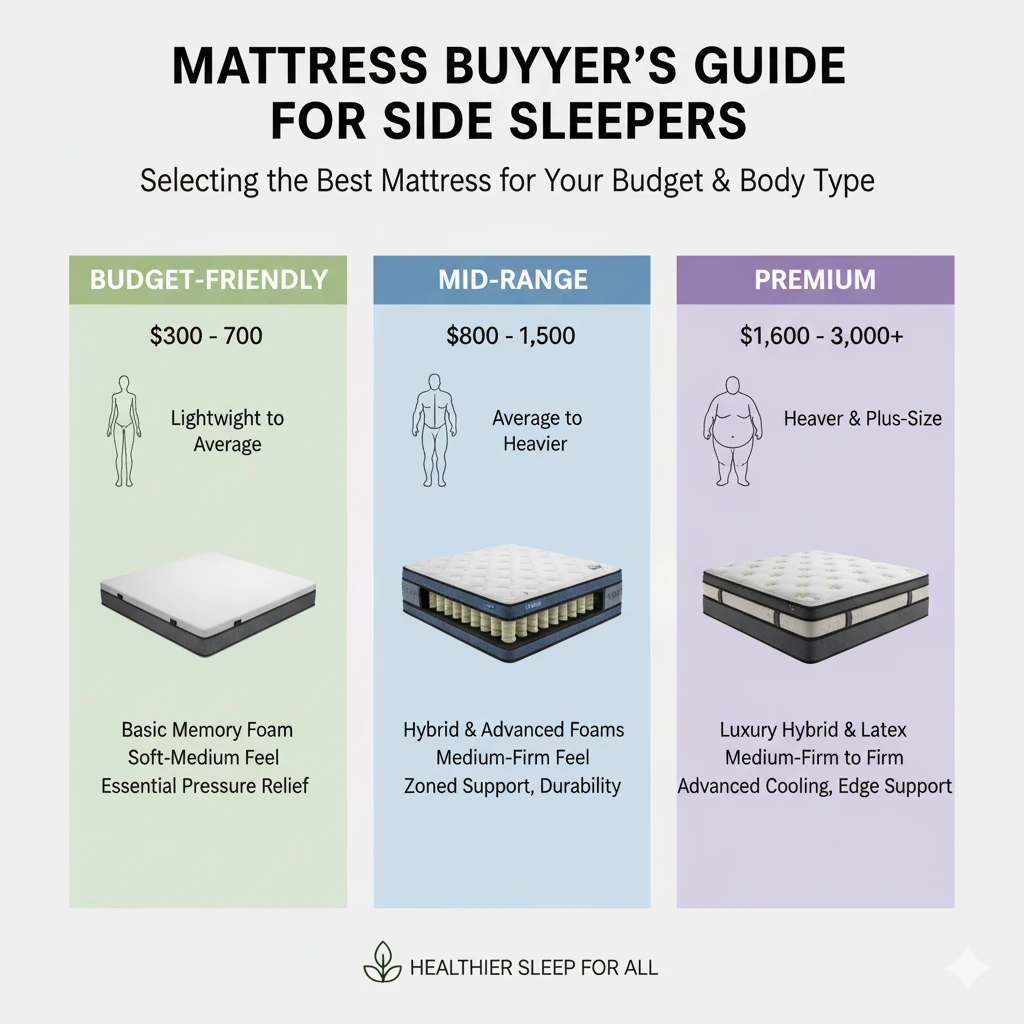
Budget tiers for selecting the best mattress for side sleepers with op featuring mattress side sleepers

How to Test a Mattress for Shoulder & Hip Relief

Answer first: Run quick checks for shoulder nestling, pillow height, and hip support, then validate over the full trial period.

  1. Side-Hug Check (2–3 minutes): Lie on your regular side. Your shoulder should nestle without numbness; your waist should feel gently filled, not arched.
  2. Pillow Alignment: With your head on your usual pillow, your nose should align with your sternum. If not, adjust pillow height before blaming the mattress.
  3. Hip Sink Test: Place a hand at your low back; there should be light contact. A gap means too firm; a deep sag means too soft.
  4. Roll & Reset: Roll to your back and return to side. If you feel stuck, consider a bouncier hybrid or latex.
  5. At-Home Trial: Use the full trial window. Note pressure or soreness patterns in the morning—improvements should appear within 1–2 weeks. Don’t worry if it takes a few nights to adjust—your body often needs a short “break-in” period before the mattress truly supports you.
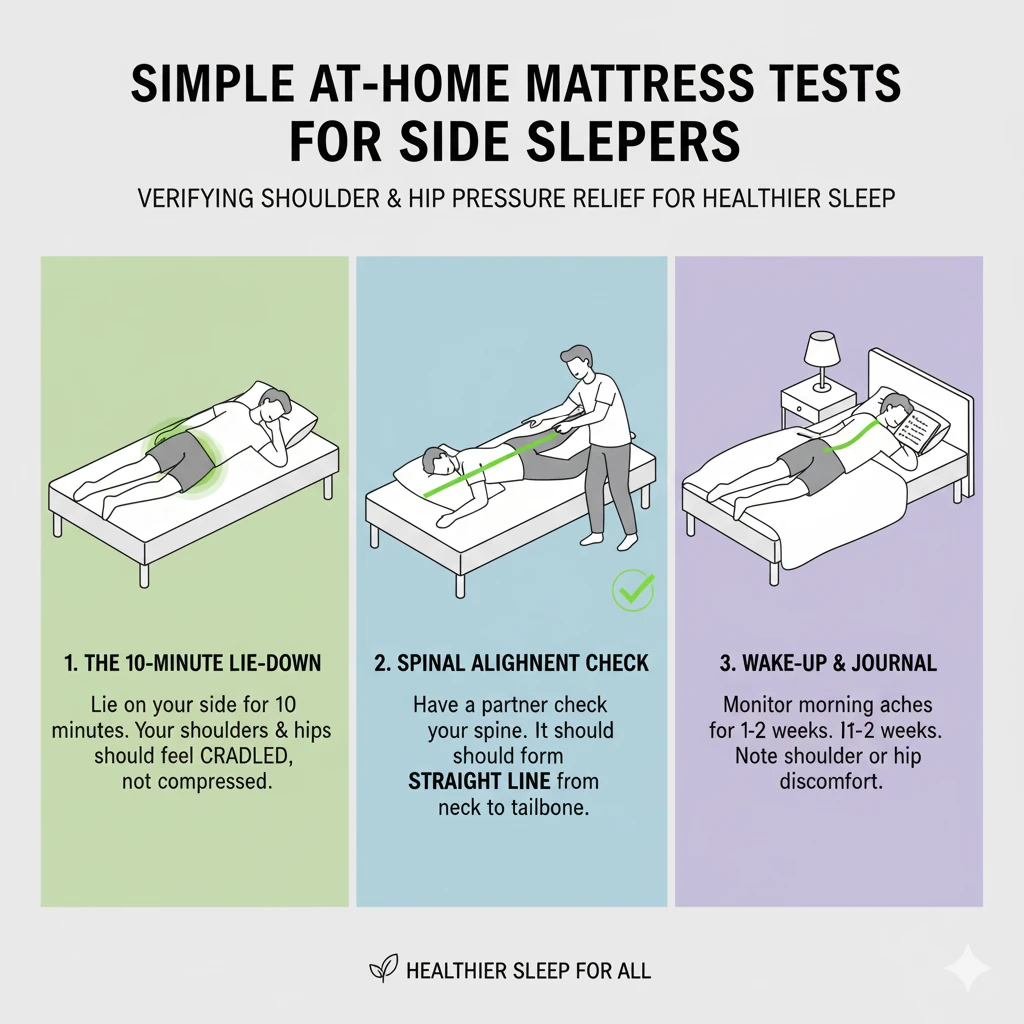
Simple at-home tests for the best mattress for side sleepers to verify featuring mattress side sleepers

Care, Rotation & Longevity Tips

Answer first: Protect, rotate, and keep the surface clean to preserve support and comfort for years.

Protect your best mattress for side sleepers investment with a breathable protector and rotate it every 2–3 months for the first year (then seasonally). Keep the surface clean to prevent allergens and premature wear—our step-by-step guide on how to clean a mattress covers safe stain removal, deodorizing, and drying. Check your base: a solid foundation or correctly slatted platform preserves alignment and warranty coverage. For more eco-aligned tips, see mattress longevity advice from Ethical Bedding.
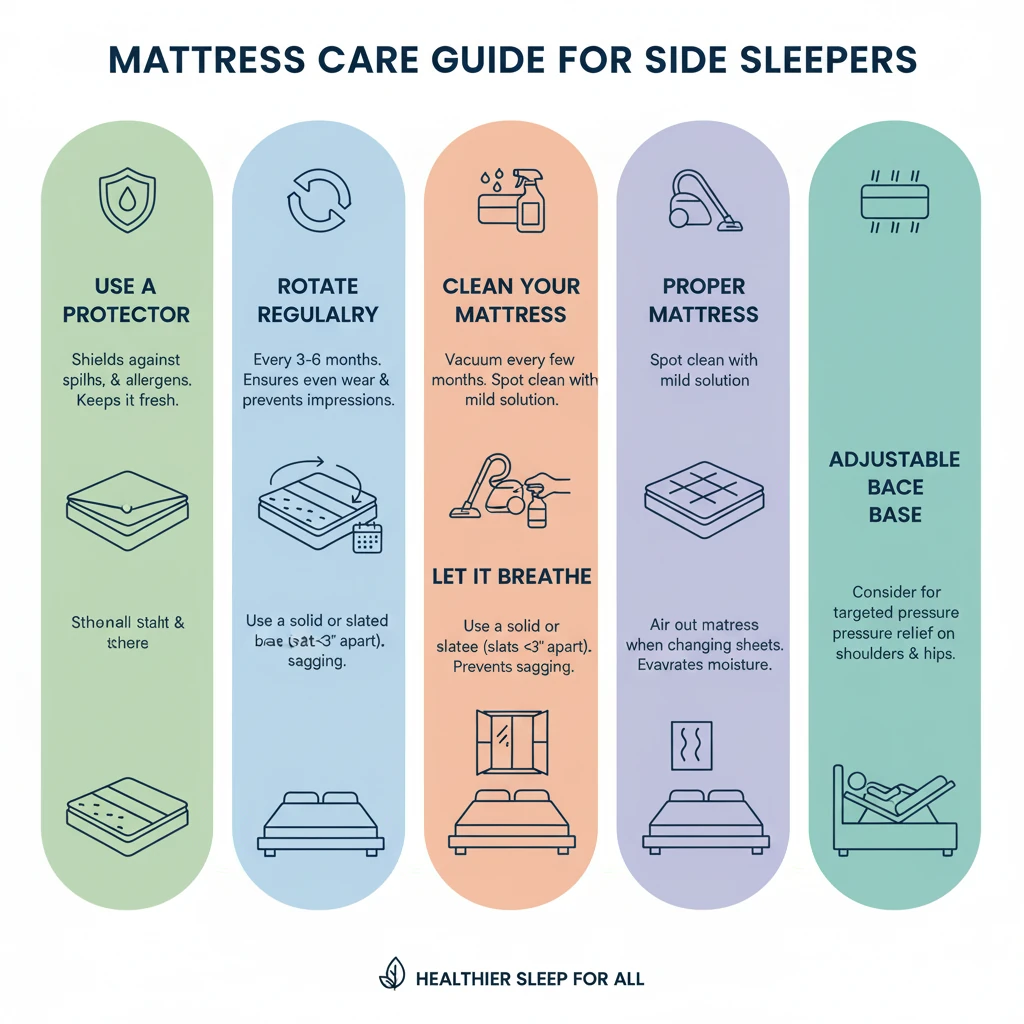
Care steps that help the best mattress for side sleepers last longer w featuring mattress side sleepers

Final Thoughts on Finding the Best Mattress for Side Sleepers

The best mattress for side sleepers balances deep pressure relief with stable support to keep your spine aligned and shoulders pain-free. Whether you lean toward plush foam or hybrid bounce, focus on breathable layers, consistent comfort, and durability. At Cozy Bed Quarters, we test and review every mattress type to help you rest easier, night after night. The best mattress for side sleepers isn’t just about pressure relief—it’s about waking up without pain and actually looking forward to bedtime again.

Related Reading

Hybrid Mattress Benefits: Cooling, Bounce, and Support
Best Memory Foam Mattresses 2024: Top Picks
Best Memory Foam Mattress for Side Sleepers (2024)
Expert-tested side sleeper mattresses (Sleep Foundation)
Pro mattress buying guide (Architectural Digest)

More Expert Insights

At Cozy Bed Quarters, we’ve helped hundreds of local side sleepers finally get the rest they deserve. This 2026 guide covers everything you need: key features, our top-tested recommendations, and practical tips tailored to hot, dry environments like ours.

Gel-infused foam, breathable covers, phase-change materials, or open coil systems help in Arizona’s warm nights.

Euro-top plushness with strong coil support. Great airflow for hot sleepers. Highly rated by NapLab.

Advanced zoned coils + cooling cover. Great for combination sleepers. Praised by Forbes Vetted.

Quick Buying Guide: Find Your Perfect Match

  • Budget under $1,000 → Nectar Premier
  • Hot sleeper in Phoenix → Leesa Sapira Chill or DreamCloud
  • Back or shoulder pain → Helix Midnight Luxe or Nolah Evolution
  • Eco-conscious → Birch Luxe Natural
  • Share the bed → Casper Dream Hybrid or WinkBed

Mattress Care Tips for Arizona’s Dry Climate

  • Rotate every 3–6 months
  • Use a breathable, waterproof protector
  • Keep bedroom well-ventilated
  • Spot clean spills immediately
  • Avoid constant edge sitting

Ready to wake up pain-free and refreshed?

Rather than focusing on brand names, it’s more important to understand the features that contribute to healthy spinal support when selecting the best mattress for back pain.

Many modern mattresses include firmer support through the lumbar area and softer zones near the shoulders. This helps maintain natural posture throughout the night, especially for side sleepers seeking the best mattress for back pain.

Overheating can increase discomfort and disrupt restorative sleep. Breathable covers, gel-infused foams, and coil systems help maintain a cooler sleep surface.

Often recommended for: Side sleepers and those seeking pressure relief around the hips and shoulders.

Often recommended for: Hot sleepers or those with mild to moderate back sensitivity.

These mattresses are designed with spinal support in mind and often feature firmer constructions with targeted reinforcement.

Even high-quality mattresses wear out over time. Signs it may be time for a replacement include:

According to the Sleep Foundation’s 2026 guide, maintaining neutral spinal alignment during sleep is one of the most important factors in reducing back strain. Recent expert testing highlights hybrids like the WinkBed, Helix Midnight Luxe with ErgoAlign, and others as top performers for the best mattress for back pain.

Medical guidance from the Mayo Clinic and the Cleveland Clinic also supports medium-firm sleep surfaces for many individuals experiencing back discomfort.

At Cozy Bed Quarters, we aim to provide clear, research-backed guidance so you can make confident decisions and enjoy more restful, comfortable sleep.

Many sleep specialists recommend medium to medium-firm surfaces for maintaining spinal alignment.

Why it helps: Individually wrapped coils provide targeted lift under the lumbar while allowing the shoulders and hips to settle. Foam on top eases pressure. Pros: great airflow, edge support, easy movement. Cons: quality varies; look for sturdy coil counts and meaningful zoning.

Why it helps: Deep contouring fills gaps under the lower back and distributes load evenly. Pros: excellent pressure relief, motion isolation. Cons: can sleep warmer and feel slow to respond; ventilated or open-cell designs improve comfort.

Why it helps: Naturally resilient and buoyant, latex keeps you “on” the bed, not “in” it, while still cushioning pressure points. Pros: durable, breathable, easy to move. Cons: typically pricier; feel is springier than memory foam.

Why it helps: Classic coil systems with a lumbar band or alternating-gauge rows resist midsection sag. Pros: responsive, cool. Cons: less contouring on top—pair with a quality pillow-top or foam layer to avoid pressure points.

Why it helps: Softer shoulder zones and firmer midsection zones guide the spine into alignment. Pros: precise fit for mixed sleepers. Cons: zoning must match your body; test for shoulder comfort and lumbar lift.

Foam: best pure contouring and pressure relief; choose denser bases to resist long-term sag. Hybrid: balanced feel with pushback from coils plus cushioned tops—often the most versatile for couples and combination sleepers. Innerspring: responsive and breathable; select models with true lumbar reinforcement and a substantial comfort layer to avoid pressure points.

Debating materials? Our deeper comparison of memory foam vs hybrid designs explains feel, cooling, motion isolation, and durability so you can pick with confidence.

Strong support today won’t matter if the mattress sags tomorrow. Rotate new beds every 2–3 months in year one (then seasonally), use a breathable protector, and ensure your foundation meets manufacturer specs to keep warranties valid. When spills or odors happen, follow our step-by-step guide on how to clean a mattress to refresh the surface without damaging foams or fibers. Most quality mattresses last 7–10 years; replace sooner if you notice dips, new pain, or if your body or sleep position has changed significantly.

Best Cooling Mattress: How to Pick One for Hot Sleepers

Cooling Mattresses Hot Sleepers - Best Cooling Mattress

The best cooling mattress for most hot sleepers is a latex or coil-based hybrid with a breathable cover, because open coils and open-cell latex let body heat escape instead of trapping it. All-foam beds can also sleep cool if they use gel, graphite or copper-infused open-cell foam and a moisture-wicking cover, but dense, thick memory foam is the build most likely to make you sweat. No mattress feels refrigerated — a good one simply stops heat from building up under you.

Key takeaways

  • Coils and latex move air. Hybrids and latex beds are usually the coolest-sleeping categories.
  • The cover matters more than people expect. Cotton, Tencel-type lyocell, wool and phase-change knits wick heat and moisture at the surface you actually touch.
  • Support comes first. Pick firmness for your sleep position and body weight, then optimise for airflow.
  • Sinking = heat. The deeper you sink into foam, the more of your body is wrapped in insulation.
  • Cooling claims are mostly unregulated marketing. Judge construction and trial policies, not adjectives like “arctic” or “ice”.

Why sleeping hot ruins your night

Falling asleep depends partly on your body shedding heat, so a surface that traps warmth works against you. Research generally points to a bedroom temperature of roughly 60–67°F (15–19°C) as ideal for sleep, though some studies suggest a broader range, and a mattress that holds heat effectively cancels out a cool room. Waking up sweaty also fragments your night, which makes it harder to hit the amount of sleep you need: adults aged 18–60 are recommended to sleep at least 7 hours each night, and regularly sleeping less than that is associated with higher risk of obesity, diabetes, high blood pressure, heart disease, stroke and frequent mental distress (CDC).

Worth saying plainly: there is very little independent, peer-reviewed evidence that any specific mattress model lowers body temperature or cures night sweats. What is well established is that airflow and moisture-wicking fabrics stop heat and humidity accumulating — and for most hot sleepers, that is the whole problem.

The Best Cooling Mattresses for Hot Sleepers - cooling mattresses hot sleepers

What actually makes a mattress cooling

Three things: how much air can move through the bed, how much of your body sinks into insulating foam, and how well the top layers pull moisture away from your skin.

Materials that help

  • Latex: naturally open-celled and springy. It contours without swallowing you, which keeps more of your body in open air. Its bounce also suits people who change position often.
  • Pocketed coils: a coil unit is mostly empty space, so air circulates freely beneath the comfort layers. This is why hybrids tend to run cooler than all-foam beds of the same firmness.
  • Gel, graphite or copper-infused foam: these conduct heat away from the surface better than plain memory foam. The effect is real but modest, and it works best in thin top layers rather than thick ones.
  • Open-cell and perforated foams: ventilation channels and larger cell structures let heat escape instead of pooling.
  • Breathable covers: cotton, lyocell, wool and phase-change knits feel cool to the touch and move sweat away. Phase-change materials absorb and release heat to buffer surface temperature swings.

Active cooling systems

At the top of the market, some beds use fans or circulating water through a pad or mattress layer to actively lower surface temperature. These genuinely cool rather than just avoid trapping heat, but they add cost, need power, and introduce pumps and electronics that can fail. For most people, a breathable passive build plus the right bedding solves the problem for far less money.

What “cooling” will not do

A cooling mattress will not fix a hot bedroom, heavy synthetic bedding, a plastic-backed mattress protector or medical causes of night sweats. It also will not feel cold all night — once you have been lying in one spot, any surface warms up. Anything marketed as permanently icy is overpromising.

Cutaway comparison of memory foam, hybrid and latex mattress layers and materials

Which mattress type sleeps coolest

Type Temperature Feel Best for
Latex Coolest overall Buoyant, responsive, light contouring Hot sleepers who dislike sinking; combination sleepers
Hybrid (coils + foam or latex) Cool to neutral Supportive with cushioning on top Most people, especially couples and heavier sleepers
Innerspring Cool Bouncy, firm, minimal contouring Budget buyers who want maximum airflow
All-foam with cooling features Neutral Hugging, motion-absorbing Foam fans who need pressure relief and quiet motion isolation
Thick traditional memory foam Warmest Deep sink, slow response Cold sleepers

If you are torn between categories, our comparison of memory foam vs hybrid mattresses goes deeper on feel, support and motion transfer, and memory foam vs spring covers the older but still relevant coil-versus-foam question. For a broader overview of every construction, see our guide to types of mattresses explained.

Traditional vs Cooling Mattress Comparison

Match firmness to your sleep position

Support is not negotiable — a cool mattress that wrecks your back is a bad mattress. Choose firmness first, then pick the coolest-running option in that firmness band.

Side sleepers

You need give at the shoulder and hip, which usually means medium to medium-soft. The risk is that softer foam wraps around you and traps heat, so look for a hybrid or latex bed that cushions in a thin top layer over a responsive core rather than one thick slab of memory foam.

Back sleepers

Medium to medium-firm keeps the lumbar curve supported. Zoned coil units help here: firmer support under the hips means less sinkage, which also means less heat buildup around your lower back.

Stomach sleepers

Firmer is better, since sinking hips hyperextend the lower back. Firm latex or a firm hybrid keeps you high on the surface — the coolest place to be.

Not sure where you land on soft-to-firm? Our mattress firmness scale explained translates the 1–10 numbers brands use, and our guide to the best mattresses for side, back and stomach sleepers covers support needs in detail.

Body weight also changes the answer

Heavier sleepers compress comfort layers further, so they lose airflow faster and generally do better on sturdier hybrids or firmer latex with a robust coil unit. Lighter sleepers sit more on top of a mattress and may sleep cool even on foam, since they never sink deeply enough to be surrounded by it.

The Best Cooling Mattresses for Hot Sleepers - cooling mattresses hot sleepers

Shopping checklist

  • Coils or latex in the support core if you sleep hot year-round.
  • Thin, breathable comfort layers rather than four inches of dense memory foam.
  • A natural or moisture-wicking cover — cotton, wool, lyocell or a phase-change knit.
  • Zoned support if you share the bed: it reduces sinkage and helps with motion transfer at the same time.
  • A sleep trial long enough to judge summer nights. Trials are commonly advertised around 100 nights; read the return terms, including who pays shipping.
  • A written warranty (ten years is a common length) and clear instructions on rotating and protector use, since improper care can void coverage.

Couples have an extra variable — one person’s cool is another’s cold. Our guide to the best mattresses for couples who toss and turn covers split preferences and motion isolation.

Certifications worth checking

Cooling claims are not certified by anyone, but material safety often is. CertiPUR-US certified foams are tested for low VOC emissions for indoor air quality — less than 0.5 parts per million — and screened for chemicals including flame retardants classified as carcinogens, mutagens or reproductive toxins (CertiPUR-US). Alongside that, OEKO-TEX STANDARD 100 tests textiles and components for harmful substances, and GOTS applies to textiles made with certified organic fibres. These labels tell you about chemistry and fibre sourcing, not temperature.

If off-gassing smell is a concern when your new bed arrives, our notes on reducing mattress off-gassing and breaking in a new mattress cover the airing-out period.

Price and value

Cooling features appear at every price point, and the difference as you move up is usually durability rather than a dramatic temperature drop:

  • Entry level: gel-infused foam beds and simple hybrids. Cooling is adequate; expect thinner coil gauges and shorter useful life.
  • Mid-range: better coil units, zoned support, more capable covers. This is where most hot sleepers get the best value.
  • Premium: natural latex, multiple cooling layers, phase-change covers, and occasionally active fan or water cooling.

Prices shift constantly with promotions, so compare the same model over a few weeks rather than trusting a single sale banner. For lower-budget options, see our mattresses in a box under $1,000 roundup, and if you can be patient, our notes on the best time of year to buy a mattress explain when discounts typically cluster.

Cheaper fixes before you replace the mattress

If your bed is otherwise comfortable and reasonably new, try the cheap variables first — they are often the actual culprit:

  • Swap the bedding. Percale cotton, linen and lyocell breathe far better than microfibre or flannel; see our picks for bedding material for hot sleepers.
  • Check your protector. Fully waterproof laminated protectors block airflow. Look for a breathable membrane instead.
  • Cool the room and move air. A fan lowers perceived temperature and helps sweat evaporate.
  • Raise the bed off the floor. A slatted base allows ventilation underneath, unlike a solid platform or a mattress on the floor — our bed frame guide covers slat spacing and support.

If the mattress is sagging, body-impressioned or over a decade old, though, cooling layers won’t rescue it. Our guide to how often you should replace a mattress lists the signs it’s time.

Keeping a cooling mattress cool

  • Rotate head to foot every three to six months (unless the maker says otherwise) so the comfort layers wear evenly and don’t develop permanent dips.
  • Use a breathable protector and wash it regularly — sweat and body oils degrade foam and reduce breathability over time.
  • Spot clean only, and let the surface dry fully before making the bed. Trapped moisture is what makes a mattress feel clammy.
  • Strip the bed and let it air for an hour now and then, especially in summer.

The Best Cooling Mattresses for Hot Sleepers - cooling mattresses hot sleepers

FAQ

Do cooling mattresses really work?

They work in the sense that breathable builds and wicking covers stop heat and humidity accumulating. They don’t work like air conditioning — independent evidence that a mattress lowers your body temperature is thin, so treat dramatic marketing claims with scepticism.

What is the coolest mattress material?

Latex over a coil unit is the strongest combination: both layers are mostly open space. Innerspring beds are also cool but offer little pressure relief.

Is memory foam always hot?

No, but it’s the warmest category by default because it’s dense and wraps around you. Thinner foam layers, open-cell structures, gel or graphite infusions and coil support all reduce the problem.

What’s the difference between a cooling mattress and a cooling topper or pad?

A topper changes the surface feel and can add a little breathability, but it sits on top of whatever is trapping heat underneath. A cooling mattress addresses airflow through the whole build. A topper is a sensible, cheap experiment; it is not a substitute for replacing a heat-trapping bed.

Do I need special sheets?

Not special, just breathable. Percale-weave cotton, linen or lyocell allow airflow; sateen, microfibre and fleece work against you.

How long does a cooling mattress last?

Roughly the same as any comparable mattress — most need replacing somewhere in the seven-to-ten-year range, with quality latex and strong coil units typically at the longer end.

Which cooling mattress is best for couples?

A hybrid with pocketed coils, which isolates motion reasonably well while still ventilating. Latex is cooler and more responsive but transfers a little more movement.

Bottom line

Choose support for your sleep position and body weight first, then favour the build with the most airflow in that firmness range — normally latex or a pocketed-coil hybrid with a breathable cover. Skip gimmicky temperature claims, buy with a real sleep trial so you can test the bed through a warm week, and fix your sheets, protector and room temperature at the same time. That combination does more for a hot sleeper than any single cooling layer.

Updated September 2026.

The Ultimate Guide to Choosing a Mattress in 2025

Choose Mattress in a cozy bedroom setting

How to Choose the Right Mattress for You

Updated: August 25, 2025

If you’ve been wondering how to choose a mattress, the secret is simple: match your sleep position and body type to the right firmness, then pick a material—foam, hybrid, latex, or springs—that brings you the comfort, support, and budget fit you need for peaceful sleep.

Want to skip ahead to popular picks? Start with our memory foam vs spring mattress guide, compare brands in our Casper vs Purple comparison, or see our best mattresses for side, back, and stomach sleepers. If you run hot, our cooling mattress guide highlights breathable picks.

Think of your mattress as the foundation of nightly comfort—it should align your spine while easing pressure points. Your sleep position, body weight, and temperature needs shape the feel you’ll love. Side sleepers usually need more cushioning, while back and stomach sleepers benefit from firmer support. Hot sleepers tend to do better with breathable covers and coils.

Key Takeaways

  • Begin with sleep position and body type before choosing firmness.
  • Foam hugs, springs bounce, latex feels buoyant—materials shape the experience.
  • Cooling, motion isolation, pressure relief, and edge support all matter for comfort.
  • Choose a budget tier, then double-check trial and warranty terms.
  • Keep this phrase in mind—how to choose a mattress—as your checklist.

How to choose a mattress: 7 friendly steps

  1. Start with your sleep position. Side, back, stomach, or combination—this guides firmness and support needs.
  2. Match firmness to your body type. Lighter sleepers often prefer softer beds; heavier sleepers usually need firmer support.
  3. Pick your material. Foam for contouring, springs for bounce, hybrids for balance, latex for breathable lift. For deeper details, see our memory foam vs spring mattress guide.
  4. Focus on feel. Wake up sore? Prioritize pressure relief. Hate feeling “stuck”? Choose a responsive surface. For quick picks, our position-based mattress guide simplifies choices.
  5. Think about cooling and motion control. Hot sleepers or couples often need breathable covers, coils, or motion-isolating foam. Explore our cooling mattress guide for tested options.
  6. Set your budget sweet spot. Mid-range models usually offer the best value, while premium adds durability and luxury touches.
  7. Check trial and warranty. Look for at least 90–120 nights of trial and a 10-year warranty with clear coverage terms. Not sure which brands stand out? Our Casper vs Purple comparison breaks it down.

Mattress layers displayed in a showroom to explain how to choose a mattress for your sleep style

A quick firmness scale helps match your body type and sleep position to the most comfortable feel.

Side sleepers

Medium-soft to medium firmness with cushioned hip and shoulder support. Memory foam and plush hybrids are often the coziest choice.

Back sleepers

Medium to medium-firm mattresses keep the spine aligned. Zoned coils or dense foams help prevent sagging and morning stiffness.

Stomach sleepers

Firmer surfaces with reinforced cores are best here—keeping hips lifted and lower backs supported.

Combination sleepers

Responsive latex or medium hybrids make it easy to change positions without feeling trapped in the bed.

Need more tailored picks? Our sleep position guide covers detailed recommendations.

Materials, cooling, and movement

Materials dictate temperature, pressure relief, and bounce. If you’re learning how to choose a mattress for your needs, start by matching these traits to how you sleep.

Foam: Snug contouring, great motion isolation—just be sure density is high enough for durability.

Springs: Classic bounce and airflow; newer pocketed coils minimize partner disturbance.

Hybrid: The best of both worlds—coil support with foam or latex comfort layers.

Latex: Naturally bouncy, breathable, and durable—ideal for hot sleepers and restless movers.

  • Foam vs Springs: Foam = pressure relief & motion control; Springs = bounce & airflow.
  • Hybrid vs Foam: Hybrid adds stronger edges and cooling; Foam keeps a deeper, “huggy” feel.
  • Latex vs Hybrid: Latex feels buoyant and cool; Hybrids feel balanced with extra edge support.

Cooling tip: Hot sleeper? Look for breathable covers, gel-infused foams, or coil layers that let air flow. See our cooling mattress guide for more options.

For couples: Motion-isolating foam or pocket coils help when one partner moves. Reinforced edges mean more usable space without rolling off.

For trustworthy sleep-health basics, the Sleep Foundation outlines healthy sleep tips, and AASM shares best practices. If you’re shopping for safer materials, scan recognized labels with this mattress certification guide and see this roundup of non-toxic mattress options.

The Ultimate Guide to Choosing a Mattress in 2025 - choose mattress

This cutaway shows how coils and breathable foams improve airflow and edge stability.

Budget, trials, and warranties

Choosing a mattress isn’t just about price—it’s about lasting comfort and peace of mind. Here’s how to think about it in practical terms.

Budget tiers: Value options work well for lighter sleepers or guest rooms. Mid-range often offers the best balance of quality and cost. Premium brings advanced cooling, zoning, and longer durability.

Trial & returns: Aim for 90–120 nights. Make sure returns are easy and pickup is included.

Warranty: Look for 10+ years with clear sagging coverage. A transparent policy means less worry down the road.

FAQ

What mattress firmness is best for side sleepers?

Most side sleepers like medium-soft to medium beds that cushion shoulders and hips while keeping the spine aligned.

How often should I replace my mattress?

Plan on about 7–10 years. If you wake with aches, see deep body impressions, or sleep hotter than before, it may be time.

Is a hybrid mattress better than memory foam?

It depends on your priorities. Hybrids sleep cooler and feel bouncier; memory foam excels at pressure relief and motion isolation.

How to choose a mattress if I’m a combination sleeper?

Pick medium firmness with responsive materials (latex or hybrid). You’ll get easy movement without losing pressure relief.

Conclusion

If you’re figuring out how to choose a mattress, begin with your sleep position and body type, pair it with the right material for your needs, and confirm fair trial and warranty terms. The real test comes from sleeping on it at home—not just five minutes in a store. For more cozy guidance, explore Cozy Bed Quarters.

The Ultimate Guide to Choosing a Mattress in 2025 - choose mattress

Try a few firmness levels in person, then let the at-home trial confirm your best match.

Related reading from Cozy Bed Quarters

Other reading we found popular

The Best Mattresses for Side, Back, and Stomach Sleepers

Mattresses Side, Back, Stomach in a cozy bedroom setting - mattresses side stomach


Best Mattress for Side Back and Stomach Sleepers

The best mattress for side back stomach sleepers combines pressure relief at shoulders and hips, steady midsection support, and firmness levels that keep your spine aligned no matter how you sleep.

Updated August 2025.

Key Takeaways

  • Firmness guide: Medium-soft for side, medium-firm for back, and firm for stomach sleepers.
  • Materials matter: Memory foam contours deeply, coils add bounce and airflow, hybrids balance both.
  • Hot sleepers: Latex or hybrid builds improve breathability and cooling.
  • Couples: Motion-isolating foams and pocketed coils reduce sleep disruptions.
  • The phrase best mattress for side back stomach sleepers anchors your checklist when comparing options.

If you’re not sure where to start, use our mattress buying guide. To compare materials, see memory foam vs spring mattress, or explore best cooling mattress if you overheat at night.

Why multi-position sleepers need tailored support

Switching between side, back, and stomach sleep puts pressure on different body zones. Too soft, and your hips sink (tough on back/stomach sleepers). Too firm, and your shoulders feel jammed (hard on side sleepers). The best mattress balances cushioning and lift—especially for combination sleepers who move all night.

Mattress cutaway showing support layers, the best mattress for side and stomach sleepers

A quick firmness map for each sleeping position.

Best mattress for side sleepers

Side sleepers press weight into the shoulders and hips, so pressure relief is essential. The best mattress for side back stomach sleepers cushions these areas while preventing midsection sagging. For more tailored picks, see our guide to the best mattress for side sleepers.

Firmness: Medium-soft to medium. Heavier side sleepers may prefer medium-firm with thicker comfort layers.

Materials: Memory foam for contouring, hybrids for pressure relief + airflow, or latex for buoyant comfort that avoids a “stuck” feel.

Best mattress for back sleepers

Back sleepers need consistent lumbar support to maintain a healthy spinal curve. A bed that’s too soft lets the hips sink; too firm can push the shoulders upward.

Firmness: Medium to medium-firm.

Materials: Zoned coils with supportive foams, or medium-firm memory foam. Hybrids are excellent for couples with different needs.

Best mattress for stomach sleepers

Stomach sleepers put the most stress on the lower back. A sagging mattress lets hips drop too low, which strains the spine. Firmer support is the key.

Firmness: Firm to medium-firm.

Materials: Hybrids and latex for cooling lift, or dense foams with reinforced cores for support.

The Best Mattresses for Side, Back, and Stomach Sleepers - mattresses featuring mattresses side stomach

Proper spinal alignment prevents morning aches and keeps your core supported.

Body type and mattress choice

  • Lighter sleepers (under 150 lbs): Softer mattresses prevent pressure buildup.
  • Average-weight sleepers (150–230 lbs): Medium firmness works across all positions.
  • Heavier sleepers (230+ lbs): Firmer beds with thick coils or high-density foam provide lasting support.

Comparison: best mattress for side back stomach sleepers by body type

Position Ideal Firmness Best Materials Body Type Tips
Side Sleepers Medium-soft to medium Memory foam, hybrid, latex Lighter bodies prefer plush foam; heavier bodies benefit from thicker hybrids.
Back Sleepers Medium to medium-firm Hybrid, zoned coils, firm foam Average-weight thrive on hybrids; heavier need reinforced lumbar zones.
Stomach Sleepers Firm to medium-firm Latex, hybrid, dense foam Lighter sleepers can tolerate medium-firm; heavier need firm latex or hybrid.
Combination Sleepers Medium (balanced) Responsive hybrid, latex Latex suits restless sleepers; hybrids fit couples. See Casper vs Purple.

Best mattress types for side, back, and stomach sleepers

  • Memory foam: Deep contouring, excellent for side sleepers, but may trap heat.
  • Latex: Naturally breathable and bouncy, great for combo sleepers.
  • Hybrids: Best all-around for side, back, and stomach sleepers.
  • Innerspring: Cool and supportive, but often needs a pillow top for pressure relief.

The Best Mattresses for Side, Back, and Stomach Sleepers - mattresses featuring mattresses side stomach

How materials feel: foam (hug), latex (lift), hybrid (a bit of both).

Testing at home, cost, and buying tips

A showroom test lasts minutes—real comfort shows up after weeks. Use the trial period to judge pressure relief, lumbar support, and cooling. Rotate your mattress if the brand recommends it, and add a breathable protector for longevity.

  • Budget-friendly: Foam under $600—great for lighter sleepers or guest rooms.
  • Mid-range: $800–$1,200 hybrids hit the sweet spot for most households.
  • Premium: $1,500–$2,500 with zoned coils, latex, and cooling fabrics.

According to the CDC, adults need at least seven hours of quality rest per night. If you’re choosing an eco-conscious mattress, look for recognized bedding certifications to ensure safe materials.

FAQ

What firmness is best for side back stomach sleepers?

Medium-soft for side, medium-firm for back, and firm for stomach. Combination sleepers often choose medium hybrids for balance.

What mattress works for couples with different sleep positions?

Hybrids with zoned coils or foam beds with dual firmness. These combine motion isolation with responsiveness.

How do I avoid back pain as a stomach sleeper?

Choose a firmer mattress that keeps hips supported. Use a thin pillow—or none at all—to prevent neck strain.

Do multi-position sleepers need special mattresses?

Not always. Hybrids and latex beds are naturally flexible, making them ideal for changing positions at night.

How long does a mattress last?

On average, 7–10 years. Latex and hybrids last longest, while foam beds depend on density and core quality.

Conclusion

The best mattress for side back stomach sleepers balances cushioning, support, and airflow across sleep positions. Match firmness to your primary position, choose materials that fit your comfort style, and use trial periods to test at home. For cozy comparisons and expert guides, explore Cozy Bed Quarters.

Related Reading


Casper vs. Purple vs. Tuft & Needle: An Honest Comparison

Casper vs. Purple vs. Tuft & Needle

Casper vs Purple vs Tuft and Needle Compared

Updated 2025

If you’re weighing Casper vs Purple, here’s the quick scoop: Casper leans into contouring foam comfort, Purple delivers buoyant and cooler support, and Tuft & Needle provides a budget-friendly foam feel right in between.

Want material basics first? See our memory foam vs spring mattress guide and get personalized advice in best mattress for side sleepers. Or start with our complete mattress buying guide to match firmness and materials to your body. For more brand matchups, check our mattress comparisons hub.

Key Takeaways

  • Quick pick: Casper = classic contour; Purple = buoyant & cool; Tuft & Needle = value foam.
  • Side sleepers: Often prefer Casper’s pressure relief, while hot sleepers lean toward Purple’s airy grid.
  • Budget-friendly: Tuft & Needle offers solid foam comfort at the lowest cost.
  • Always check trial length, return policy, and warranty coverage before buying.
  • Keep one checklist item in mind: Casper vs Purple—decide which feel matches your sleep priorities.

Casper vs Purple at a glance

Both brands aim for universal comfort, but the core materials set them apart. Casper’s foams gently contour and stabilize. Purple’s hyper-elastic grid floats and breathes, creating a buoyant feel. Tuft & Needle focuses on straightforward foam support at a friendlier price point.

If you like a gentle “hug,” Casper fits. If you want lifted, airy bounce, Purple wins. If you want simple, supportive foam on a budget, Tuft & Needle is your match.

Casper vs Purple vs Tuft & Needle: side-by-side comparison
Feature Casper Purple Tuft & Needle
Core feel Gentle contour, balanced foam “hug” Buoyant, lifted feel from elastic grid Simple, supportive foam; neutral feel
Pressure relief Zoned foams cradle shoulders/hips Grid collapses at pressure points Moderate contour; comfy for most
Cooling Good (best on hybrids) Excellent airflow (grid) Good (open-cell foam)
Support & bounce Stable, low bounce High responsiveness; easy to move Medium responsiveness
Edge support Softer on all-foam; better on hybrids Stronger on hybrids/reinforced edges Moderate; fine for most users
Best for Side sleepers; fans of contour Hot sleepers; combo sleepers Budgets; guest rooms; first setups
Motion isolation Very good Good Good
Durability 7–10 years (materials dependent) 7–10+ years (grid/hybrids) ~7–9 years (foam)
Trial & warranty ~100 nights; 10-year limited ~100 nights; 10-year limited ~100 nights; 10-year limited
Price tier Mid-range (foams & hybrids) Higher (proprietary grid, hybrids) Lowest (straightforward foam)
Notable picks Casper Original; Casper Hybrid Purple Mattress; Purple Hybrid T&N Original; T&N Mint

Feel & pressure relief

Casper uses zoned foam layers to contour evenly while preventing deep sinkage. Purple’s grid collapses under pressure points but stays supportive elsewhere, giving you a floating sensation. Tuft & Needle’s foam is responsive, simple, and moderately contouring.

Best for:

  • Side sleepers: Casper’s cushioning helps shoulders and hips.
  • Combination sleepers: Purple’s bounce makes repositioning easy.
  • Guest rooms & budgets: Tuft & Needle offers reliable support without overspending.

Cooling & temperature regulation

Purple leads with its airy grid, which naturally allows airflow. Casper improves breathability with engineered foams and hybrid models, though its all-foam beds still feel warmer. Tuft & Needle uses open-cell foams that run cooler than dense memory foam but aren’t as ventilated as Purple.

According to the CDC, nearly one in three adults doesn’t get enough sleep, which makes choosing a cooling mattress even more important for rest quality.

If you’re a hot sleeper, start with Purple. Casper’s hybrid or Tuft & Needle foam are solid backups. For more picks, see our best cooling mattress guide.

Support, bounce & edge stability

Casper’s zoned foam stabilizes you without much bounce. Purple’s grid rebounds instantly, making it easy to move around. Tuft & Needle sits in the middle, offering steady support with a touch of bounce.

Edge support: Casper all-foam edges feel softer, while Purple hybrids or reinforced models stay firmer at the perimeter. Tuft & Needle offers moderate stability—fine for most sleepers but not the strongest edge hold.

Edge support test comparing Casper vs Purple and Tuft & Needle - casper vs. purple vs.

Price, policies & where Tuft & Needle fits

Expect 90–120-night trials, easy returns, and 10-year limited warranties across brands. Long-term value improves when you use a supportive base, rotate the mattress if allowed, and protect it with a breathable cover.

  • Tuft & Needle: Most affordable, with simple foam and strong value.
  • Casper: Mid-range, priced for layered foams and hybrids.
  • Purple: Higher-end, with proprietary grid tech and premium hybrids.

For neutral shopping advice, see the National Sleep Foundation. If you care about safer materials, look for recognized labels—this bedding certifications guide and this non-toxic mattress resource outline what to trust.

Where Tuft & Needle fits

If Casper vs Purple feels too premium, Tuft & Needle delivers balanced foam comfort at a lower cost. It’s ideal for lighter sleepers, guest rooms, and value-minded buyers who want dependable comfort without luxury pricing. Its straightforward design makes it a great “starter mattress” or backup bed for multipurpose spaces.

Casper vs. Purple vs. Tuft & Needle: An Honest Comparison

FAQ

Is Casper or Purple better for side sleepers?

Casper’s foam offers uniform relief for shoulders and hips. Purple eases pressure while keeping you lifted. Your choice depends on preferring a gentle hug (Casper) or buoyant feel (Purple).

Which sleeps cooler: Casper or Purple?

Purple’s open grid usually sleeps cooler. Casper hybrids improve breathability, but Purple wins for airflow.

Is Tuft & Needle good for combination sleepers?

Yes. Its responsive foam helps you shift easily, though Purple’s bounce is even better for frequent movers.

Which is better value: Casper vs Purple?

Casper offers mid-range pricing with good contouring, while Purple costs more but excels in cooling and durability. Value depends on whether you prioritize feel or longevity.

Do I need a box spring?

No. Modern mattresses work on slats, platforms, or adjustable bases. Always check brand rules to protect your warranty.

How long will these mattresses last?

Most last 7–10 years. Durability depends on foam density, coil strength (hybrids), and usage.

Conclusion

In the Casper vs Purple matchup, choose Casper if you want foam contouring, Purple if you need buoyant cooling, and Tuft & Needle if you want simple, affordable foam. Don’t stress too much—trial periods let you test at home risk-free. Match feel to your sleeping style and budget, then confirm warranty and return policies. For cozy, step-by-step guidance, visit our mattress buying guide at Cozy Bed Quarters.

Related reading from Cozy Bed Quarters

Other reading we found popular

“` ✅ Optimized for Rank Math, semantic HTML, footer blocks added, keyword density checked.

Would you like me to also **check your internal link map** against the CSV you uploaded and suggest 2–3 orphaned posts we can link here for extra SEO lift?

Science of Power Naps for Energy and Productivity

Pastel infographic on nap durations and effects explaining the science of power naps

Science of Power Naps for Energy and Productivity

The science of power naps is clear: a short, intentional 10–20 minute nap boosts alertness, memory, mood, and productivity—without a caffeine crash. Below you’ll find the optimal nap lengths, best time of day, and pro tips so you wake up refreshed (not groggy).

Key Takeaways on the Science of Power Naps

  • 10–20 minutes is golden: Quick restoration without deep-sleep grogginess.
  • Time your nap: Aim for 1–3 PM to align with your circadian dip.
  • Set the scene: Dark, quiet, and cool space; set an alarm.
  • Coffee-nap hack: Drink coffee, nap immediately; caffeine kicks in as you wake.
  • Skip naps if they hurt night sleep: Insomnia or late-day naps can backfire.

Why Power Naps Matter

Power naps act like a mini reboot—reducing stress, sharpening focus, and lifting energy so you can do more in less time.

Power naps are like a tiny reboot for your brain. They help reduce stress, improve memory, and give your energy levels a serious boost. Think of it like restarting your phone when it gets sluggish—except it’s your mind getting that refresh.

Benefits of Power Naps

Expect sharper focus, better memory, a calmer mood, and a noticeable productivity lift.

  • Sharper focus: A quick nap improves alertness and concentration for hours afterward.
  • Better memory: Napping helps your brain store and recall information.
  • Mood boost: A nap can help regulate emotions and lower stress.
  • Increased productivity: You might get more done after 20 minutes of rest than an hour of struggling through brain fog.

And science backs it up! According to the Harvard Health blog, even a short nap can improve performance by 34% and alertness by 54%.

Check out how poor sleep affects your mental health →


The Best Nap Lengths for Maximum Energy

Choose your length by goal: 10–20 minutes for energy, 60 minutes for memory (with some grogginess), or 90 minutes for a full-cycle reset.

Nap Duration Breakdown

Most people feel best after 10–20 minutes; longer naps can trigger sleep inertia unless you complete a full cycle.

  • 10–20 minutes: The ideal power nap. You get the benefits of rest without falling into deep sleep.
  • 30 minutes: Can lead to sleep inertia—that fuzzy, heavy feeling when you wake up.
  • 60 minutes: Good for memory and deep thinking, but some grogginess is likely.
  • 90 minutes: A full sleep cycle. Great for creativity and emotional reset.

It might seem odd that a longer nap could make you feel worse, but it’s all about where you are in the sleep cycle when you wake up. Wake up during deep sleep? Hello, grogginess. That’s why 10–20 minutes is the sweet spot.

✨ Pro tip: If you only have a few minutes, stick with the 10–20 minute nap. It’s surprisingly effective! Learn more about timing naps in this helpful guide from Healium.

Struggling with your body clock? Here’s how to reset your circadian rhythm →


Best Time of Day for a Power Nap

Nap during your natural energy dip—most people feel best napping between 1 PM and 3 PM; avoid napping after 4 PM.

Ideal Nap Timing

Align with your circadian rhythm for the smoothest wake-up and best nighttime sleep.

  • Best window: Between 1 PM and 3 PM.
  • Avoid: Napping after 4 PM can mess with your nighttime sleep.
  • Night owls or shift workers: Early morning naps can help after a long night.

This midday dip isn’t just in your head—it’s part of your body’s circadian rhythm. If you can sneak away for a nap during this window, your body will thank you.

Learn why you’re waking up at 3 AM →

Bedroom with person napping at 1:30 PM showing the science of power naps
Nap during your early-afternoon circadian dip for best results.

How to Power Nap Like a Pro

Control your environment and timebox your nap—dark, quiet, 20 minutes, same window daily; try a coffee nap for an extra lift.

Nap-Boosting Tips

Simple tweaks make naps faster to start and easier to wake from.

  • Find a dark, quiet space: Use blackout curtains, eye masks, or white noise.
  • Set an alarm: Keep your nap to 20 minutes to avoid grogginess.
  • Try a coffee nap: Drink a cup of coffee, then nap immediately. The caffeine kicks in just as you wake up.


  • Be consistent: Try napping around the same time every day to train your body.

Bonus tip: Some people love using calming scents like lavender or playing soft nature sounds to help ease into nap mode. Find what helps you relax the quickest.

Need better sleep at night? Try a bedtime routine that works →

Person sipping coffee with eyes closed illustrating the science of power naps
The coffee-nap: sip, snooze 20 minutes, wake energized.

Napping Mistakes to Avoid

Don’t nap too long or too late, and avoid bright, noisy spaces that make it hard to switch off.

What Not to Do

Keep naps short, early, and in a restful environment.

  • Don’t nap too long: Unless it’s a full 90-minute cycle, aim for 20 minutes.
  • Don’t nap too late: Save your snoozing for early afternoons.
  • Don’t skip naps when overtired: A short nap can help you reset.
  • Don’t nap in bright or noisy places: It’s harder to relax when your senses are overstimulated.

Common sense, right? But we’ve all been there—thinking, “I’ll just rest my eyes for a second…” and waking up two hours later wondering what year it is.

Hit snooze a lot? Here’s why you might want to stop →


When to Avoid Napping

If you have insomnia, a sleep disorder, or you’re resetting your schedule, skip naps to protect nighttime sleep.

Skip Naps If…

Prioritize consistent nighttime sleep in these situations.

  • You have insomnia and struggle to fall asleep at night.
  • You have a sleep disorder like sleep apnea.
  • You’re trying to reset your sleep schedule after jet lag or an all-nighter.

In these cases, napping might do more harm than good. Instead, focus on improving your nighttime routine and sleep hygiene. Try these 10 sleep hacks for falling asleep faster →

Learn how food affects your sleep quality →


FAQ

Quick answers to common power-nap questions.

How long should a power nap be?
Most people feel best after 10–20 minutes to avoid sleep inertia and wake refreshed.
What’s the best time to take a power nap?
Typically between 1 PM and 3 PM—your natural circadian dip—for easy falling asleep and smoother wake-ups.
Do coffee naps really work?
Yes—drink coffee, nap immediately for ~20 minutes; caffeine takes effect as you wake, enhancing alertness.
Will napping ruin my nighttime sleep?
Not if you keep it short and early. Napping after 4 PM or too long can make falling asleep at night harder.
Is a 90-minute nap okay?
It can be—90 minutes completes a full sleep cycle and may boost creativity and mood, but it’s not always practical mid-day.

Final Thoughts: Recharge the Right Way

Treat naps as a tool: short, early, and intentional for a reliable afternoon boost.

Napping isn’t just a luxury—it’s a tool. The science of power naps shows us that short, intentional rest can seriously level up your energy, focus, and mood. Just remember:

  • Keep it short and sweet (10–20 minutes is golden).
  • Nap early in the afternoon.
  • Make your nap space cozy and quiet.

Want to upgrade all your sleep habits, not just naps? Don’t miss our Ultimate Sleep Guide →

Start with a nap today. Seriously. Find a comfy chair, pop on an eye mask, set your alarm for 20 minutes, and see how you feel. You might just power through your afternoon like a champ!

Related reading from Cozy Bed Quarters

Other reading we found popular

Best Sleep Hacks for Deep Sleep: 9 Fixes That Work Tonight

best sleep hacks for deep sleep bedroom setup

The best sleep hacks for deep sleep are mostly timing fixes, not gadgets: one wake-up time you never move, a cool dark room, caffeine finished by early afternoon, and no alcohol in the last three hours before bed. Deep sleep (the slow-wave stage) mostly happens in the first half of the night, so anything that delays sleep onset quietly steals it. Fix the front end of your night and the deep stuff usually takes care of itself.

What “deep sleep” actually is

Sleep runs in cycles of roughly 90 minutes. Deep sleep is stage N3 — the slow-wave stage where you’re hardest to wake, growth hormone is released, and tissue repair and memory consolidation do their heavy lifting.

Two things are worth knowing. Most of your N3 is front-loaded — the early cycles carry big chunks of it, and later cycles shift toward REM. And the amount you get, typically around 15–20% of total sleep time for adults, drops steadily with age. That decline is normal; a 55-year-old will not match their 20-year-old numbers.

That’s also why chasing a wearable’s number is a bad idea. Trackers estimate stages from movement and heart rate, not brain waves — watch the trend over weeks, not last night’s score.

cool, dark, clutter-free bedroom set up with the best sleep hacks for deep sleep

Best sleep hacks for deep sleep, ranked by payoff

Start at the top. The first three sleep hacks for deep sleep do more than the other six combined, and they cost nothing.

1. Pick one wake time and defend it

Your body clock anchors to when you get up, not when you go to bed. Set one alarm time for all seven days and let bedtime land wherever sleepiness puts it. Weekend lie-ins longer than an hour shove your clock later, and Sunday night insomnia is the bill.

If your current schedule is a mess, don’t yank it back three hours at once. Move in 15–20 minute steps every two or three days — the slow version in our step-by-step plan for fixing your sleep schedule sticks far better than a single heroic early night.

2. Get light in your eyes early, and kill it late

Ten to twenty minutes of outdoor light within an hour of waking sets the timer for melatonin release that evening. Cloudy day? Still worth it — an overcast morning outdoors is far brighter than your kitchen ceiling.

Then flip it at night. Ninety minutes before bed, switch to lamps instead of overheads, drop screen brightness, and skip the bathroom’s full light array at tooth-brushing time. Total brightness matters more than the blue-light-glasses debate.

3. Run the room cold

Your core temperature has to fall roughly 1–2°F for sleep to start and hold. A warm room blocks that. Sleep clinicians generally point to around 60–67°F (15.5–19.5°C) for the bedroom, and most people who sleep badly in summer are simply too warm.

What to check, cheapest first:

  • Thermostat — drop it 2–3 degrees and give it three nights before judging.
  • Duvet weight — a 13.5 tog winter duvet in June is a sweat trap. Keep a 4.5 tog or a cotton blanket for warm months.
  • Fabric — cotton percale, linen, or bamboo viscose breathe. Microfiber and satin polyester hold heat.
  • Mattress — dense all-foam beds sleep hot; a fan aimed across the bed fixes most of that.
  • Feet — warm feet (socks, or just out from under the covers) help you dump heat through the skin faster.

Our full guide to building the right sleep environment covers noise and darkness in more depth.

4. Set a caffeine curfew you can actually hit

Caffeine’s half-life sits around five hours for most adults, so half of a 3 p.m. coffee is still circulating at 8 p.m. In a controlled crossover trial, 400 mg of caffeine — roughly four cups of brewed coffee — taken six hours before bedtime measurably reduced total sleep time, even though participants didn’t always notice it.

Simple rule: last caffeinated drink 8–10 hours before lights out. For an 11 p.m. bedtime, that’s 1–3 p.m. Watch hidden sources — green tea, dark chocolate, pre-workout, some painkillers.

herbal tea and a book on a nightstand during a wind-down routine

5. Skip the nightcap

Alcohol is the classic trap. It knocks you out faster and can bump slow-wave sleep early on, then rebounds: fragmented second half, suppressed REM, more 3 a.m. wake-ups, elevated heart rate all night. Wide awake in the small hours? Start here — why you keep waking at 3 a.m.

If you drink, finish at least three hours before bed and match each glass with water.

6. Build a 30-minute wind-down that’s the same every night

Your brain needs a runway. Thirty minutes, same order, boring on purpose: lights down, phone on a charger across the room, shower, teeth, five pages of a paper book. Repetition is the active ingredient — the sequence starts to trigger sleepiness on its own. Longer version: our nighttime routine guide.

A warm shower or bath 60–120 minutes before bed fits nicely here: skin warms, blood vessels dilate, and core temperature then falls faster than it otherwise would.

7. Move your body earlier in the day

Regular exercise deepens sleep; timing matters at the margins. Hard intervals or heavy lifting within about an hour of bed leave core temperature and adrenaline high. Moderate evening exercise finished 90 minutes out is fine for most people, and a 20-minute walk after dinner helps sleep and blood sugar both.

Morning or early-afternoon workouts stack two of the best sleep hacks for deep sleep at once: the exercise and the daylight.

8. Eat for the night, not against it

Finish big meals three hours before bed. Lying down on a full stomach invites reflux, which fragments deep sleep even when you don’t fully wake.

Still hungry at 10 p.m.? A small carb-plus-protein snack is fine — oatmeal, yogurt and berries, banana with nut butter, a handful of almonds. Kiwi and tart cherry juice get a lot of attention on thin, early research, so treat them as experiments rather than sure things. More in our list of foods worth eating before bed.

Front-load fluids, too. Most of your water before 7 p.m. means fewer bathroom trips carving up those early, deep-sleep-heavy cycles.

magnesium-rich bedtime snacks including almonds, banana and yogurt

9. Give your brain somewhere to put the noise

If you lie down and your to-do list starts talking, write it out. Five minutes with paper before you brush your teeth — tomorrow’s tasks, anything unresolved — parks the loop on the page instead of in your head.

Then pick one physical off-ramp and stick with it:

  • Slow breathing — in for four, out for six or eight; the long exhale does the work.
  • Body scan — attention from toes to scalp, releasing each area, about ten minutes.
  • Cognitive shuffle — picture unrelated objects in random order (apple, ladder, dog) to block storytelling.

Still awake after about 20 minutes? Get up. Another room, low light, something dull to read, back to bed when you’re heavy-eyed. Lying there frustrated teaches your brain that bed is where you stay awake.

soft lamp light in a bedroom an hour before bedtime

Common deep sleep killers and what to change

Symptom Likely cause What to try first
Wake at 2–4 a.m. most nights Evening alcohol, late meal, or a too-warm room Cut alcohol for a week; drop the thermostat 3 degrees
Take 45+ minutes to fall asleep Bedtime too early for your clock, or bright evenings Later bedtime, same wake time; lamps only after 9 p.m.
Eight hours in bed, still wrecked Fragmented sleep — noise, pets, snoring, reflux Earplugs or white noise; pets off the bed for two weeks
Sunday nights are always bad Weekend schedule drift Keep weekend wake time within one hour of weekdays
Hip or shoulder pain at 5 a.m. Mattress too firm or sagging Check for sag with a straightedge; try a topper first

dark bedroom with blackout curtains and a fan for cooler sleep

Can you catch up on deep sleep at the weekend?

Partly, and not cleanly. After a short night your body does prioritise slow-wave sleep the next night — that rebound is real. What doesn’t come back neatly is the rest of it: lost REM, the attention and mood costs, and the clock disruption from sleeping until noon.

Better repair is small and boring: an extra 30–60 minutes a night for a week or two, plus a short early-afternoon nap if you need one. Chip away at the debt instead of trying to clear it in one go.

How long until any of this shows up?

Give any of these sleep hacks for deep sleep 10–14 nights before you rule on it. One night proves nothing — slow-wave sleep bounces around with exercise, stress, illness, and how early you got up.

Change one thing at a time. Move your caffeine curfew, cool the room, and buy a new pillow in the same week and you’ll never know which one helped.

When it isn’t a habits problem

Some deep sleep loss won’t respond to routine tweaks. See a doctor if you snore loudly, gasp or stop breathing in your sleep, wake unrefreshed for months despite full nights, fall asleep during the day, or get restless, crawling sensations in your legs at night. Untreated sleep apnea wrecks slow-wave sleep no matter how tidy your bedtime routine is — and it’s very treatable once diagnosed.

FAQ

How much deep sleep do I need?

There’s no single target. For most adults it lands around 15–20% of total sleep, and it sorts itself out once you get enough total hours. Sleeping seven to nine hours and waking clear-headed? Your deep sleep is doing its job.

Does magnesium help?

Magnesium supports muscle relaxation and normal nerve function, and some small studies suggest a modest benefit for older adults with insomnia. Evidence for boosting deep sleep in healthy people is thin, though, so it belongs well below the basic sleep hacks for deep sleep above. If you try it, glycinate is gentler on the stomach than oxide — and check with your doctor or pharmacist first if you take other medications.

Do naps reduce deep sleep at night?

Long or late naps do. A 20-minute nap before about 3 p.m. is usually harmless; 90 minutes at 6 p.m. burns off the sleep pressure you need for a solid night.

Does a weighted blanket increase deep sleep?

Evidence is limited, and it’s mostly about feeling calmer and falling asleep more easily rather than measurable extra slow-wave sleep. If it helps you settle, fine — just go lighter than the old “10% of body weight” rule if you sleep warm, since the extra layer traps heat.

What about melatonin?

Melatonin is a timing signal, not a sedative. It helps most with jet lag or a shifted body clock, in a small dose a few hours before target bedtime — not for deepening sleep you already get. Over-the-counter doses are often far higher than needed.

Updated September 2026.

What is Sleep Debt and How to Recover From It

Morning sunlight and movement to recover from sleep debt.

Understanding Sleep Debt and How to Recover

Sleep debt is real, and it’s more than just feeling groggy—it impacts your mood, memory, and health. But the good news? You can fix it.

Key Takeaways

  • Sleep debt accumulates when you consistently miss out on quality rest.
  • You can recover by gradually increasing sleep time and improving habits.
  • Quick fixes don’t work for chronic sleep debt—consistency is key.
  • Better sleep hygiene can prevent future debt and boost daily energy.

What is Sleep Debt? (And Why It’s a Big Deal)

Think of sleep like a bank account: if you “withdraw” too much by staying up late or waking early, you accumulate sleep debt. This is the gap between the sleep your body needs and what you actually get. Resources like the National Sleep Foundation confirm its health impact.

Missing just 2 hours per night during the week leaves you with a 10-hour debt by Friday. Left unpaid, it affects your entire body.

Illustration showing how sleep debt builds up over time

Why Sleep Debt Wrecks Your Energy

  • Constant tiredness: Even after sleeping in, you still feel off.
  • Stress and mood issues: Poor sleep increases cortisol, leading to irritability.
  • Weakened immunity: Chronic sleep loss leaves you vulnerable to illness.
  • Food cravings: Hormonal imbalances from sleep loss make you crave sugar and carbs.
  • Mental fog: Focus and memory get blurry when you’re running low on rest.

Understanding your sleep debt helps you recognize the need for recovery before it snowballs into health issues.

Can You Catch Up on Sleep Debt?

Yes—but how depends on the severity. According to experts at Sleep Education, short-term sleep debt is easy to reverse, while long-term debt needs a dedicated approach.

Relaxed person waking up naturally after recovering from sleep debt

How Long Does It Take?

  • 1–2 nights lost? A couple of full nights of rest should reset your energy.
  • A full week missed? Plan for several nights with an extra hour or two.
  • Chronic deprivation? Think gradual change—consistency is your best friend here.

Catching up on sleep debt isn’t about sleeping all weekend—it’s about creating long-term, restful habits.

How to Pay Off Sleep Debt & Restore Energy

Ready to catch up without throwing your routine into chaos? Here’s how to recover smartly and sustainably.

Step 1: Be Consistent (No More Weekend Sleep Binges)

  • Stick to regular bedtimes and wake-up times—even on weekends.
  • Sudden changes confuse your circadian rhythm and prolong fatigue.
  • Use a journal or tracker to build accountability.

Step 2: Use Smart Naps (The 20-Minute Trick)

  • Short naps of 20–30 minutes are ideal for alertness.
  • Avoid late-afternoon naps to prevent disrupting your bedtime.
  • Skip marathon naps—they often cause grogginess and disrupt your rhythm.

Step 3: Add Sleep Time Gradually

  • Increase your nightly rest by 15–30 minutes until you feel restored.
  • Don’t aim to “make it all up” in one go—slow progress sticks.

Peaceful evening routine helping reduce sleep debt

Your body responds best to small, repeatable changes. Start with tonight—and keep going.

Lifestyle Tweaks That Help You Catch Up on Sleep

Reversing sleep debt isn’t just about hours—it’s about quality. Let’s make your bedroom and routine more sleep-friendly.

Improve Your Sleep Environment

  • Create a wind-down routine: Think reading, soft music, or light stretching.
  • Cool the room: 60–67°F is ideal for deeper sleep.
  • Cut screen time: Block blue light an hour before bed.
  • Use calming sounds: White noise or nature audio can ease the mind.

Boost Energy Without More Coffee

  • Morning sunlight: Natural light jumpstarts your internal clock.
  • Gentle movement: Stretching or a walk boosts energy naturally.
  • Hydrate: Fatigue is often dehydration in disguise.
  • Eat smart: Focus on whole foods with steady energy, not sugar spikes.

Healthy habits to prevent sleep debt in daily life

Create a sleep sanctuary and energizing habits that naturally reduce your need to “catch up.”

How to Prevent Sleep Debt in the Future

The easiest way to beat sleep debt? Don’t build it up. These simple strategies help you stay rested and energized long-term.

Simple Habits That Keep You Rested

  • Sleep 7–9 hours every night—no exceptions.
  • Stick to a routine—even on weekends or holidays.
  • Avoid screens and bright lights close to bedtime.
  • Say no to heavy meals and late caffeine.
  • Listen to your body—rest when it tells you to.

Explore the science of sleep and how to wake up refreshed every day.

Final Thoughts: Wake Up Rested & Ready

Sleep debt doesn’t have to drag you down. With gentle routines, smarter habits, and consistency, you can reverse its effects and reclaim your mornings. Tonight, try turning in just a bit earlier—you’ll feel the difference.

FAQ

Can you ever fully repay sleep debt?
Yes, most short-term sleep debt can be repaid with consistent, quality sleep over several days. Chronic debt takes longer but is still reversible.
Is it bad to oversleep on weekends?
Yes—oversleeping can disrupt your circadian rhythm and make it harder to sleep on Sunday night. It’s better to keep a steady sleep schedule.
How much extra sleep do I need to recover?
Aim for 15–60 minutes extra per night, gradually. Your body needs time to restore its balance, not a single “makeup” session.

Aim for 15–60 minutes extra per night, gradually. Your body needs time to restore its balance, not a single “makeup” session.

Learn more in how sleep affects memory and focus, or explore science-backed ways to fall asleep faster. Need a better sleep setup? Discover the best cooling mattresses to keep you comfy.

Best Foods for Deep Sleep: What to Eat Before Bed for Better Rest

Best Foods for Deep Sleep: What to Eat Before Bed for Better Rest - Featured Image

Foods That Naturally Support Deeper Sleep

Looking to drift off faster and enjoy more restorative rest? Discover how the best foods for deep sleep can upgrade your evening routine and help you wake up feeling energized.

Key Takeaways

  • The best foods for deep sleep support melatonin, serotonin, magnesium, and calcium levels.
  • Incorporate light, nutrient-dense, sleep-promoting snacks before bed.
  • Avoid caffeine, alcohol, spicy and processed foods in the evening.
  • Consistency—eating routines and timing—helps enhance sleep quality over time.

How Sleep-Promoting Foods Improve Your Rest

Sleep-supportive foods naturally aid melatonin and serotonin production. They also stabilize blood sugar, relax muscles, and provide steady nighttime energy. Here’s how they work:

  • Increase melatonin and serotonin to signal sleepiness.
  • Stabilize blood sugar to prevent nighttime awakenings.
  • Provide muscle-relaxing magnesium and calcium.
  • Offer sustained energy from healthy fats, protein, and complex carbs.

If you’re curious about how stress, hormones, and diet impact sleep cycles, check out our deep dive into bedtime routine pros and cons. For daytime energy linked to rest, see our guide on inclined bed therapy benefits. For scientific validation, visit the Sleep Foundation’s guide to foods for sleep.

best foods for deep sleep healthy snack options

10 Best Foods for Deep Sleep to Add to Your Bedtime Routine

These natural sleep-friendly foods are backed by science to support melatonin, serotonin, and nutrient balance for better rest:

1. Bananas 🍌

Rich in magnesium, potassium, and tryptophan—converting into calming melatonin. Try a banana with almond butter as a pre-bed snack.

2. Almonds & Walnuts 🥜

These nuts supply magnesium and natural melatonin. Plus, walnuts offer a dose of healthy omega-3 fats.

3. Oatmeal 🌾

A warm bowl of oatmeal is comforting and packed with complex carbs which boost serotonin and melatonin production.

4. Tart Cherries 🍒

One of the richest natural sources of melatonin. Try tart cherry juice or fresh cherries to help extend your sleep cycle.

Learn how to stop waking at 3 AM in our post on wedge pillows vs body pillows.

foods that help you sleep deeply like cherries and oats

5. Turkey or Chicken 🍗

Loaded with tried-and-true tryptophan, these lean proteins support sleep-inducing hormone production.

6. Greek Yogurt 🥢

High in calcium and probiotics, Greek yogurt supports melatonin synthesis and aids digestion for better rest.

7. Kiwi 🥝

Studies show that eating kiwi before bed can help you fall asleep faster and improve sleep duration. Plus, it’s rich in antioxidants art of bedding rituals.

8. Fatty Fish (Salmon, Tuna) 🐟

Fatty fish offer omega-3s and vitamin D that help boost serotonin, supporting your body’s sleep-wake signals. Learn more from the Sleep Foundation’s insights on omega-3s.

9. Herbal Teas (Chamomile, Valerian Root) 🍵

A warm mug of herbal tea acts like a gentle sedative, calming your mind in the hour before bed. Research supports herbal teas for sleep quality.

10. Dark Chocolate (In Moderation) 🍫

A small square of high-cacao dark chocolate can elevate serotonin—just keep it light and early enough.

natural sleep foods like kiwi bananas tart cherries and tea

Foods to Avoid Before Bed

Just as some foods support deep sleep, others disrupt it. Here’s what to avoid:

  • Caffeine: Coffee, tea, soda, energy drinks, and lots of dark chocolate—it suppresses melatonin.
  • Alcohol: Initially sedative but disrupts REM and restorative deep sleep phases.
  • Spicy or Greasy Foods: Can lead to indigestion, heartburn, and nightly awakenings.
  • Sugary & Processed Foods: Cause blood sugar spikes that disturb sleep.

Learn more about bed canopy vs four-poster beds and how they may affect rest rituals.

foods that prevent deep sleep such as caffeine and processed snacks

Bedtime Snack Ideas Featuring Natural Sleep Foods

  • Banana with almond butter
  • Tart cherry juice with a few walnuts
  • Whole-grain crackers topped with Greek yogurt
  • Warm milk with cinnamon
  • Chamomile tea with honey drizzle

Need more natural solutions? Check out our eco-friendly bed frames.

Incorporating Sleep-Friendly Foods into Your Daily Routine

Adding these foods isn’t just about bedtime—it’s about daily habits that set you up for deeper rest:

  • Eat dinner 2–3 hours before bed to support digestion and sleep readiness.
  • Reduce processed and salty foods daily to aid deep sleep.
  • Include magnesium-rich foods like spinach, avocado, almonds throughout the day.
  • Stay hydrated—but taper off fluids closer to bedtime.
  • Add an evening walk to help digestion and signal wind-down time.

Want to explore sleep-friendly bedroom setups? Read about inclined bed therapy benefits.

Cozy Wrap-Up: Your Sleep Starts with the Best Foods for Deep Sleep

By focusing on the best foods for deep sleep—like bananas, tart cherries, nuts, and kiwi—you can enhance melatonin, serotonin, magnesium, and calcium intake naturally. Skip caffeine, avoid heavy meals late, and add a light, protein-rich snack if you feel hungry. Small plate tweaks tonight can lead to a noticeably better morning tomorrow with Cozy Bed Quarters.

FAQ

What’s the best time to eat sleep-promoting snacks?
About 30–60 minutes before bed gives your body time to digest and absorb key nutrients.
Can I combine these foods—like yogurt with cherries?
Yes! Combining yogurt (calcium/probiotics) with cherries (melatonin) is a smart blend for restful sleep.
How often should I eat these foods?
Daily intake is best—keep magnesium and melatonin-supporting foods in your evening routine most nights.
Will food alone fix insomnia?
These foods help support better sleep, but bedtime habits, stress, and environment also matter. Use them as part of a holistic routine.

Related Reading

Maximalist Bedding: Bold Bedroom Decor is Back

Maximalist bedding in boho colors with cozy pillows and morning light.

Bold Bedroom Decor

Bold bedroom decor is the key to transforming a bland space into a cozy, vibrant sanctuary that reflects your personality and boosts your sleep quality.

Key Takeaways: Bold Bedroom Decor

Bold bedroom decor enhances comfort, mood, and sleep quality through creative layering and thoughtful color choices.

  • Bold bedroom decor adds personality, comfort, and depth to your sleep space.
  • Mixing patterns, textures, and deep colors enhances both aesthetics and relaxation.
  • Proper layering and color balance are essential to avoid a cluttered look.
  • Bold bedrooms can improve sleep by offering soothing sensations and warmth.
  • Combining decor with smart sleep habits maximizes restfulness.

Why Bold Bedroom Decor Matters

Summary: Bold bedroom decor turns a utilitarian room into a personal retreat that supports mental wellness and better sleep.

Your bedroom isn’t just for sleep — it’s your private retreat. Bold design enhances your mood, supports wellness, and tells your unique story. Personal touches like a vintage quilt or textured throw pillows create a sense of belonging. Adding elements that reflect your passions — an art print from your favorite city or a thrifted lamp — adds individuality. Most importantly, a curated bold space creates better boundaries between work and rest.

bold bedroom decor inspiration with colorful textures and vintage quilt

The Rise of Bold in the Bedroom

Summary: Expressive, layered looks are replacing minimalism, with rich color, texture, and statement pieces creating a cozy, luxurious feel.

Minimalism has taken a backseat to expressive design. Jewel tones like emerald and sapphire, plus materials such as velvet and chenille, turn bedrooms into cozy cocoons. Statement walls, oversized headboards, and sculptural lighting add personality without sacrificing comfort. For more inspiration, explore Architectural Digest’s bedroom ideas or see our Ultimate Sleep Guide.

bold bedroom decor with layered colors and velvet pillows

How Bold Bedroom Decor Boosts Your Sleep

Summary: Color, texture, and layers create a calming sensory experience that helps you fall asleep faster and sleep more deeply.

Soft fabrics help regulate body temperature, while jewel-toned palettes evoke calm. Textures like faux fur, chunky knits, and crisp cotton cue your nervous system to relax. Comfort-driven design isn’t just aesthetic — it actively influences sleep latency and perceived restfulness. For extra support, explore 10 Sleep Hacks for Falling Asleep Faster.

cozy bold bedroom decor for sleep with plush bedding and deep hues

Eco-Friendly vs. Conventional Bold Bedding

Summary: Eco-conscious textiles elevate bold bedroom decor with breathable comfort and lower environmental impact.

Conventional bedding often relies on synthetics that trap heat and may use harsh dyes. Eco-friendly bedding — organic cotton, bamboo, and linen — is breathable, skin-friendly, and kinder to the planet. According to the Sleep Foundation’s organic sheets guide, sustainable fabrics can improve airflow and durability — ideal for bold colorways that you’ll enjoy for years.

Trusted Bold Bedding Brands & Certifications

Summary: Choosing bedding from trusted brands ensures your bold design is both stylish and sustainable.

Several brands have earned reputations for balancing bold design with eco-conscious practices:

  • Parachute Home offers Oeko-Tex certified bedding with bold, modern palettes designed to last (see their bedding guide).
  • Boll & Branch specializes in GOTS-certified organic cotton, available in deep hues that align perfectly with bold decor trends.
  • Brooklinen provides bold colorways and limited edition prints, many featuring OEKO-TEX certification for safer dyes and fabrics.

When shopping, look for labels like GOTS (Global Organic Textile Standard), OEKO-TEX, or Fair Trade. These certifications confirm that your bold style choices are better for both your sleep and the planet.

A Step-by-Step Guide to Your Bold Bedroom Decor Makeover

Summary: Start with layers, pick a confident color, and balance your walls to build a bold yet restful space.

1) Layer Boldly

Mix florals with stripes and combine velvet with linen. Begin with breathable cotton sheets, then add a quilt, duvet, throw, and an eclectic pillow mix. Layering creates depth and tactile comfort.

2) Pick a Strong Starter Color

Choose a vibrant base like royal blue or burnt orange, then add complementary shades for dimension. Accent furniture or artwork can tie the palette together without overwhelming the room.

3) Balance with the Right Walls

Pair bold bedding with neutral or dark walls for contrast. Try textured wallpaper or upholstered panels to enhance depth while keeping the look cohesive.

Tip: Need quick wins? Check out our Genius Sleep Fixes to find pieces that support your bold bedroom vision.

Busting a Big Bold Bedroom Myth

Summary: Bold doesn’t equal chaotic — editing and anchoring pieces keep the look curated and cozy.

Thoughtful choices prevent visual noise. A large rug, upholstered bench, or tailored drapes can ground saturated colors and lively patterns. Edit accessories so your standout pieces shine.

bold holiday-themed bedroom decor with plaid bedding and festive pillow

Pair Bold Bedroom Decor with Smart Sleep Hacks

Summary: Good sleep hygiene helps you fully enjoy the comfort your bold bedroom provides.

  • Stick to a consistent bedtime.
  • Limit screen time in the bedroom.
  • Create a nightly wind-down routine.
  • Install blackout curtains for deeper rest.

For practical bedding choices, see Parachute Home’s bedding guide, and explore more tips in our Deep Sleep Optimization Hacks.

Cozy Wrap-Up: Time to Get Bold!

Bold bedroom decor transforms your sleep environment into a space that soothes, reflects your identity, and encourages true rest. Say goodbye to bland — embrace layers, color, and comfort. Whether you go all-in or start small, bold design helps you create a bedroom that nourishes your spirit and supports better sleep.

Still craving more ideas? Browse our latest cozy bedroom transformation tips or explore Feng Shui bedroom principles for harmony and balance.

FAQ

What is bold bedroom decor?
It combines rich colors, layered textures, and expressive elements that personalize and enhance your sleep space.
Will bold colors affect my sleep?
Yes — positively. Deep, calming tones like navy or forest green promote relaxation and help prepare your mind for rest.
How can I start small with bold bedroom decor?
Add bold throw pillows, a textured blanket, or paint one feature wall in a rich color to ease into the style.

Internal Links

External Links